

Types of lamps are sorted by four questions: what job the light does (ambient, task, accent or decorative), where the lamp sits (table, desk, floor, wall or ceiling), which style it follows (traditional, mid-century modern, boho, vintage), and, because lamp is also the trade word for a bulb, which light source it holds (incandescent, halogen, fluorescent or LED). This page gives each name one plain sentence, for retail buyers, importers and hotel purchasers who need the right word on an order, and for anyone furnishing a room.
Key takeaways
Most lamp names answer one of four questions: the job, the position, the style or the bulb.
- By job, lamps give ambient, task, accent or decorative light; a finished room usually runs at least two of these layers.
- By position the families are table, desk, floor, wall and ceiling; a desk lamp differs from a table lamp mainly in having a head you can aim.
- Table lamps split further by power, switch and shade: corded or rechargeable, pull chain or touch, fabric or glass.
- In US efficiency rules a lamp is the bulb, and since July 25, 2022 a general service lamp sold there has to reach 45 lumens per watt.
- The U.S. Energy Information Administration counted 63% of households lighting mostly with LED bulbs in 2024, against 4% in 2015.
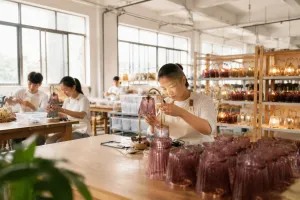
Table lamps are the family we go deepest on. We build them in our own Foshan factory, so that section points to designs in our decorative table lamps range; the six specialty lamps we also make get one line each, and every other family is explained by name only.
Types of Lamps by What the Light Does: Ambient, Task, Accent, Decorative
Sorted by job, every lamp gives one of four kinds of light: ambient light to see the room by, task light for one activity, accent light to pick out an object, or decorative light that is itself the thing to look at. Lighting designers call these layers; the table sorts common lamp names into them before the catalog starts.
| Layer | What it does | Typical lamps | Where a table lamp fits |
|---|---|---|---|
| Ambient | Lights the whole room evenly enough to move around and talk | Ceiling fixtures, a pair of shaded table lamps, torchiere floor lamps | A pair of drum-shaded lamps can carry a small bedroom or guest room after dark |
| Task | Puts brighter, aimed light on one surface: a page, a keyboard, a counter | Desk lamps, swing-arm lamps, clip-on lamps, under-cabinet strips | A bedside lamp with its shade rim near eye level does reading duty |
| Accent | Makes one object or zone brighter than what surrounds it | Picture lights, adjustable spots, LED strip inside shelving | A small lamp beside a painting or on a bookcase shelf |
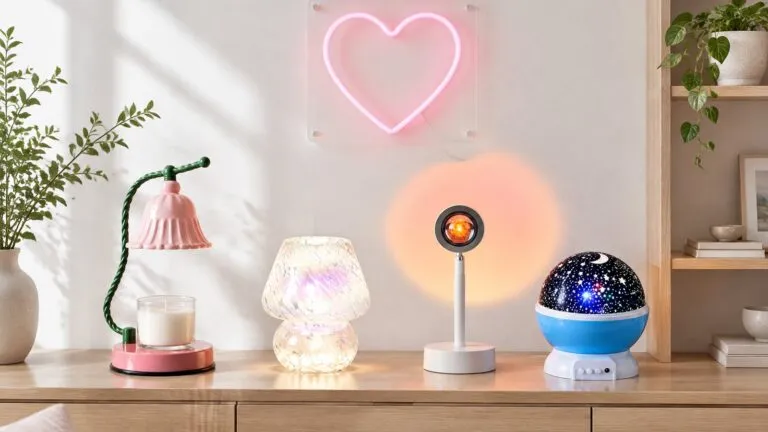
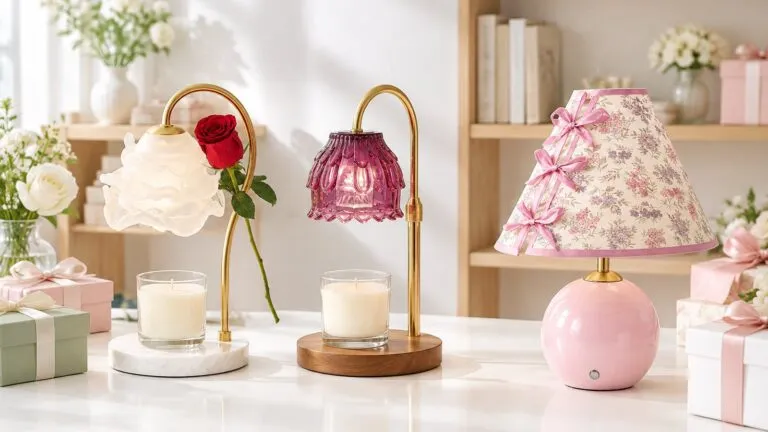
| Decorative | Is meant to be looked at; light output comes second | Mushroom glass lamps, sunset lamps, LED neon, candle warmer lamps | Most novelty and gift table lamps live here |
The same lamp can change layer with its setting. A drum-shaded table lamp at full output is ambient light in a small bedroom; dimmed to a glow, it turns decorative, which is why the room table further down lists several types per room.
Reading is task light, and a reading lamp is chosen by what reaches the page: white light, enough of it, CRI 90 or higher and a shade that keeps the bulb out of the eyes are four of the six checks in our guide to the best lamps for reading.
Types of Lamps by Position: Table, Desk, Floor, Wall and Ceiling
Sorted by position, lamps fall into five families: table, desk, floor, wall and ceiling. Each name below gets one sentence that stands on its own; the floor, wall and ceiling entries are vocabulary only.
- Table lamp: a freestanding lamp with a base, a body and usually a shade, made to stand on a side table, nightstand, console or dresser.
- Bedside lamp: a table lamp sized and switched for a nightstand, often sold in pairs.
- Buffet lamp: a tall, slender table lamp for a sideboard, explained in its own note below.
- Desk lamp: a lamp with an adjustable arm or head that aims light onto a work surface.
- Floor lamp: a lamp on a tall stand that rests on the floor, usually beside seating or in a corner.
- Torchiere: a floor lamp whose bowl faces up, so the ceiling becomes the surface that lights the room.
- Arc lamp: a floor lamp with its weighted base set to one side and a sweeping arm that hangs the shade above a seat or table.
- Clip-on lamp: a lamp with a spring clip in place of a base, so it holds on wherever there is an edge to grip.
- Wall sconce: a decorative light fixed to a wall; every sconce is a wall light but not every wall light is a sconce, a distinction set out in what a wall sconce is.
- Swing-arm wall lamp: a wall-mounted lamp on a hinged arm, often fitted beside a bed.
- Pendant: a single light hanging from the ceiling on a cord, rod or chain.
- Chandelier: a branched ceiling fixture that carries several lights at once.
- Flush and semi-flush mount: ceiling fixtures that sit tight against, or just below, the ceiling.
- Recessed downlight: a fixture set into the ceiling so that only its trim shows.
Desk Lamp vs Table Lamp: What Separates the Two
The split is the head. A desk lamp aims: an arm, a gooseneck or a pivoting shade points light at a page or a keyboard. A table lamp spreads: its shade sends light down and out across the furniture and the room, and the shade is part of the look.
In 1932 the automotive engineer George Carwardine invented the spring and lever mechanism behind the Anglepoise, which lets the lamp stay where it is put after being moved in any direction (Design Museum). Hybrids blur the line: our lamp with wireless charger puts a 3 W LED head on a flexible gooseneck that turns through 360 degrees, beside a 15 W wireless charging pad, so it serves as a desk lamp and as a bedside reading light. Our range is table lamps; a dedicated desk lamp is developed to a buyer’s brief as OEM/ODM work, not held as stock.
Decorative and Specialty Lamps: Candle Warmer, Sunset, Projector, LED Neon, LED Strip, Solar
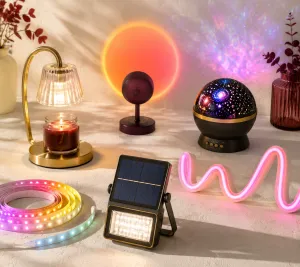
Some lamps are named for what they do rather than where they stand. We make all six below in the same Foshan factory.
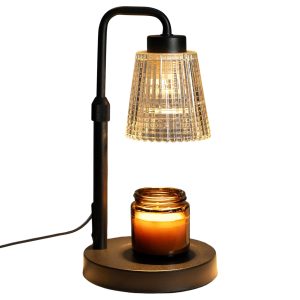
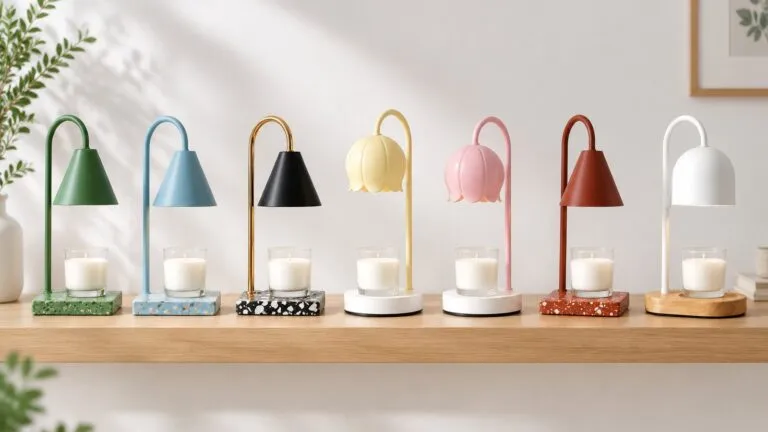
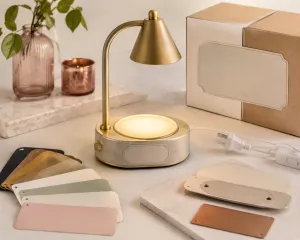
- Candle warmer lamp: a lamp whose warm bulb melts the top of a jar candle from above, so the scent spreads with no flame; see how a candle warmer is used.
- Sunset lamp: a small LED lamp with a lens that projects a circle of sunset-colored light onto a wall, covered in what a sunset projection lamp is.
- Star or galaxy projector: a projector that throws stars and a drifting nebula across a ceiling; some builds use a laser diode for the star layer, others LED optics only.
- LED neon: LED light inside a flexible tube bent into words or shapes; it imitates glass neon, a gas-filled glass tube we do not make (LED and glass neon compared).
- LED strip: a flexible tape of LEDs, cut to length and fixed under cabinets, behind screens or along shelves.
- Solar flood light: an outdoor floodlight whose panel charges a battery by day for light at night; when solar flood lights are worth it is covered separately.
Types of Table Lamps: The Category We Make
Types of table lamps are told apart by how they are powered, how they switch, and what the shade and body are made of. These are the ten we build, each tied to a design in our range.
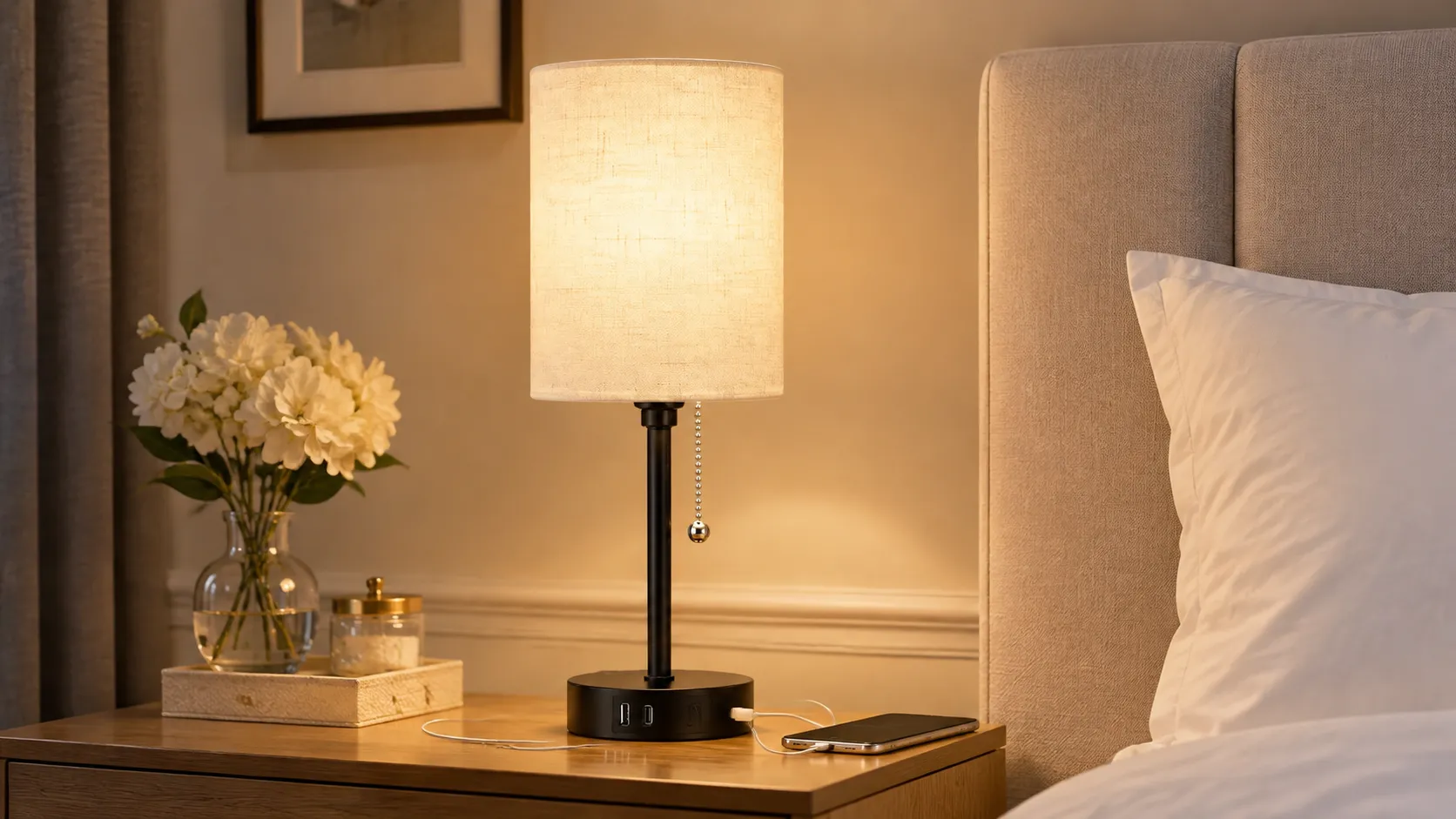
- Bedside lamp: a compact table lamp for a nightstand with a control that is easy to find in the dark; our nightstand lamps come as a set of 2, switched by a touch on the metal body, with two USB charging ports in the base.
- Touch-dimming lamp: a lamp that switches and dims when its base or body is touched; on the touch versions of our modern bedside lamps, touches step from low to medium to high, and a fourth turns the lamp off.
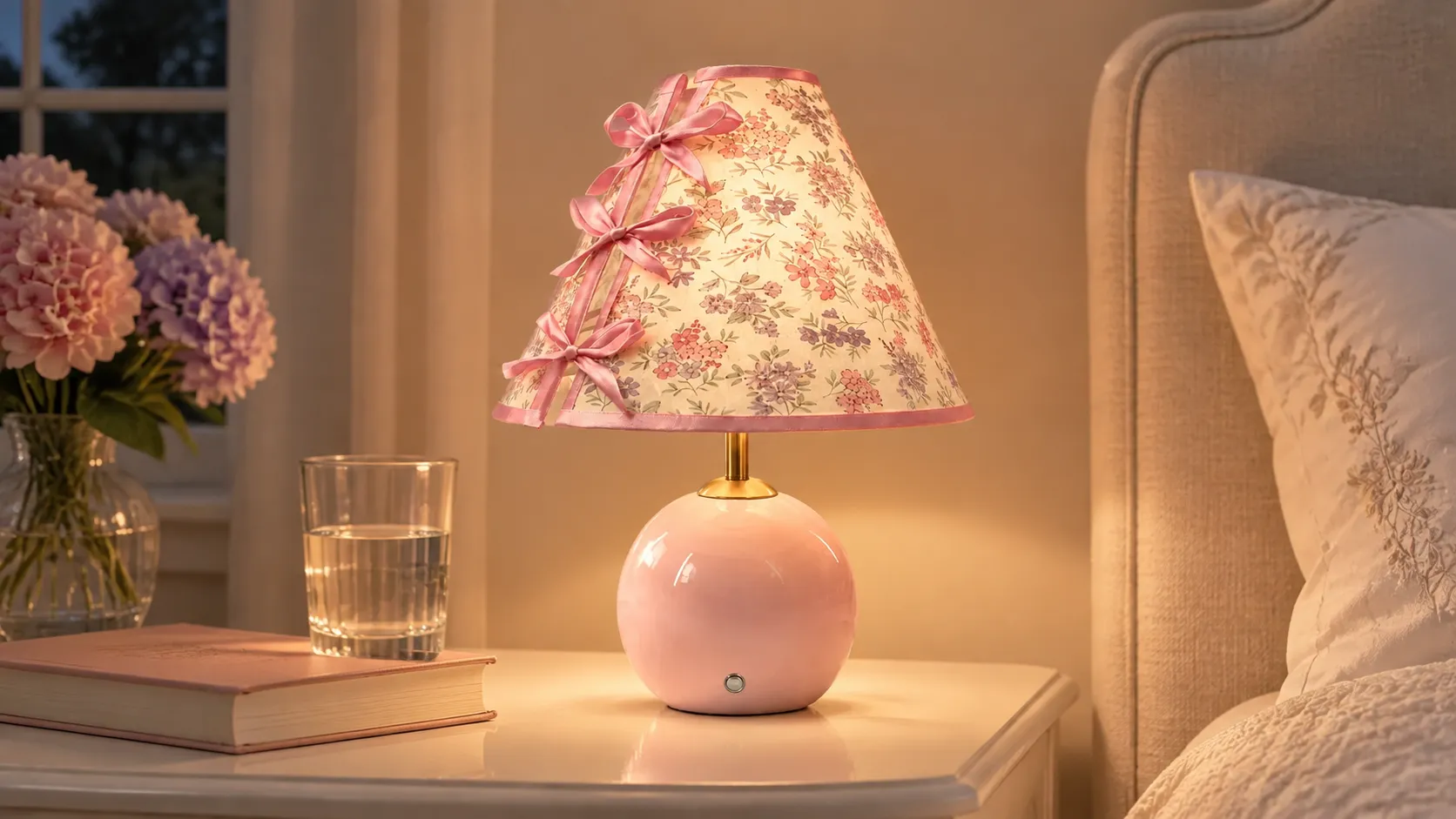
- Cordless rechargeable lamp: a lamp with a built-in battery that stands anywhere with no cable while lit. Our cordless pink ceramic table lamp charges over USB at 5 V and runs 6–8 hours per charge; what to check before buying one is in the best cordless table lamps.
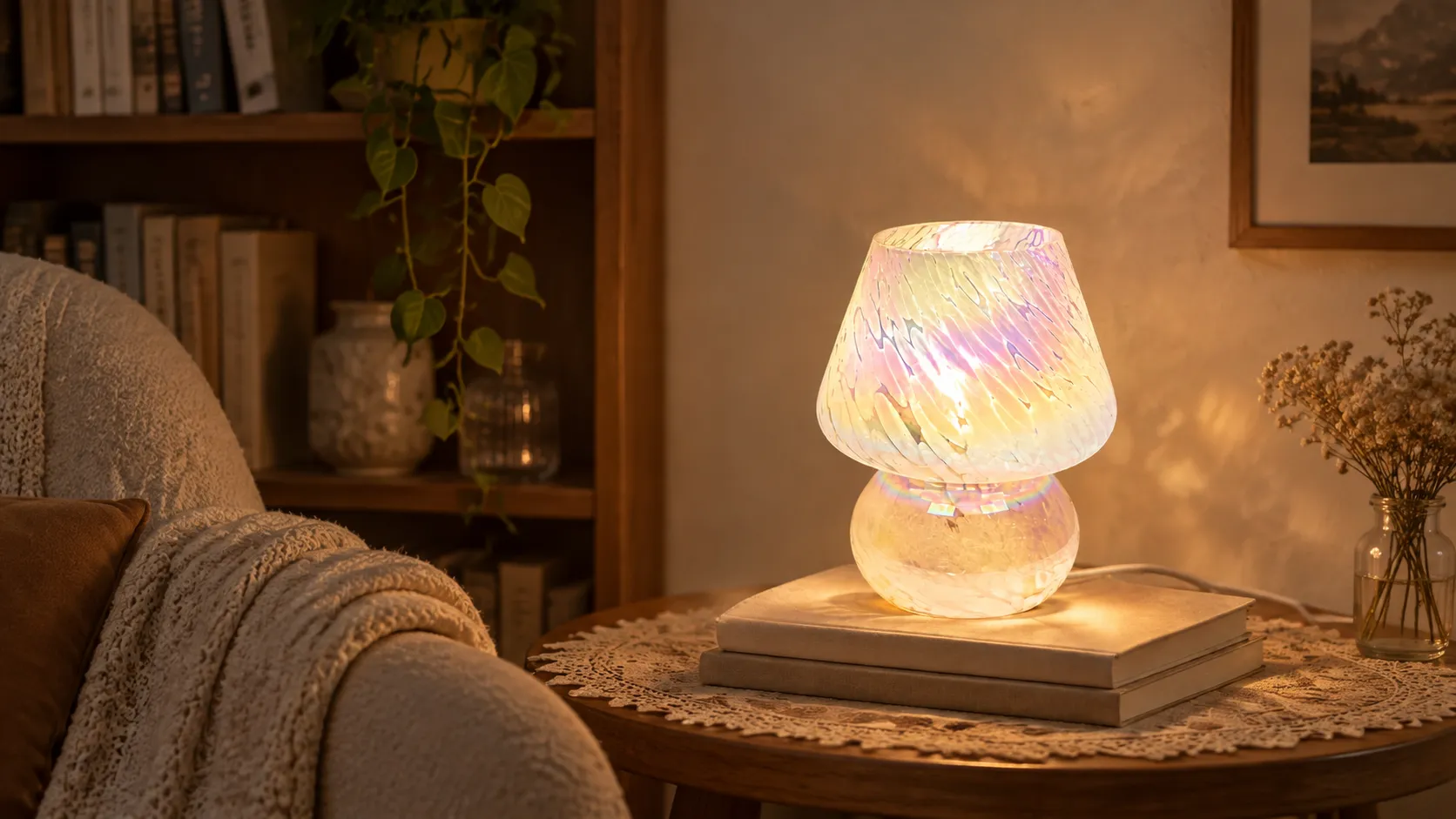
- Mushroom glass lamp: a lamp whose domed shade sits on a rounded foot like a mushroom cap; ours is hand-blown glass from top to bottom, corded, with a replaceable 5 W bulb.
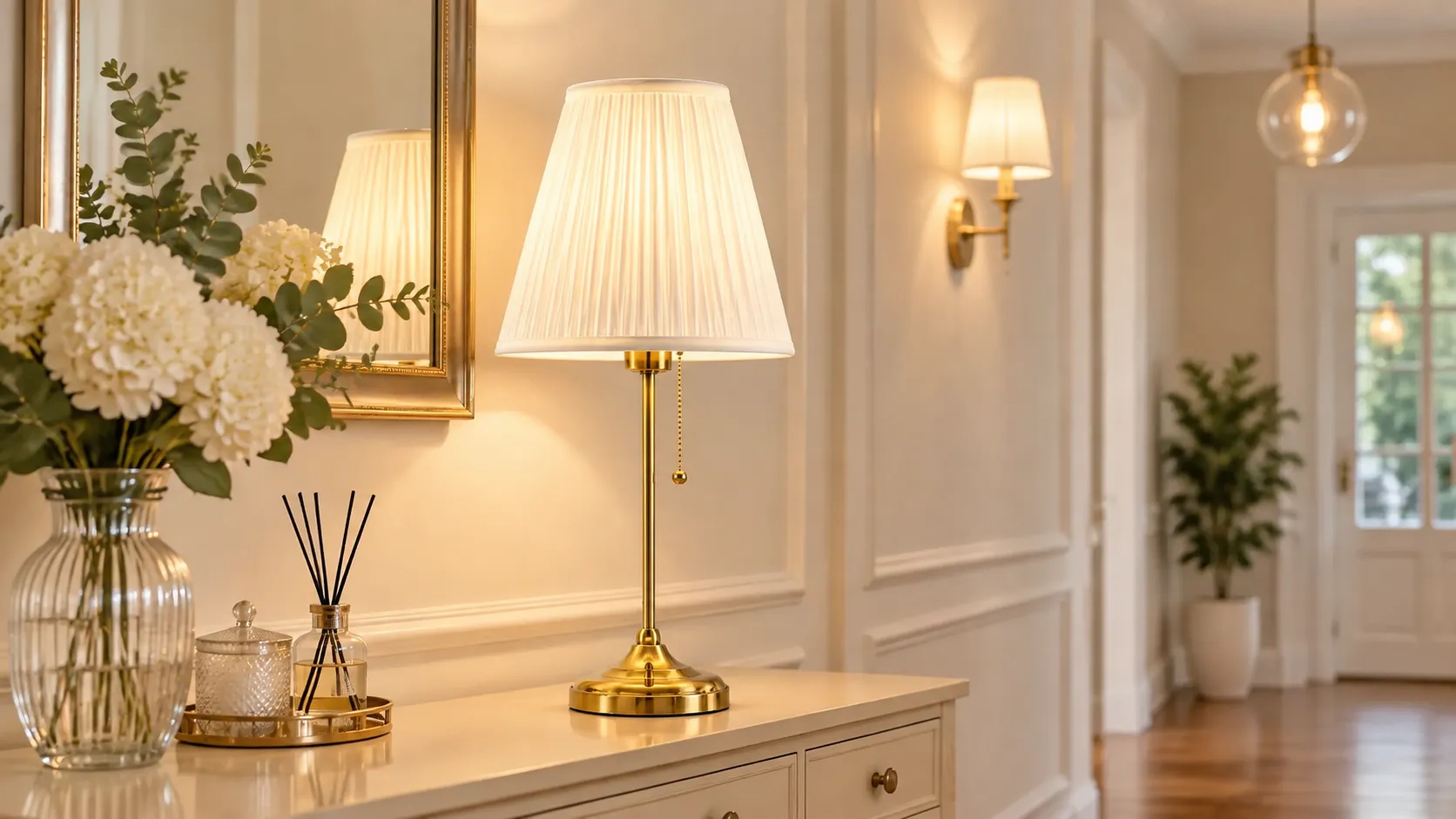
- Fabric and pleated shade lamp: the classic outline of a cloth shade over a slim stem; our traditional table lamp has a tapered, finely pleated white shade, a bead pull chain and a brass-tone or chrome base.
- Glass shade lamp: a lamp whose shade is glass rather than cloth, so the shade itself glows; our small glass lamp sets a frosted, ribbed glass dome on a black beaded stem.
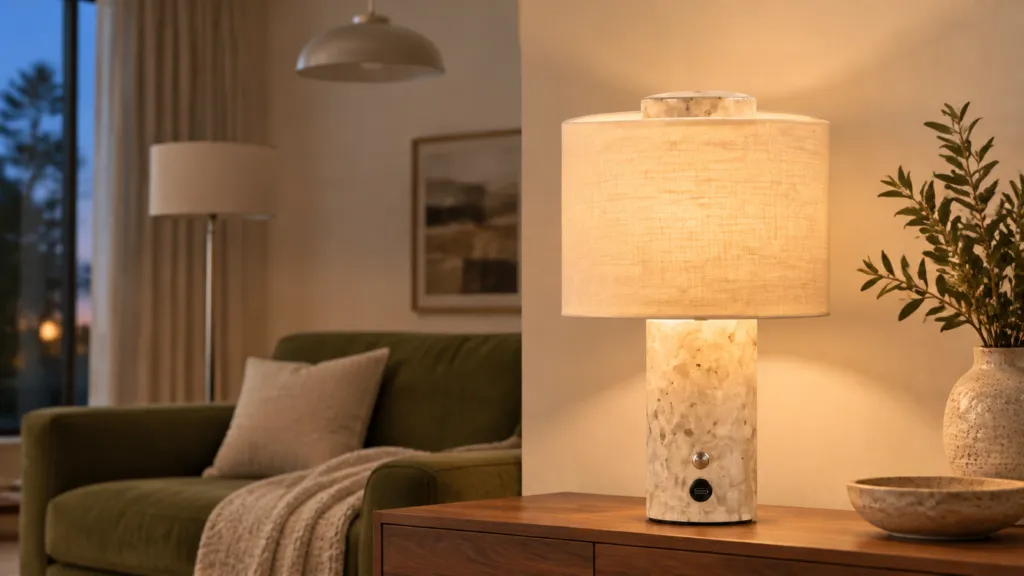
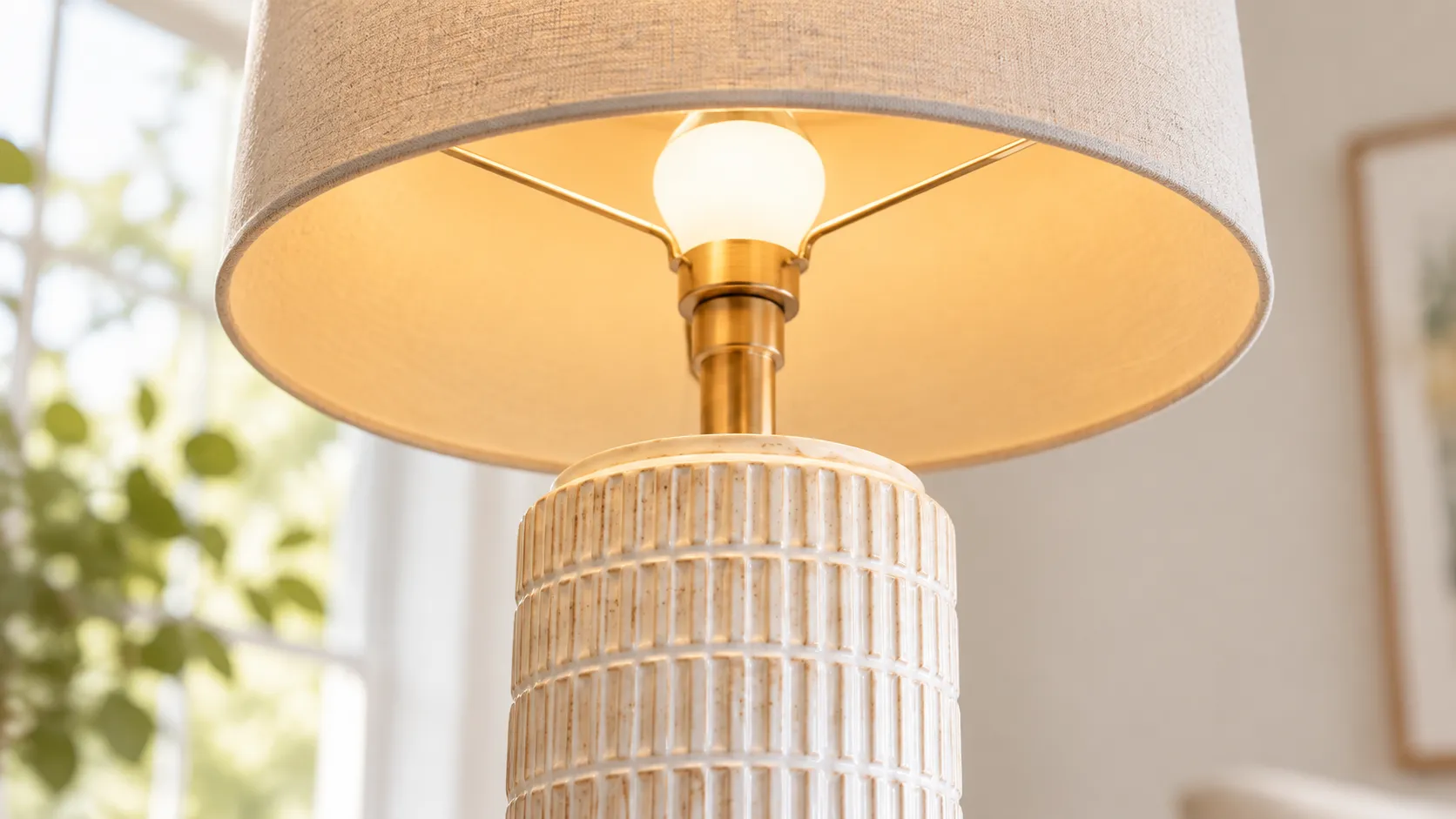
- Ceramic body lamp: a lamp whose body is a glazed ceramic form; our textured ceramic column lamp puts a fabric drum shade over an off-white grid-relief glaze.
- Hotel lamp with USB and outlet: a guest-room lamp whose base also charges devices. Our hotel lamps with USB and outlet carry one USB-A port, one USB-C port and an AC outlet, and a pull chain steps a three-color LED bulb through 2700K, 3500K and 5000K.
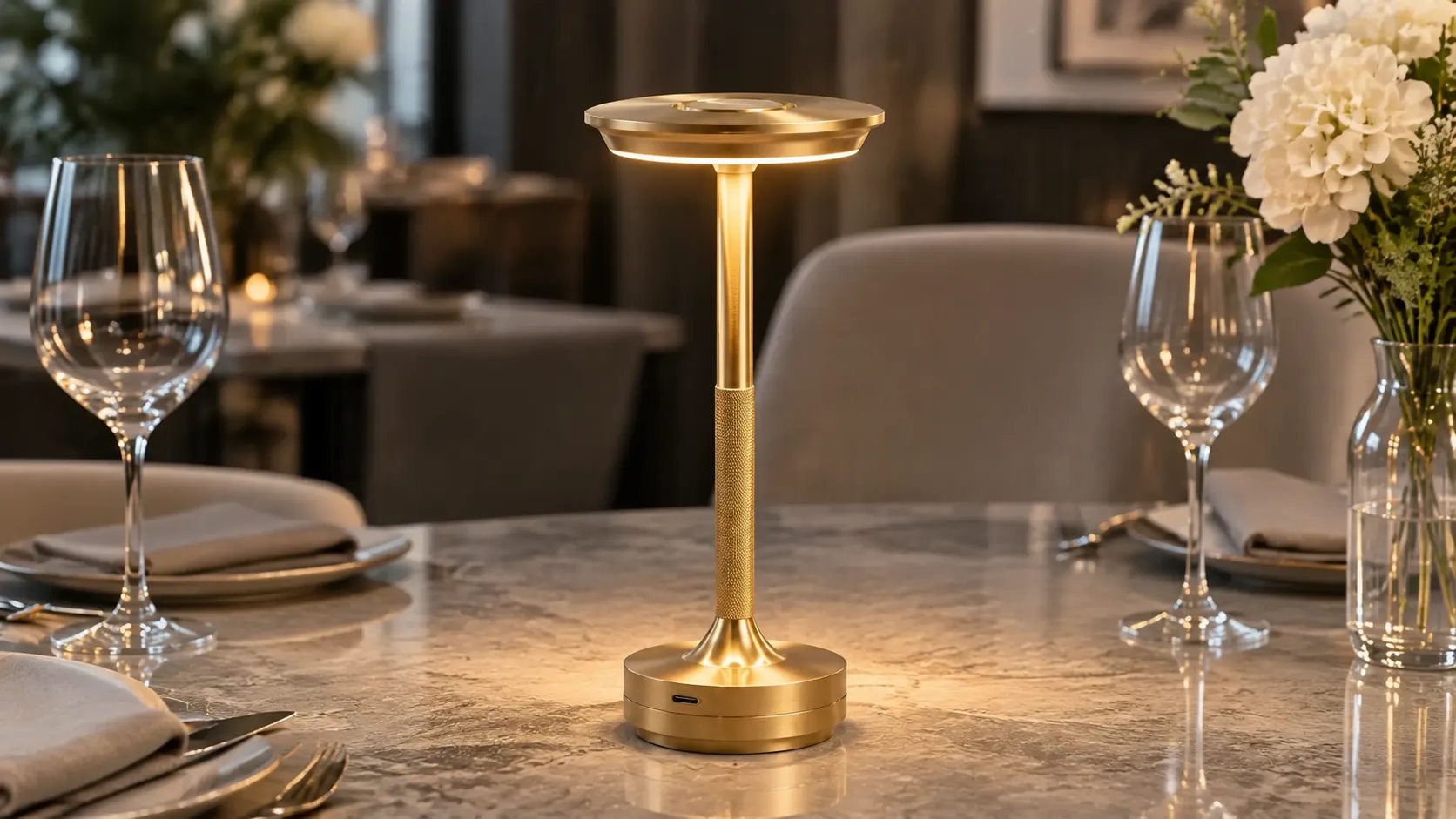
- Rechargeable dining table lamp: a slim cordless lamp for restaurant and bar tables; ours is aluminum alloy, 27.5 cm tall, with a 13 cm disc head, touch dimming and USB-C charging.
- Lamp with wireless charger: a lamp whose base doubles as a charging pad for a phone; ours, described in the desk lamp note above, adds a Bluetooth 5.0 speaker and an alarm clock.
What Is a Buffet Lamp?
A buffet lamp is a tall, slim table lamp made to stand on a buffet or sideboard, with a narrow base and a shade small for its height, so it rises above serving dishes without hiding the wall behind. They are usually bought in pairs to frame a mirror or a painting. None of our lamps is sold under that name; the word describes a proportion and a place, so ask for one by overall height and shade width.
Lamp Styles: Traditional, Mid-Century Modern, Boho, Vintage and More
Lamp styles are named after the period or interior a lamp borrows from, and the shade and base usually give the style away before anything else does.
- Traditional: turned or column bases in brass, ceramic or wood under a fabric shade, often pleated or bell-shaped.
- Tiffany: a leaded shade of colored glass pieces, usually on a bronze base, after the lamps Louis Comfort Tiffany was making by 1898 (Halim Museum).
- Art Deco: stepped bases, fan and sunburst motifs, chrome and frosted glass; the V&A calls the 1925 Paris exhibition of modern decorative and industrial arts one of the most pivotal moments for the style (Victoria and Albert Museum).
- Mid-century modern: clean lines, domes and globes, tapered legs and warm wood or colored enamel, from the post-war design movement of the same name.
- Industrial: exposed bulbs, metal cages, pipe fittings and dark metal finishes taken from factories and workshops.
- Scandinavian: pale wood, white or grey linen shades and plain shapes that keep a room calm.
- Farmhouse: distressed wood, galvanized metal and lantern shapes with a rural feel.
- Boho: woven rattan, jute or paper-look shades, often with a flared or scalloped edge, in natural colors.
- Coastal: clear glass, rope and whitewashed finishes in sand and sea colors.
- Vintage and banker’s lamps: period cues such as warm brass and green cased glass; a banker’s lamp pushes light down onto a desk or bar top, as our vintage bar lamps guide explains.
- Contemporary: current shapes built around one strong material, with little ornament.
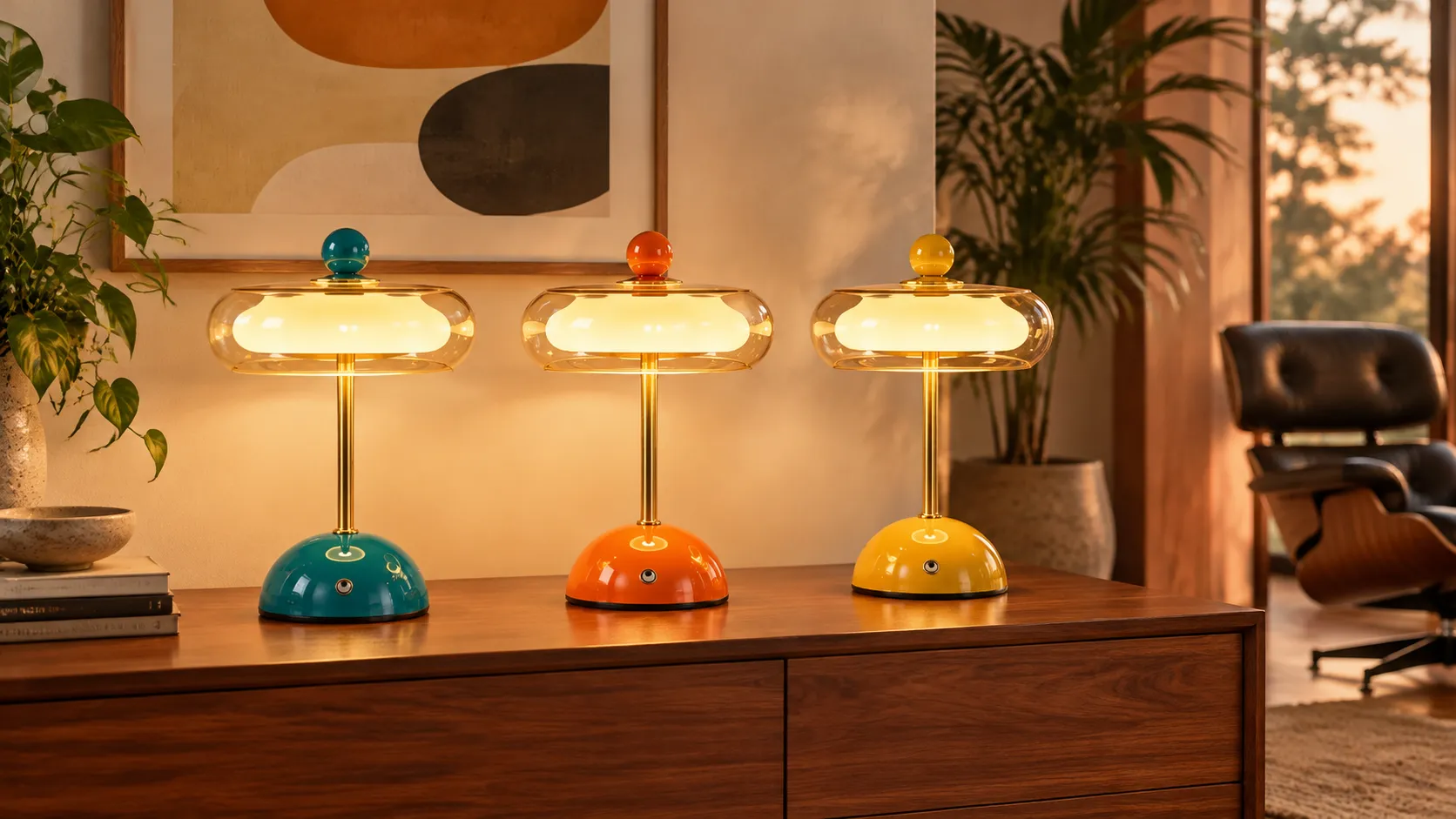
Three of these styles are in our range: the traditional table lamp with a pleated shade and pull chain, the mid-century modern lamps with an amber-tinted shade over a glossy half-dome base in six colors, and the boho table lamp with a woven-look scalloped shade.
When “Lamp” Means the Light Source: What Sits Inside a Table Lamp
In the lighting trade and in regulation, lamp often means the bulb rather than the furniture. US federal efficiency rules define a light fixture as the complete unit built around one or more light sources, and use lamp for the source that fits into it (Code of Federal Regulations). Someone asking for lamp types may mean incandescent, halogen, fluorescent or LED; this section follows that meaning only as far as the inside of a table lamp.
Two kinds of source sit inside a table lamp. The first is a socket that takes a replaceable bulb. US federal rules define the medium screw base as the Edison screw with the prefix E-26 (Code of Federal Regulations). Our hotel lamp uses E26 on US versions and E27 on EU, UK and AU versions, and our ceramic column lamp has an E27 socket for bulbs up to 60 W. The second is an integrated LED, with the diodes built into the lamp head, as on our rechargeable dining table lamp and on the gooseneck head of our lamp with wireless charger, each a 3 W LED.
Each kind carries a tradeoff. With a socket, a spent bulb does not end the lamp’s life and the light color can be changed later, which matters to hotels that keep lamps for years. An integrated LED allows slimmer heads and cordless designs, but when the diodes or the driver fail, the whole lamp is the replacement part.
Federal rules have already narrowed the choice for US orders. Since July 25, 2022, the sale of any general service lamp, a category that covers bulbs from 310 to 3,300 lumens, has been barred unless it reaches 45 lumens per watt (Code of Federal Regulations). The older incandescent caps in the same section let a 750–1,049 lumen bulb draw up to 43 W; at the top of that range and the full 43 W, our arithmetic gives about 24 lumens per watt, roughly half the 2022 floor. The legal floor rises again for lamps made from July 25, 2028: on the formula in the same section, our arithmetic puts the minimum for an 800-lumen integrated, omnidirectional lamp without standby mode at about 124 lumens per watt, and about 115.5 for the same class with standby. For a US program, plan on an LED bulb in the box or an integrated LED. An LED bulb packs diodes, a driver and a heat sink into the shape of a filament bulb, as what LED light bulbs are explains.
Homes have moved the same way. In its March 2026 analysis of the 2024 Residential Energy Consumption Survey, the U.S. Energy Information Administration reported that 90% of US households used at least some LED bulbs and 37% used nothing else indoors (U.S. Energy Information Administration).
Source: U.S. Energy Information Administration, Residential Energy Consumption Survey, as reported in Today in Energy, March 23, 2026, retrieved 2026-11-10
Lamp Types Room by Room: Living, Bedroom, Dining, Hotel
Match the lamp type to what each room is used for after dark: rooms for sitting need several low sources, rooms for working need one aimed source, and rooms shared with guests need controls anyone can find.
| Room | Lamp types that work | Why |
|---|---|---|
| Living room | Table lamps on end tables, a floor lamp beside seating, a ceiling light on a dimmer | Several low sources at different heights make a room easy to sit in; one overhead light flattens it |
| Bedroom | Matched bedside lamps, a touch or dimmable lamp, a small decorative lamp on a dresser | Controls have to be reachable from the pillow, and a low setting matters more than peak output |
| Dining room | A pendant or chandelier over the table, buffet lamps on the sideboard | The table takes the overhead light; the sideboard lamps add a warm second layer at eye level |
| Restaurant or bar table | Cordless rechargeable table lamps | No cable crosses the floor, and tables can be moved between services |
| Home office or study | A desk lamp with an aimable head, plus ambient light | The work surface gets aimed light while the rest of the room stays lit around it |
| Hotel guest room | Bedside lamps with USB ports or an outlet in the base, pull chain or touch switches | Guests charge devices without hunting for a socket, and simple switches need no instructions |
| Entry and hallway | A console table lamp, wall sconces, ceiling fixtures | A lamp left on by the door is the first light anyone sees on the way in |
Size is the other half of the match: for a bedside lamp, the rule is where the shade rim lands against a seated reader’s eyes, set out in how tall bedside lamps should be.
In the living room row, the count starts from the seats and the surfaces you want lit after dark rather than from a fixed number; the five spots that earn a lamp are set out in where to put lamps in a living room.
For Buyers: Building a Table Lamp Range by Type
A table lamp range is easiest to build as a grid of three choices, power, switch and shade, rather than as a list of favorite designs. Fix those three per room and per market, and samples can be compared line by line while gaps show before the order goes out.
Name the room and the channel
A hotel room wants charging ports and simple switches, a gift shelf a shape that sells as a present, an online listing a lamp that photographs with no cable.
Choose the power type
Corded with a socket for a replaceable bulb, corded with built-in LEDs, or rechargeable with a battery charged over USB-C. Rechargeable models are free of the outlet; corded ones never run flat.
Choose the switch
Pull chain, toggle, rotary dimmer, touch steps or remote. The switch decides how the lamp behaves in a dark room.
Choose shade and body
Fabric drum or pleated, glass dome, woven or acrylic shades over ceramic, metal or wood-grain bodies. The shade sets the style and how much light escapes sideways.
Fix plug, bulb and packaging, then sample
State the plug for each destination and whether a bulb ships in the box. Sampling takes about 15 days, and sample fees are refundable on your production order.
Two figures most table lamp listings leave out are worth asking for in writing: light output in lumens and color rendering. Ask the factory to state both on the quotation for each version. The designs behind every type on this page sit in our table lamp collection.
Quote a table lamp range by type
We make table lamps in our own factory in Foshan, 4,000 square metres with 40 people across two production lines. Send the rooms, the markets and the power, switch and shade mix you want, and we will quote the range design by design. Sampling takes about 15 days, and sample fees are refundable on your production order.
Watch it work
The four questions behind a lamp name, in 42 seconds:
FAQ
What are the 7 main types of lamps?
The 7 main types of lamps are not a fixed list: no lighting standard names seven, and guides group lamps in different ways. Grouped by position, there are five families, table, desk, floor, wall and ceiling, plus specialty lamps such as projectors and LED neon. If the question is about light sources, lamp is the trade word for the bulb, and the main types are incandescent, halogen, fluorescent and LED.
What are some different styles of lamps?
Different styles of lamps are named for the period or interior they borrow from, such as traditional, Tiffany, Art Deco, mid-century modern, industrial, Scandinavian, farmhouse, boho, coastal and contemporary. To place an unfamiliar lamp, read the shade first: pleated fabric points to traditional, a mosaic of colored glass to Tiffany, a dome over a slim stem to mid-century, and a woven shade to boho.
What is the difference between a table lamp and a bedside lamp?
The difference between a table lamp and a bedside lamp is the job, not the construction: a bedside lamp is a table lamp chosen for a nightstand. That job asks for a smaller footprint, a switch or touch control within reach of the pillow, a low setting for winding down and, often, a matched pair. A table lamp in a living room can be taller, wider and switched once an evening.
Sources
Every external figure above was checked on 2026-11-10: the definitions, the efficacy floor and the incandescent caps against the current Code of Federal Regulations, household bulb shares against the U.S. Energy Information Administration, design dates against the Design Museum, the Victoria and Albert Museum and the Halim Time & Glass Museum.
- Electronic Code of Federal Regulations, 10 CFR 430.2 Definitions (a light fixture is a complete lighting unit consisting of light sources and ballasts or drivers with the parts that distribute the light; a general service lamp has an initial output of 310 to 3,300 lumens and is not a light fixture; the medium screw base is the Edison screw base with the prefix E-26), retrieved 2026-11-10.
- Electronic Code of Federal Regulations, 10 CFR 430.32(dd) General service lamps (from July 25, 2022, the sale of any general service lamp below 45 lumens per watt is prohibited; general service incandescent lamps of 750 to 1,049 lumens are capped at 43 W; general service lamps made from July 25, 2028 must meet an efficacy formula by lamp class, which for an 800-lumen integrated omnidirectional short lamp works out to a minimum of about 124 lumens per watt without standby mode and about 115.5 with it), retrieved 2026-11-10.
- U.S. Energy Information Administration, More U.S. homes used LEDs over other bulb types for indoor lighting in 2024, Today in Energy, March 23, 2026 (90% of households used LED bulbs, 37% for all indoor lighting; mostly LED 4% in 2015 and 63% in 2024; mostly CFL 32% to 7%; mostly incandescent or halogen 31% to 10%), retrieved 2026-11-10.
- Design Museum, The Anglepoise lamp (designed by the automotive engineer George Carwardine around a spring and lever mechanism he invented in 1932 that remains in position after being moved in every direction), retrieved 2026-11-10.
- Halim Time & Glass Museum, Lamps of Tiffany Studios (by 1898 Tiffany was creating hanging and standing lamps, pairing leaded glass shades with his own bronze bases), retrieved 2026-11-10.
- Victoria and Albert Museum, An introduction to Art Deco (the 1925 Paris Exposition Internationale des Arts Decoratifs et Industriels Modernes as one of the most pivotal moments for Art Deco), retrieved 2026-11-10.
