





A neon sign for garage walls gets chosen from a photograph shot in somebody’s living room and then hung in a building with a concrete floor, a roller door and a compressor that cycles twice an hour. The wall is brick, block, painted steel or bare stud. The air carries brake dust in spring and sanding dust in autumn. None of that shows in the listing photograph, and all of it decides whether the piece still looks like the photograph six months later.
This is for the person placing the factory order rather than the person holding the drill: a buyer at an auto service group, a hardware or home decor retailer, a gift retailer stocking the June window, a private-label seller adding a category. Letter height against viewing distance, backboard shape and the USB-or-adapter question already live in our guide to sizing a sign for a room wall, and price bands by size sit in the neon sign price guide.
What wears out first in an LED piece, and in what order, is set out in how long neon signs last; this page adds only what a garage does to those conclusions. Everything below is the part of the specification that changes because the room has a car in it, and it applies to the custom neon signs range.
Key takeaways
Specify a neon sign for garage use backwards. Survey the wall before you approve the artwork, size from the open bay door rather than the workbench, and assume the piece gets judged on a phone photograph taken after six months of film.
- A 48 by 24 inch acrylic backboard is 5.9 to 9.8 lb of panel before the tube, cable and fixings, which rules out adhesive strips on a garage wall.
- Extruded acrylic is rated to 160 degrees Fahrenheit for continuous service and deflects under load at 195, so where the sign hangs beats which climate it hangs in.
- A 48 inch panel moves about 0.19 inch across a 100 degree swing, so the fixing holes want clearance rather than a tight fit.
- Dirt depreciation is measured rather than assumed: clean interiors lose around 10% of their light over a two to three year cleaning cycle, and a bay is dirtier.
- Customer artwork carrying somebody else’s word mark is a refusal rather than a quotation, and the exposure follows whoever sells the finished piece.
What a Garage Wall Does to a Sign That a Living Room Wall Does Not
Three conditions separate the two rooms, and they are worth naming before any artwork exists. The first is film: oil mist off a compressor, brake dust off a rotor, sanding dust off a bodywork job, all airborne, all landing on vertical surfaces as happily as horizontal ones. The second is temperature, because most of these buildings are neither heated nor cooled. The third is the wall. A living room wall is plasterboard with a stud somewhere behind it. A garage wall is solid brick, hollow block, ribbed steel, an open stud bay or a sheet of OSB screwed across one.

The buying side is wider than the category name suggests. Automotive service technicians and mechanics held 825,800 jobs in 2025 (U.S. Bureau of Labor Statistics), 32% at automobile dealers and 25% in mechanical and electrical repair shops, which is a lot of bay walls. On the residential side, 65% of single-family homes completed in 2024 had a two-car garage and another 15% had three bays or more, against 9% with no parking facility at all, according to the National Association of Home Builders analysis of the Census Bureau Survey of Construction. Gifting is real money too: Father’s Day spending was forecast at $27.9 billion in 2026, an average of $226.58 per shopper, with 77% of consumers planning to mark the day (National Retail Federation).
Those audiences want the same object with a different card around it. The shop group wants a logo, a fixing pack suited to a bay wall and a piece that survives whoever cleans the bay. The decor retailer wants a stock range and a photograph that sells. Only the shop group will tell you what the wall is made of without being asked.
Sizing a Neon Sign for Garage Walls From the Bay Door
A room sign is sized from the seat. A garage has no seat. The piece gets read from three places: the open roller door, where a passer-by sees it framed by the opening; the far bay, where a technician glances across a car on a lift; and the two feet in front of the bench at night. The middle case usually binds, and it sits further away than buyers expect, because a two-bay building puts the end wall at shop-window distance rather than bedroom distance. The arithmetic from viewing distance to letter height does not change with the room, and it comes with a chart in our room sign sizing guide.
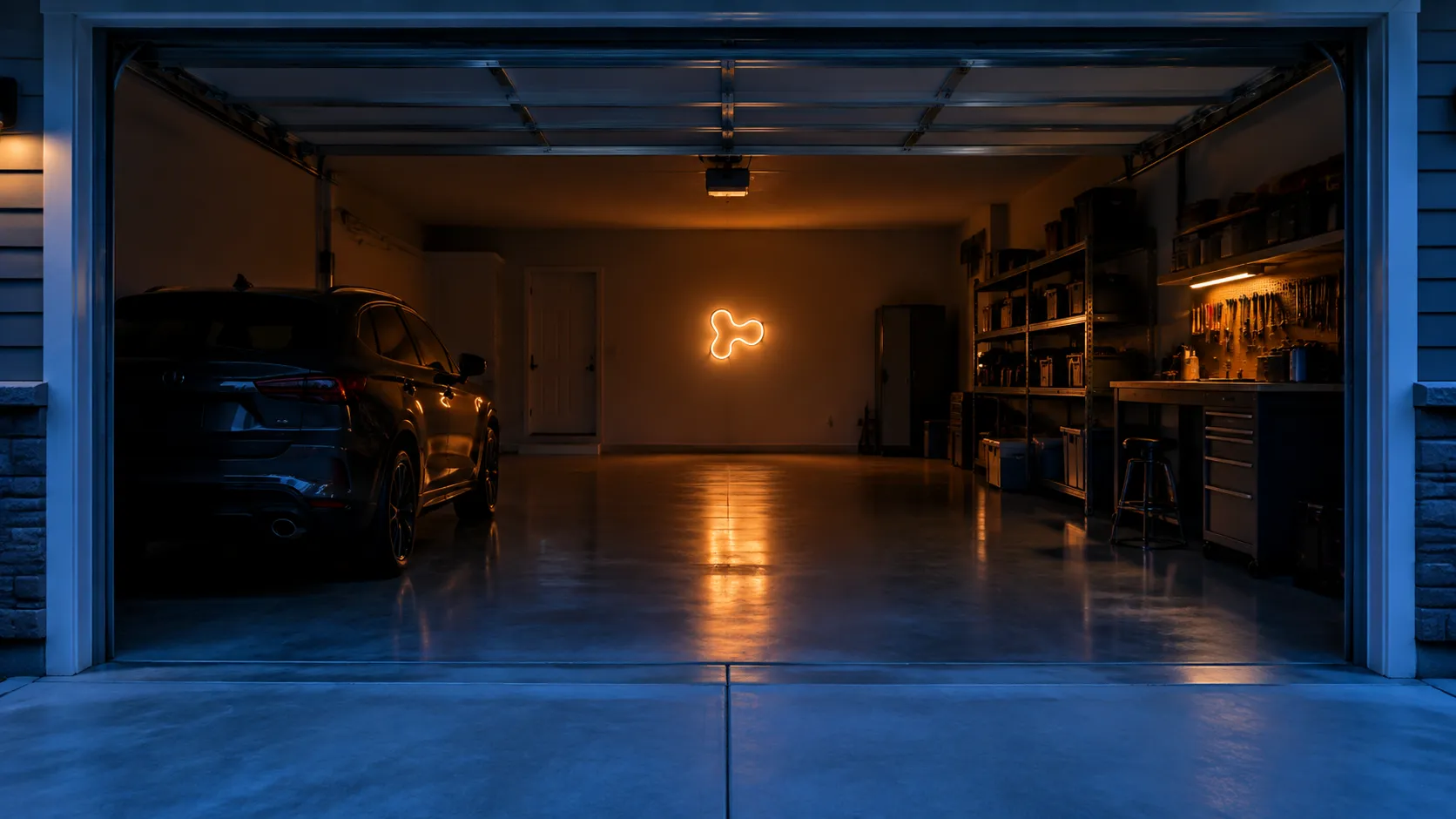
What changes is that the number comes back bigger, and a bigger sign is a heavier sign. Acrylic is not light. Extruded sheet has a specific gravity of 1.19 by ASTM D792 (U.S. Plastic Corp), enough to make the backboard rather than the tube the thing the wall carries.
Source: specific gravity 1.19 for extruded acrylic sheet, U.S. Plastic Corp physical properties table (ASTM D792); panel weights computed by BeginLighting, retrieved 2026-09-20
Read that chart as a fixing decision rather than a freight one. Up to about 30 by 15 inches the argument is really about surface quality: smooth, sealed, sound. Past 36 by 18 inches the panel alone outweighs what most adhesive systems will hold on cold masonry, and at 60 by 30 inches you are hanging 9 to 15 lb of plastic plus tube, cable and adapter from four points in somebody else’s building.
Brick, Block, Steel or Studs: What the Sign Hangs On
Ask what the wall is before you ask what the sign should say. The five rows below cover nearly every garage in the US market, and the useful column is not the anchor. It is what has to be in the box.
| The wall | Fixing that holds | What the carton needs | Where it goes wrong | Who has it |
|---|---|---|---|---|
| Solid brick | Masonry screw or sleeve anchor, rated well above panel weight | Anchors, screws, template, level, bit note | Soft old brick crumbles at the face; a wrong hole is forever | Older attached garages |
| Hollow concrete block | Sleeve or toggle expanding behind the face shell, or a rail | Rail or four toggles, template, longer screws | A solid-material screw strips on breaking into the core | Detached garages, small units |
| Steel building panel | Self-drilling screws into a rib, or a rail across two ribs | Self-drillers, sealing washers, rail, template | The panel drums, and unsealed holes rust and streak | Farm shops, prefab bays |
| Painted drywall on studs | Screws into the stud; hollow anchors only for small formats | Screws, anchors, stud-finding note, level | Nothing lands on a stud where the customer wanted it | Finished home garages |
| OSB or plywood | Wood screws straight in, almost anywhere | Screws, washers, template | Easiest wall, and the one repainted around the sign | Home workshops, rented units |
The brick row hides a real disagreement. Fastener suppliers usually tell installers to put concrete screws in the brick face rather than the mortar joint, because mortar is softer and less consistent; on hollow block the argument often runs the other way. Both can be true, since the answer depends on the unit, the mortar and the anchor, which is why it cannot be settled inside a product listing. The Brick Industry Association publishes attachment guidance as an engineering document with placement detailing and design procedures (Technical Notes 44, Anchor Bolts for Brick Masonry), not as a rule of thumb. The honest retailer position is that no carton covers every wall: ship an anchor pack rated well above panel weight, print which walls it is for, and say plainly that soft brick, hollow block and steel panel want a fixing chosen on site.
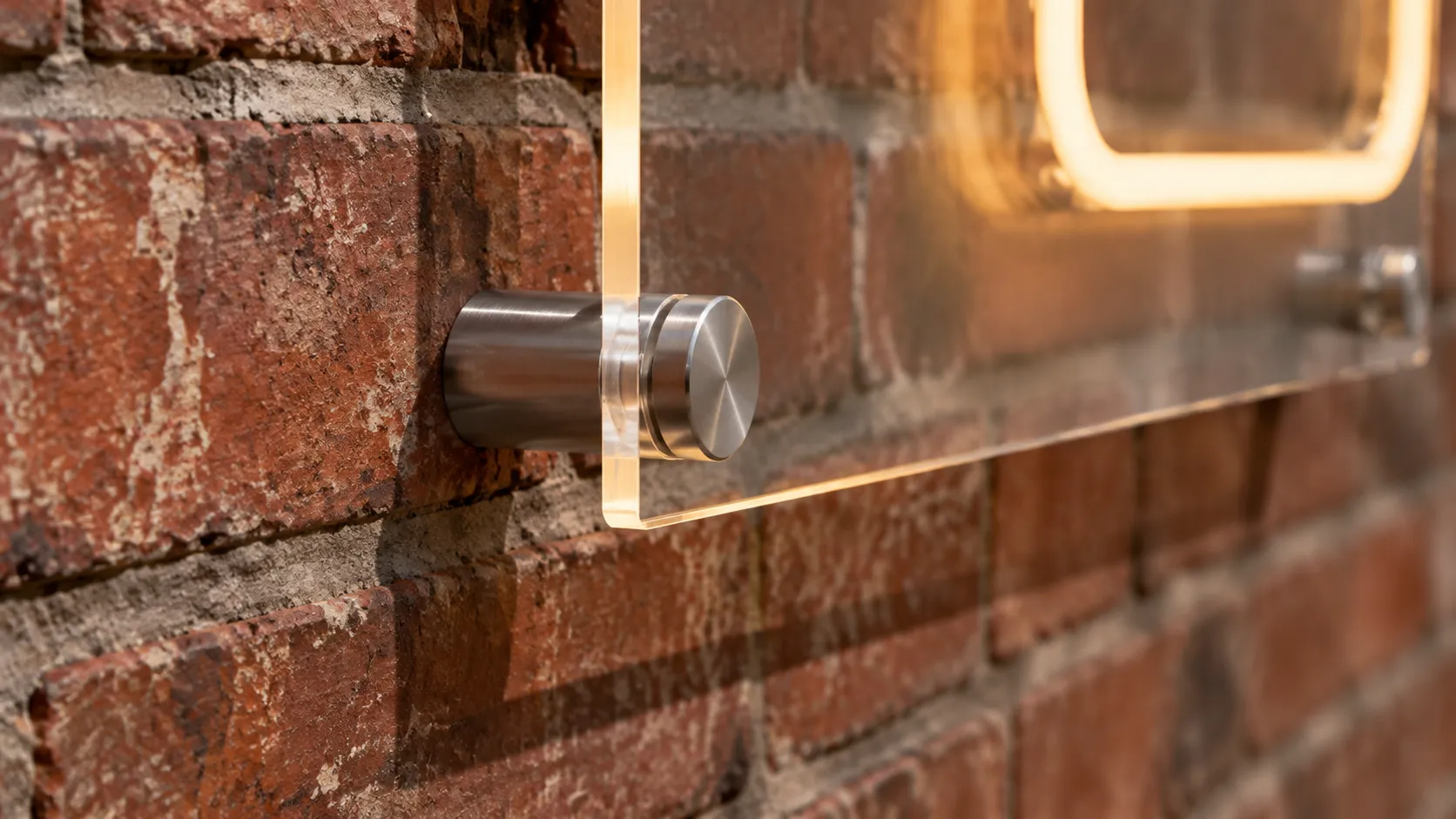
The cable is the other half of that decision and it gets handed to the installer far too often. Measure the run to a socket that exists, decide whether the adapter hangs in free air or sits on a shelf, and choose cable colour against a dark bay wall rather than a studio backdrop. In 2023, US fire departments responded to an estimated 23,700 residential building fires involving electrical malfunction, with 305 deaths and around $1,501,600,000 in loss (U.S. Fire Administration). None of those are about neon signs, and all of them are why a piece needing three chained extension leads has been specified in the wrong place.
Survey the wall
What it is made of, how old, what is already screwed to it. A daylight photograph beats a brief written from memory.
Fix the viewing line
Name the spot the sign is read from, measure that distance, write it on the drawing before anyone opens a font menu.
Size it, then weigh it
Turn letter height into a panel size, read the weight off the chart above, check it against the fixing pack you planned to ship.
Choose the fixing, write the carton
Anchors, screws, standoffs, template and level are settled here, with the card line naming which walls the pack covers.
Route the cable
Measure to a socket that exists, place the adapter, and pick cable colour for the wall it runs down.
Live with the sample in a real bay
A week on the wall, door cycling and compressor running, tells you what a photo studio never will.
Oil Film, Brake Dust and What Six Months in a Shop Look Like
Light loss from dirt on a fixture is a measured quantity in lighting engineering, with its own name and its own factor. A NALMCO field study of more than 200 office, retail and school sites, reported in EC&M, put luminaire dirt depreciation at 0.92 after 18 months and 0.89 after 36 months, against the 0.84 to 0.85 and 0.75 to 0.80 assumed by the older IESNA procedure, and concluded that about 10% loss over a two to three year cleaning cycle was closer to reality for many spaces than the 20% used before. Offices are the clean end of that scale. A working bay, where a parts washer and an orbital sander share air with the sign, is not.

The design consequences are small and specific. Flush mounting is easier to wipe than standoff mounting, because the gap behind a standoff barrel collects film that nothing short of a brush will reach. Any open channel or upward-facing ledge becomes a dust shelf, and a continuous line with no flat tops stays clean longer. Cut-to-shape backboards carry far more edge per square foot than a rectangle, and every edge gathers film. The customer photographs the piece at month six, not week one, so a cleaning line on the card is the difference between a sign that has gone dim and a sign that looks dim.
None of this changes what fails inside the sign, only what it looks like while it works. The failure order, driver first, is covered in how long neon signs last. A garage accelerates the cosmetic half of that story and leaves the electrical half where it was.
Cold Nights, Hot Afternoons and the Acrylic in Between
The published numbers for the backboard material are easy to find and almost never read. Extruded acrylic sheet carries a maximum recommended continuous service temperature of 160 degrees Fahrenheit, with 190 degrees allowed short term, deflects under a 264 psi load at 195 degrees by ASTM D648 and reaches its Vicat softening point at 220 degrees by ASTM D1525 (U.S. Plastic Corp). Ambient air in a garage reaches none of those. A dark panel behind glass in afternoon sun, or one mounted a foot above a unit heater, is a different question, and it is about where the sign hangs rather than which climate it hangs in.
Cold matters through movement rather than failure. The coefficient of linear thermal expansion for the same sheet is 0.000040 in/in per degree Fahrenheit by ASTM D696, roughly 0.19 inch of growth and shrinkage across a 48 inch panel over a 100 degree swing and about half that across a 24 inch one. The brick behind it does not move. Specify clearance holes rather than tight ones, put a nylon washer under the screw head, and never let an installer pull a panel flat against an uneven brick face in a cold building. Adhesive mounting has an application temperature floor of its own, which is one more reason a garage range is a drilled range; that discussion belongs with the room wall guide.
Heat shortens the electrical life too, and the failure order behind it sits in the lifespan guide. Thermal management is generally the single most important factor in the performance of an LED over its lifetime, and the higher the temperature at which LEDs run, the faster the light degrades (ENERGY STAR), where useful life means output falling by 30 percent rather than the piece stopping. A sign spending August against a sunlit steel panel runs hotter than the same sign in a bedroom, and reaches that 30 percent sooner.
Custom Neon Garage Signs When the Artwork Is a Shop Logo
Custom neon garage signs split into two jobs. One is a stock design in a garage-flavoured shape: a wrench outline, a piston, a route marker, a short phrase in script. The other is a business logo turned into tube, and only the second has a proof cycle worth arguing about. A logo drawn for a printed invoice carries hairlines, gradients, drop shadows and enclosed counters that a continuous tube cannot follow. What comes back is a simplified single-weight version, and the owner has to agree it is still their logo before anything gets bent.
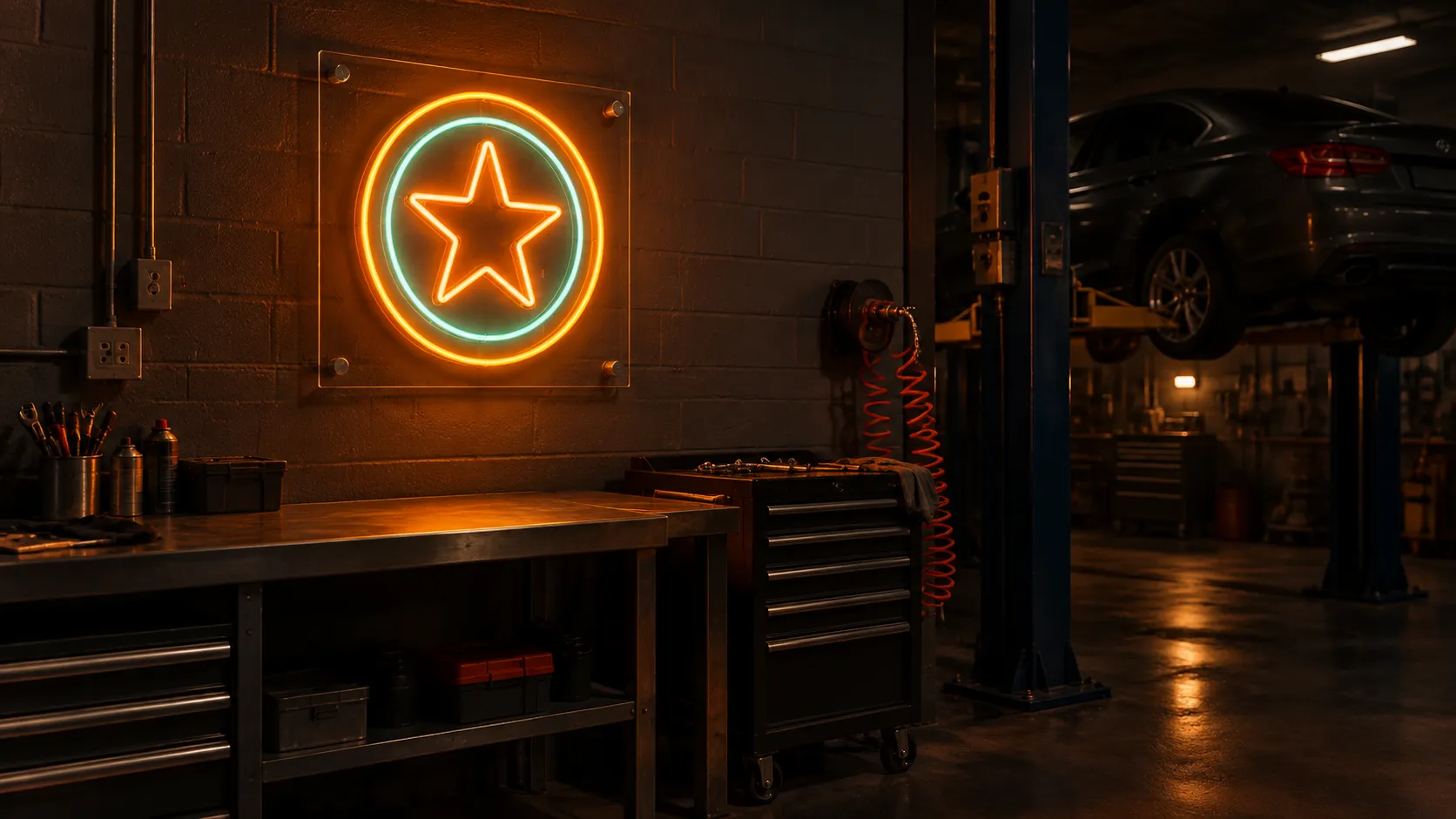
Placement inside the building is the part buyers get wrong. The wall this page covers is the working one, behind the bench in the bay. Front of house starts at the glass rather than the block: the door piece, the window and the counter are set out in our shop front guide. For trade buyers fitting out bays across several sites, the business LED neon sign format is the usual starting point: tubing on a cut acrylic backing, with size, colour, fixing pack and artwork set per order.
One practical note for anyone quoting custom garage neon signs as a multi-site rollout. Hold the artwork file, not only the finished sign. Shops change hands, a reversing van takes out a wall, and a replacement that does not match the other four is worse than none. The file, the tube colour reference and the panel dimensions are the reorder.
Custom Neon Beer Signs and the Line You Cannot Cross
Custom neon beer signs are one of the strongest pre-made shapes in the garage and workshop range, and they are where a private-label seller gets into trouble fastest. In this catalogue the phrase means a beer-themed design: a pint glass outline, a bottle cap, a tap handle, a short phrase set in your own lettering. It does not mean a brewery’s logo, wordmark or trade dress, and the distinction has nothing to do with how closely the artwork was copied.
The US Patent and Trademark Office defines trademark infringement as the unauthorized use of a trademark or service mark on or in connection with goods in a manner likely to cause confusion, deception or mistake about the source of the goods. Courts weigh how similar the marks are, how related the goods are, the marketing channels used, the class of buyer, evidence of actual confusion, the intent behind adopting the mark and the strength of the original (USPTO). Remedies run from an injunction to orders to destroy the infringing articles and damages covering the defendant’s profits.
Turn it into a written rule instead of a judgement call. Any customer file containing a third-party word mark, logo or distinctive trade dress is refused at quotation, and the order form says so above the upload box. The rule costs a handful of sales and removes a class of risk that follows whoever puts the finished piece on sale rather than whoever bent the tube. Bar and restaurant placements are a separate buy with their own brief, covered in our bar sign guide.
Custom Neon Signs for Man Cave Walls, Where the Screen Wins
Custom neon signs for man cave corners share a wall with a television, and the television always wins. The piece is read off-axis, at low brightness, with a bright rectangle two feet away, which pushes two specification points up the list. The first is dimming: a sign that cannot go low gets switched off during anything anyone watches. The second is viewing angle, because a piece mounted flat beside a screen is seen from 40 or 50 degrees off centre, and artwork with tight overlapping strokes turns into a smear from there.

The corner still has to survive being a garage. Half of these rooms are a converted bay with the car back in it every winter, which brings the film, the swing and the masonry wall straight back. If the corner also holds a rack and a bench, the training-wall version has its own rules in the barbell sign guide. Custom neon signs for garage gifting run on a seasonal calendar rather than a decor one, and the June window and the moving-house gift are two sizes in two cartons.
Budget is the question buyers ask last and should ask first. Price bands by size, including what changes between a stock shape and a bespoke one, are laid out in the price guide. Match the band to the wall you surveyed in step one, and the rest of the custom neon signs range comes down to choosing artwork.
Specify the garage range around the walls it hangs on
BeginLighting works out of Foshan, where our own plant runs 4,000 square metres with 40 people across two production lines. The neon program is quoted to spec rather than picked off a page: backboard size and thickness, fixing pack, cable colour and length, dimmer, artwork rules and carton contents are lines on the order. Send the wall types your customers have and the sizes you want to hold, and we will quote it.
Watch it work
The bay-door sizing, the fixing a brick or steel wall needs and what six months of shop dust does, in 30 seconds:
FAQ
Can a neon sign be mounted on the garage door itself?
It is the one surface worth refusing outright. A sectional door flexes at every panel joint, slams at the end of its travel and moves twice a day, which is a fatigue test no acrylic panel with four holes in it was drawn for. The cable is worse: anything feeding a moving door has to survive a bend cycle several thousand times a year, and every tidy answer involves trailing cable. Put the piece on the wall beside the opening instead.
What happens to an LED neon sign left in an unheated garage over winter?
Electrically, very little. The parts that complain are mechanical, and the winter event is condensation rather than cold. A panel sitting at outdoor temperature sweats the moment the door opens and warm air arrives, and water standing in a screw hole in a steel wall becomes a rust streak by spring. Specify stainless or coated fixings wherever the wall is metal, keep the adapter off the floor, and avoid mounting hard against an uninsulated outer skin, the first surface in the building to condense.
How do you fix a sign to a concrete block wall without hitting a hollow core?
You stop avoiding the core and choose an anchor that expects it. Hollow block gives you a face shell of roughly an inch and then air, so a screw sized for solid material either strips as it breaks through or holds on that shell alone. Two routes work: a sleeve or toggle that expands behind the shell, or a mounting rail spanning several points so no single fixing carries much. For a retail carton the rail packs easier and explains itself.
Do garage signs need a different power supply from a bedroom sign?
Usually the same class of supply and a completely different cable plan. The supply is sized by the tube run, and the tube run does not care what room it is in. Everything around it changes: the nearest working socket is measured in bays rather than feet, the adapter ends up somewhere it can be kicked or splashed, and the switch the owner wants is never beside the sign. Quote cable length against a measured run and make an inline switch standard.
Sources
Every external figure above was checked on 2026-09-20: garage share of new homes from the National Association of Home Builders analysis of Census Bureau data, employment from the Bureau of Labor Statistics, gifting from the National Retail Federation, acrylic properties from a published materials table, dirt depreciation from a NALMCO study reported in EC&M, LED thermal behaviour from ENERGY STAR, electrical fire counts from the U.S. Fire Administration, trademark definitions from the USPTO, and masonry attachment guidance from the Brick Industry Association.
- National Association of Home Builders, Parking Trends in Newly Completed Single-Family Homes, 2024 (65% two-car garages, 15% three or more, 9% one-car, 9% no parking facility; source data Census Bureau Survey of Construction), the basis for the garage share figures, retrieved 2026-09-20.
- U.S. Bureau of Labor Statistics, Occupational Outlook Handbook: Automotive Service Technicians and Mechanics (825,800 jobs in 2025; 32% at automobile dealers, 25% in automotive mechanical and electrical repair and maintenance, 15% self-employed), the source of the shop-wall audience figures, retrieved 2026-09-20.
- National Retail Federation, Father’s Day Spending to Hit Record $27.9 Billion ($226.58 average per shopper; 77% of consumers celebrating; survey of 7,914 consumers fielded April 30 to May 6), the gifting figures in the opening section, retrieved 2026-09-20.
- U.S. Plastic Corp, Physical Properties for Extruded Acrylic Sheet (specific gravity 1.19 by ASTM D792; maximum recommended continuous service temperature 160 degrees Fahrenheit and 190 degrees short term; deflection temperature under 264 psi load 195 degrees by ASTM D648; Vicat softening point 220 degrees by ASTM D1525; coefficient of linear thermal expansion 0.000040 in/in per degree Fahrenheit by ASTM D696), the source of the weight chart and every temperature figure, retrieved 2026-09-20.
- EC&M, Designing Lighting Systems for Use in a Dirty Environment, reporting a NALMCO controlled field study of more than 200 office, retail and school sites (luminaire dirt depreciation 0.92 at 18 months and 0.89 at 36 months versus 0.84 to 0.85 and 0.75 to 0.80 under the traditional IESNA procedure; about 10% loss recommended over a two to three year cycle rather than 20%), the dirt depreciation figures, retrieved 2026-09-20.
- ENERGY STAR, U.S. Environmental Protection Agency, Learn About LED Lighting (thermal management generally the single most important factor in LED performance over a lifetime; higher operating temperature degrades light faster and shortens useful life; useful life defined at a 30 percent drop in light output), the thermal claims in the temperature section, retrieved 2026-09-20.
- U.S. Fire Administration, FEMA, Residential Building Electrical Malfunction Fires (23,700 fires, 305 deaths, 800 injuries and $1,501,600,000 in loss in 2023), the basis for the cable and socket caution, retrieved 2026-09-20.
- U.S. Patent and Trademark Office, About Trademark Infringement (definition of infringement as unauthorized use likely to cause confusion, deception or mistake as to source; the factors courts weigh; remedies including injunction, destruction of infringing articles, monetary damages and attorney fees), the trademark section, retrieved 2026-09-20.
- Brick Industry Association, Technical Notes on Brick Construction index, listing Technical Notes 44 Anchor Bolts for Brick Masonry (types of anchor bolts, detailing of placement, design procedures), the published reference behind the brick fixing guidance, retrieved 2026-09-20.
