




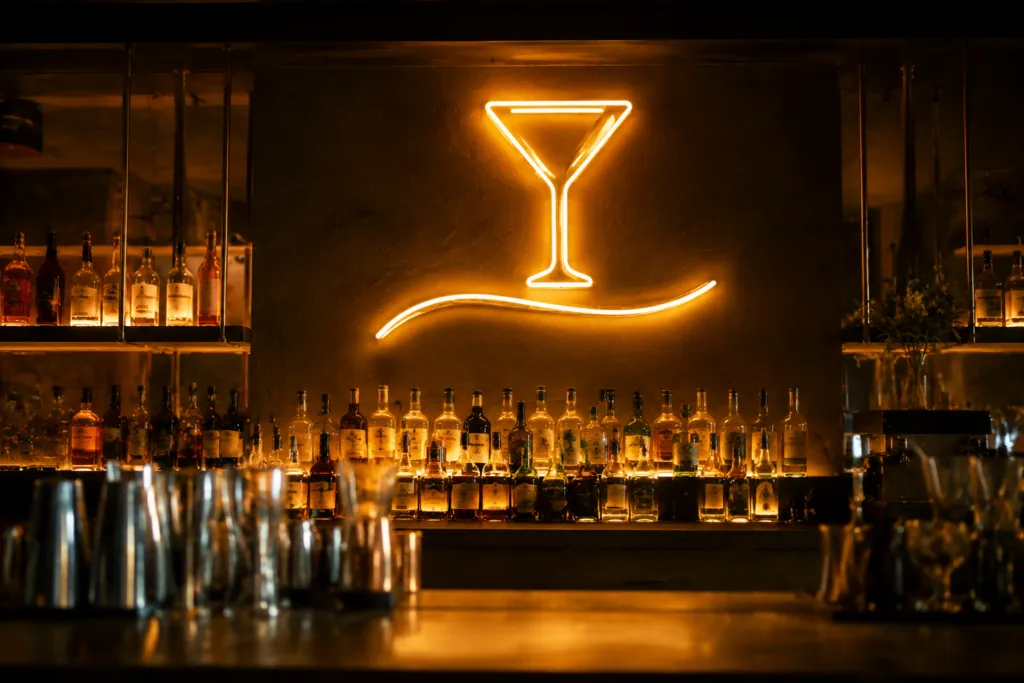
A personalized neon bar sign has to do a job that a novelty sign never does: read across a dim, loud room, live in a service environment for years, and look identical when you order six more next spring. This guide is for the people who buy it, whether you are fitting out one bar or standardizing signage across a restaurant group. It covers where the sign goes and how big it has to be, what to put on it, how to keep artwork consistent across stores, and how a commercial order actually runs.
Key takeaways
Size from the read distance, not from the wall. Keep the copy short. For more than one location, lock one master artwork and change only the name, then treat proof, sample and reorder as separate approvals.
- About one inch of capital letter height reads at ten feet, a best-case figure, so round up for a dark room (Signs.com; Pannier Graphics).
- The back bar, the booth wall and the entry are three different jobs, and they take three different sizes.
- A venue sign carries a name, a short house phrase or one clean icon. Longer copy stops reading at bar light levels.
- Multi-location consistency comes from a written spec and one approved reference unit, not from re-sending the logo.
- LED neon flex runs on a low-voltage supply, so running cost and heat behave nothing like the old glass tube signs.
01Sizing a neon sign for bar backs, booth walls and entryways
Start with distance, not with the wall. The sign trade works to roughly one inch of capital letter height for every ten feet of viewing distance. Measure to the farthest guest who should be able to read the sign, divide by ten, and that is your letter height in inches. Round up: that rule assumes good conditions, and a bar at night is not. Most venue signs that disappoint were sized to look right on the wall in daylight, then hung in a room whose far end is thirty feet away.
Source: United States Sign Council Foundation, On-Premise Sign Legibility research; Signs.com; Pannier Graphics (retrieved 2026-08-25)
The three positions want different answers.
| Position | Who reads it, and from where | What that means for the sign | What usually goes wrong |
|---|---|---|---|
| Back bar or bottle wall | Guests at the rail and across the room, ten to thirty feet | Bigger letters than the sketch suggests, and simple shapes that survive lit shelving and glassware | It competes with backlit bottles and mirrors, and stops reading |
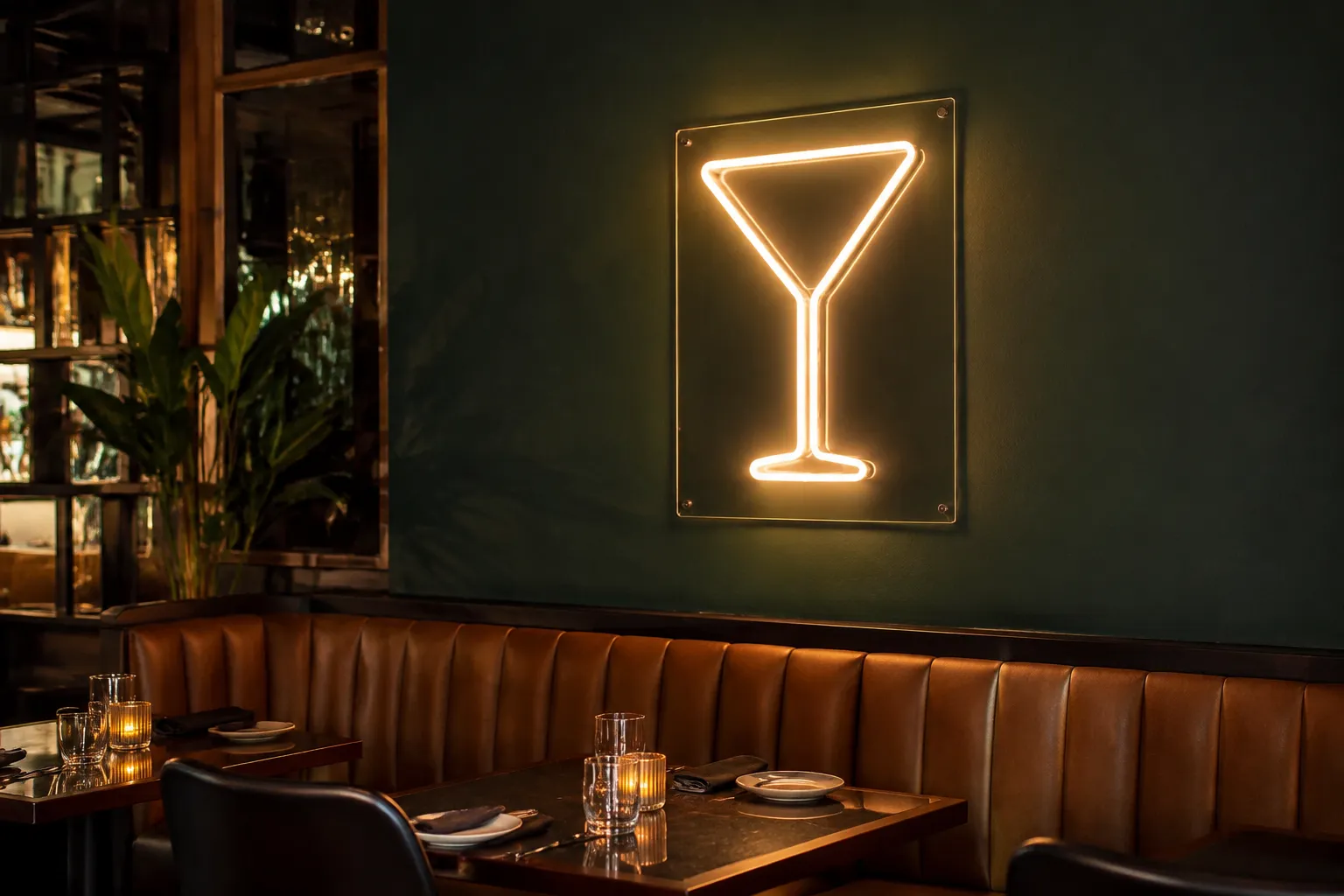
| Booth or feature wall | Seated guests and phone cameras, three to ten feet | Smaller and more detailed is fine; frame it to a seated eye line | Hung too high, so it crops out of every booth photo |
| Entry, window or street-facing | People walking or driving past, twenty feet to well over a hundred | The largest letters, one color, no fine detail; check it through window film and at an angle | Local rules on illuminated street-facing signage were never checked |
Two checks before you approve a size. Tape the outline on the wall at full size and look from the farthest seat. And settle where the power comes from, or you get a cable run across the artwork. The custom neon signs range shows the shapes and backing styles these positions usually land on.
02What actually goes on a custom neon bar sign
A venue sign works best carrying one idea. Orders come down to three: the venue name as a wordmark, a short house phrase, or a single icon such as a coupe, a pint or a martini glass. Stacking all three reads as clutter once the room lights drop.
Constraints specific to neon, worth knowing before you send artwork:
- Stroke width wants to be even. Neon is a continuous run of light, so a typeface built on thick-to-thin contrast loses its character in tube form.
- Tight kerning fills in. Letters that nearly touch on a printed menu glow into each other on a wall.
- Each color is its own section, another run and another set of joins, and that shows up in the quote.
- The backing changes the read. Cut-to-shape disappears on a dark wall and the letters float; a rectangular panel reads as a framed sign and hangs level.
- Send vector artwork. A logo pulled off a website gets redrawn either way, and an unsupervised redraw is why first proofs come back wrong.
Color does more work than buyers expect: warm white and amber read as a classic bar and photograph close to how the room looks, while saturated pink and teal read as a photo wall and take over the picture. If your sign is mainly lettering, the guide to custom neon name signs goes deeper on making a name legible in tube form.
03Custom neon signs for restaurants: one artwork, many locations
Signage gets difficult at the second location, not the first. Order store by store, from whoever is cheapest that quarter, and within a year the pink is off in one room, the letters are fatter in another, and the signs hang at three different heights. None of it shows in isolation; all of it shows side by side.
The fix is to treat the sign as a spec, not a purchase.
- One master file. Vector, with the location name on its own layer so it swaps without redrawing the layout.
- A written spec sheet: dimensions, letter height, colors, backing shape, mounting method, and which side the power exits. That sheet, not the logo file, is what a supplier quotes against.
- One approved reference unit. Screens disagree with each other about neon colors, so approve a physical sign, keep it, and match every later batch to it.
- The same source for reorders. Color and stroke drift most when a repeat order moves to a different maker for a small saving.
- Spares on the shelf. One dark sign in a room full of matching ones looks worse than none, and a spare turns that into a five-minute fix.
04How custom neon signs for business orders run, from proof to reorder
A commercial order runs in five steps; skipping the middle two turns a simple job into a rework.
Brief
Artwork, finished size, mounting position, indoor or outdoor, and where the power is.
Proof
A to-scale drawing with dimensions, colors and backing shown. Print it full size, or tape the outline up, before approving.
Sample
One physical unit, approved and kept. Optional for a single sign; the cheapest insurance in the project for a rollout.
Batch
Built against the approved sample, with per-location name variants running off the same layout.
Reorder and spares
Quoted against the same spec sheet, so a new store next year gets the same sign, not a fresh interpretation.
Quantities, timing and sample terms are quoted per project: a booth piece and a rollout of street-facing signs are not the same job. What stays constant is the sequence: nothing goes to batch until a physical reference exists. For budget planning before you have a spec, the breakdown of how much a neon sign costs covers what actually moves the number.
05Running cost, heat and leaving the signs on
Three questions come up in nearly every venue conversation, and they share a root: buyers are pricing the risks of glass tube neon. Traditional neon is a sealed glass tube of gas excited by a high-voltage transformer, which is where the reputation for warm surfaces and a visible line on the power bill came from. What ships as neon signage for venues today is almost always LED flex: a run of LEDs in a flexible sleeve on a low-voltage supply.
That change is why the operating answers are boring now. Power draw is a fraction of the glass equivalent at the same size, the sleeve runs warm at most, and the part that gives out first is usually the power supply, not the light. Two habits keep it that way: give the power supply air instead of sealing it into a cavity behind the backing, and put the signs on the same switch or timer as the bar lighting so they are not lighting an empty room at four in the morning. For the durability side, the guide on how long neon signs last takes it further.
Ordering for a bar, a restaurant or a group of locations?
Send the artwork, the wall it goes on and the number of locations, and you get back a spec to approve rather than a lump-sum number: dimensions, colors, backing, mounting, and per-store name variants off one layout. Your order runs on the same line — and the same checks — as our own retail brand.
06Watch it work
The venue signage playbook, in 31 seconds:
Frequently asked questions
Do neon lights use a lot of electricity?
Not in the way the old glass signs did. Traditional neon runs a high-voltage transformer to excite the gas sealed inside the tube, and that is where the reputation for a heavy power bill came from. Almost every venue sign sold today is LED flex on a low-voltage supply, which draws a small fraction of what the glass equivalent drew at the same size. For a bar or restaurant running several pieces through service, the signs are a rounding error next to refrigeration, cooking and air conditioning. If you want the real figure for your own site, take the rated power printed on the sign’s power supply, multiply it by the hours you run it, and multiply that by what your utility charges.
Do neon signs get hot?
Glass neon does get genuinely warm, which is why those signs are mounted out of reach. LED neon, the flexible kind used in nearly every bar and restaurant order now, runs warm at most and is safe to sit beside a booth or behind a bar rail. The part that runs warmest is the power supply rather than the sign face, so it needs air around it instead of being sealed into a cavity behind the backing or buried against soft furnishing. If a sign ever feels hotter than warm, or the warmth is concentrated in one spot rather than spread along the run, unplug it and have it looked at: that points to a connection or supply fault rather than normal operation.
Can you leave neon signs on all the time?
You can, and most venues leave their signs on right through service without thinking about it. LED neon is built for long runs, so the practical limit is not the light itself. Running around the clock mostly shortens the life of the power supply, which is the component that fails first, so the sensible setup is to put the signs on the same switch or timer as the rest of the bar lighting and let them go dark when the room is empty. Two extras worth knowing: street-facing illuminated signage is sometimes covered by local rules about hours, and keeping one spare unit on the shelf means a failure never leaves a room half lit.
Sources
- Signs.com, Signage 101: Letter Height Visibility, retrieved 2026-08-21.
- Pannier Graphics, Letter Height Visibility Chart for Outdoor Sign Readability, retrieved 2026-08-21.
- United States Sign Council Foundation, On-Premise Sign Legibility research (the letter-height rule behind the sizing chart), retrieved 2026-08-25.
- Custom Neon, Everything You Need to Know: LED Neon vs Glass Neon (12 V or 24 V low-voltage supply versus a high-voltage transformer for glass tube), retrieved 2026-08-25.
- Sygns, Neon Signs Power Consumption and Energy Use (per-metre power of LED neon flex versus glass neon), retrieved 2026-08-25.
- Aha Neon, How Much Electricity Do Neon Signs Use (running-cost background for the operating questions above), retrieved 2026-08-25.
