



A neon sign for shop fronts has a harder job than anything hanging in a living room: it has to be read through glass, at an angle, by somebody walking past who was not looking for it. That one difference sets the size, the mounting position and most of the cost, and it is why a piece that looked right in a supplier photograph arrives too small to do any work.
This is written for the person placing the order: an owner buying one sign, a purchasing lead rolling out a chain, a fit-out contractor pricing signage into a package. Prices sit in bands set by size, color count and whether the piece goes outside, worked through in our guide to how much a neon sign costs; service life is in how long neon signs last. What follows is the specification.
Key takeaways
Size a shop sign from the distance it has to be read at and the angle it is read from, never from the floor area of the store. Glass rules, weather protection, logo shape and multi-site consistency follow from it.
- Mounting angle matters more than size. A sign read head-on works at an average legibility index of 30 feet of viewing distance per inch of letter height; flat against a shopfront it is modeled at 10 (USSC Foundation).
- On a tightly spaced retail street the index falls again, by a factor of 0.83 to 0.67, so the letters that work look oversized on a drawing.
- The window is your most regulated surface. Many codes cap window signs at 25 percent of the glass, and at least one counts anything within 18 inches of the pane, front or back.
- A logo converts to tube when it survives as continuous stroke with room around it: the USSC minimum keeps negative space at 60 percent of copy area.
- Past the glass a sign becomes an inspected electrical installation with its own circuit, disconnect and drain holes, which in most markets is a local contractor’s job.
Three Positions, and Why They Are Three Different Purchases
A store has three places a lit sign can go, and they are not three sizes of one product.
The fascia talks to somebody who has not arrived yet, usually from across a road and at an angle. The window talks to somebody already on the pavement, close and moving slowly, through a reflective sheet of glass. The counter wall talks to somebody already inside, and to their phone camera.
Sign research treats the first two as separate problems. A sign mounted flat on a shopfront is what the literature calls a parallel sign: the face is foreshortened until the last few meters, so it gets read in short glances at wide angles. Letter heights developed for head-on signs, the USSC Foundation notes, “do not provide adequate parallel sign legibility” (USSC Foundation, 2015). Fascia and window are sized by different arithmetic.
Two boundaries first. This covers permanent signs on mains power. Portable pieces for a stall, a pop-up or a trade stand run on batteries, which changes the brightness and run time you can ask for; that split is in battery operated neon signs. Venue signage has its own sizing in personalized neon bar signs, and training floors in barbell neon signs.

| Position | Who it is for | What sets the size | Ask before you order |
|---|---|---|---|
| Fascia above the door | People who have not arrived yet | Read distance and angle | Is it a permitted installation here |
| Inside the display window | People already on the pavement | Glass area rules and setback | How far back will it hang |
| On the entrance door pane | People deciding whether you are open | Door glass height and eye level | Does it clear handle and closer |
| Behind the counter | People paying, and their cameras | The light level it sits against | Can it be dimmed, and how is it fixed |
| Outside, past the glass line | Passing traffic in all weather | Protection, drainage, circuit rules | Who carries permit and inspection |
An Open Sign Big Enough to Read Across the Street
The most common sizing mistake is to size from the floor area of the store, the one number that has nothing to do with it.
Advice that reads “18 to 24 inches for a small shop” is guessing at a room, not a sightline. What decides the size is how far away a person stands when they need to read the sign, and at what angle. Walk to the point where you want to be noticed and measure back.
In 2015 the USSC Foundation published its Best Practice Standards for On-Premise Signs, which turns distance into letter height through a legibility index in feet of viewing distance per inch of letter height. The average standard is 30 feet per inch (USSC Foundation). Retail streets are not average: the same document applies an adjustment factor of 0.83 in moderately congested in-town zones and 0.67 in highly congested ones, listing tightly spaced retail and on-street parking among the conditions. That pulls the working index to about 25, then 20 feet per inch; real-world observation recorded an average decrease of at least 35 percent against test-track values, with extremes as low as 7 feet per inch.
For a sign mounted flat on the shopfront the parallel model is blunter still. Its letter height equation is LH = (lanes × 10 + lateral offset in feet) / 5, and the worked example in the standard puts a two-lane road with the sign set 37 feet back from the kerb at 11.4 inches of letter height (USSC Foundation). Set the word in capitals and add 15 percent, since caps need more height than mixed case at the same distance. Very few shopfront signs are ordered anywhere near that big.
One thing favors a tube sign. Penn State’s Transportation Institute found that signs lit from within are read from 40 to 60 percent greater distances than signs lit by a fixture pointed at them, give a driver roughly 2 seconds more to react, and that an externally lit sign has to be 40 percent larger to match (Garvey et al., 2004). A neon piece is lit inside the stroke, so it starts on the right side of that comparison. Brightness beyond that is not a lever: the same guideline caps recommended night luminance at 750 cd/m², and brighter signs did not read better in testing.
Custom Neon Window Signs and the Rules of the Glass
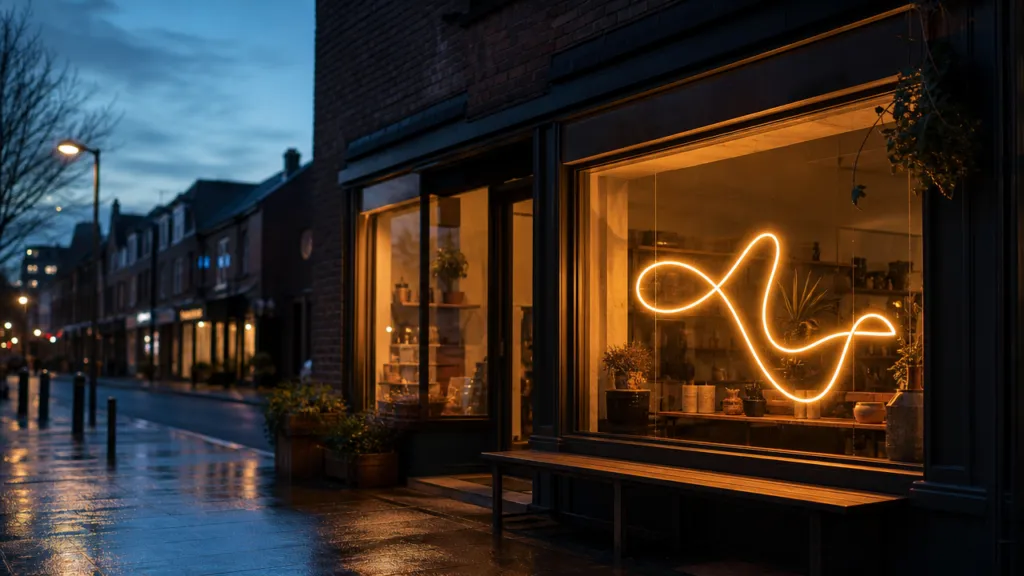
Custom neon window signs are the easiest thing in the store to install and the most tightly regulated surface to install them on.
The area cap comes first. Los Angeles County’s Title 22 sign regulations allow temporary window signs at no more than 25 percent of the area of any single window, or of adjoining windows on the same frontage (Los Angeles County, section 22.52.920). Prince William County, Virginia, uses the same ceiling in commercial districts, 25 percent of the aggregate area on each window or glass door. The number is common enough to plan around; the definition underneath it is where people trip.
Prince William County counts as a window sign anything visible from outside that is attached to, or within 18 inches of, a window or glass door. Los Angeles County goes the other way and steps back from restricting signs that form part of a merchandise display, provided they stand at least one foot from the window. Read together, the point falls out: how far back you hang the sign can change which rule it lives under, so ask your planning office before ordering glass-sized artwork. If you lease, ask the landlord too.
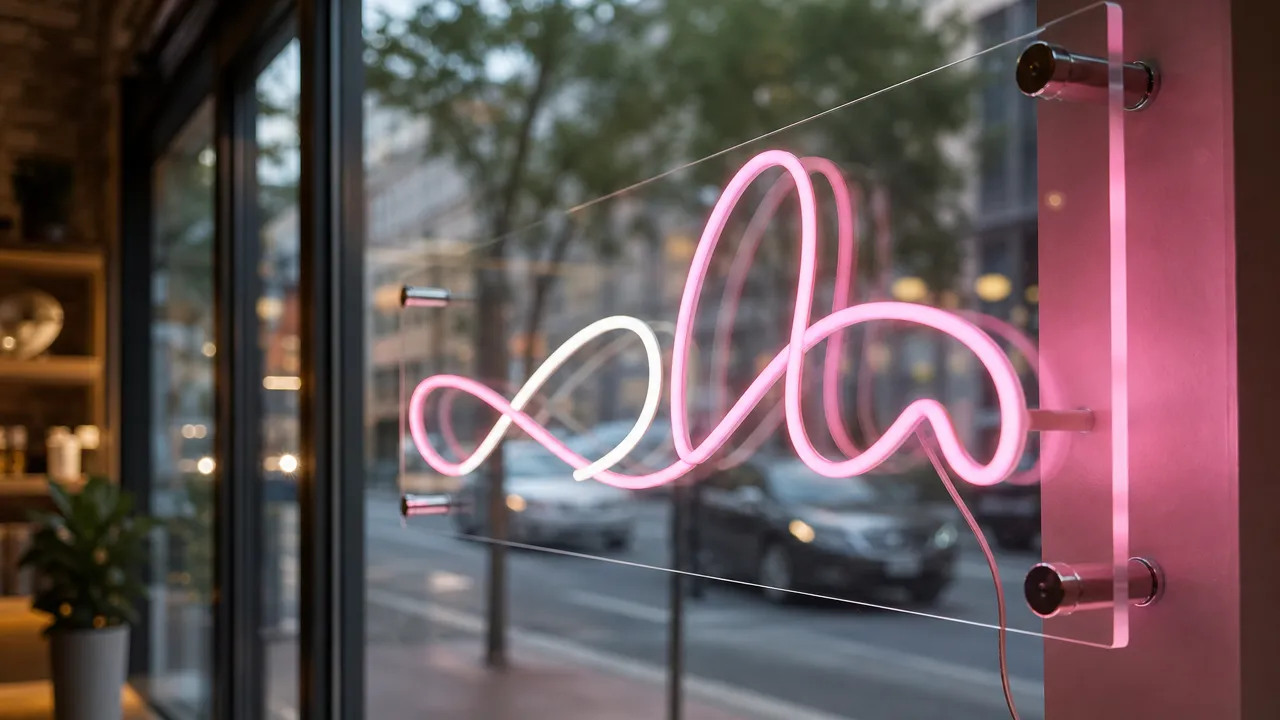
Then there is the glass. At night the inner face of the pane throws a second, dimmer copy of your sign back into the store wherever the sign sits parallel to it; angling the piece a few degrees, or setting it back with display in front, kills most of that. Cable exit is the other thing nobody draws: the lead has to reach a socket without crossing the display, which means deciding the mounting side before the artwork is final. A clear cut-acrylic backing panel on standoffs is the usual answer: it holds the piece off the glass and takes the strain of the tube, and it is how our own LED neon signs are built.
Custom Neon Logo Signs: What Survives the Trip Into Tube
Custom neon logo signs are sold on the promise that your mark becomes light, and the honest version of that promise has edges.
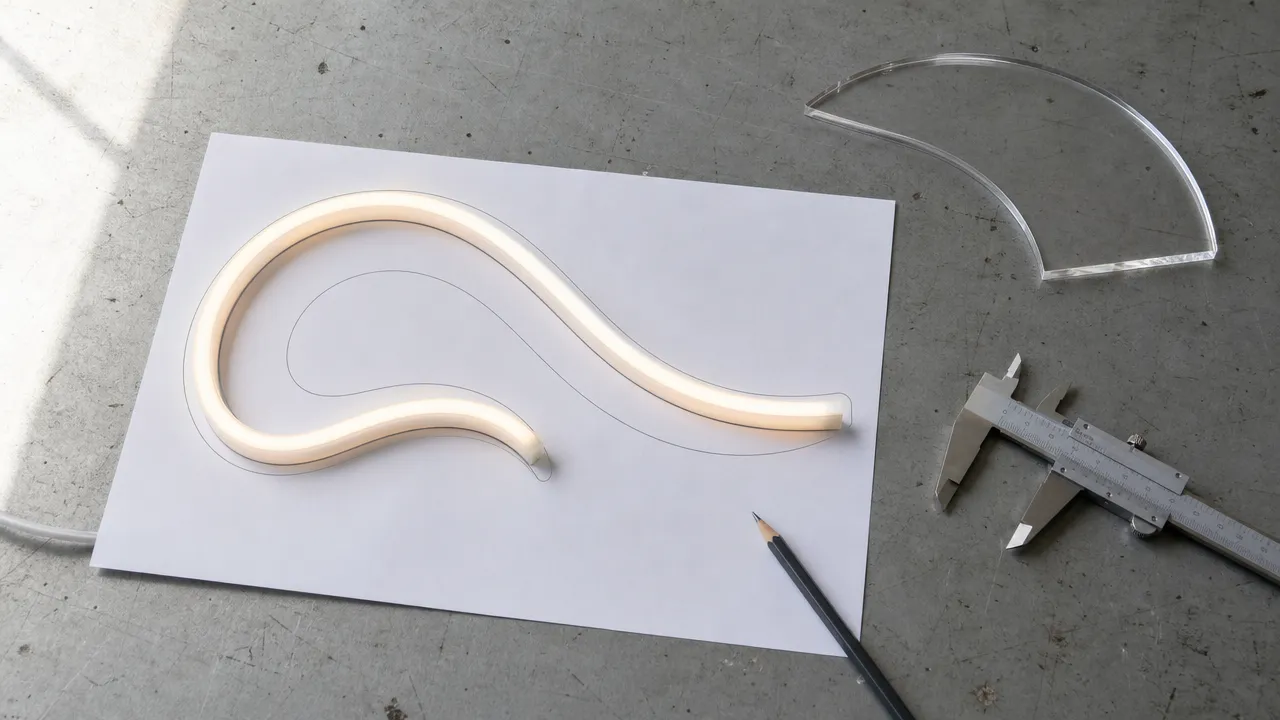
A logo converts well as continuous stroke of roughly even width, with enclosed shapes that stay open at the size you are ordering, in one or two colors. It converts badly when it leans on hairline serifs, a gradient, a photographic element, a drop shadow doing the separation work, or small type set beneath a mark. Registered trademark symbols and thin strap lines rarely make it as tube; they get printed on the backing panel, or dropped.
Spacing is the constraint most people meet late. The USSC standard sets a floor for the relationship between copy and the space around it: negative space should never be less than 60 percent of the copy area, a 40 to 60 split it calls the minimum for a reasonable expectation of legibility (USSC Foundation). Applied to a lockup that is a rule about subtraction: the mark that works at shopfront scale is usually the wordmark alone, or the icon alone.
So the question to put to any supplier before artwork approval is which elements will be bent tube and which printed or cut on the backing. A quotation that does not answer it is a quotation for a picture. Typeface behavior and how a proof gets signed off are covered separately in custom neon name signs; our own script work sits in custom script LED neon signs, and the storefront format in neon signage.
The Counter Wall, Where the Sign Competes With Your Own Lighting
A sign behind the till is read from about three feet by somebody paying, and photographed from six by somebody who came in for the photograph.
This is where buyers over-specify brightness and under-specify contrast: the sign is not in a dark room, it is against a wall your own scheme already lights hard. Recommended illuminance for retail interiors runs 10 to 30 footcandles in circulation areas and stockrooms, 20 to 80 in a department store, 25 to 100 in a drugstore or convenience format, and 30 to 100 for serviced merchandising, with self-service merchandising pushed to 200 (IES). A piece that looked commanding in a dim showroom has to hold against those numbers, which is a question about the backing panel and contrast rather than watts.
Source: Illuminating Engineering Society footcandle recommendations, published as a reference sheet by Elite Lighting (retrieved 2026-09-05)
Three notes for this wall. Mount it above the head height of whoever works the till, because a bright stroke at eye level for eight hours becomes a complaint. Ask for a dimmer, since the level that reads well at opening is rarely the one that photographs well after dark. And choose the backing color deliberately: a warm tube on a white panel under 100 footcandles loses most of its edge, while the same tube on a dark panel keeps it. The merchandising thinking behind that wall is in sensory retail display ideas.
Custom Neon Signs Outdoor: What Changes Past the Glass
Custom neon signs outdoor is the same drawing and a different product, and the difference is not only the sealing.
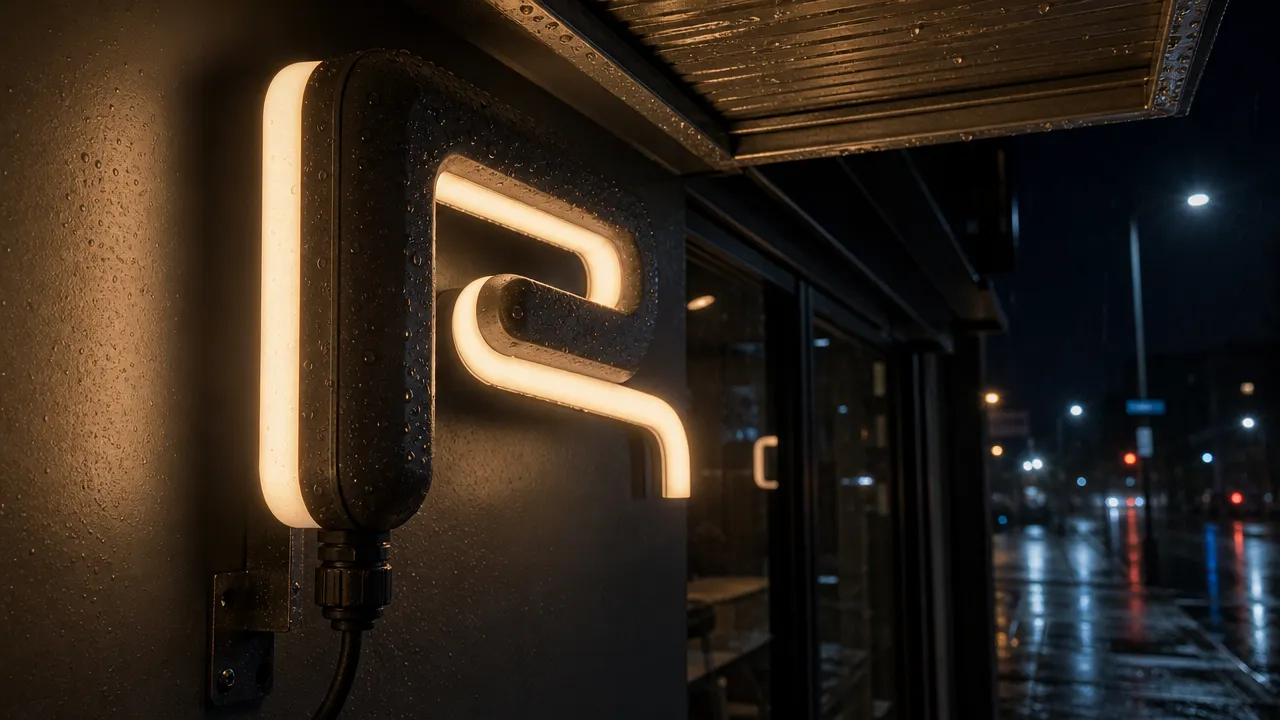
Protection is described with the IP code, defined in IEC 60529, where the first digit covers solid objects and dust and the second covers water. Treat a single figure with suspicion until you know what it applies to, because an outdoor assembly is only as protected as its weakest opening: the tube may be one rating, the cable gland another, the power supply a third. Ask for all three, and where the supply is meant to sit. Our explainer on waterproof LED strips and IP ratings covers how those digits behave once installed.
Sealing is not the whole answer either, because outdoor signs are usually drained rather than made airtight. Palo Alto’s 2016 inspection guideline for electrical signs, following Article 600 of the electrical code, has inspectors check that wet-location signs carry drain holes no smaller than a quarter of an inch and no larger than a half inch at every low point. The same checklist covers what buyers rarely think about: a dedicated circuit carrying no other load, capped at 20 amperes for incandescent and fluorescent signs and 30 amperes for neon tubing; a disconnect within sight, or a lockable one; and signs mounted 14 feet above any area vehicles reach unless protected (City of Palo Alto). The underlying rules are national, in NFPA 70.
Which leads to a recommendation against our own interest. In the United States and most of Europe the exterior fascia sign is a permitted, inspected installation, and the permit is issued against a local contractor. Buying it direct from any overseas maker, ourselves included, can leave you owning a handsome object nobody local will energize. The split that works is to run the exterior sign through a contractor in your own market and source the window, door and interior pieces directly, where no permit is in play. Outdoor construction also carries a premium over an indoor piece of the same size, broken down in our neon sign cost guide.
Ordering for a Second Store, and a Tenth
One neon sign for shop fronts is a purchase. Ten across ten leases is a program, and the failure mode is a set that stops looking like a set.
The variables that move between sites are dull and expensive: fascia widths differ by a foot or two, window heights by more, sightlines completely, power by market. Order ten identical pieces against your flagship and several will be wrong for their opening. Order ten separately across two years and the color will drift, because tube color is a batch property and nobody wrote the reference down.
The questions worth asking are about the program, not the piece. Which dimension is fixed across sites and which flexes. Where is the color reference written. How is each piece packed and labeled, so a store receives its own sign rather than the pallet’s. The sourcing checks behind them are in importing lighting from China.
Survey every site, not the flagship
Fascia width, glass height, the distance you want to be seen from, and anything blocking it: awning, tree, column, delivery bay.
Set a size family, not a size
Two or three widths covering the surveyed range, artwork proportioned for each. One size fitted to the largest unit swims in the rest.
Fix the artwork and color reference in writing
One approved file and one color reference per tube color, both quoted in the order so a reorder is matched, not eyeballed.
Split the order by power and surface
Group by destination voltage and plug pattern, then by what the sign mounts to: glass, plasterboard, brick or a shopfitted panel.
Buy the spares with the first order
Power supplies, mounting kits and cable sets, ordered while the batch runs and held centrally.
Photograph the first install and reuse it
The first fitted store becomes the instruction for the rest: mounting height, cable route, socket used, dimmer setting.
When a program is ready to quote, the range sits in wholesale custom neon signs.
Spec a shopfront program rather than a single piece
We make lighting in our own factory in Foshan, 4,000 square meters and 40 people across two production lines, and build to drawings as readily as to our own designs. Send the artwork, the surveyed sizes and the market the electrics have to suit, and we will quote the set.
Watch it work
The read-distance test, the window rule and the first glow through the glass, in 39 seconds:
FAQ
Do I need a permit for a neon sign in a shop window?
Usually not for the electrical work, since a plug-in interior piece counts as equipment rather than an installation. Planning rules and your lease are separate questions and both can bite. Some jurisdictions permit permanent window signs while exempting temporary ones, some do the reverse, and several count an illuminated one against your permitted frontage area. Leases are stricter than people expect: anything fixed to the shopfront is normally an alteration needing written consent. Ask the planning office and the landlord in the same week, before artwork.
Can a neon shop sign be read in daylight?
A lit tube reads best against a darker background, so a sign that dominates at night can vanish at midday behind a south-facing window. Two things fix it. Contrast: a dark or tinted backing panel gives daylight something to work against; a clear panel against a bright street gives it nothing. Position: set back inside the window with display around it, the sign sits in relative shade. If it has to work in both conditions, say so at quotation stage: that changes the backing and sometimes the tube color, not the size.
What is the difference between an LED neon shop sign and an illuminated light box?
A light box is a sealed cabinet with a translucent face lit from behind, so the whole panel glows and the graphic is printed into it. An LED neon sign is a bent tube glowing along its own line, usually on a cut backing panel, so the light is the shape rather than a face over a source. Light boxes hold more information and survive weather more easily. Tube pieces carry one mark or a few words, photograph better and mount lighter. Chains often use both: a box on the fascia, tube in the window.
Who installs a shop sign in a leased unit, and what happens at the end of the lease?
Interior pieces are typically fitted by your own shopfitter or the supplier’s installer. Anything on the exterior face, or anything hard-wired, goes to a licensed contractor in your market who takes out the permit and meets the inspection. The part people forget is the exit: most retail leases require reinstatement, so fixings, cable routes and any core drilled through the fascia have to be made good. Price that into the project.
Sources
Every external figure above was checked on 2026-09-05: legibility and luminance from the United States Sign Council Foundation, window limits from two county codes, inspection points from a municipal guideline, retail light levels from the Illuminating Engineering Society, protection ratings from the standard that defines them.
- United States Sign Council Foundation, Best Practice Standards for On-Premise Signs, Bertucci and Crawford, 2015 (the legibility index, congestion factors, caps allowance, parallel sign equation, negative space minimum and night luminance), retrieved 2026-09-05.
- Garvey, P.M., Ramaswamy, C., Ghebrial, R., De la Riva, M., and Pietrucha, M.T. (2004). Relative visibility of internally and externally illuminated on-premise signs. University Park, PA: The Pennsylvania Transportation Institute, Pennsylvania State University (the internal versus external illumination findings).
- Garvey, P.M. (2006). On-Premise Signs: Determination of Parallel Sign Legibility and Letter Heights. State College, PA: The Visual Communication Research Institute (the parallel sign letter height model).
- County of Los Angeles, Title 22 Sign Regulations, section 22.52.920 (the 25 percent window cap and the one foot display setback), retrieved 2026-09-05.
- Prince William County, Virginia, Commercial Sign Regulations (the 25 percent cap and the 18 inch window sign definition), retrieved 2026-09-05.
- City of Palo Alto, Development Services, Inspection Guidelines: Electrical Signs, 2016 (circuit limits, disconnect, mounting height and drain holes), retrieved 2026-09-05.
- National Fire Protection Association, NFPA 70, National Electrical Code (Article 600, the national rules the municipal checklist applies), retrieved 2026-09-05.
- International Electrotechnical Commission, IEC 60529, Degrees of protection provided by enclosures (IP Code), edition 2.2 (the two digit rating structure), retrieved 2026-09-05.
- Illuminating Engineering Society / Elite Lighting, IES Footcandle Recommendations (the retail illuminance ranges charted above), retrieved 2026-09-05.
