





LED strip lighting with motion sensor control is bought by a different person than plain accent tape. The buyer is a cabinet maker, a fitted-wardrobe installer, or a hardware buyer building a kitchen-and-storage assortment, and the first question is never brightness. It is which trigger belongs in the box, and what happens on the day the light comes on with nobody in the room.
Three modules carry the category: a passive infrared sensor watching for a moving body, a switch that reads whether a door is shut, and a short-range hand-wave pad. This guide stays on that choice; voltage, cut points and driver sizing sit in our LED strip spec decoder, and the retail case for carrying under-cabinet lighting at all is in the under-cabinet buyer primer.
Key takeaways
Choose the trigger before the tape. Passive infrared suits open runs a person walks into, a door switch suits enclosed storage, and a hand-wave pad suits a counter where hands are wet. Delay, sensitivity, cold start and false triggers are the four things to prove on the sample.
- A passive infrared sensor reads the difference between two sensing elements, not heat. Motion has to cross its lens pattern, so a person walking straight at it is the hardest case there is.
- A closed cabinet defeats infrared sensing outright, which is why wardrobes and glazed display cases want a door switch instead.
- Turn sensitivity down before you move the sensor, and move the sensor before you argue with the supplier. Guidance keeps sensors more than 8 feet from air vents (Crestron).
- Battery kits exist because passive infrared emits nothing. The cells set the cold limit: alkaline is rated for −18 °C to 55 °C (Energizer).
- Adhesive is the commonest field failure. Foam tape wants a surface at 21 °C to 38 °C and needs three days to reach full strength (3M).
Three Ways a Strip Decides to Switch Itself On
A sensor strip is two products bolted together: a length of tape, and a small module that decides when to power it. The module is the part worth arguing about.
Three ship in volume. A passive infrared unit asks whether a warm body moved in front of its lens. A door switch asks whether the door is held shut against a magnet. A hand-wave pad asks whether an object is within a few centimetres of it. A line on a quotation that reads LED strip lighting motion sensor tells you nothing about which of the three sits in the box.
The reason buyers keep asking is measurable. In 2018 the General Services Administration published a study it commissioned from the Department of Energy’s Pacific Northwest National Laboratory across 76,000 square feet of open-plan office in Fort Worth. After the conversion to LED, light-level tuning and occupancy sensing cut lighting energy by a further 43 percent (U.S. GSA). That is why the trade now treats sensing as a line item rather than an upsell.
| Trigger | What it senses | Where it belongs | How it fails |
|---|---|---|---|
| Passive infrared | A moving temperature contrast crossing its lens pattern | Hallways, stairs, open shelving, a counter | Misses slow movement aimed at it; fires on warm airflow |
| Magnetic door switch | Whether the door is held closed against a magnet | Wardrobes, closets, drawers, glazed cases | Contacts wear or weld above their current rating |
| Hand-wave pad | An object within a few centimetres of the lens | Kitchen counters, wet hands, an open shelf edge | Reads a hanging tea towel, a sleeve, or steam |
| Touch pad | Direct contact on the pad itself | Where a deliberate on and off is wanted | Needs a free hand, so it is not hands-free |
Most disappointment here comes from selling one of these where another belonged. Our own kit sits in the strip range, specified around placements rather than effects.
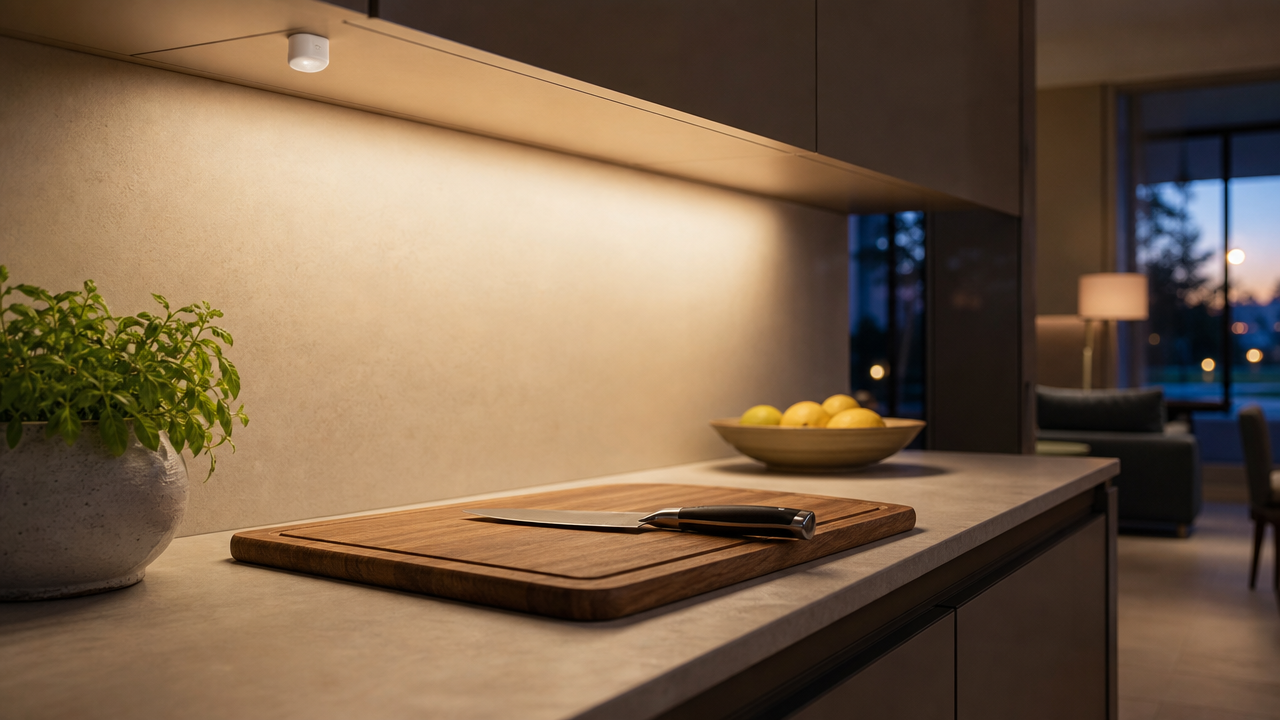
PIR: What an LED Strip Light PIR Motion Sensor Kit Actually Detects
An LED strip light PIR motion sensor kit does not detect heat. It detects a difference, and that distinction explains almost every complaint this category generates.
Crestron’s placement guidance sets out the mechanism plainly. The sensor uses a differential pair behind a Fresnel lens, and most units carry only a handful of sensing elements, typically four in a ceiling unit. “Think of this as a four-pixel camera,” the document says. A general rise in room temperature registers as nothing. Only when one element sees a change its partner does not is motion reported (Crestron).
Two consequences land on a specification. Sensitivity is the size of difference the pair has to see, which is why the setting mainly exists to stop pets switching a light on. The second is the one suppliers rarely volunteer: if a person moves without crossing from one lens facet to another, the sensor cannot register it, and turning the dial up will not rescue it. “Increasing sensitivity will not improve the performance of the sensor,” the same guidance says (Crestron). Somebody walking slowly down a narrow corridor at the lens is the textbook miss.
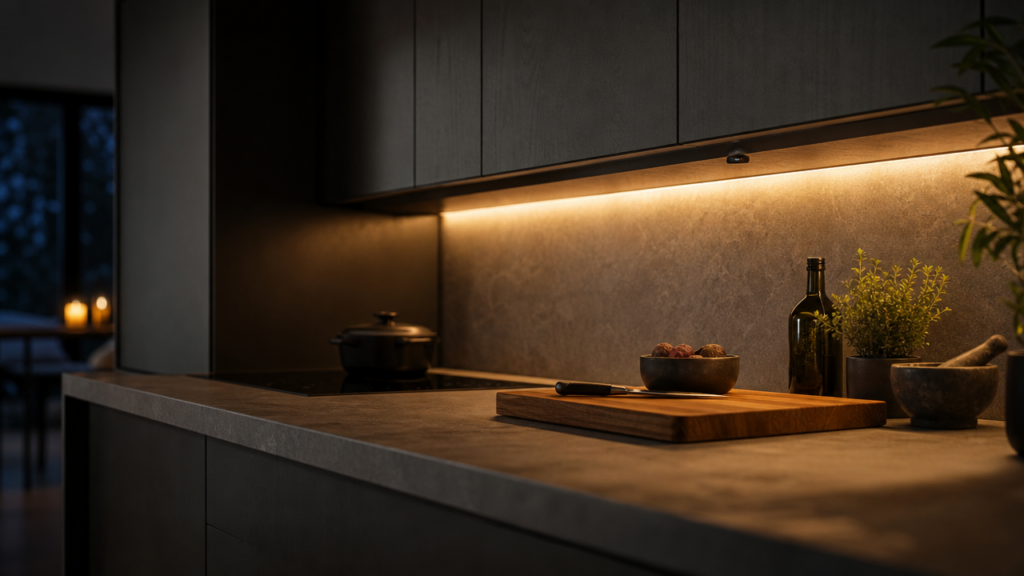
So aim the sensor across the traffic rather than into it. Under a wall cabinet the lens should look along the counter run, not out into the room. That costs nothing at the drawing stage, and cannot be fixed later. One further limit decides a placement later: the sensor reads contrast, so the smaller the contrast, the shorter the range.
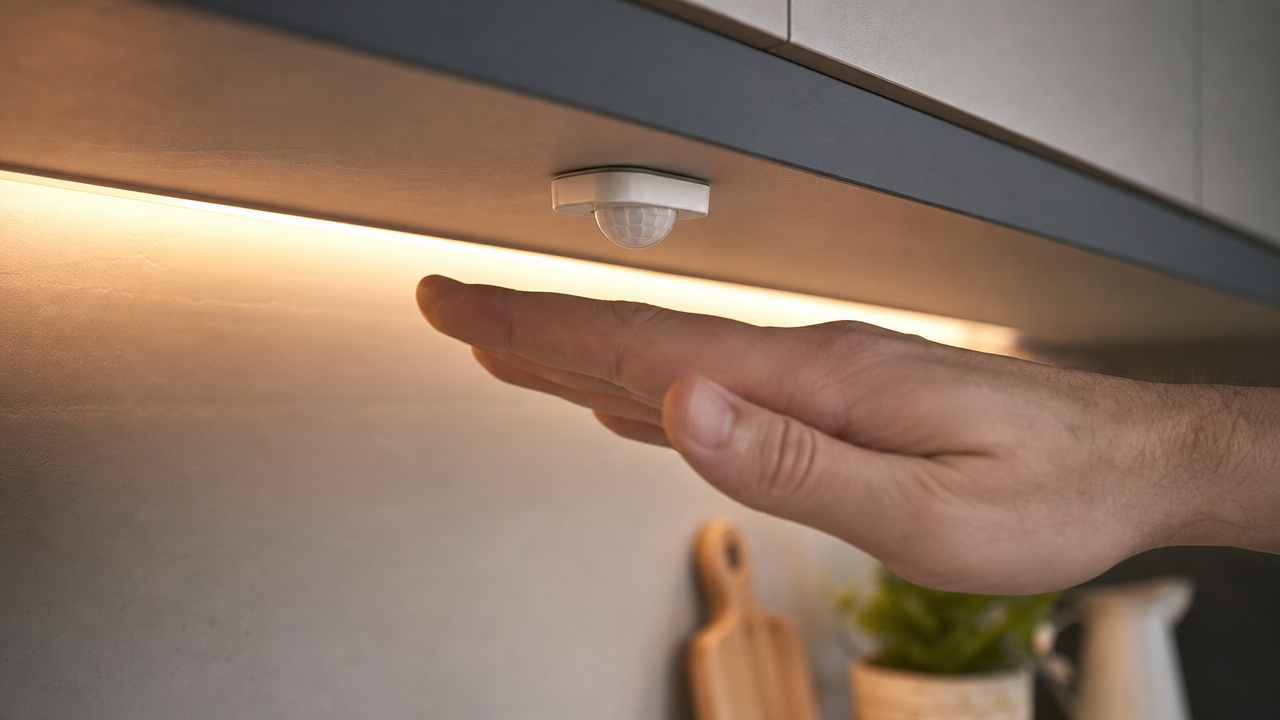
Door Switches: Wiring a Cabinet Door Activated Light
A cabinet door activated light is the only honest answer for enclosed storage, because a sensor that cannot see out of a closed box has no way of knowing anyone is there.
The hardware is ordinary and cheap: a magnet on the door leaf, a reed or plunger switch on the carcass, wired so the circuit closes as the door swings open. Nothing to calibrate, no delay to argue about, no false trigger to chase. It behaves the way a refrigerator light behaves, which is why buyers burned by sensing keep coming back to it.
One number decides whether it lasts. Ask for the switch contact rating in amps, then set it against the draw of a full run at the length you intend to sell, not the length on the sample bench. Small magnetic switches sold into this trade are often rated for a fraction of an amp, and a two-metre demo will not reveal what a five-metre wardrobe run does to them.
Closets raise one more question, and it belongs to the local authority rather than a catalogue. The residential electrical provisions set clearances between a luminaire and the storage space inside a clothes closet: 305 mm (12 in.) for a surface-mounted, completely enclosed LED unit above the door or on the ceiling, and 152 mm (6 in.) recessed (International Residential Code, Section E4003.12). Whether a low-voltage tape run falls inside that scope is for the inspector on the job, so put the question to the authority having jurisdiction before committing to a closet program.
A word about our own kit, since this guide keeps pointing at it. The under-cabinet motion strip kit is switched by a single PIR sensor (120°, 1 to 3 m) at fixed brightness, and it does not ship a magnetic door switch. For a genuinely door-triggered wardrobe that means a kit built around a door switch, or accepting infrared sensing with the door open.
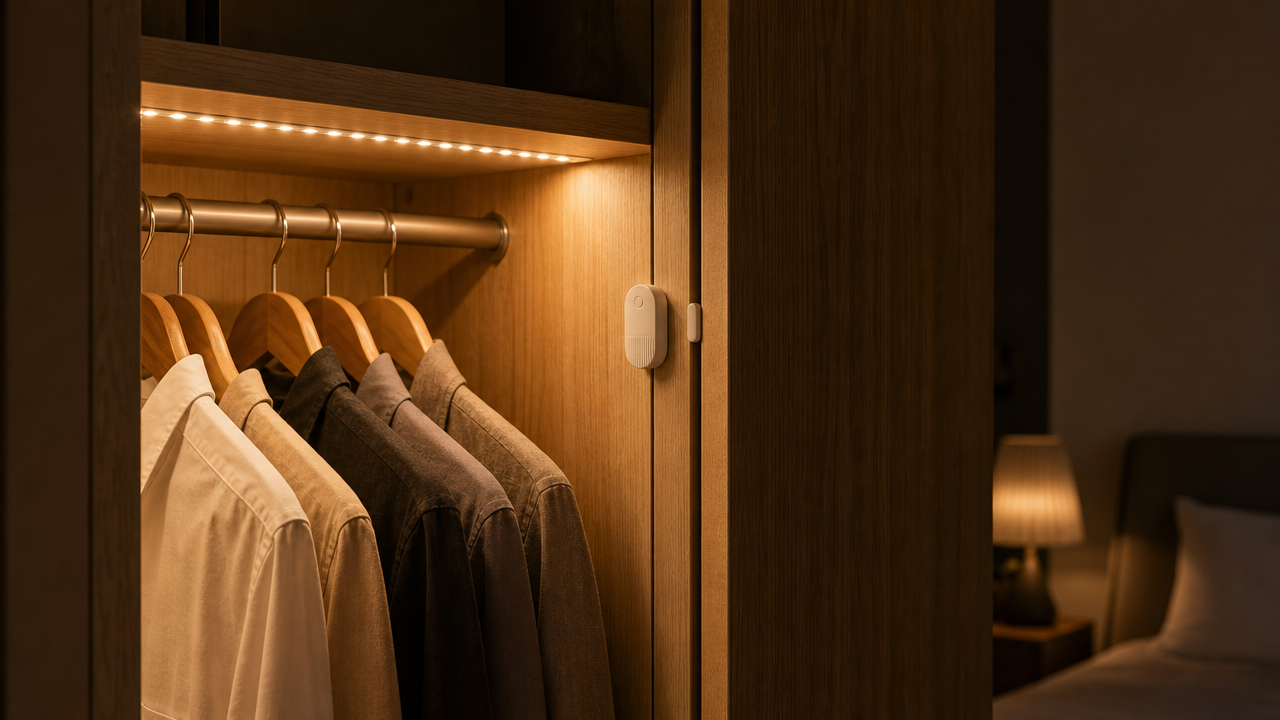
Hand Wave and Touch: The Trigger for a Wet-Hands Counter
Hand wave is the trigger kitchen buyers ask for by name, and the one most often sold into the wrong position.
It is an active sensor. A small emitter throws infrared out, a receiver watches for the reflection, and the module switches when an object comes within a few centimetres. The short range is the point: the light answers a deliberate gesture and ignores somebody walking past. That makes it right above a prep counter, at the front lip of an open shelf, and anywhere hands are too wet for a switch.
The failure modes fall out of the same short range. A tea towel hung over the rail sits permanently inside the detection zone and holds the light on until the cells give up. A sleeve does it intermittently, which is worse, because an intermittent fault is hard to reproduce for a complaint. The mounting position has to clear the rail, the towel and the extractor path, and that is a drawing decision rather than an installation one. Our own kit carries neither a hand-wave nor a touch pad; its only trigger is the PIR sensor. Kitchen placement sits in our guide to LED strip lights for kitchens.
Delay, Sensitivity, Cold Start and False Triggers
Four settings decide whether a sensing kit is kept or returned, and all four can be proved on one sample in an afternoon.
Start with delay. Time delay is “the period between the last detected motion and when the lighting turns Off or reduces output” (Lighting Controls Academy). Too short, and a person standing still at a counter is left in the dark, which reads as a fault. Too long, and the sensing has no point. What belongs in the order is the full set of steps the module offers, and which one it powers up on.
Sensitivity and false triggers are two names for one argument. Air moving across the sensor from a vent, or anything that makes the housing warm and cool, produces readings the module cannot tell from a person; sensitivity settings paper over some of it, but the correct fix is to move the sensor, and the same guidance keeps sensors more than 8 feet from air vents (Crestron). It also spaces ultrasonic units more than 12 feet apart, because they emit at roughly 42 kHz and otherwise hear each other (Crestron). Under a kitchen cabinet the equivalents are the extractor and afternoon sun.
Cold start is two limits discussed as one. The source is the easy half, since the Department of Energy lists good performance in cold temperatures among the characteristics of LEDs (U.S. DOE). The battery is the hard half: alkaline cells are recommended for −18 °C to 55 °C and run as low as −20 °C with significantly lower performance, and Energizer notes that no capacity is actually lost in cold, it is simply harder to access (Energizer).
The third cold limit is the one that generates callbacks. Foam mounting tape is temperature-sensitive at the moment it goes on: 3M puts the desirable application temperature for its VHB range at 21 °C to 38 °C, with minimum surface temperatures of 10 °C for the common families and 15 °C for several others, while holding once applied stays satisfactory down to −40 °C (3M). Application is the cold problem, not service. A strip fitted in an unheated garage in February lets go in spring.
Source: 3M, VHB Tapes Product Information Guide, time and temperature build-up table (retrieved 2026-09-05)
The same guidance says an assembly can be handled within ten minutes but should not be stressed for 72 hours (3M). That line belongs in the leaflet of any sensing kit sold on tape. Mounting in a channel removes the argument, and profile choice is covered in our piece on the LED channel for strip lights.
Mount it where it will live
Under a real cabinet lip at real height, not flat on a bench.
Walk it both ways
Cross the sensor, then walk slowly at it. The second case generates complaints.
Time the delay three times
Stopwatch, last movement to off, against the steps printed on the pack.
Provoke it for an hour
Extractor on, oven open, sun across the lens. Count false starts and note each cause.
Start it cold
Leave kit and cells in a fridge overnight, then switch on before they warm.
Pull the tape at 72 hours
Not at three minutes, and on the finish the cabinets will have.
Battery or Wired: Two Supply Routes, Two Different Jobs
Battery sensing kits exist because of a quirk of the sensor rather than a breakthrough in cells: passive infrared emits nothing at all.
“This passive nature is why battery powered sensors are usually of the PIR type,” Crestron’s guidance notes, against ultrasonic units that push energy into the room and cannot live on cells (Crestron). Source efficiency finishes the argument: LED products make light up to 90 percent more efficiently than incandescent, with rated life set where output has dropped 30 percent rather than at failure (ENERGY STAR), and current products reach up to 150 lumens per watt (U.S. DOE). A few seconds of light a dozen times a day is a load cells can carry.
What batteries cost you is an owner. Somebody has to notice the light dimming and change them, and in a rented flat or a display case at the back of a shop, nobody does. That is why a plug-in route wins most retail programs. Our own motion strip kit runs from a low-voltage adapter into a standard outlet, so there is no junction box, no switch loop and no trade visit to book.
Hardwiring stays right in one case: new cabinetry, specified before the carcasses are made. It also puts an electrician on the critical path and ties the light to the furniture, a poor trade in a rental fit-out. Damp locations add their own constraint, covered in our guide to waterproof LED strip and IP ratings.
What Ships in an LED Strip Light Motion Sensor Kit
An LED strip light motion sensor kit is a bill of materials before it is a product, and most disputes at sample stage are really disputes about that list.
Our own retail pack is complete on the shelf: the strip, the PIR motion sensor, a 2 A plug-in adapter and mounting accessories, so the SKU needs no add-on parts at the point of sale. It comes in 1 to 5 m lengths, in white or warm white, with a US, EU or UK plug, and the sensor is its only trigger. On kits that offer several modes, the default matters more than it sounds: it is what a shopper judges the product by in the first thirty seconds.
Two things sit outside the pack and belong in the drawing. Cabinet runs rarely match a reel length, so the cut interval belongs in writing rather than in the installer’s head; the detail is in our piece on cutting LED strip lights to fit. The second is the channel, which decides whether diodes show as dots on a glossy counter.
| Line item | Why it moves the outcome | The form the answer takes |
|---|---|---|
| Length and segmentation | How many cabinets one pack serves | Metres, sections, connector type |
| Trigger modes and default | First impression out of the box | Mode list, and which powers up |
| Delay steps | Most complained-about behaviour | Every step, printed on the pack |
| Sensor lead length | Whether the module reaches | Millimetres, on the drawing |
| Adapter and plug type | One pack cannot serve two markets | Plug pattern and voltage per country |
| Mounting method | Commonest field failure here | Tape grade, or channel and fixings |
| Spare parts | Sensors fail before tape does | Each orderable on its own |
| Retail pack | Shelf presentation and leaflet | Artwork, languages, 72-hour note |
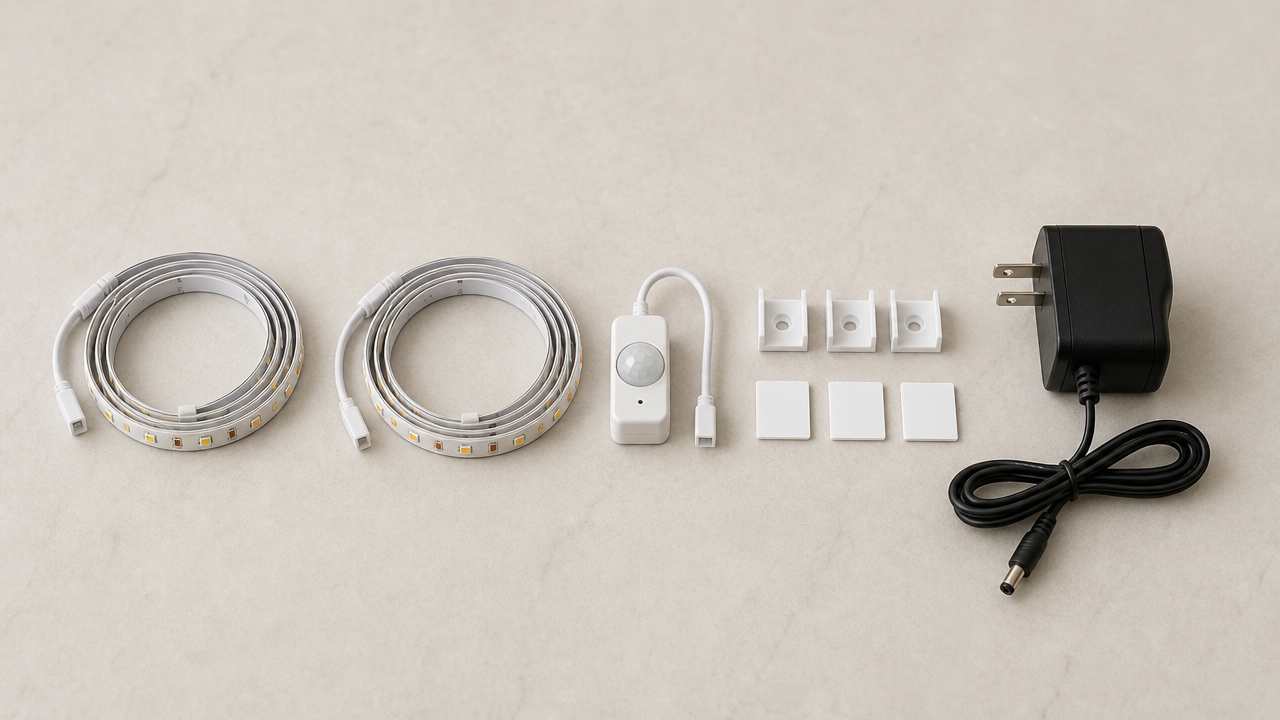
Do Motion Sensor Lights Need a Switch?
A plug-in kit like ours does not need a wall switch: the PIR sensor is the switch, a 2 A adapter feeds it from an ordinary wall socket, and unplugging the adapter turns it off completely.
Shoppers look for a switch out of habit, because a ceiling light answers one; on this kit the sensor is the control.
When It Lights, and When It Goes Dark on Its Own
It lights when a person moves inside the 120° sensor field, 1 to 3 m out: feet landing beside a bed, someone stepping up to a counter. The movement has to cross the lens pattern, not just happen inside the fan, so a person standing still gives it nothing to register (Crestron).
It goes dark on its own once movement stops and the time delay defined in the delay section above runs out; time it on the sample before a listing quotes a figure. Power pairs the same way: unplugged, it stays off; plugged back in, the sensor is in charge again.
What Shoppers Mistake for a Fault
The confusion comes from expecting a switched light, so anything one would not do reads as a defect. Four such reports are the kit working as built:
- Dark with someone right there: they are standing still, or outside the 120° fan or its 1 to 3 m reach.
- Off in the middle of a task: nobody moved for longer than the delay, and moving again brings it back.
- No dimming: brightness is fixed.
- Nothing to pair: no remote or app comes with it.
A fifth, coming on with nobody there, can be a placement problem, covered in the Delay, Sensitivity, Cold Start and False Triggers section above.
What to Print on the Listing, Box and Leaflet
Print one line before anyone asks: “Motion-activated: the sensor is the switch. Plugs into a wall socket.” Run it from cheapest to most thorough:
- Listing title and first bullet. Free, and it turns away the shopper who wanted a remote before the order, not after.
- Stock service replies. The strip cannot be held on, because it waits for movement, and it switches off at the plug.
- Box front. The same line, settled with the retail pack artwork in the sample checklist above.
- Leaflet, first page. The on and off pairs in three lines, then the four reports, headed as not faults.
Need Constant Light? Stock a Switched Strip Alongside It
A shopper who wants light that stays on until they turn it off needs a second product, not a setting, because this kit has no always-on mode: the PIR sensor is its only trigger. Stock a hand-operated strip beside it.
The hand-operated strips we currently list are colour kits, run from a remote or a phone app and dimmable.
Wardrobes, Display Cases and Stairs: Three Placements That Behave Differently
Inside cabinet lighting with door switch control is the easiest of these three placements to get right, and the one most often specified as motion sensing by mistake.
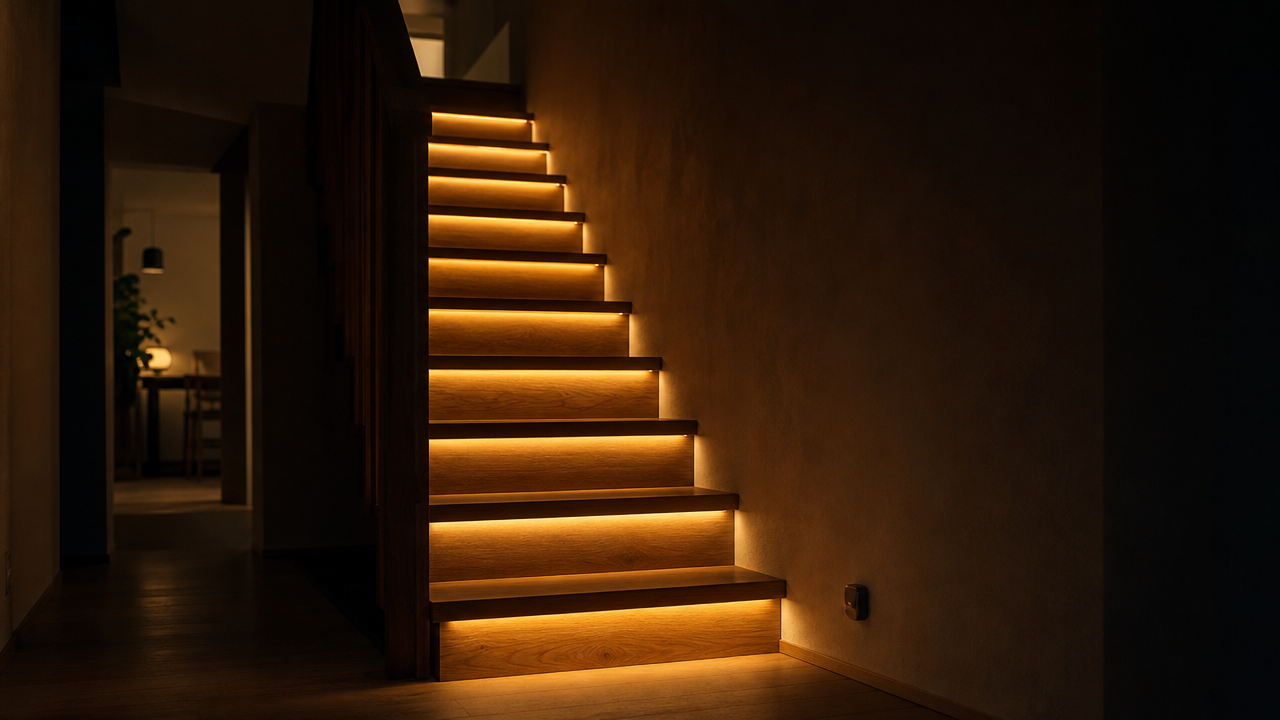
The stair case has its own brief beyond the trigger — which edge the tape lights, glare on the way down, and where a strip sits against the code-required fixture — covered in LED strip stair lighting.
A wardrobe is an enclosed box. The door spends its life shut, and while it is shut there is nothing for an infrared sensor to see. A switch on the carcass answers the question directly and costs less. Settle one detail before the order: where the switch sits on a soft-close hinge, because a door that closes slowly holds the light on for the whole travel.
Everything about the wardrobe itself — rod versus shelf-edge placement, colour rendering on dark cloth, the storage-space clearances — sits in LED strip lights in closet builds; this page stays on the trigger.
Glazed display cases are the trap. The instinct is to mount a sensor inside the case pointing out at the room, and it will not work, because a passive infrared unit reads long-wave infrared and an ordinary glass pane does not pass it. Put the sensor outside where it can see the aisle, or use a door switch on the access panel. The merchandising side sits in our notes on mood lighting across cozy home categories.
Stairs are where delay earns its money. The light has to outlast the slowest climb in the house, which is longer than the default on most modules. Mount the unit at the side of the flight so the climb crosses its pattern rather than running along it. One neighbouring job that is not this job: an ambient run behind a screen is an effects product rather than a sensing one, and the length-to-screen-size sizing sits in our guide to TV LED strip lights, built around an addressable strip.
Specify the trigger, not just the tape
LED strip lighting with motion sensor is a specification before it is a catalogue number. We build our strip and sensing kits on our own floor in Foshan, 4,000 square meters, 40 people, two production lines. On the motion kit, light tone, length and plug version are chosen per kit, and every version is triggered by the PIR sensor alone. Send the placements you are targeting and the market the adapter has to suit.
Watch it work
The walk test, the lens aim and the vent clearance, in 44 seconds:
FAQ
Do LED strip lights with a motion sensor need to be hardwired?
Usually not. Three supply formats reach the shelf and the pack tells you which you have: cells in the sensor housing, a low-voltage plug-in adapter, or bare leads meant for a driver behind the cabinet. Only the third calls for a trade visit.
How long do the batteries last in a battery-powered motion sensor strip?
There is no honest single figure, and a supplier who offers one has guessed. Runtime follows triggers per day, seconds of light per trigger, and how much strip the cells drive. Take the run current at your selling length, multiply by daily on-time, compare against cell capacity, then discount for cold.
Can one sensor control more than one cabinet run?
Yes, inside two limits. The adapter has to carry every metre hanging off it with headroom left. The second gets missed: one sensor means one decision, so every run switches together. Where two cabinets open at different moments, two sensors beat one sensor and a longer cable.
What is the difference between a PIR sensor and a microwave sensor?
A passive infrared unit receives only. A microwave unit transmits and reads what returns, so it detects through thin non-metallic panels and catches smaller movements. In furniture both are liabilities: it notices somebody behind a cabinet back, and constant transmitting rules out battery power.
Can a sensing strip be cut to length?
The strip usually can; the kit sometimes cannot. Confirm which end carries the module and the feed, because anything cut off downstream goes dark. Ask for the cut interval and the connector part number before the first sample.
Sources
Every external figure above was checked on 2026-09-05, and the time-delay definition on 2026-10-21: sensor behaviour from Crestron and the Lighting Controls Academy, control savings from the General Services Administration, source performance from the Department of Energy and ENERGY STAR, and temperature limits from the battery and adhesive makers.
- Crestron Electronics, Occupancy Sensor Placement and Technology Best Practices, DOC. 8239A (sensing elements, sensitivity limits, vents, 8 feet, 42 kHz, 12 feet), retrieved 2026-09-05.
- Lighting Controls Academy, a coalition of the National Electrical Manufacturers Association, A Deep Dive on Occupancy and Vacancy Sensors (time delay definition), retrieved 2026-10-21.
- U.S. General Services Administration, Advanced Lighting Controls and LED, GPG Findings 037, November 2018 (76,000 square feet, 43 percent), retrieved 2026-09-05.
- U.S. Department of Energy, LED Basics (cold performance, 70 percent life point, 150 lumens per watt), retrieved 2026-09-05.
- ENERGY STAR, U.S. EPA, Learn About LED Lighting (90 percent efficiency, 30 percent drop), retrieved 2026-09-05.
- Energizer, Alkaline Manganese Dioxide Handbook (−18 °C to 55 °C, −20 °C limit, capacity access), retrieved 2026-09-05.
- 3M, VHB Tapes Product Information Guide (21 °C to 38 °C, 10 °C and 15 °C minimums, −40 °C holding, bond build, 72 hours), retrieved 2026-09-05.
- UpCodes, Luminaires in Clothes Closets, International Residential Code E4003.12 (12 in. and 6 in. clearances), retrieved 2026-09-05.
