



Two quotations for under cabinet LED strip lighting can look identical on the cover page and still price out very differently. Nothing in the part number explains the gap. The answer sits in six fields: delivered light per foot, colour quality, form factor, electrical class, ingress protection, and the basis behind the hours claim. This is how a sourcing team reads those six before anyone argues about cost.
BeginLighting runs its own lamp production in Foshan and wholesales to US retailers, distributors and private-label brands. LED strip is a sourced category for us rather than a house line, which is exactly why we read strip specifications the way a buyer has to: line by line, against a published standard.
Key takeaways
- Delivered lumens per foot, not watts or LED count, is the first honest number. The ENERGY STAR floor here was 125 lumens per lineal foot, which is not a target.
- Efficacy for cove and under-cabinet luminaires had to reach only 50 lumens per watt, the lowest indoor bar in that programme.
- Colour is a pair, not a headline: Ra of at least 80 and R9 above zero.
- An hours figure is worthless without its LM-80 report, TM-21 projection, drive current and temperature.
- ENERGY STAR lighting certification sunset on 31 December 2024. Use the numbers as contract language, not a logo.
What under cabinet LED strip lighting must deliver at the counter
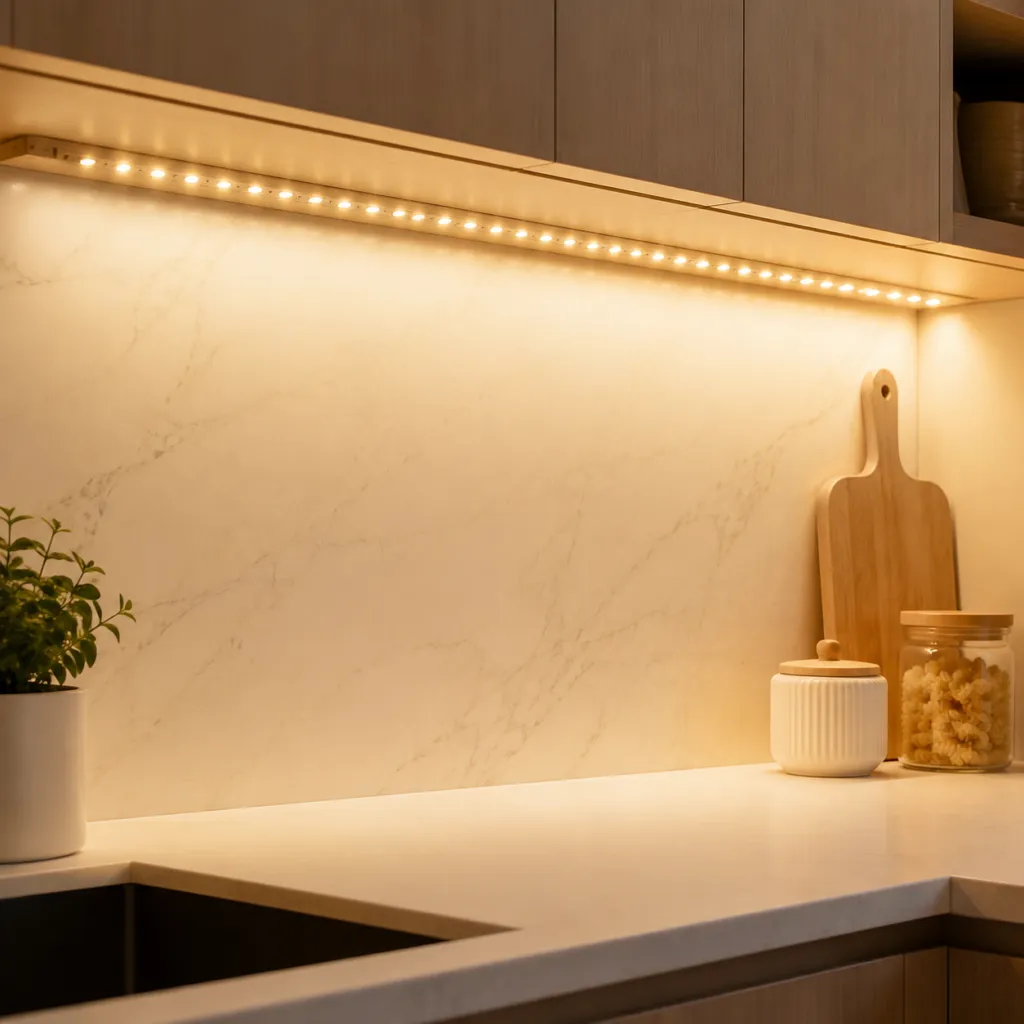
Start with the only output number that survives a real kitchen: delivered lumens per foot of run. Watts per metre flatters inefficient tape, and LEDs per metre says nothing about how much light leaves the diffuser. The one federal-programme benchmark written for this exact fixture class was blunt. Under the ENERGY STAR Program Requirements for Luminaires Version 2.2, a cove or under-cabinet luminaire had to deliver at least 125 lumens per lineal foot of measured luminaire length.
Two companion numbers matter as much and are almost never quoted. Luminaire efficacy for this class had to reach 50 lumens per watt, the lowest indoor floor in the whole set, as the chart further down shows. And the light had to go somewhere useful: at least 60 per cent of total lumens inside the zero to sixty degree zone, symmetric about the nadir. That clause separates a strip that lights a countertop from one that lights the underside of the wall units.
A product can clear every bar and still be too dim for food preparation, because a compliance floor is set where the worst acceptable product sits. The useful question is how far above it a supplier will be measured, on finished-luminaire photometry rather than a bare-tape datasheet.
To know how far above, work backwards from the surface. A guide compiled from the IES Lighting Handbook, tenth edition, by Energy Trust of Oregon and the Lighting Design Lab puts general retail ambient light at 50 foot-candles and retail perimeter zones at 75 average, ranging from 35 to 150. It also places accent lighting on displays at three to ten times ambient, the job an under-cabinet run performs on a merchandised shelf.
Source: Energy Trust of Oregon and Lighting Design Lab, Footcandle Light Guide (retrieved 2026-08-24)
Form factor: flexible tape versus a rigid light bar
Under-cabinet light reaches the counter through several product families, and this guide covers only two: flexible LED tape on a reel, and the rigid bar that is the same tape pre-fitted into a channel with a diffuser. Puck lights, hardwired linear fixtures and the question of which family suits which run are a separate decision, worked through in our under-cabinet LED lighting retail buyer primer. Settle the family there, then come back here.
Retail listings split the same hardware two ways. Shoppers look for an LED light bar for under cabinet mounting, and just as often for an LED light bar under cabinet shelving, and both usually describe one thing: an aluminium extrusion with tape, optic and wiring already terminated. That pre-assembly is the whole sourcing decision. A bar arrives as a finished luminaire of fixed length, photometered as a unit; tape arrives as a component someone else finishes on site.
The consequences run in opposite directions. Tape wins on assortment efficiency, since one reel spec covers many cabinet lengths. Bars win on returns: the two failure modes that dominate under-cabinet complaints, a botched cut and a peeling adhesive line, are designed out at the factory. What is always wrong is comparing a reel price against a bar price and calling the difference a saving.
Flexible tape on a reel
- One spec covers many cabinet lengths, fewer SKUs to forecast
- Channel, diffuser, driver and connectors specified separately
- Cut interval and solder pads become the customer problem
- Photometry quoted for bare tape, not the finished assembly
Rigid light bar
- Finished luminaire, one safety file, one photometry report
- Fixed lengths mean more SKUs and more dead stock risk
- Thermal path through the extrusion is designed, not improvised
- Installs with a screwdriver and a lead, no soldering
One practical point decides more returns than either spec sheet: mounting position. A strip at the front lip throws light onto the backsplash and into the user’s eyes; set too far back it leaves the counter front in shadow and reflects diodes off a polished worktop. Ask where the channel is designed to sit relative to the cabinet face. Our under-cabinet motion sensor LED strip kit and the wider smart LED light strip range are specified around that question first.
Colour: CCT, CRI Ra, R9 and binning
Colour is where LED strip lighting for kitchen cabinets earns or loses its reputation, and it is three numbers that suppliers collapse into one. First is correlated colour temperature. ANSI C78.377 turns a marketing word into a measurable target, covering the range from 2200K to 6500K and defining chromaticity tolerance as quadrangles equivalent to four-step or seven-step MacAdam ellipses. Ask which of the two the supplier quotes to: the seven-step version permits visible reel-to-reel variation that the four-step version does not.
Second and third are the colour rendering pair. The ENERGY STAR luminaires criteria required an indoor solid-state luminaire to meet or exceed Ra of 80 and R9 greater than zero. Ra averages eight pastel test colours and is easy to score well on; R9 is the deep red sample, and it decides whether raw meat, peppers, terracotta and warm timber look like themselves. A strip quoting Ra 80 with no R9 figure is quoting half an answer, and the missing half is what customers photograph.
How Ra 80, 90 and 95+ differ in practice, and how to check a supplier’s colour rendering claim before the order is placed, is covered in our guide to the color rendering index.
Consistency across production runs is what buyers forget until the second purchase order. Two reels made months apart to the same nominal CCT can sit in different corners of the same tolerance quadrangle and read as mismatched on one cabinet run. Put binning tolerance in the specification in MacAdam steps, require later runs to match the approved sample within the same step count, and keep a retained sample.
Pick the CCT by the room, not the catalogue: 2700K to 3000K flatters timber and warm paint, while 3500K to 4000K makes white surfaces read as clean. Whichever you choose, the US packaging obligation is fixed. The Federal Trade Commission Lighting Facts rule at 16 CFR 305.23 requires brightness in average initial lumens, energy used in average initial wattage, life in years based on three hours of operation per day, and light appearance as a colour temperature marker on a scale from 2,600 K to 6,600 K.
Electrical: voltage, drivers, Class 2 and cut points
Almost all under-cabinet tape runs on low-voltage direct current from an external driver, which places it under UL 2108, the standard for low voltage lighting systems under National Electrical Code Article 411. UL Solutions published revisions on 6 December 2019 that took effect on 6 December 2021, and two speak directly to strip: field-cuttable Class 2 luminaires, which UL describes as typically LED flexible circuit boards, now require certain markings repeated at intervals along the product, and installation instructions are required for all luminaires.
The driver is the component most likely to end the product life and is almost always quoted as an afterthought. Headroom first: a supply sized exactly to connected load runs hot for its whole service life and fails early, so state the margin you expect. Power factor second, because the same ENERGY STAR criteria set a floor of 0.7. Location rating third, since a driver above a hob lives in a different thermal and grease environment from one in a joinery void, and wet-location power units addressed in the UL 2108 revision must be marked double insulated.
Then the run length question, which is really a voltage question. A low-voltage strip is a long resistive conductor, so the far end sits below the feed voltage, and past a certain length that shows as visible dimming and a warm colour shift at the end of the counter. Higher-voltage architectures tolerate longer runs at the same power. Never accept a maximum run length as a bare number: ask for it at your output, your ambient temperature, and with the power injection points it assumes.
Cut interval is the last electrical line and the cheapest to get wrong, because installers shorten runs on site and the distance between solder pads decides how much of every reel becomes offcut. Get it in writing with the connector system: solderless connectors that loosen in a warm cabinet are a leading cause of intermittent flicker.

Ingress protection under a kitchen cabinet
Ingress protection is graded by the IP code from IEC 60529: the first digit covers solids and dust, the second water, with accredited test laboratories such as Intertek publishing the tier definitions. Suppliers present the code as a quality tier, so buyers over-specify and pay for sealing that does nothing, or under-specify and absorb returns. Under a cabinet the right answer is modest: the hazard is splash and cleaning product, not immersion.
Two traps are worth stating plainly. The top of the scale is not one fixed test: the depth and duration behind an IP68 claim are set by the manufacturer, not by the code, so get them in writing. And an IP code says nothing about ultraviolet stability, chemical resistance or heat dissipation, while the potting that achieves a high rating traps heat against the diodes. The rating applies to the tape as tested, not to connectors or the driver.
| Rating | What the code covers | Typical construction | Where it belongs in a kitchen |
|---|---|---|---|
| IP20 | No water protection | Bare flexible circuit in a channel | Dry cabinet interiors, away from the sink |
| IP65 | Dust tight, resists water jets | Silicone coating or sleeve | Default for counters and anything wiped daily |
| IP67 | Withstands temporary immersion | Silicone tube with sealed ends | Splash zones, wash-down areas, covered exterior |
| IP68 | Continuous immersion, declared conditions | Fully potted extrusion | Almost never under a cabinet |
Lifetime, warranty and what the hours promise
A lifetime figure on a strip datasheet is usually a round marketing number with no method attached. A credible claim has three parts. The L value sets the threshold, so L70 is where output has fallen to seventy per cent of initial and L80 to eighty. The basis should trace to LM-80 lumen maintenance testing of the LED package projected forward under TM-21, and the ENERGY STAR criteria required measurement points from zero through 6,000 hours at the corresponding drive current. The third is the operating condition behind it.
Against that method the benchmarks are modest: an L70 rated lumen maintenance life of at least 25,000 hours indoors, 35,000 outdoors and 50,000 for inseparable luminaires. Modern packages beat that comfortably. A March 2020 study prepared for the U.S. Department of Energy analysed 223 separate LM-80 data sets from tier one manufacturers, 84 per cent from testing completed in 2018 and 2019, and found 96 per cent of the calculated TM-21 decay constants corresponded to an L70 near 60,000 hours.
The same work points at what does limit the product. Colour shift is tracked as its own parametric failure, with thresholds at chromaticity shift magnitudes of 0.004 and 0.007, so a strip can pass its lumen target while drifting far enough off its colour point to look wrong beside a newer reel. Alongside sit the mundane failures: the driver, a connector, a solder joint, or adhesive letting go in a warm cabinet. Ask what the driver is rated for separately, and what the warranty pays when the tape survives but the supply does not.
The published warranty benchmark makes useful contract language. ENERGY STAR required a written warranty in the packaging of at least three years where the driver is replaceable, extended to five years where it is not, and made the partner, not the showroom or retailer, solely responsible for honouring it. Import that structure into your supply agreement and the argument about who handles a field claim disappears.
Source: U.S. EPA, ENERGY STAR Luminaires Version 2.2, section 9.2 (retrieved 2026-08-24)
Two limitations belong on the record, because both cut against the easy version of this article. The benchmark itself is retired: EPA announced final ENERGY STAR lighting sunset plans on 13 March 2023, effective 31 December 2024, so the mark is no longer a shortcut for new lighting products. The numbers still work, but as contract language rather than a logo on a carton. A supplier offering an ENERGY STAR claim on a new strip product today is a reason to slow down, not speed up.
The second limitation is about us. LED strip is a sourced category for BeginLighting rather than a house production line, so on strip we can offer component-level documentation and QC discipline, but not the floor-level traceability we offer on the lamp categories we build ourselves. Apply the same test to any supplier: ask whether the person quoting owns the process behind the number, and treat a confident answer with no document as a missing document.
Choosing the best LED strip for under cabinet lighting
Choosing the best LED strip for under cabinet lighting is not a hunt for the highest number in every field. It is a matching exercise between four decisions that constrain each other: the illuminance the surface needs, the colour quality the merchandise demands, the ingress rating the zone justifies, and the control tier the customer will actually use. Push any one past what the application needs and the other three get more expensive without getting better.
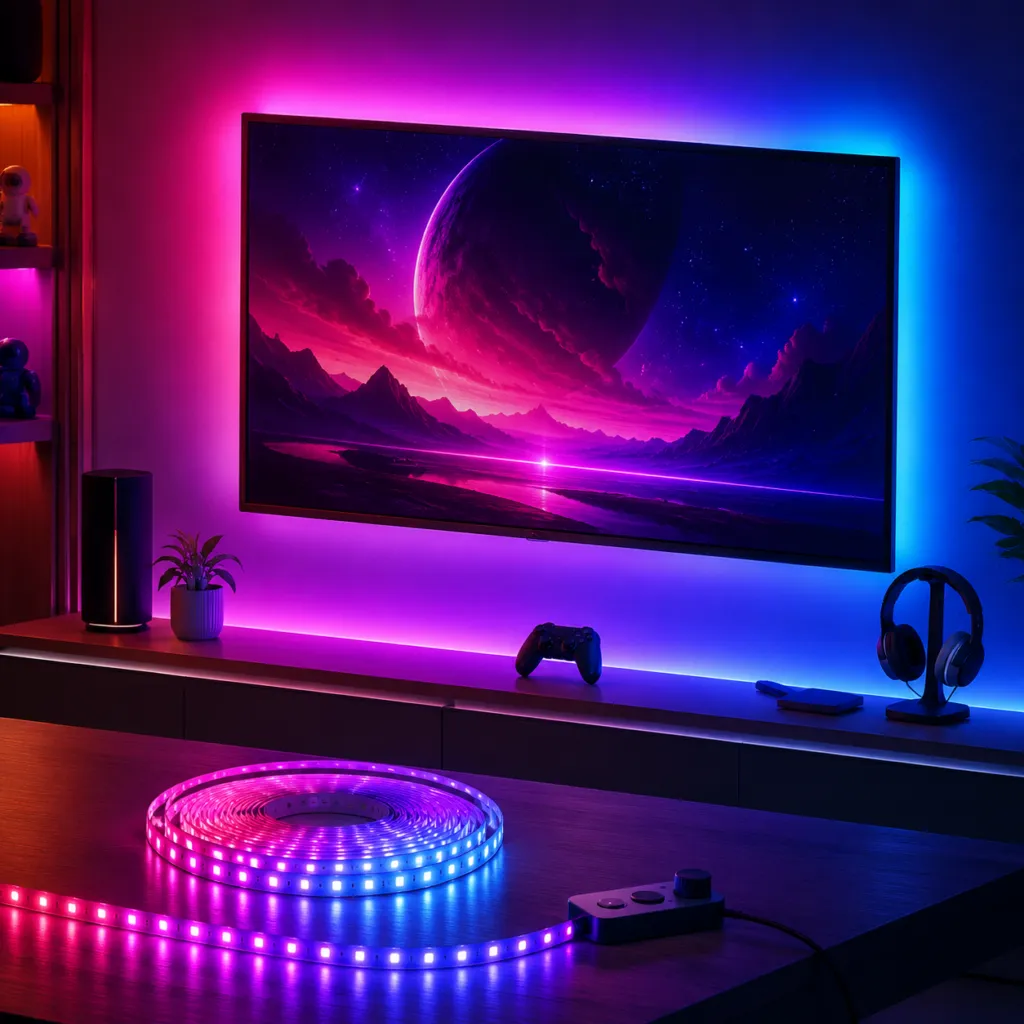
Control tier is where over-specification is commonest. Single colour and tunable white behave as one lamp, with almost no software surface to fail. Addressable tape gives every pixel its own driver chip and needs a controller, an app and firmware, and in warranty data that software layer, not the diodes, produces the angry reviews. Under a kitchen cabinet the extra tier adds a pairing step that can fail and nothing that sells. Keep it for entertainment lines, and browse the wider BeginLighting product range if the assortment needs both.
Turn that into the request for quotation by stating the performance you require and the evidence you will accept in the same line, and saying plainly that a blank field scores as not met. Ask for delivered lumens per foot at your CCT and CRI on the finished assembly; efficacy in lumens per watt; Ra and R9 with the CCT tolerance in MacAdam steps; the LM-80 report, TM-21 projection and the current and temperature behind them; the driver as a separate line with rated life, power factor and location rating; cut interval, connector system and maximum run length; and warranty terms naming who honours a field claim.
Request every document in your own company name, tied to your own product code, and check that any certificate scope matches the exact SKU you are buying, not a sibling model. Republished certificate numbers belonging to a neighbouring product are the commonest paperwork theatre in this category, easy to check and expensive to miss.
Send the spec, not just the part number
Give us the six fields up front: delivered lumens per foot, the colour pair, form factor, electrical class, ingress rating with its conditions, and the lifetime basis you expect documented. We will return a matched wholesale offer with the documentation package behind it.
Frequently asked questions
How many lumens per foot does under cabinet LED strip lighting need?
Work backwards from the surface, not from a catalogue figure. The ENERGY STAR floor for cove and under-cabinet luminaires was 125 lumens per lineal foot, a compliance minimum rather than a task-lighting target. Food preparation and retail display surfaces sit far higher on the IES scale, so specify the foot-candle level the counter must reach.
Is an LED light bar better than tape under a cabinet?
It depends who finishes the product. A rigid bar ships as a complete luminaire with one photometry report and one safety file, removing the two commonest field failures: a bad cut and a peeling adhesive line. Tape covers more lengths from fewer SKUs but pushes channel and driver decisions downstream.
What CRI should I specify for LED strip lighting for kitchen cabinets?
Specify the pair, not the headline. ENERGY STAR indoor criteria required Ra of at least 80 together with R9 greater than zero, and R9 is the deep red sample that decides whether meat, peppers and warm timber look right. For food display, ask for a higher Ra with R9 still stated.
Do I need a waterproof rating under a kitchen cabinet?
IP65 is the sensible default, because the real hazard is splash and daily wiping rather than immersion, and IP20 is fine for dry cabinet interiors away from the sink. IP68 covers immersion only under conditions the manufacturer declares, and its potting traps heat and blocks on-site cutting.
How long should an under-cabinet strip last, and what does the hours figure mean?
The number is meaningless without its method. Ask for the L70 or L80 value, the LM-80 test data, the TM-21 projection, and the drive current and temperature behind it. Department of Energy analysis of 223 LM-80 data sets found 96 per cent projecting an L70 near 60,000 hours.
- U.S. Environmental Protection Agency, ENERGY STAR – “Program Requirements for Luminaires, Version 2.2”. https://www.energystar.gov/sites/default/files/Luminaires%20V2.2%20Final%20Specification_0.pdf (retrieved 2026-08-24)
- U.S. Environmental Protection Agency, ENERGY STAR – “Light Fixtures for Partners”. https://www.energystar.gov/products/light_fixtures/partners (retrieved 2026-08-24)
- U.S. Environmental Protection Agency, ENERGY STAR – “Downlights Key Product Criteria”. https://www.energystar.gov/products/light_fixtures/downlights-key-product-criteria (retrieved 2026-08-24)
- U.S. Department of Energy – “Lumen and Chromaticity Maintenance Behavior of Light-Emitting Diode Packages Based on LM-80 Data”, March 2020. https://www.energy.gov/sites/prod/files/2020/03/f73/rti_lm-80-white-leds_mar2020.pdf (retrieved 2026-08-24)
- Legal Information Institute, Cornell Law School – “16 CFR 305.23, Labeling for lighting products”. https://www.law.cornell.edu/cfr/text/16/305.23 (retrieved 2026-08-24)
- UL Solutions – “Opportunities and Impacts of Revisions to UL 2108”. https://www.ul.com/news/opportunities-and-impacts-revisions-ul-2108-standard-low-voltage-lighting-systems (retrieved 2026-08-24)
- Energy Trust of Oregon and Lighting Design Lab – “Footcandle Light Guide”, from the IES Lighting Handbook tenth edition. https://www.lightingdesignlab.com/sites/default/files/pdf/Footcandle_Lighting%20Guide_Rev.072013.pdf (retrieved 2026-08-24)
- Buildings magazine – “ANSI continues advancements on SSL chromaticity standard”. https://www.buildings.com/building-systems-om/lighting/article/55254903/ansi-continues-advancements-on-ssl-chromaticity-standard-magazine (retrieved 2026-08-24)
- Illuminating Engineering Society – “Standards Toolbox”. https://www.ies.org/standards/standards-toolbox/ (retrieved 2026-08-24)
- Intertek – “Ingress Protection Testing per IEC 60529”. https://www.intertek.com/lighting/performance/ingress-protection/ (retrieved 2026-08-24)
