



TV LED strip lights are bought as a decorative product and returned as a technical one. The listing photograph shows an even wash of light on the wall behind a big panel. The parcel that comes back three weeks later holds a strip that finished 40 cm short of the last corner, a length that lifted off the housing on the second warm evening, and a top edge visibly greener than the bottom one. This guide is for the person placing the factory order: a private-label seller, or a buyer adding a low-ticket attachment to a TV-mount line.
Two neighbouring questions are out of scope. Voltage drop along a 5 V run and the addressable chip families behind RGBIC are answered in our LED strip spec decoder, and where a run may be cut is in where LED strip can and cannot be cut. Sensor-triggered strip for cabinets is a separate buy, handled in LED strip lighting with a motion sensor.
Key takeaways
A TV backlight is bias lighting, not room lighting. Size it from the panel geometry rather than the size band on the box, budget the USB port honestly, specify one LED bin per order, and put the surface prep in the carton.
- A 16:9 panel is 0.872 times its diagonal wide and 0.490 times tall, so the four-sided run is 2.72 times the diagonal: 3.80 m on a 55-inch, 4.50 m on a 65-inch, 5.19 m on a 75-inch.
- The reference viewing environment puts the background near 10% of peak picture luminance, at D65, in a 10 lux room (ITU-R BT.2035). Brighter is not better here.
- A USB host port supplies 2.5 W at the 2.0 default and 4.5 W at the 3.x default, well under 1 W per metre on a four-sided 65-inch run.
- Most LEDs are binned at 4 to 7 steps, and at 3000 K a gap over 60 K is likely to show (Photometric Testing). A reel spliced from two bins is a two-tone reel.
- 3M puts its tape at about 50% of ultimate bond strength after 20 minutes and 100% after 72 hours. Customers judge it in the first ten.
What Is a TV Backlight Actually For?
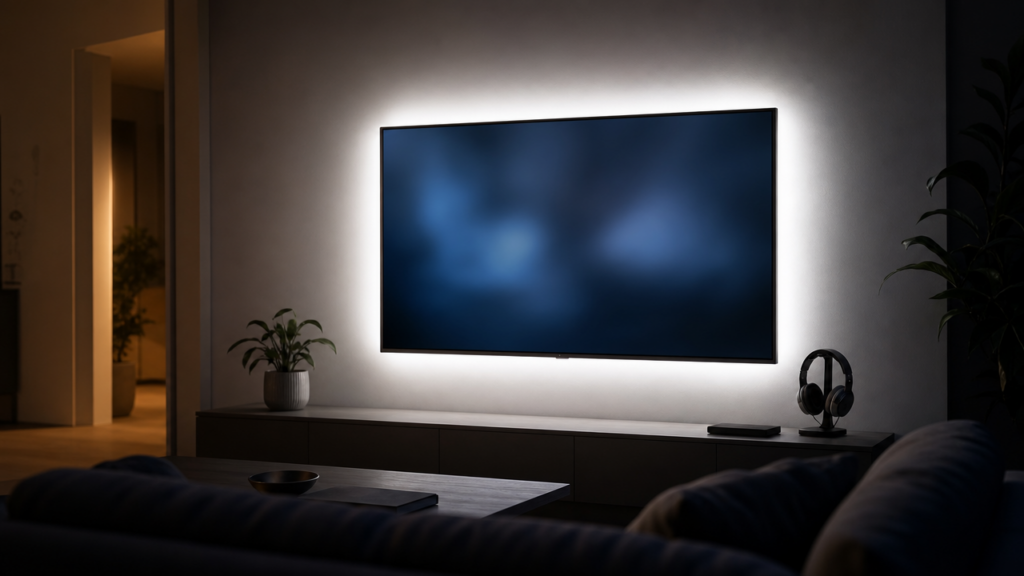
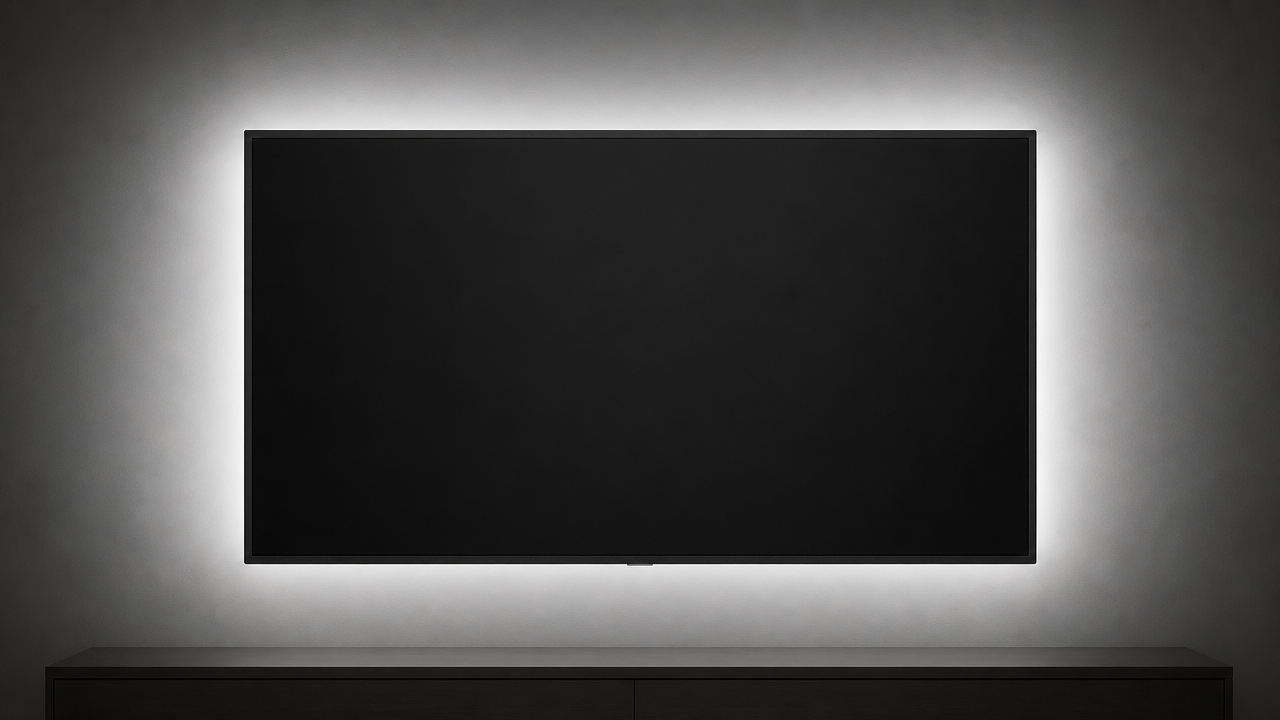
The job is bias lighting: a low, neutral wash on the wall behind the panel so the eye is not holding a bright rectangle in a dark room. That is a far smaller job than lighting the room, which is why these products can run off a USB port at all.
In 2013 the International Telecommunication Union published its reference viewing environment for evaluating HDTV material, and the numbers in it describe this product exactly. Room illumination of 10 lux. Background chromaticity at D65. A ratio of the luminance of the background behind the picture monitor to the peak luminance of the picture of approximately 10% ±2% of the reference white value (ITU-R BT.2035). With reference white set in the same document at 100 cd/m², the wall behind the screen should sit near 10 cd/m², and every other surface in the room is asked to be dark and matte.
Read that as a product brief and three things fall out. A modest power budget is a fit rather than a compromise. A kit whose out-of-box preset is saturated purple is shipping the wrong default. And the cheapest white backing tape is a false economy once the strip sits close to a wall. None of that stops a buyer selling colour: most people who buy led strip lights for tv use want the scene modes. The neutral setting is simply the one the product gets judged on when somebody sits down to watch a film.
Led Strip Lighting Behind TV: From Screen Diagonal to Metres of Tape
Led strip lighting behind tv panels is sized by geometry, and the geometry is short enough to do in your head. A 16:9 rectangle is 0.872 times its diagonal wide and 0.490 times its diagonal tall, so the four-sided perimeter is 2.72 times the diagonal.
Run that on the sizes that sell and the answers are 3.80 m around a 55-inch panel, 4.50 m around a 65-inch and 5.19 m around a 75-inch. Now compare them with the way the category is merchandised. Reels are commonly cut at 3.8 m and 4.6 m, and the box is labelled with a band rather than a size: 55 to 65 inch, 65 to 75 inch. A 3.8 m reel is an exact fit for the bottom of its band and 0.7 m short at the top of it. That mismatch is the most avoidable return in the category, and it is baked in before anyone touches the adhesive.
The correction a factory owes a buyer is that the raw perimeter overstates the requirement. The tape sits inboard on the rear housing, and every inch of inset shortens all four sides. On a 65-inch panel you need roughly three and a half inches of inset on every edge before a 3.8 m reel closes the loop, and most housings have no flat unbroken band that far in. The other lever is the bottom edge: skipping it takes a 65-inch set down to 3.06 m, and that edge is usually hidden by a stand and spilling onto the console. Decide the layout, then buy the reel for it.
Source: computed from the 16:9 HDTV geometry in ITU-R BT.2035, retrieved 2026-09-05
| Screen size | Panel width × height | Four-sided run | Three-sided run | Where a 3.8 m reel lands |
|---|---|---|---|---|
| 43-inch | 95 × 54 cm | 2.97 m | 2.02 m | 0.84 m spare |
| 50-inch | 111 × 62 cm | 3.46 m | 2.35 m | 0.35 m spare |
| 55-inch | 122 × 68 cm | 3.80 m | 2.59 m | Exact, no corner slack |
| 65-inch | 144 × 81 cm | 4.50 m | 3.06 m | 0.69 m short of four |
| 75-inch | 166 × 93 cm | 5.19 m | 3.53 m | 1.38 m short of four |
| 85-inch | 188 × 106 cm | 5.88 m | 4.00 m | Short of three too |
How Much Can a USB Port Actually Power?
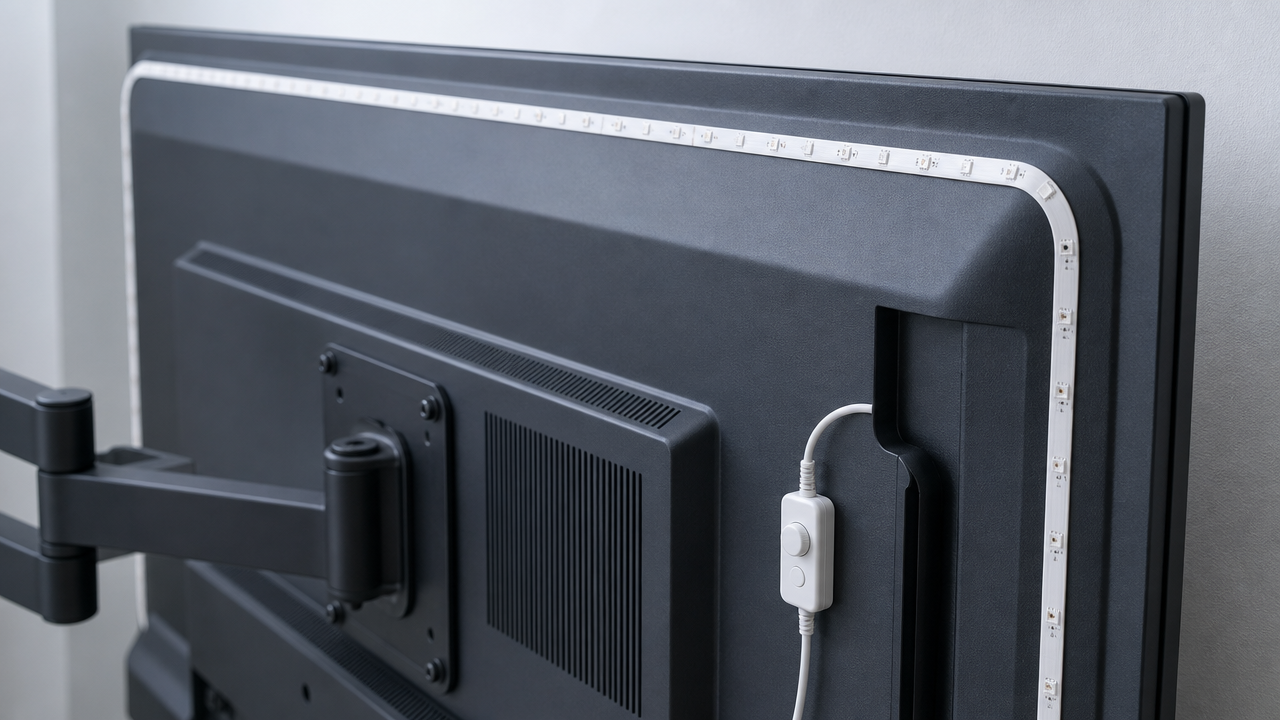
The power budget is set by the port, not by the kit. Under the USB standards a host port supplies 5 V at 500 mA, giving 2.5 W at the 2.0 default, rising to 900 mA and 4.5 W at the 3.x default (USB power standards, summarised by Cambrionix). Whatever a listing claims, that is the ceiling.
Spread it over a run and the arithmetic gets blunt. A 2.5 W budget across a 3.8 m reel is 0.66 W per metre; across a four-sided 75-inch run of 5.19 m it is 0.48 W per metre. For scale, the U.S. Department of Energy’s 2021 consumer guide puts a 1,100-lumen replacement for a 75-watt incandescent at as little as nine watts of LED (U.S. DOE), and ENERGY STAR rates LED products up to 90% more efficient than incandescent (ENERGY STAR). Even against that, a whole TV backlight runs on about a quarter of one modern bulb.
This is where a factory has an incentive to be vague, so here is the unhelpful version. A USB-powered kit cannot be a room light, and no amount of density or binning changes that. If the listing promises a party wall or a gaming-room wash, the honest answer is a mains adapter, a higher voltage and a different bill of materials, which costs more and adds a plug type per destination market. Sized against the roughly 10% surround target above, though, the small budget is the right budget, and a kit honest about being bias lighting beats one that oversells and then gets measured against the promise.
Why Does the Strip Come Off the Back of the Panel?
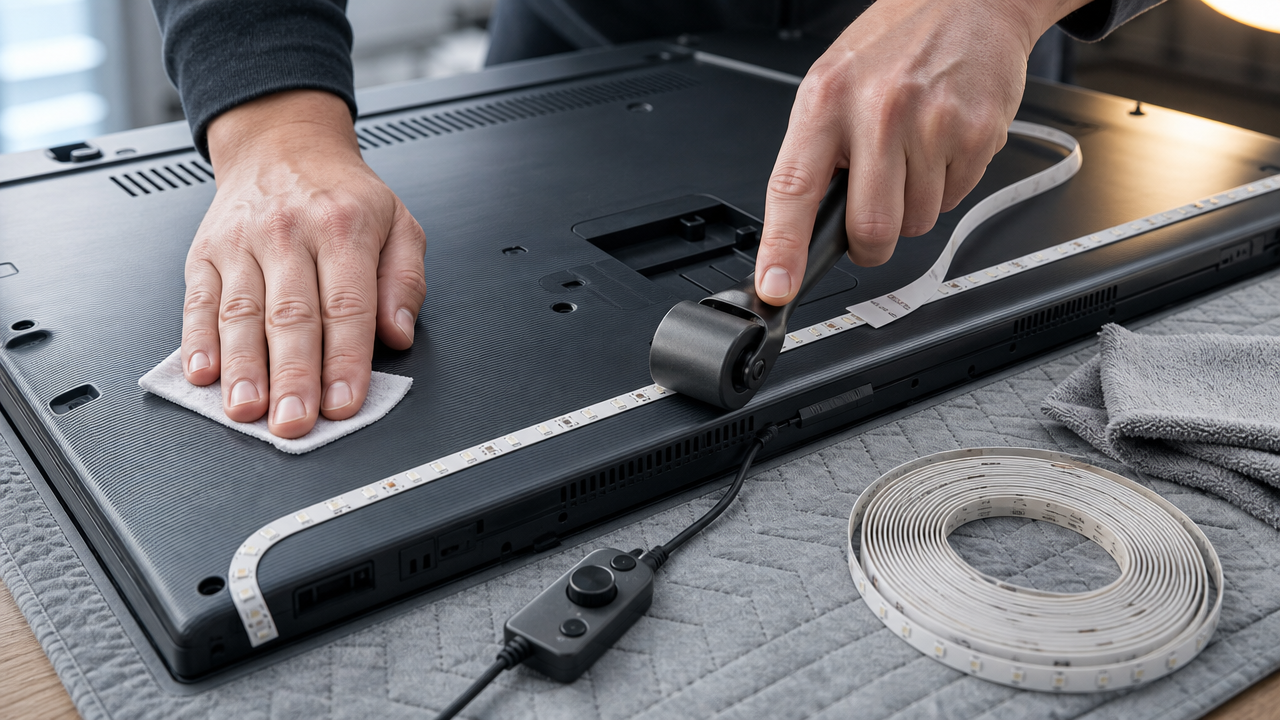
Most reports that read as adhesive failure are preparation failures, and the company that makes the tape says so in plain numbers. 3M’s technical bulletin for its VHB tapes asks for the substrate to be cleaned with a 50:50 mixture of isopropyl alcohol and water, the tape applied with at least 15 psi (100 kPa) of roll-down pressure, and roughly 50% of ultimate bond strength at 20 minutes, 90% at 24 hours and 100% at 72 hours at room temperature (3M).
Put that against how the product is used. A customer unboxes at nine in the evening, wipes nothing, presses with a fingertip rather than a roller, and has formed an opinion by half past nine. At twenty minutes the bond is at half strength on a surface that may still carry mould release. The fix belongs in the carton: an alcohol prep pad, a card that says press hard along the whole run, and one sentence about leaving it alone overnight. A prep pad buys down a return for the price of a sachet.
The wider question — which adhesive grade suits which wall, when to add clips as a mechanical backup, and how to buy replacement tape — is covered in LED strip lights with double sided tape, clips and adhesive.
Two surface facts decide the rest. The back of a panel runs warm and is usually a low surface energy plastic with ribs, vents and recesses, so the flat band available for tape is narrower than it looks and a strip routed over a rib is a strip with a lever on it. And the backing matters optically too: the reference viewing document above asks for dark matte surfaces around the picture, and a glossy white carrier behind the diodes throws a reflected line onto the wall. Where geometry needs more help than tape can give, the profile options are in our guide to the LED channel for strip lights.
Colour Shift and Light Leak: the Two Faults Seen First
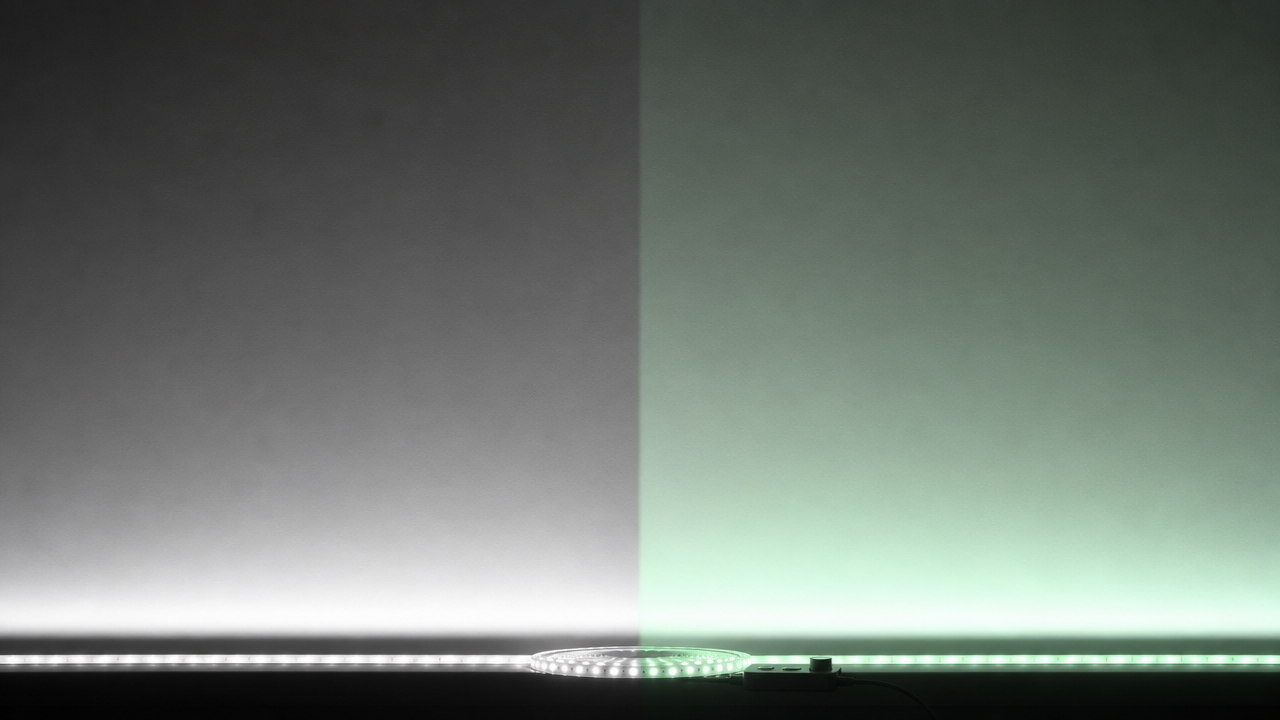
A strip is a row of several hundred separate emitters, so colour consistency is a purchasing decision made at the reel, not a quality problem discovered at the wall.
The vocabulary is worth learning because it is what a factory answers to. Colour spread is measured in steps of MacAdam ellipses, also written as SDCM. A 1-step ellipse defines a zone within which the eye cannot tell two sources apart, most LEDs are binned at the 4 to 7 step level, and the nominal colour temperature quadrangle in the ANSI C78.377 chromaticity standard is itself a 7-step ellipse (Photometric Testing). The same reference gives the practical threshold: at 3000 K, two sources more than 60 K apart will probably look different side by side. On a TV backlight those two halves are 30 cm apart on one wall, the least forgiving arrangement there is.
So the purchase order needs two lines and one honest limit. Ask for a single bin across the production order, and state the step tolerance you accept. Ask that a reel is not spliced from two bins to make up length, because a splice puts the transition in the middle of a visible run. The limit is that tighter binning is a real cost and much of this market runs at four steps: better to specify four and hold it than to write two into a document nobody intends to honour.
Light leak is geometry rather than chemistry. Too far outboard and the emitters show from an off-axis seat as a bright rim; too close to the wall and you get a hard line instead of a wash. The remedies are inset, a diffused emitter face, and a spacing rule printed on the card.
What Ships in a TV LED Light Strip Kit?
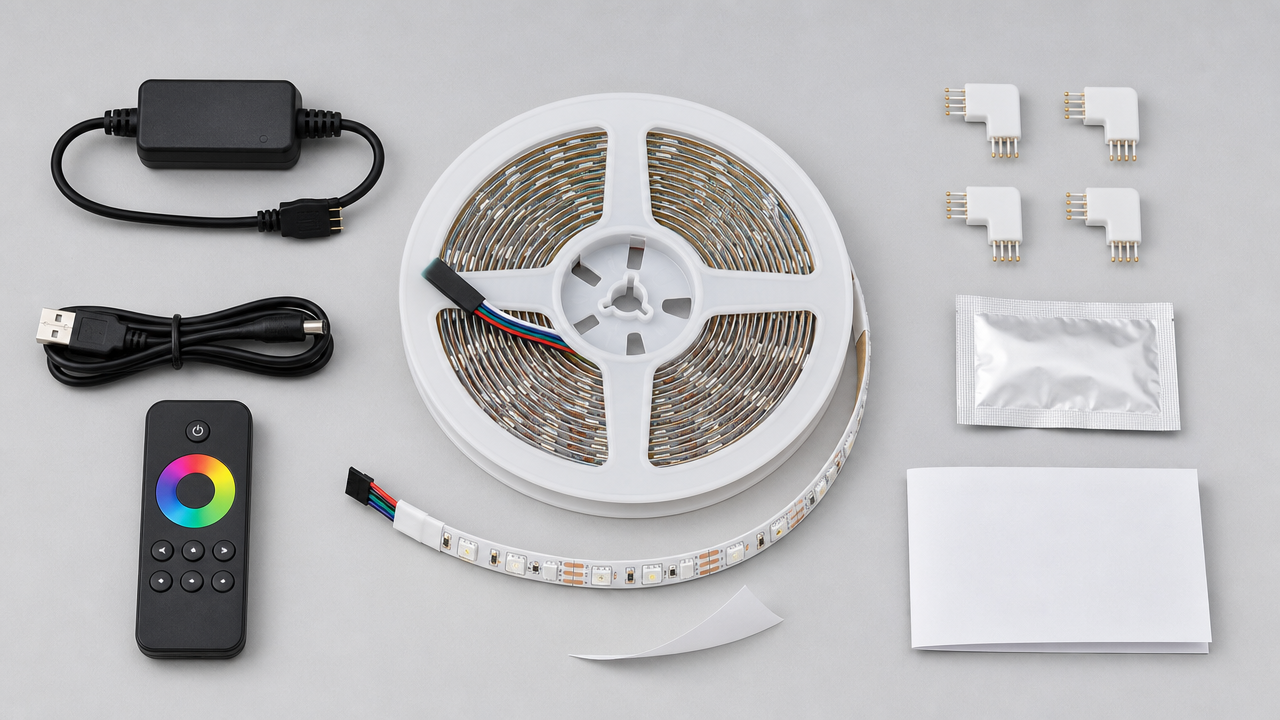
A tv led light strip kit should ship with the strip cut and terminated to your run, an inline controller, a USB-A lead of a stated length, corner pieces for the turns, spare adhesive, an alcohol prep pad and a card with the layout diagram. Every part somebody has to source separately at nine in the evening becomes a message to your support address.
The four cut first when a price target is missed are the prep pad, the corner pieces, the spare adhesive and the diagram, which are exactly the four that keep the product on the wall. Lead length is worth arguing about too: a cable that reaches a side-mounted socket does not reach a downward-facing one, and a remote belongs in the box only if the control tier includes one.
Seasonal buyers assemble a different kit list; the indoor, outdoor and extension groupings for a December shelf are laid out in LED strip lighting Christmas kits: a Q4 restock guide.
The commercial case sits in the returns arithmetic. In 2025 the National Retail Federation put total US retail returns at $849.9 billion, 15.8% of annual sales, and estimated 19.3% of online sales would be sent back (NRF). A low-ticket accessory does not absorb that on margin; it survives by not coming back, which makes carton contents a returns-control decision rather than a cost line. We build strip in Foshan rather than buying it in, so the bill of materials is negotiable. The RGBIC music-sync LED strip is the 5 m addressable format most of these kits are cut from, the app-controlled smart LED strip is the plainer specification, and both sit in our LED strip line.
Remote, App or Music: Pricing an Ambient Lighting TV LED Strip Kit
An ambient lighting tv led strip kit is priced by how it is controlled, and every tier adds a cost after the sale as well as before it.
A remote adds a receiver, a battery and an object customers lose. An app adds a radio module, a firmware image and a listing in two app stores that somebody keeps alive for the commercial life of the SKU, which is the part buyers underestimate: the module is cheap and the maintenance is not. Music sync adds a microphone or line input plus a behaviour that has to be tuned, because a strip reacting to every footstep reads as broken.
There is a technical reason to test the music tier hardest. LEDs have very little thermal or phosphor persistence, so they follow whatever current the driver sends almost instantly, and temporal light modulation can stay visible even at 1000, 2000 or 6000 Hz where there is relative movement between the eye and the source (U.S. DOE). Music sync is deliberate modulation beside a screen people photograph. Run the sample at the bottom of its dimming range, film ten seconds on a phone, and look for banding before signing it off.
| Control tier | Added to the bill of materials | Added after the sale | Where it belongs |
|---|---|---|---|
| Inline switch only | Nothing beyond strip and lead | Almost no support load | Fixed-white bias lighting |
| Infrared or RF remote | Receiver, coin cell, handset | Lost handsets, pairing questions | Price-led listings, gift boxes |
| App control | Radio module, firmware, two store listings | App maintenance for the life of the SKU | Smart-home ranges with support |
| Music sync | Microphone or line input, tuned response | Sensitivity complaints, banding in phone video | Gaming and youth listings |
| Per-segment colour | Addressable strip and controller | Higher expectations of colour uniformity | Premium tier, tight reel binning |
What Should You Check on the First Sample?
Everything above collapses into one evaluation you can run in an evening, on the screen size the SKU sells against, in the dark.
Do not judge a backlight on a workbench. The product is used from two to three metres away, lights off, against a wall the buyer did not choose. A sample that looks even at arm’s length can show a scalloped edge from a sofa, and a colour difference invisible under office lighting is the first thing anybody notices in a dark room.
Measure the chassis, not the box
Tape the rear housing of the set you sell against, inset and all, and write that run on the drawing with a corner allowance.
Fix the power path first
Port or adapter, decided before anything else, because it sets the voltage, the length limit and the plug types per market.
Choose three sides or four
Then specify how a corner is made: folded turn, moulded piece or soldered joint. Leaving that to the line is how two batches arrive different.
Put the colour tolerance in writing
One bin per production order, a stated step tolerance, no splicing to make up length. Ask for three reels from one batch at sample stage.
Prep, press and wait
Alcohol wipe, firm roll-down along the whole run, overnight before judging. Note whether the carton contains what that takes.
Film it in the dark
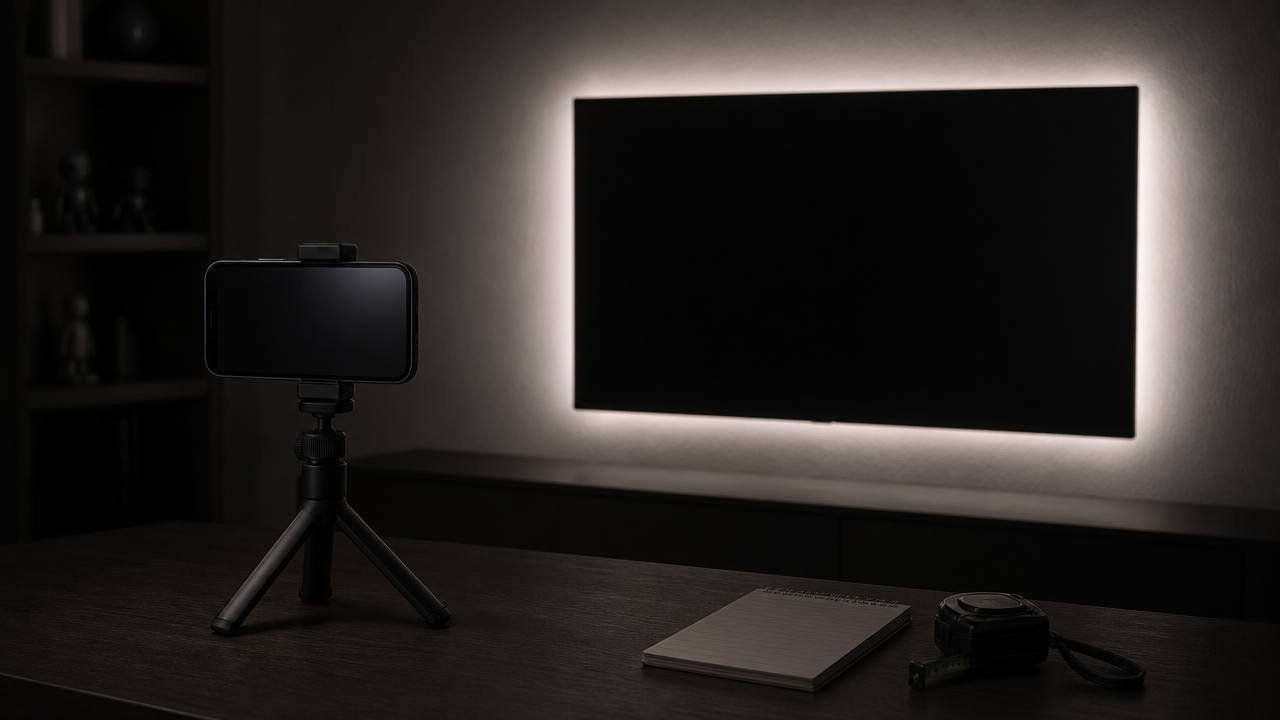
Screen off, lights off, phone on a tripod at the seating position. Look for banding, a hot line at the top edge, a colour split between legs.
One habit carries the rest: ask the factory what it will not do. A supplier who says a 3.8 m reel does not go four ways round a 65-inch panel is telling you something useful before the freight is booked rather than after the reviews land.
Have the kit built to your layout
We make LED strip in our own factory in Foshan, 4,000 square metres with 40 people across two production lines, so run length, bin, corner treatment and carton contents are specification lines rather than take it or leave it. Send the screen sizes you sell against, the power path and the control tier, and we will quote the kit.
Watch it work
The tear-down, the run measured off the panel and the switch-on, in 16 seconds:
FAQ
Do TV LED strip lights work on a curved TV?
They do, but the corners decide it. A curved panel bends across its width, so the top and bottom runs sit on a gentle arc while the side runs stay flat. Pressure-sensitive tape holds a single-axis curve as long as it is pressed down progressively from one end rather than laid on and smoothed afterwards, which traps the strip in tension. The failures show at the corners, where the tape is asked to bend two ways at once. For curved-panel SKUs, specify moulded corner pieces or a short flying lead between legs, and say so on the card.
Can a TV LED light strip kit run from the television’s USB port on every set?
No, and the two failure modes differ. Some sets have no spare port left once a streaming stick or a drive is plugged in. More often the port exists but drops out in standby, so the lights die with the picture and come back with it, which is fine if the customer expects it and reads as a fault if they do not. The rating is printed beside the socket, so the card should tell people to look. Check the lead length against a downward-facing socket too, which is what a wall-mounted set usually presents.
Should a tv led light strip kit ship with a mains adapter or only a USB lead?
It depends which promise the listing makes. A USB lead keeps the box light, avoids plug variants per destination market and matches what bias lighting needs. An adapter raises the available power and lets the same strip serve a longer run or a brighter mode, at the cost of a plug type for every market, a heavier carton and a second cable to route. The unhappy middle is a kit sold on brightness with a USB lead in the box.
What colour should a TV backlight be set to for watching films?
Neutral, and closer to daylight white than to warm. The reference viewing environment for evaluating HDTV material specifies a background at D65 chromaticity, roughly 6500 K (ITU-R BT.2035), because a tinted surround shifts how the eye reads colour on the screen beside it. For a product team the instruction is about defaults: ship with the neutral preset selected and the colour scenes one step in. Customers who want purple will find it, and everyone else gets the right setting without reading anything.
Can a led strip light kit for tv be cut down to fit a smaller screen?
Usually yes at the marked cut points, with two consequences specific to kits. The offcut is dead length you have paid for, which matters when one SKU covers several size bands. And where the controller sits inline near one end, cutting from the wrong end leaves the controller in the wrong corner with the lead pointing away from the socket. Mark the intended cut end on the strip itself, not only on the card. Where cut points fall and how to rejoin a run is covered in our piece on cutting LED strip.
Sources
Every external figure above was checked on 2026-09-05: viewing conditions from the ITU, power limits from the USB standards, adhesive behaviour from the tape manufacturer, colour tolerance from photometric testing, returns from the NRF, efficiency from the U.S. Department of Energy and ENERGY STAR.
- International Telecommunication Union, Recommendation ITU-R BT.2035, A reference viewing environment for evaluation of HDTV programme material (10 lux room, D65 background, background luminance at about 10% ±2% of reference white, reference white at 100 cd/m², dark matte room surfaces, 16:9 image system), retrieved 2026-09-05.
- Cambrionix, Understanding USB Power Standards (USB 2.0 hosts providing up to 2.5 W, USB 3.x hosts up to 4.5 W), retrieved 2026-09-05.
- 3M, Surface Preparation for 3M VHB Tape Applications (50:50 isopropyl alcohol and water, at least 15 psi / 100 kPa roll-down pressure, 50% of ultimate bond strength at 20 minutes, 90% at 24 hours, 100% at 72 hours), retrieved 2026-09-05.
- Photometric Testing, LED Colour Difference Metrics: SDCM and MacAdam Ellipses (1-step ellipse indistinguishable to the eye, most LEDs binned at 4 to 7 steps, ANSI C78.377 nominal quadrangle equal to a 7-step ellipse, 60 K difference visible at 3000 K), retrieved 2026-09-05.
- National Retail Federation, Consumers Expected to Return Nearly $850 Billion in Merchandise in 2025 ($849.9 billion total, 15.8% of annual sales, 19.3% of online sales), retrieved 2026-09-05.
- U.S. Department of Energy, Consumer Guide to Energy-Efficient Lighting, 2021 (1,100 lumens from as little as nine watts of LED; the Kelvin scale for light colour), retrieved 2026-09-05.
- ENERGY STAR, U.S. Environmental Protection Agency, Learn About LED Lighting (up to 90% more efficient than incandescent; rated lifetime set at a 30% drop in light output), retrieved 2026-09-05.
- U.S. Department of Energy, Solid-State Lighting Program, Flicker (little thermal or phosphor persistence in LEDs; temporal light modulation visible at 1000, 2000 and 6000 Hz where there is relative movement), retrieved 2026-09-05.
