


Key takeaways
- One head query, two intents. When a shopper types under cabinet led lighting for kitchen counters into a search bar, they are choosing an install path (plug-in or hardwired) and a light quality (warm task light or color). Stock for both.
- Power supply sizing is the returns killer. Size the driver at strip watts divided by 0.8, so it runs near 80% of rating. A 44-watt run needs a 55-watt supply (Waveform Lighting).
- Voltage decides run length. A single 12V feed holds up to about 16.4 ft before visible dimming; 24V reaches about 32.8 ft (Super Bright LEDs).
- Cut only on the marks. Copper pads and a scissor icon show the safe cut points; cutting elsewhere kills the segment.
- Spec light quality, not just brightness. Kitchens want CRI 90 or higher and 2700K to 3000K. RGB sells on shelf but renders food poorly.
01The retail case for stocking under-cabinet LED
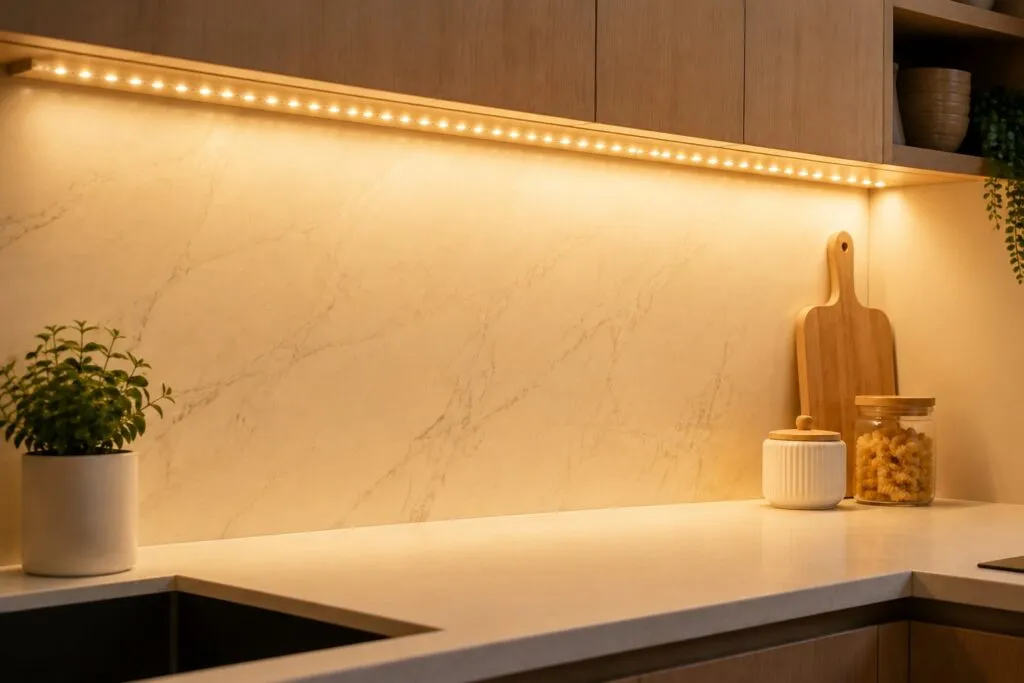
Under-cabinet lighting is one of the easiest add-on categories a home and hardware retailer can carry, because the value is obvious the moment a shopper flips it on. When a shopper types under cabinet led lighting for kitchen counters into a search bar, they are not researching a hobby. They are trying to kill the shadow their own body casts on the countertop, and they want a fix that looks built-in rather than bolted-on. That is a fast, high-intent purchase, and it pairs naturally with the rest of a cozy-home basket.
The underlying technology also removes most of the old objections. According to the U.S. Department of Energy’s Energy Saver residential lighting fact sheet (retrieved 2026-07-17), LED lighting uses up to 90% less energy and lasts up to 25 times longer than incandescent lighting, and lighting is roughly 15% of a typical home’s electricity use. For a counter light that may run several hours a night, that combination of low draw and long life is the difference between a novelty and a fixture people keep. It also means fewer warranty returns for burned-out lamps, which matters more to your margin than to the shopper.
For a buyer, the practical work is narrower than the category looks. You are choosing an install path, a form factor, a power supply, and a light quality, then confirming the supplier can deliver those consistently at your volume. The rest of this primer walks each decision in the order an importer actually faces it, using real numbers you can put on a spec sheet. If you are building the wider assortment, this line sits inside the same cozy-home mood lighting basket that candle warmers and projectors belong to.
02Hardwired or plug-in: which install path do your shoppers need?
Both, and a smart assortment carries each rather than betting on one. Led under cabinet lighting splits into two install paths that serve different shoppers. Plug-in kits are the volume seller: they need no electrician, install with adhesive backing and a cord to the nearest outlet, and suit renters and quick weekend retrofits. Hardwired runs connect into the home wiring, hide every cord, and dim from a single wall switch, which reads as premium and can lift a home’s appraised value.
The tradeoff is real and worth stating plainly to your own buyers. Hardwiring almost always requires a licensed electrician, and in many jurisdictions that is not optional if the homeowner wants to keep insurance coverage intact, so the cheaper-looking hardwired fixture can carry a large hidden install cost. Plug-in avoids that bill entirely but spends an outlet and shows a cord unless the cabinet has a hidden receptacle. Neither is better in the abstract; the right pick depends on whether your shopper is mid-remodel with the walls open or upgrading a finished kitchen on a budget.
Where a plug-in job a shopper can do ends and a hardwired job that belongs to an electrician begins, and what to test before the strip goes up, is set out step by step in our guide to installing LED strip lights.
Plug-in kits
- No electrician; DIY install in minutes
- Ideal for renters and finished kitchens
- Lower landed cost, easier to merchandise
- Uses an outlet; cord may show
- On-strip or inline switch, not a wall dimmer
Hardwired runs
- Cords fully hidden; built-in look
- Dims from one wall switch across the run
- Reads premium; can add resale value
- Licensed electrician usually required
- Best fit is a studs-open remodel
For sourcing, the useful move is to carry a plug-in kit as the everyday hero and offer a hardwire-ready version of the same strip for the premium tier. That lets one product photo and one spec sheet cover both shoppers, and it keeps your SKU count sane. Our under-cabinet motion-sensor LED strip kit is built as exactly that everyday hero.
03Strip, bar, or puck: which form factor should you carry?
Carry flexible strip as the everyday hero, add a rigid linear bar for the premium straight-run tier, and keep puck lights only for display cabinets. Under cabinet led strip lighting is the flexible tape most shoppers now expect: a thin, adhesive-backed strip that bends around corners and disappears behind the cabinet lip. Linear bars are rigid aluminum channels with the same diffused look but more structure and better heat sinking. Puck lights are round spots, cheap and simple, but they throw visible pools of bright and dark that many shoppers dislike over a work surface.
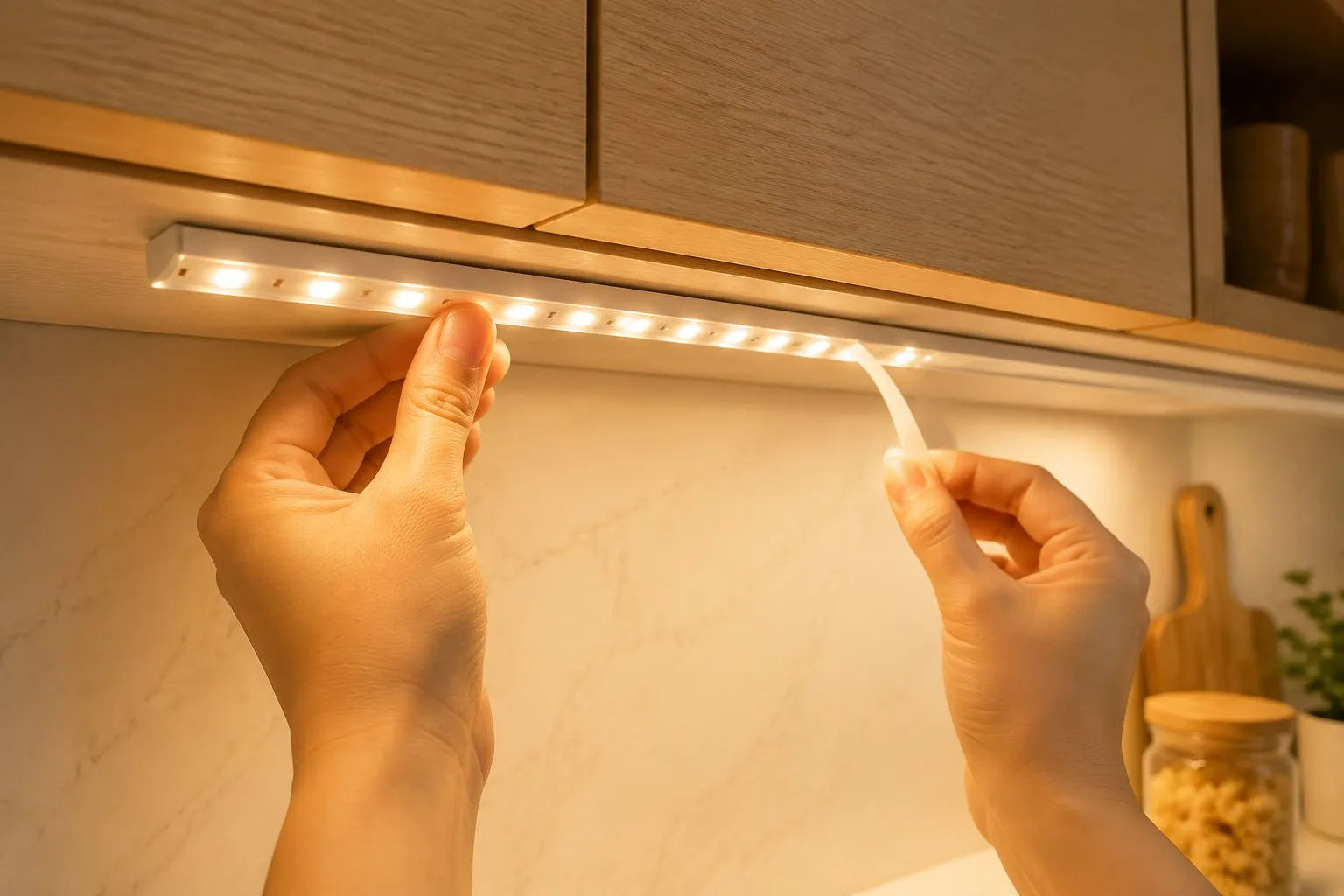
The nuance here is diffusion. A bare strip of individual LED dots can look spotty against a glossy backsplash, which is why the better kits mount the strip in an aluminum channel with a frosted cover, or use a densely packed strip so the dots blur into a line. Mounting position matters as much as the light itself: placing the strip at the front rail of the upper cabinet, closest to the counter edge, throws light onto the work surface instead of down the backsplash, which is where shoppers complain about shadows. That single detail drives more satisfaction than a few extra lumens.
| Form factor | Best for | Look on the counter | Buyer note |
|---|---|---|---|
| Flexible strip | Most kitchen runs, corners, retrofits | Continuous line if diffused or dense | Cuttable to length; verify cut interval |
| Linear bar / channel | Premium, straight runs | Even, shadow-free, best heat control | Fixed lengths; link connectors matter |
| Puck lights | Display cabinets, single accents | Scalloped pools of light and dark | Cheapest; weakest as task light |
04What size LED strip power supply do you need?
Size the driver at the strip’s total wattage divided by 0.8, so it runs at about 80% of its rating with 20% headroom to spare. An undersized power supply is the single most common failure in a low-voltage kit, and it is the number one thing a buyer should confirm on any led light strip power supply before committing to an order. The math is simple and worth putting on your spec sheet, and it is the rule the strip makers themselves publish (Waveform Lighting’s power-supply calculator, retrieved 2026-07-16): add up the strip’s total draw, which is watts per foot multiplied by total feet, then divide by 0.8.
Find the load per foot
Read watts per foot from the strip spec sheet, then multiply by the run length. Example: 3.5 W/ft over 22 ft is 77 W of draw.
Add 20% headroom
Divide the load by 0.8 (the same as multiplying by 1.25). For the 77 W run that is about 96 W, so you need a supply rated at least 96 W. Waveform Lighting’s own worked example: a 44 W run needs a 55 W supply.
Match voltage and safety class
The supply voltage must match the strip (12V or 24V), and for a residential kit it should be a UL-listed Class 2 driver so the low-voltage side stays inside safe limits.
Headroom is not padding for its own sake. A supply run at its ceiling gets hot, and heat is what shortens the life of the cheapest component in the box. Spending a little more on driver capacity is the quiet difference between a kit that comes back as a return and one that runs for years. When you compare quotes, an undersized driver is often why one price looks lower than another, so normalize on the same headroom rule before you decide.
05Can you cut LED strips to fit, and how long can one run be?
Yes, you can cut a strip to fit, but only at the marked points, and a single low-voltage run has a hard length limit set by voltage drop. Take the cut rule first. Strips are cuttable only at marked points, shown by a scissor icon and a pair of exposed copper pads. On 12V strips those cut points fall every 3 LEDs, roughly every 2 inches; on 24V strips they fall every 6 LEDs, roughly every 4 inches (per HitLights’ guide to cutting LED strips). Cutting anywhere between the marks severs the circuit and disables that segment for good, so the tighter cut spacing on 12V is a genuine advantage when a run has to fit an odd cabinet length.
Now the length limit. Low voltage fades over distance, which caps how long one run can be. As current travels down a thin strip, resistance eats voltage, so the far end looks dimmer than the near end. This is the main reason to care about 12V versus 24V. Because a 24V strip draws half the current of a 12V strip at the same power, its power loss is only a quarter as much (loss rises with the square of current), so it holds brightness over a much longer single run before you have to feed power from both ends.
Max single-feed run before visible voltage drop
One power feed, no mid-run injection · run length in feet
Source: Super Bright LEDs, “12-Volt vs. 24-Volt LED Strip Lights: What’s the Difference?” (retrieved 2026-07-16). 12V ≈ 16.4 ft (5 m); 24V ≈ 32.8 ft (10 m) per single feed.
For a buyer, the takeaway is a stocking rule, not a physics lesson. Short cabinet runs and tight fits favor 12V for its finer cut spacing. Long, continuous runs and open-plan kitchens favor 24V for its reach. A supplier that offers the same strip design in both voltages lets you cover both without doubling your catalog.
06Warm white or RGB: what light quality should you spec?
Spec CRI 90 or higher and 2700K to 3000K warm white for the actual task light, and treat RGB as an accent upsell rather than the main light over a counter. Brightness is the spec shoppers ask about, but light quality is the spec that decides whether they keep the light. Under cabinet lighting for a kitchen is task lighting, and task lighting lives or dies on color accuracy: a color rendering index of 90 or higher makes raw ingredients, cutting boards, and finishes look true rather than washed out. For brightness, a target of 200 to 500 lumens per linear foot covers most counters, with the higher end for dark stone or deep cabinets. For that accent upsell, an RGBIC music-sync LED strip does the job.
Color temperature is the other half. Warm 2700K reads cozy and suits open dining areas; 3000K is the safe warm-neutral default most kitchens want; 4000K and above look cooler and more clinical, better for a workshop than a home counter. The gradient below is the range shoppers are choosing between.
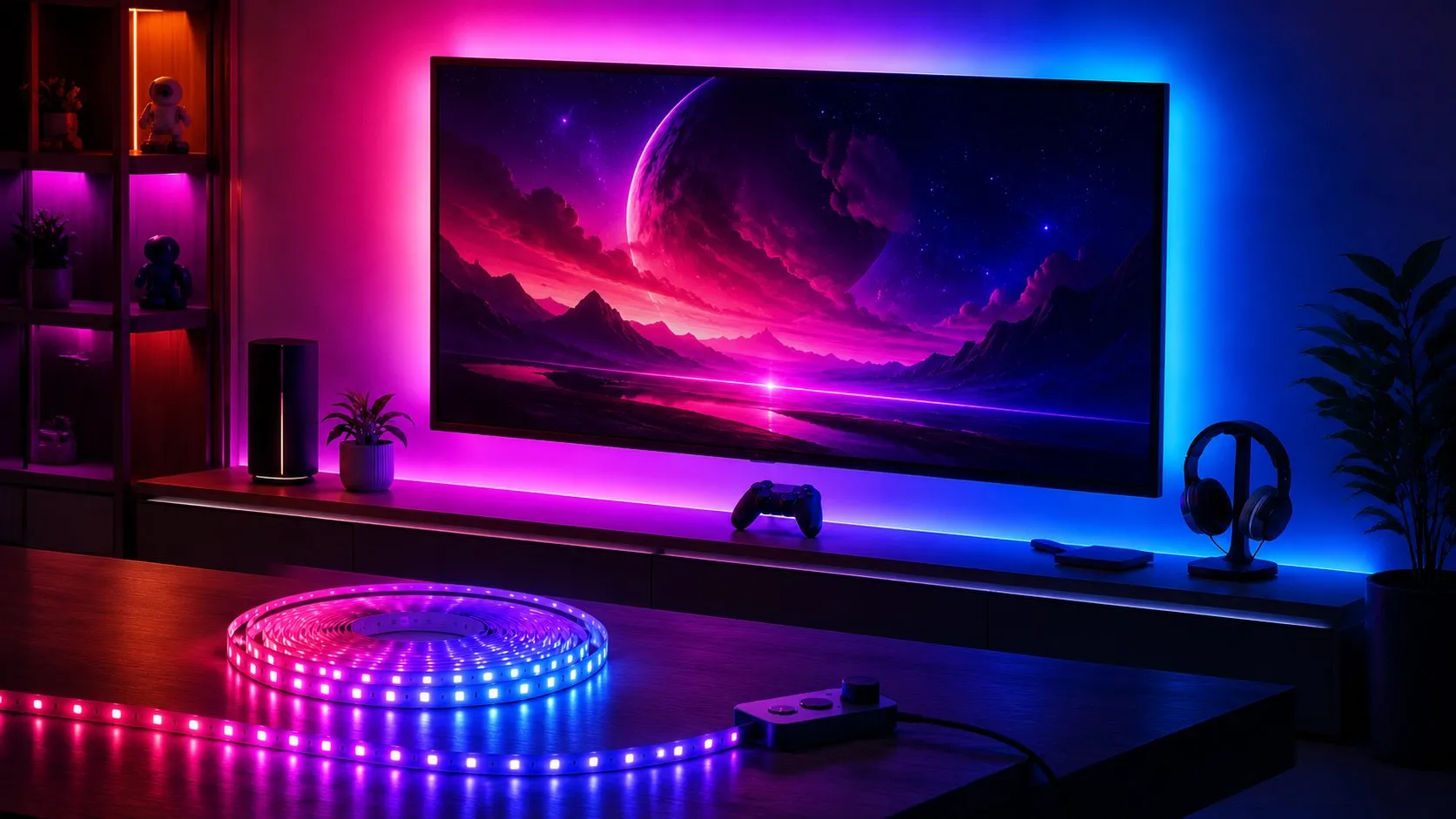
That brings up RGB and RGBIC color-changing strips, which look spectacular on a shelf and sell hard on impulse. The honest tradeoff is that color-mixing strips usually deliver weaker white-light quality and lower effective CRI than a dedicated warm-white task strip, so they are a poor choice as the only light over a work surface. The strong play for a buyer is to merchandise them as ambience and accent, behind a toe-kick or above the cabinets, and keep a high-CRI white strip as the actual task light. Shoppers who want the color show and the good task light simply buy both.
07See it in place: sizing and install at a glance
A short walkthrough makes the two decisions that generate the most support tickets, sizing the driver and choosing where to mount the strip, concrete for a first-time buyer or their retail staff. The clip below shows a plug-in under-cabinet kit going onto the front rail of an upper cabinet, then the power-supply math from section four applied to that run. Use it as the explainer you attach to a product listing or a training deck.
08What to require from your supplier
Turn everything above into a one-page requirement you hand a factory before you commit: a UL-listed Class 2 driver, and a spec sheet that states every number you need to size and sell the kit. On safety, a residential kit’s driver should be a UL-listed Class 2 power supply. Class 2 is a defined limit under UL 1310 and NEC Article 411: the output stays under 60 volts DC and 100 VA, about 100 watts, which is the level that removes meaningful fire and shock risk on the low-voltage side (Super Bright LEDs, Class 2 guide). Pairing a UL-listed strip with a non-Class 2 supply actually voids the strip’s listing, so the driver is not a corner to cut. Ask for the driver’s listing, not just a claim.
On performance, ask for a spec sheet that states watts per foot, voltage, LED density, CRI, color temperature, lumens per foot, IP rating, and cut interval. Those are the numbers that let you size a power supply, predict run length, and answer a shopper without guessing. A supplier that cannot produce that sheet is a supplier whose kits you will be returning. This is also where private label matters: the same tooling can carry your brand, your packaging, and your chosen CCT and CRI, which is how a retailer turns a commodity strip into a defensible product. For where this category sits in the 2026 assortment, see our note on home ambiance lighting trends for private-label buyers.
Source the strip line factory-direct
BeginLighting builds its Smart LED Light Strips in Foshan and ships them factory-direct for wholesale and private label, with your CCT, CRI, packaging, and branding. Pricing is quoted per order. Tell us your run lengths, voltage, and volume, and we will spec it with you.
Frequently asked questions
What size led light strip power supply do I need for under-cabinet lighting?
Add up the wattage the strip draws (watts per foot multiplied by total feet), then divide by 0.8 so the driver runs at about 80 percent of its rating. Waveform Lighting gives the worked example of a 44-watt run needing a 55-watt supply. That 20 percent headroom keeps the power supply cool and lengthens its life.
Is under cabinet led strip lighting better than puck lights for kitchens?
For a continuous, shadow-free wash along a counter, a strip or linear bar mounted at the front edge of the upper cabinets is usually cleaner than puck lights, which throw visible scallops of bright and dark. Pucks still suit glass display cabinets and single accent spots. Most kitchen task runs use strip or bar.
Can led under cabinet lighting be hardwired, or does it have to plug in?
Both exist. Plug-in kits need no electrician and suit renters and quick retrofits, but they occupy an outlet and show a cord. Hardwired runs hide all wiring and dim from a wall switch, but a licensed electrician is required in most jurisdictions. Many retail kits ship plug-in with an optional hardwire path.
What color temperature and CRI should under cabinet lighting be for a kitchen?
For kitchen task light, aim for a color rendering index (CRI) of 90 or higher so food and finishes look true, and 2700K to 3000K for a warm, inviting counter. 3000K is the safe warm-neutral default; 4000K reads cooler and more clinical. Brightness targets of 200 to 500 lumens per linear foot cover most counters.
Can you cut under-cabinet LED strips to fit different cabinet lengths?
Yes, but only at the marked cut lines, shown by a scissor icon and a pair of copper pads. On 12V strips those points fall every 3 LEDs (about 2 inches); on 24V strips every 6 LEDs (about 4 inches). Cutting anywhere else disables that segment. Cut ends can be rejoined with solderless connectors.
Sources
- U.S. Department of Energy, “Lighting accounts for about 15% of an average home’s electricity use” (fact sheet, PDF). energy.gov (PDF), retrieved 2026-07-16.
- Waveform Lighting, “Online Calculator for LED Strip Light Power Supply Requirements.” store.waveformlighting.com, retrieved 2026-07-16.
- Super Bright LEDs, “12-Volt vs. 24-Volt LED Strip Lights: What’s the Difference?” superbrightleds.com, retrieved 2026-07-16.
- Super Bright LEDs, “What is Class 2: A Guide to UL, NEC, Power Supplies & Strip Lights.” superbrightleds.com, retrieved 2026-07-16.
- HitLights, “Can You Cut LED Strip Lights? A Complete DIY Guide.” hitlights.com, retrieved 2026-07-15.
- Waveform Lighting, “Do LED strip lights require UL listing?” waveformlighting.com, retrieved 2026-07-15.
- ENERGY STAR, “Residential Light Fixtures At A Glance.” energystar.gov (PDF), retrieved 2026-07-15.
Dimming compatibility: the spec that decides the return rate
Under cabinet lighting led dimmable is a claim printed on nearly every box in this category and honoured by a much smaller number of them. Dimming is not a property of the strip alone; it is a property of the strip, the driver and the wall control acting together, and a mismatch anywhere along that chain reaches the shopper as flicker, a dead band at the bottom of the dial, an audible buzz, or a minimum level they would describe as off.
- Confirm the dimming method by name, whether leading edge, trailing edge, 0-10V or PWM at the driver, instead of accepting the single word dimmable on a datasheet.
- Require a named list of wall dimmers the driver has actually been tested against, and put that list in the box.
- Check the minimum dim level and whether the light is flicker-free there, not only at full output.
- For plug-in kits, test the supplied inline dimmer or remote against the exact strip length the kit contains, because a lightly loaded driver behaves differently from a fully loaded one.
Hardwired versus plug-in, one layer deeper
Led under cabinet lighting hardwired sells to a different shopper than the plug-in kit does, and stocking both without labeling the difference clearly is a returns generator. The hardwired buyer is renovating, is comfortable with a junction box or is working with a contractor, and wants a clean run with no visible cable and a proper wall switch. The plug-in buyer is a renter or an upgrader who needs the whole job finished in an afternoon with adhesive and an existing outlet.
The retail consequence is packaging and copy rather than product. A hardwired SKU needs its electrical requirements on the front of the box; a plug-in SKU needs its cord length and expected outlet position stated just as prominently, because a kit whose lead does not reach the outlet comes straight back to the shelf.
Form factor at a glance
Puck lighting under cabinet produces pooled circles of light and is simpler to install across short cabinet spans, while an LED light strip for under cabinets produces an even continuous line with no scallops on the backsplash. Neither is universally better: pucks suit deep cabinets with well-separated zones and shoppers who want a screw-and-go install, and strip suits long continuous runs and a flush modern look.
| Criterion | Puck | Strip |
|---|---|---|
| Light pattern | Pooled circles, visible scallops | Even continuous line |
| Best cabinet run | Short or separated spans | Long continuous spans |
| Install | Screw or adhesive per unit, fewer parts | Adhesive run plus driver and connectors |
| Field cutting | Not applicable, fixed units | Cuttable at the marked pads |
| Common returns cause | Uneven coverage along the counter | Adhesive failure and dimmer mismatch |
On under-cabinet LED we are the producer rather than a sourcing partner: strip, driver and accessories specified together on our own floor, samples coordinated, and one quote consolidated. Send your cabinet run lengths, install path and dimmer requirement and we will come back with wholesale pricing through Request a Quote.
What is the best under cabinet lighting for kitchen use?
There is no single answer for every kitchen, but for a retail assortment the best under cabinet lighting for kitchen shoppers is usually a warm-white, high-CRI strip kit offered in the common cabinet lengths, sold alongside a puck option for short or awkward spans. Prioritise color rendering and dimming behavior over headline lumens: a kitchen counter is a task surface where food and finishes have to look right, and a light that renders color poorly gets judged harshly no matter how bright it is.
