


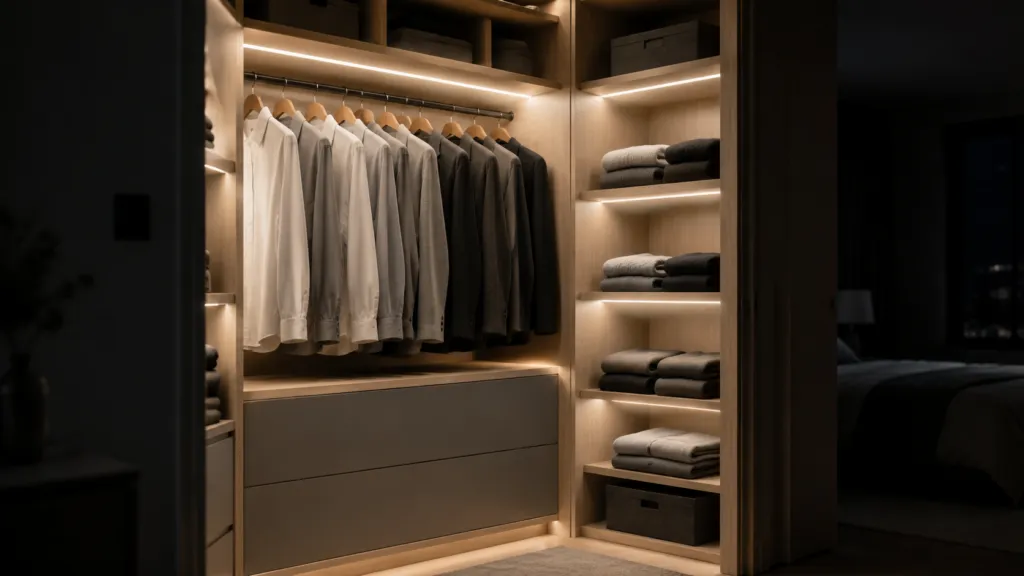
LED strip lights in closet and wardrobe joinery are bought from a photograph and judged in the four seconds somebody has to tell navy from black on a Tuesday morning. That is the whole product. The metre count, the diode density and the controller tier all exist to serve one thing: a vertical plane of fabric being legible at arm’s length before the door swings shut again.
Three neighbouring questions belong elsewhere. Which trigger switches the run on, door switch against passive infrared against wave sensor, is settled in our guide to LED strip lighting with a motion sensor. Voltage, tape formats and how to read a supplier sheet are in the LED strip spec decoder and the retail buyer primer on cabinet runs; where a reel may be cut is in our piece on cutting LED strip. This one is about the box: what a closet does to light, and what the electrical code does to a closet.
Key takeaways
Spec led strip lights in closet builds from the storage space outward. Code clearance decides where tape may sit, the front edge decides whether light reaches the fabric, colour fidelity decides whether the garment is identifiable, and the duty cycle decides how much fading you have added.
- The residential electrical code defines a closet storage space as the volume reaching 24 inches out from the side and back walls up to 6 feet or the highest hanging rod, then 12 inches or the shelf width to the ceiling.
- A surface-mounted LED fixture with a completely enclosed source needs 12 inches (305 mm) of clearance from that volume; a recessed one needs 6 inches (152 mm). Only a fixture identified for installation inside the storage area may sit within it.
- A bare colour rendering figure is a weak promise: the U.S. Department of Energy reports that nine of the top twelve rated products in its own preference research scored CIE Ra 73 or less.
- Light damage is cumulative and irreversible, and conservation practice caps book display at 150 lux with ultraviolet content under 75 microwatts per lumen.
- Wrong size, fit or colour was the biggest single return reason in a Narvar survey, at 46% of returns from retailers other than Amazon. The strip is the part of the wardrobe that decides what colour a garment looks.
What a Closet Asks a Strip to Do That a Ceiling Fixture Cannot
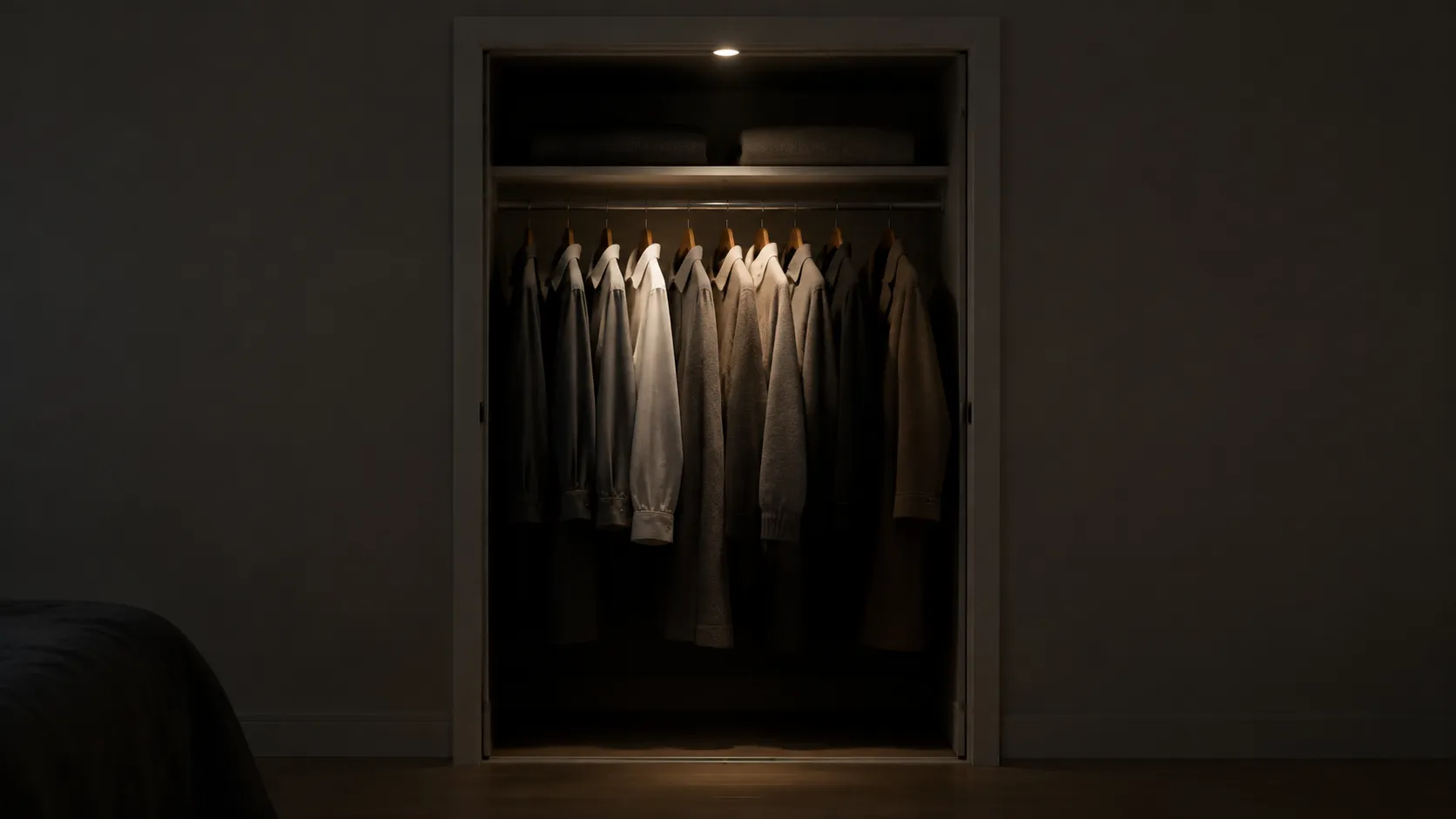
A closet is a narrow box in which the person doing the looking stands between the light and the thing being looked at. That one fact disqualifies most of what gets installed.
Hang a fixture on the ceiling of a reach-in and the useful light travels down the front of the clothes for about the top third, meets the shoulder line and stops. In a walk-in the fitting is directly overhead, which puts the owner’s own head and shoulders between it and the rail they are reaching into. Garment faces are vertical planes roughly 24 inches deep, and a source above them grazes rather than illuminates. Buyers read the symptom as dimness and fit a brighter ceiling light, which lights the shoulders more brightly and the sleeves no better.
A tape run fixes the geometry instead of the quantity. Mounted at the front lip of a shelf and aimed down, it sits in front of the garment plane rather than above it, and the light arrives near a right angle to the fabric. Most enquiries for led strip lights for closet interiors turn up as a metre count and a colour temperature, which is the wrong pair of numbers: aim point and colour fidelity do more work than either. This is task lighting sold in the decorative aisle, and the order should say so.
The Storage Space Is a Code Term Before It Is a Design Decision
Before anyone picks a colour temperature, the residential electrical code has already drawn a box inside the closet and put most of it out of bounds to most fixtures.
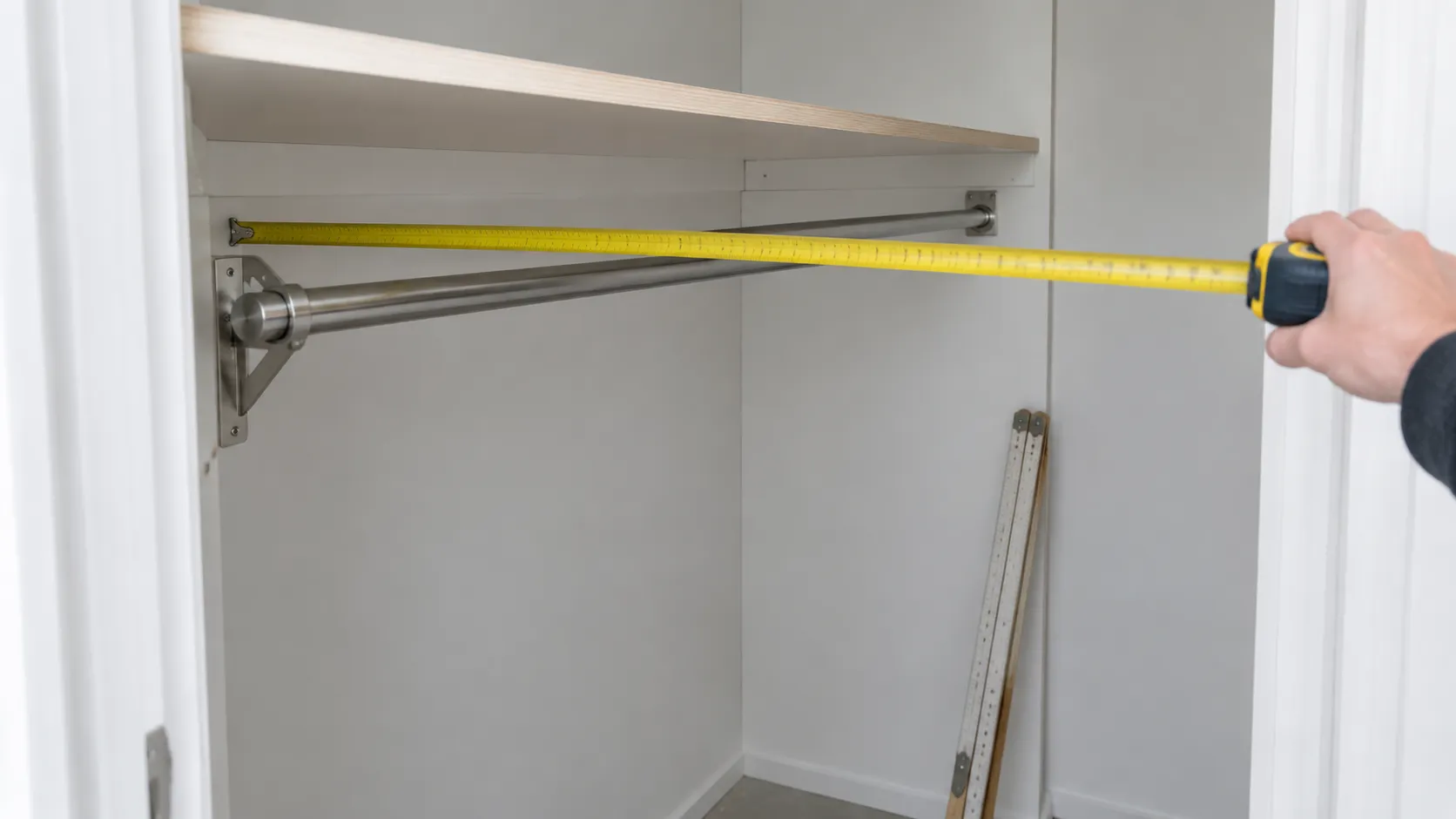
The code text defines that storage space as the volume bounded by the side and back closet walls, running from the floor to 6 feet or to the highest clothes-hanging rod at a horizontal distance of 24 inches from those walls, then continuing to the ceiling at 12 inches or the width of the shelf, whichever is greater (2018 International Residential Code section E4003.12, carrying the National Electrical Code language on clothes closets). In a 24-inch deep reach-in that swallows the whole depth below rod height. The clearances that follow are not ornamental: 12 inches (305 mm) for a surface-mounted incandescent or LED fixture with a completely enclosed source, and 6 inches (152 mm) for a recessed one.
Then comes the line the tape trade lives on. The same section permits surface-mounted fluorescent or LED fixtures identified as suitable for installation within the closet storage area to sit inside that volume with no separate clearance. A run along the underside of a shelf or up a door stile is inside the storage space in almost every closet worth lighting, so the question is not how bright the tape is but whether it is identified for the place it is going. If not, the run moves outside the volume: the front lip of the top shelf and the vertical edges of the carcass, never the back wall behind the rail.
The honest limit is that we are a factory and the local inspector is not. Code editions and state amendments move, so treat this as the question to put to the specifier for the destination market rather than a clearance to print on a carton. Tape against rigid bar is settled in the retail buyer primer.
| Fixture type | Minimum clearance | What it means for a tape run |
|---|---|---|
| Surface-mounted incandescent or LED, enclosed source | 12 in (305 mm) | Ceiling or over-door only; a shelf-edge run cannot meet it in a 24-inch closet |
| Recessed incandescent or LED, enclosed source | 6 in (152 mm) | Trimmed into the carcass above the shelf line, at the cost of head height |
| Surface-mounted fluorescent | 6 in (152 mm) | The legacy format tape is replacing on the same mounting line |
| Recessed fluorescent | 6 in (152 mm) | Same position, same loss of usable depth |
| Surface-mounted fluorescent or LED identified for the closet storage area | May sit inside the storage space | The only route to a shelf-edge or rail-level run; the identification is the specification |
Led Strip Shelf Lighting: Aim at the Front Edge, Not the Back Wall
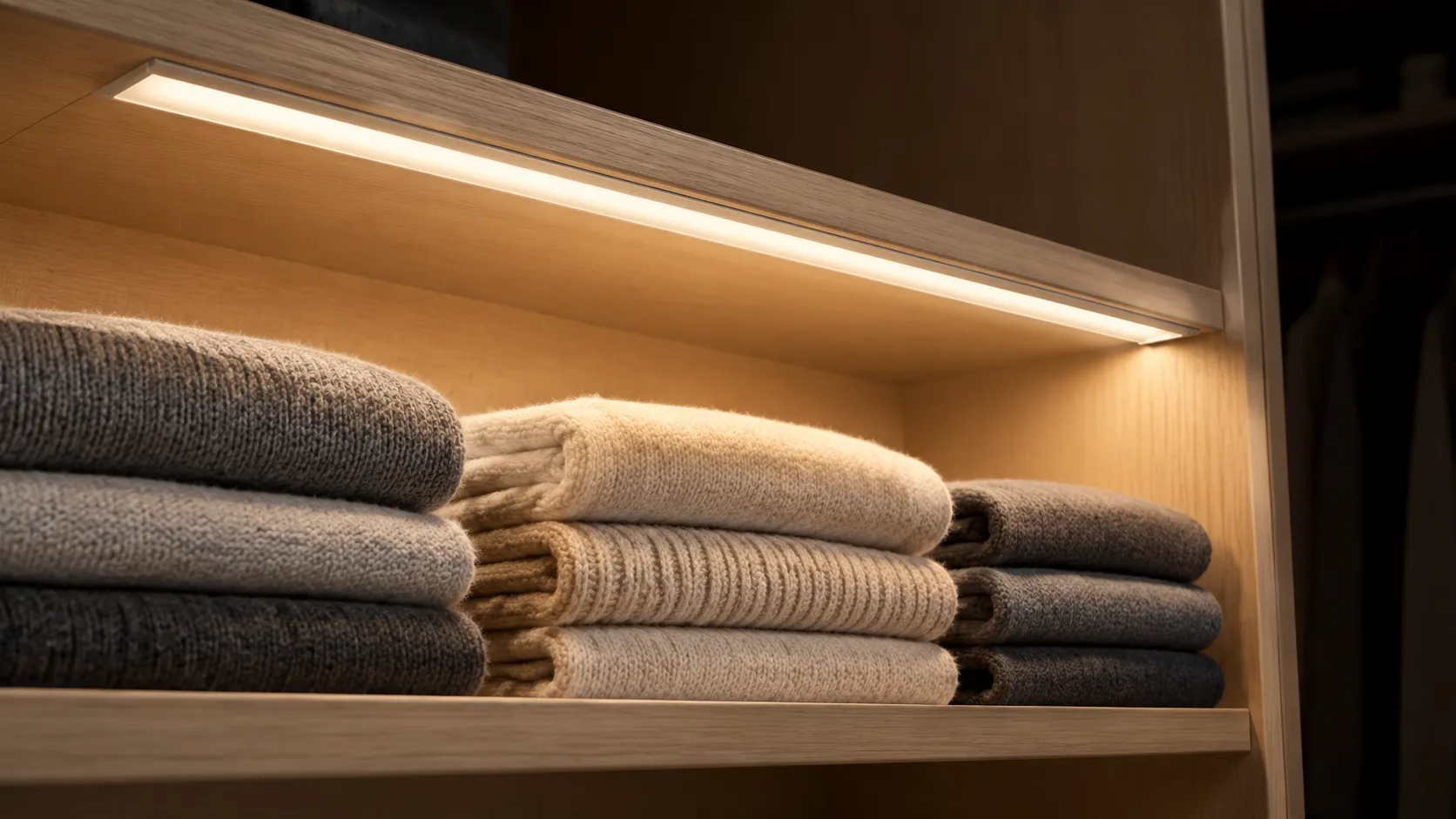
Led strip shelf lighting fails in one predictable way. The tape goes on the back wall behind the stack, lights the wall beautifully and the folded jumpers not at all, because the stack is standing in its own shadow.
Led strip lighting for shelves behaves differently from a rail run because the object is horizontal and the eye is above it. The line that works is the front edge of the shelf above, facing down and slightly back, so light falls across the face of the stack below. Two details decide whether it reads as fitted joinery or a hardware bin: the tape has to sit behind a lip or inside a channel so the emitters are out of the eye line, and the diode pitch has to be tight enough that scallops do not print on the shelf below. Profiles and diffusers for both are in our guide to the LED channel for strip lights.
Drawers get left out of the quote and asked for afterwards. A run inside the drawer front, aimed back across the contents, lights the whole tray as it opens and disappears when it shuts. Shoe shelving wants the opposite of the clothing rail: light from the front edge shows the toe box, light from the back wall shows heel counters nobody is choosing between.
| Placement | What it lights well | Where it fails | What to put on the order |
|---|---|---|---|
| Front lip of the top shelf, facing down | Full length of hanging garments, both rails in a double hang | Glare into the eye if the lip is shallow | Channel with diffuser, set back from the edge |
| Front edge of each fixed shelf | Folded stacks and the ends of labels | Nothing below the lowest shelf | Cut lengths per shelf, one feed, connectors counted |
| Vertical run on the side gable or door stile | Even wash down a tall hanging section | Grazes drawer fronts, misses their contents | Continuous length, corner treatment stated |
| Inside the drawer front, aimed back | The whole tray, at the moment it opens | Nothing while the drawer is shut | Short cut lengths, slim profile, strain relief at the joint |
| Back wall behind the rail | The wall | Everything the customer wanted lit | Do not quote it |
Colour Fidelity Decides Whether Navy Reads as Black
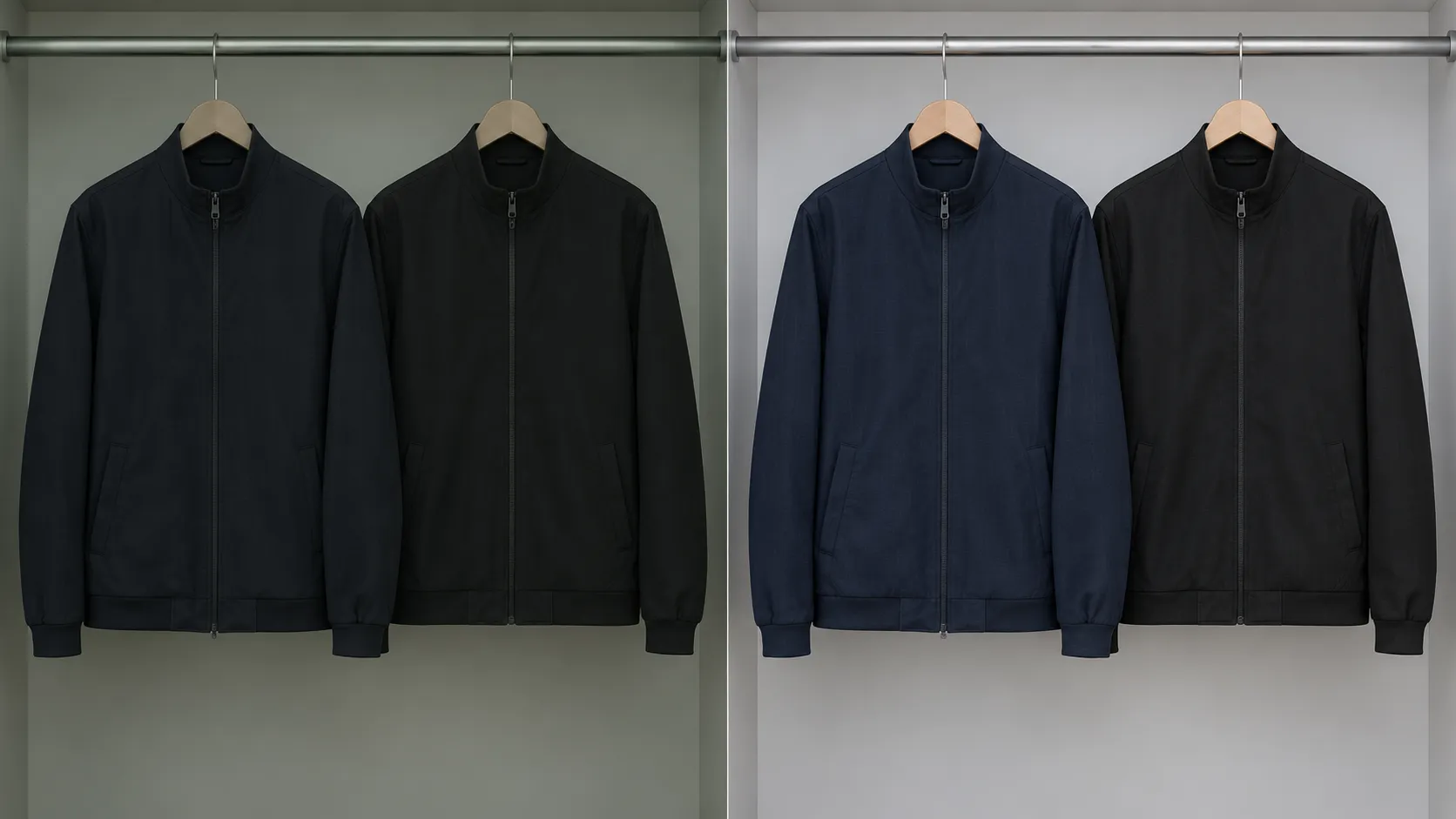
The closet is the one room in the house where the customer is performing a colour-matching task, in a hurry, at close range, and will blame the clothes rather than the light when it goes wrong.
Colour fidelity usually arrives as a single averaged number, and that number is weaker than it looks, because the average is taken across pastel test samples: a source can score well on those while rendering deep reds and rich blues poorly. The U.S. Department of Energy is blunt about the limits in its own colour rendition research, reporting that nine of the top twelve rated products in a preference study had a CIE Ra value of 73 or less, and that average fidelity alone is a weak predictor of human perception (U.S. Department of Energy). The method it points to instead, standardised as ANSI/IES TM-30, reports a fidelity score and a gamut score together.
For a wardrobe programme that becomes three lines on the order and one test. Ask for the fidelity figure and the saturated-red performance separately rather than the average. Ask that every reel comes from one colour bin, because two bins on one rail put the difference 300 mm apart, where the eye is least forgiving. Then run the test that settles it: light a real navy jacket, a real black one and a real charcoal one side by side at the height they will hang, and try to sort them.
The trade-off cuts against selling the premium tape, so it is worth saying out loud. Higher fidelity costs lumens and money, and not every closet earns it. A coat cupboard by the front door is a find-the-sleeve problem, not a colour-matching one, and a mid-grade warm strip is the right answer there. Spend the colour budget on the wardrobe that faces the bedroom, where somebody dresses. That split is also why a bedside fixture and a wardrobe run are different purchases: the lamp is chosen for what it throws into the room, as our notes on the bedroom mood lamp set out, while the wardrobe run is judged on a surface 300 mm away.
The commercial stake is not subtle. A Narvar survey reported by Retail Dive found wrong size, fit or colour was the single biggest reason consumers sent goods back, at 46% of returns from retailers other than Amazon (Narvar, reported by Retail Dive). That figure lumps three causes together and only one of them is yours, which is the honest reading. Against US returns of $849.9 billion in 2025 (National Retail Federation), a closet light is still the cheapest intervention available.
Bookcase Led Strip Lighting and the Dose Nobody Budgets
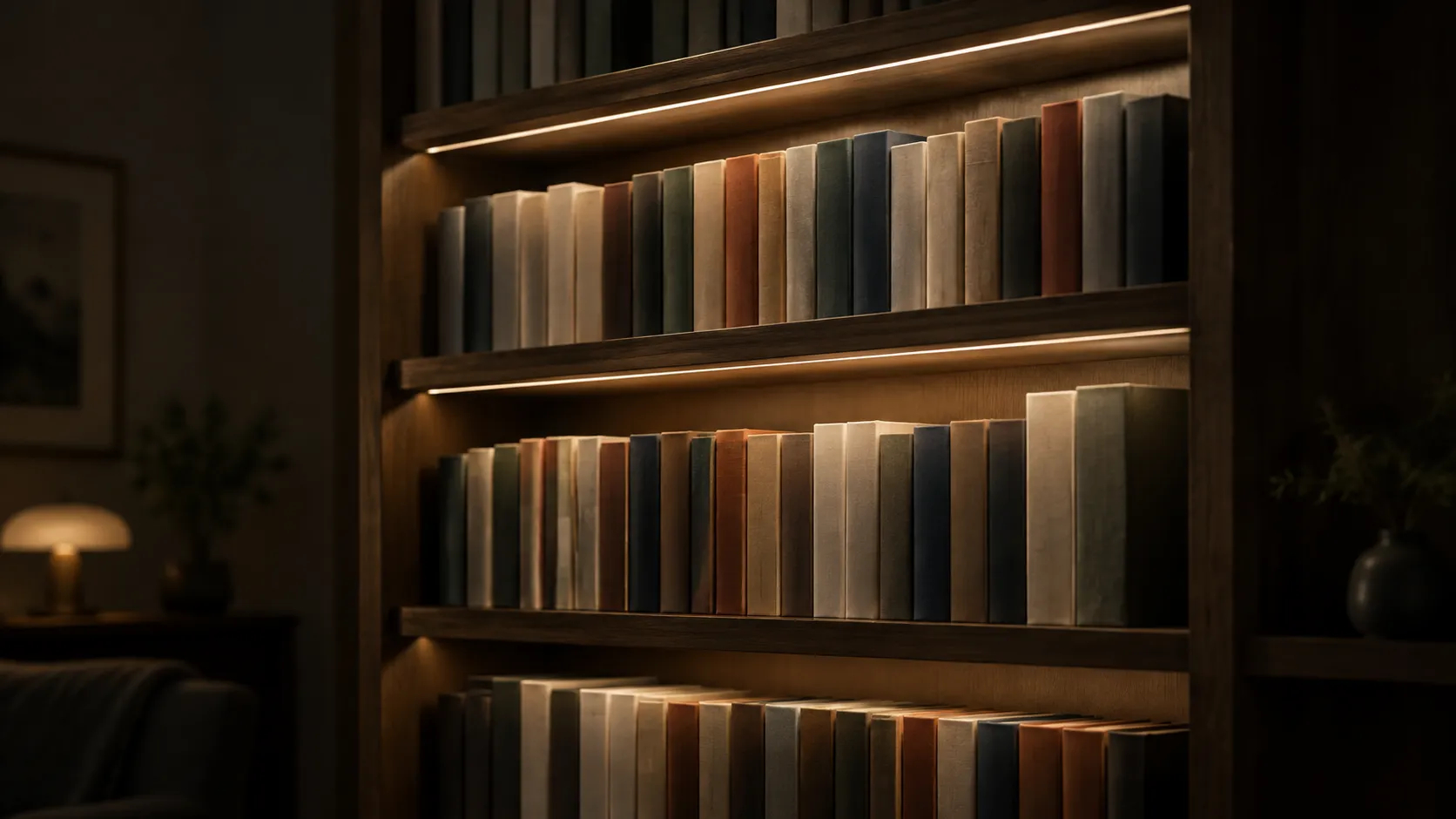
Bookcase led strip lighting is the same hardware sold to a different customer, and it carries a failure mode the wardrobe version does not: the light that shows the spines is also fading them.
Conservation practice has measured this for decades. The Canadian Conservation Institute puts the ceiling for displaying and storing books at 150 lux with ultraviolet content under 75 microwatts per lumen, and states that damage from light is cumulative and irreversible (Canadian Conservation Institute). Its note on textiles gives the arithmetic in one line: total exposure is illuminance multiplied by hours, so 100 lux for 400 hours does the same damage as 50 lux for 800 hours. Its guidance for costumes adds a three-month maximum display period.
Measure a shelf run against that budget and the duty cycle matters more than the brightness. A closet strip that only lives while a door is open is switched on for one to two hours a week. A display run on an evening timer spends between eleven hundred and eighteen hundred hours a year lit, and one left on through the day spends three to five thousand. At the same 150 lux those are not the same product, and the difference is a switch rather than a component.
Source: computed from the 150 lux ceiling and cumulative-exposure arithmetic published by the Canadian Conservation Institute, retrieved 2026-09-12
Two things follow for anyone quoting a bookcase or a glazed display run. The dose argument favours a run that switches itself off over one that merely dims, because a quarter output left on all evening still accumulates hours. And the trigger doing that switching is a specification in its own right, with three routes and a set of failure modes that earn their own page: they are in our guide to sensing strip.
Power Is the Wire You Cannot Add After the Joinery Ships
Every closet lighting failure that is not optical is a power decision taken too late, usually by somebody who assumed a socket would appear.
Decide the feed before the carcass is cut. A wardrobe interior has no outlet in it, so the low-voltage supply arrives through a chase drilled in the gable or it does not arrive at all, and the customer ends up with a cable stapled across a painted wall. The driver needs somewhere ventilated and reachable that is not among the clothes, which usually means above the top shelf or behind a kick panel. Run lengths, voltage drop and cut points live in the spec decoder and in where a reel can be cut; what closets add is that the cuts have to land on shelf pitch rather than on the reel’s convenience.
Two physical facts sit behind the electrics. LEDs follow whatever current the driver sends them almost instantly, having little thermal or phosphor persistence, and temporal light modulation can stay visible at 1000, 2000 or 6000 Hz where there is relative movement between the eye and the source (U.S. Department of Energy). A closet is exactly that condition: a hand sweeping along a rail a metre from the emitters, so test a sample at the bottom of its dimming range with a hand moving under it. Heat is the second fact. An incandescent lamp releases about 90% of its energy as heat while LED products deliver light up to 90% more efficiently (ENERGY STAR), which is a licence to mount close to textiles, not a licence to bury tape in a sealed timber groove.
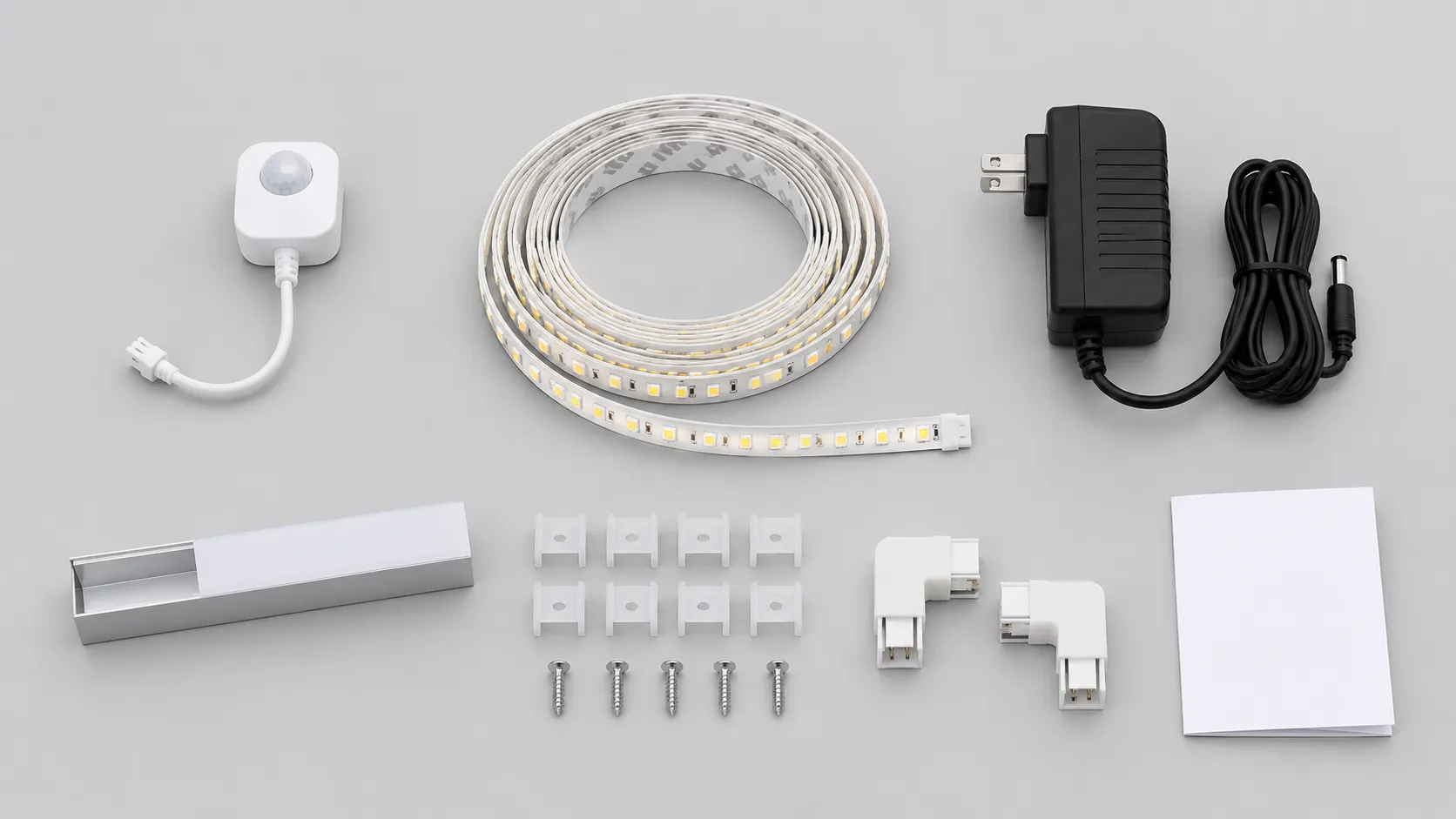
Pack contents are the last piece and the first thing trimmed to hit a price. A kit without mounting clips, channel, corner pieces and a card showing the aim angle gets installed by somebody improvising at the end of a long day. Our cabinet strip kit with a sensing module and the plainer app-controlled strip are the two formats most closet programmes are cut from, both in our strip line.
Specifying a Closet Programme Without the Callback
Everything above collapses into an order of operations for specifying led strip lights in closet programmes, and the order matters more than any single line in it, because each decision closes off options further down.
The sequence below starts inside the code box rather than at the reel, because a clearance question can invalidate a placement everything else was designed around, and it finishes in a dark room, because that is where the faults are visible.
Draw the storage space first
Mark the volume on the elevation before choosing a fixture. It tells you which placements need tape identified for use inside it.
Fix the placement and the aim
Front lip, shelf edge, gable or drawer front, with the aim angle written on the drawing rather than left to the installer.
Settle the power path
Where the chase runs, where the driver lives and which plug goes to which market. This decides run length and cut points, so it comes before the reel.
Put the colour tolerance in writing
Fidelity and saturated-red performance stated separately, one bin per production order, no reel spliced from two bins to make up length.
Set the duty cycle before the trigger
Decide the hours a year the run may be lit, then choose the switching that delivers them. The number comes first.
Walk it at night, with clothes in it
Lights off in the room, real garments on the rail, standing where the owner stands. Look for glare at eye height and a dark bottom third.
One habit beats the rest of the list: make the sample arrive with the garments it has to light. A reel judged on a bench under shop fluorescents says nothing about the Tuesday morning it was bought for.
Have the closet run built to your carcass, not to a reel length
We build LED strip in our own factory in Foshan, 4,000 square metres with 40 people across two production lines, so cut lengths, channel, colour bin and pack contents are lines you write rather than a catalogue you pick from. Send the shelf pitch, the destination market and the colour range you sell, and we will quote the run.
Watch it work
The shoulder shadow, the front-lip mounting line and the navy-against-black test, in 30 seconds:
FAQ
Will an LED strip make a wardrobe warm enough to matter for the clothes?
Not at the powers a closet run uses, but the question is worth turning around. The risk is not the garments warming; it is the tape cooking itself. A flexible strip sheds heat through whatever it is stuck to, so a run that is fine on an aluminium channel can sit far hotter glued into a routed groove in chipboard under a timber cover. Specify the channel as part of the lighting rather than as trim.
Can closet led strip lights be cut down to fit a short rail?
At the marked cut points, yes, and the closet case adds a planning step the general answer does not. Shelf pitch is set by the joinery, cut pitch by the reel, and the two rarely agree. Decide which shelves get a continuous run and which get individual lengths joined by a feed cable before the order goes in, then count the connectors that implies and put them in the pack.
How do we stop a strip peeling off a melamine shelf edge?
Melamine is a low surface energy face carrying release agent and dust, and pressure-sensitive adhesive needs clean, firm contact and time to build its grip. Wipe the face with alcohol and let it flash off, press the whole length down with a roller instead of a fingertip, and hold each end mechanically with a clip so the adhesive is never the only thing resisting a peel. On a shelf edge the tape is loaded in peel every time something is pulled off the stack.
Should a closet strip be dimmable, or is a single output enough?
One well-aimed output covers most reach-ins, and a dimmer is often bought to compensate for a strip pointed at the wrong thing. Dimming earns its place in two cases: a walk-in that doubles as a dressing room and wants a low setting at night, and a glazed display run whose owner is trading visibility against exposure. It does not solve exposure on its own, since a quarter output left on all evening still accumulates hours.
Does a strip inside a drawer need a different specification from one on a rail?
Slimmer physically, the same electrically, fussier mechanically. A drawer run has to clear the contents and the runners, so profile height decides whether it fits at all, and the feed cable crosses a moving joint, which calls for a service loop and strain relief rather than a cable pulled tight on closing. Aim it back across the tray rather than down into it.
Sources
Every external figure above was checked on 2026-09-12: closet clearances from the residential code text, light dose limits from the Canadian Conservation Institute, colour rendition and flicker from the U.S. Department of Energy, efficiency from ENERGY STAR, and returns data from Retail Dive and the National Retail Federation.
- UpCodes, Luminaires in Clothes Closets, section E4003.12 of the 2018 International Residential Code as adopted in Texas, carrying the National Electrical Code text at 410.2 and 410.16 (definition of closet storage space at 24 in from the side and back walls to 6 ft or the highest rod then 12 in or shelf width to the ceiling; 12 in / 305 mm clearance for surface-mounted enclosed incandescent or LED, 6 in / 152 mm recessed; fixtures identified for the closet storage area permitted inside it), retrieved 2026-09-12.
- Canadian Conservation Institute, Basic Care of Books, CCI Notes (maximum 150 lux with ultraviolet content under 75 microwatts per lumen; light damage cumulative and irreversible; limit exposure time), retrieved 2026-09-12.
- Canadian Conservation Institute, Textiles and the Environment, CCI Notes (light fades colours and weakens fibres; ultraviolet not to exceed 75 microwatts per lumen; total exposure equals illuminance multiplied by hours, so 100 lux for 400 hours equals 50 lux for 800 hours), retrieved 2026-09-12.
- Canadian Conservation Institute, Caring for Textiles and Costumes, preventive conservation guidelines for collections (display textiles for limited time periods, a three-month maximum), retrieved 2026-09-12.
- U.S. Department of Energy, Solid-State Lighting Program, Color Rendition (nine of the top twelve rated products had a CIE Ra value of 73 or less; average fidelity alone is a weak predictor of human perception; TM-30 fidelity score Rf and gamut score Rg), retrieved 2026-09-12.
- U.S. Department of Energy, Solid-State Lighting Program, Flicker (LEDs have little thermal or phosphor persistence and a very rapid on or off response; temporal light modulation visible at 1000, 2000, 6000 Hz or higher where there is relative movement), retrieved 2026-09-12.
- ENERGY STAR, U.S. Environmental Protection Agency, Learn About LED Lighting (LED products produce light up to 90% more efficiently than incandescent; incandescent bulbs release 90% of their energy as heat; rated life based on a 30% drop in light output), retrieved 2026-09-12.
- Retail Dive, Consumers’ common return reason: wrong color, size or fit, reporting a Narvar survey (wrong size, fit or color the top reason for returns, 34% at Amazon and 46% at other retailers), retrieved 2026-09-12.
- National Retail Federation, Consumers Expected to Return Nearly $850 Billion in Merchandise in 2025 ($849.9 billion total, 15.8% of annual sales, an estimated 19.3% of online sales), retrieved 2026-09-12.
