

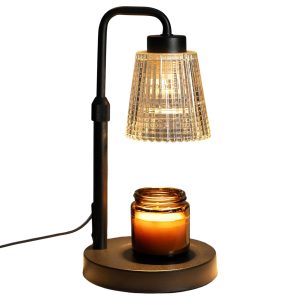
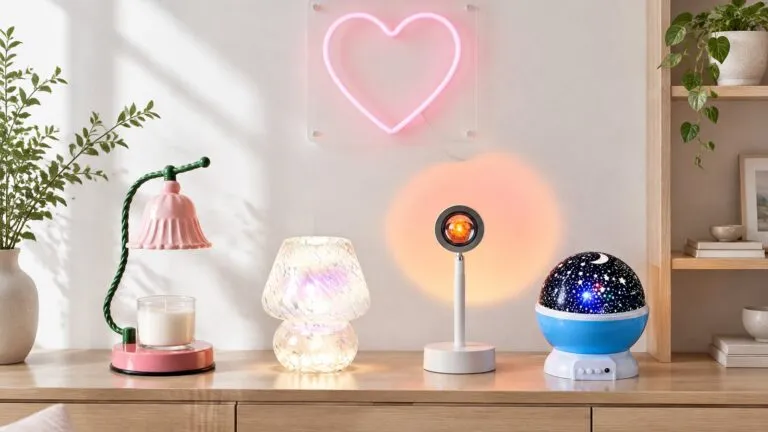
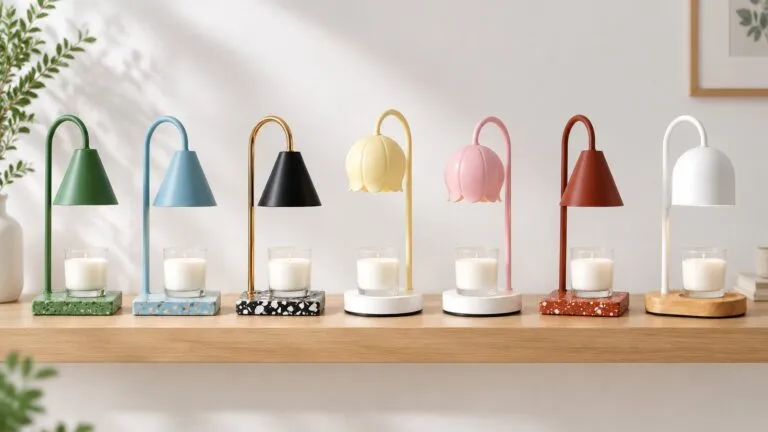
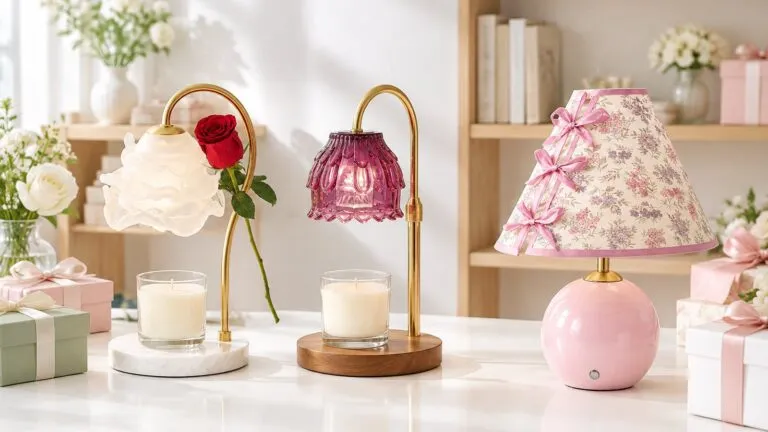
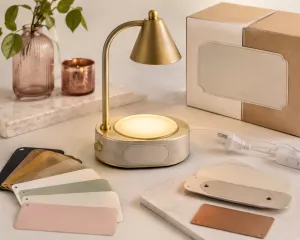

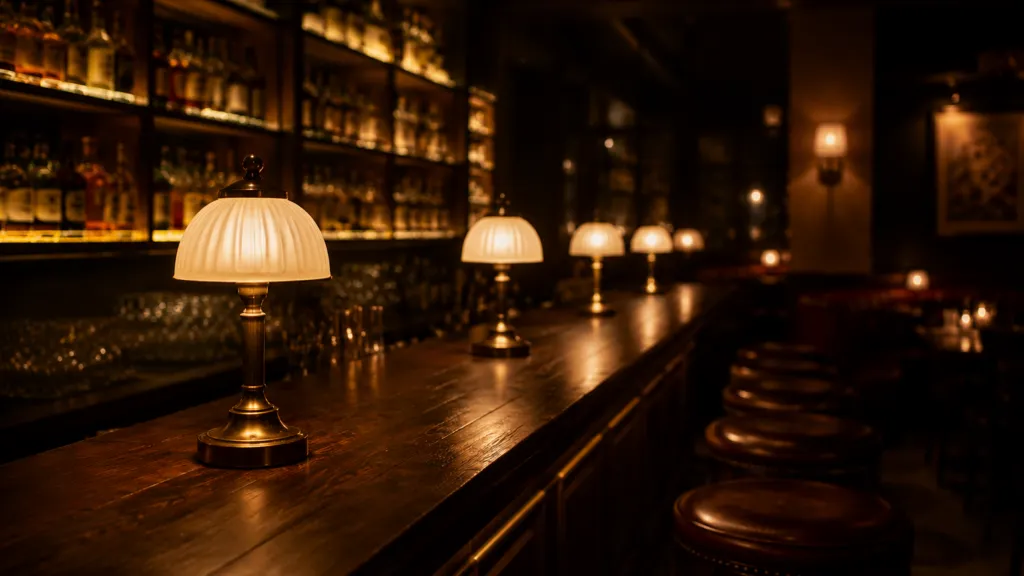
Vintage bar lamps are the small, low-output fixtures that sit on a bar top, a booth table or a back bar shelf and carry the character of the room. They are not the reason a guest can read the menu; they are the reason the room feels worth an extra hour. This guide is for the person placing the order — a bar owner, an operator, a designer specifying for a group — and covers the formats, the light levels they work inside, the LED sources behind the period look, and the electrical questions that decide whether a good-looking lamp can legally sit on a guest’s table.
Runtime and charging logistics for cordless models are handled separately in our guide to battery table lamps for restaurants and hotels. This piece stays on the look itself: what the word means when a supplier uses it, and how to specify it so the sample matches the picture in your head.
Key takeaways
Vintage bar lamps carry a room’s character, not its light level. Specify the look through shade, finish and color temperature, buy the electrics new and listed for your destination market, and treat back bar linear lighting as a separate layer.
- Three products are sold as vintage: genuine antiques, faithful reproductions, and modern lamps with period cues. Only the last two scale to a whole room.
- Recommended illuminance for a dining surface runs 5 to 20 footcandles, against 20 to 50 at a cashier station and 50 to 100 in a kitchen (IES). Table lamps live in the lowest band.
- Vintage bankers lamps are the most recognizable member of the family: brass base, green cased-glass shade, light pushed down onto the surface rather than out at the guest.
- The period look now comes from an LED source, so color temperature, dimming behavior and batch consistency decide whether a delivery looks like a matched set.
- Old wiring is what fails an inspection. Buy the electrical side new and listed to your market’s standard, and keep rewired antiques off a commercial floor without an electrician’s sign-off.
What Buyers Mean by Vintage Bar Lamps
The phrase covers three different products, and a supplier will rarely say which one they mean until you ask.
The first is genuine antiques. Wonderful objects, and almost impossible to run a venue on: no two are alike, spares do not exist, and the wiring inside is whatever somebody last did to it. One on a shelf is a good idea; twelve matched ones on twelve booth tables is not an order you can place.
The second is reproductions — current production built to an older design, with the original proportions and modern electrics. This is where the recognizable shapes live: the green-shaded desk lamp, the brass gooseneck, the industrial cage, the milk-glass dome. Order twelve now and twelve more next year, and they will match.
The third and largest group is modern lamps with period cues: fluted glass, aged brass, a filament-look bulb, a turned wood base. Nothing is historically specific; it simply reads as old. Most of what is merchandised under this heading belongs here, which is why two suppliers can show identical photographs of nothing alike, and why finish durability, glass quality and batch consistency are the only things worth arguing about.
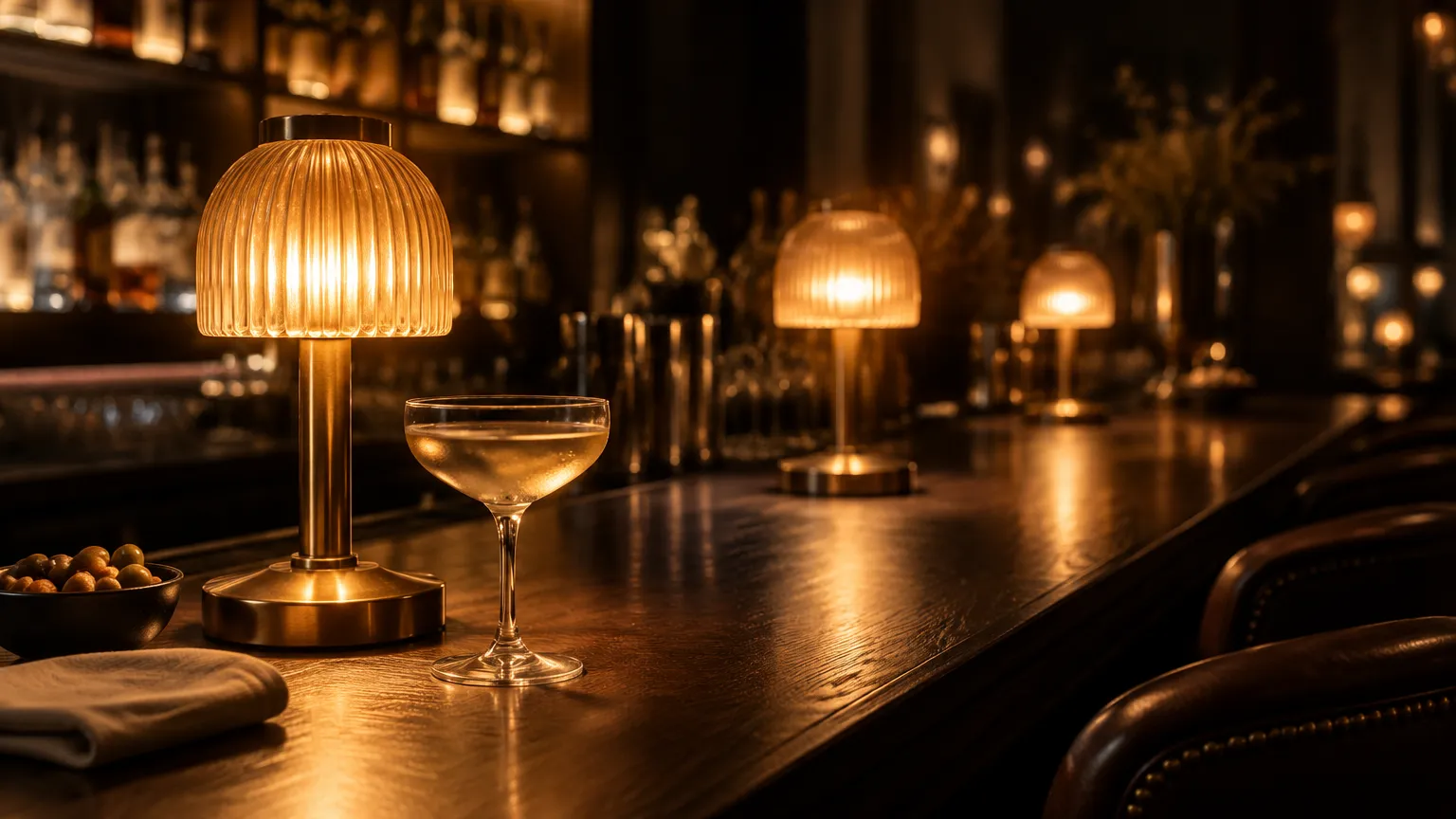
Where the Light Actually Has to Land
Before choosing a lamp it helps to know how little light a bar surface is meant to receive, because the number is lower than people guess.
Published guidance for food service facilities puts a dining surface at 5 to 20 footcandles, cleaning at 10 to 20, a cashier station at 20 to 50, displays at 30 to 100, and kitchen and prep at 50 to 100 (IES). Read that list from the bottom up and the brief falls out of it. The kitchen is bright because people work with knives and heat. The point of sale is bright because someone is reading a screen. The table your guest is sitting at is the darkest place in the building, on purpose.
So arguing about lumens with a lamp supplier is wasted effort. A table lamp is not asked to deliver those footcandles by itself; the ceiling layer and any wall wash do most of that. It is asked to be the warm, human-scaled thing in the guest’s field of view — a sightline product before it is a lighting product.
Source: Illuminating Engineering Society footcandle recommendations, published as a reference sheet by Elite Lighting (retrieved 2026-08-28)
Two consequences follow. Dimming matters more than output, and glare control more than either: at 5 to 20 footcandles a bare filament in the eyeline is not atmospheric, it is uncomfortable.
Vintage Bankers Lamps: The Silhouette Everyone Recognizes
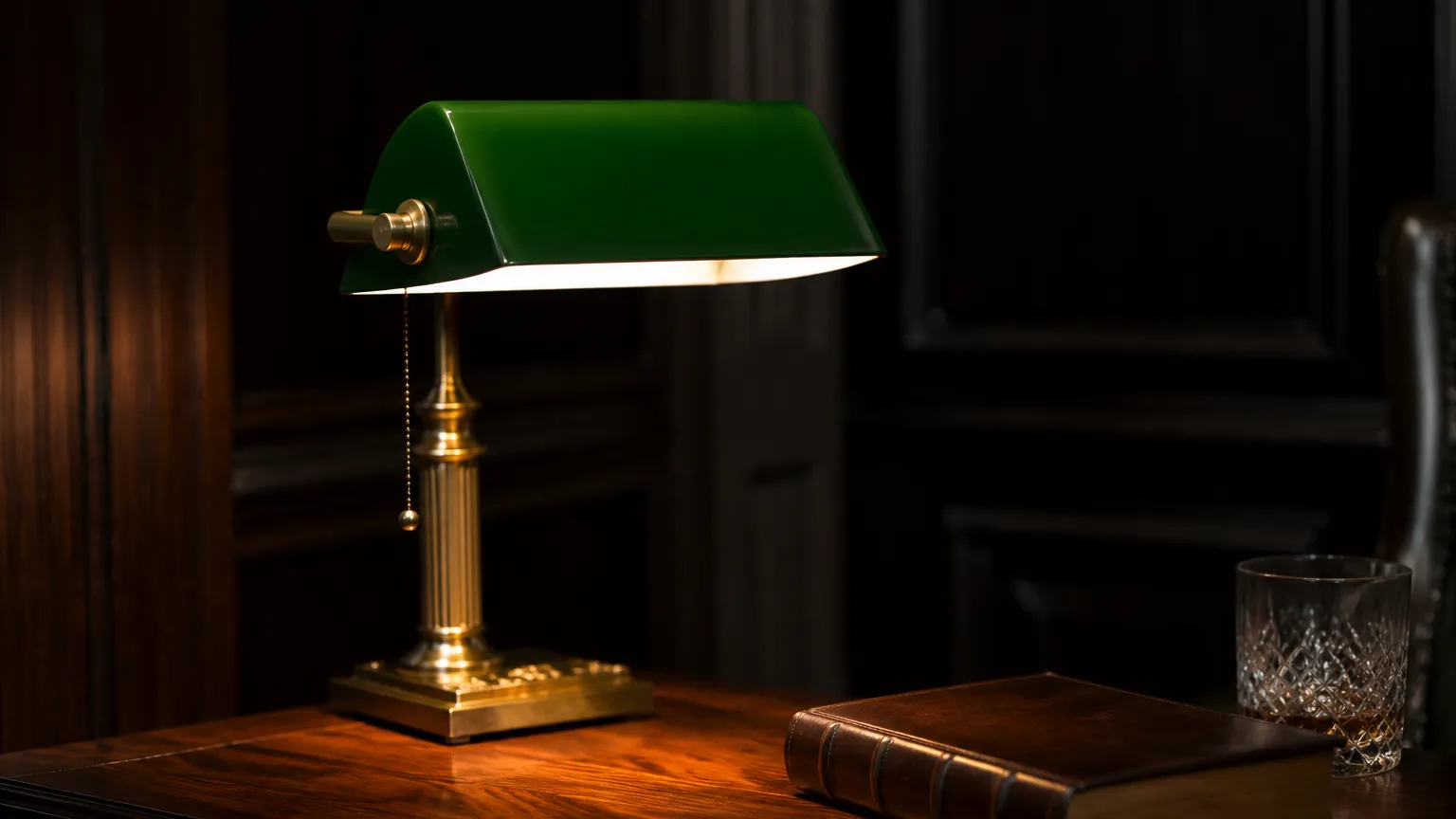
Vintage bankers lamps — brass base, green cased-glass shade, pull chain — are the one period lamp a guest can name, which is why they keep turning up on bar tops and in whiskey rooms.
The design has a documented origin. It was first sold as the Emeralite, a contraction of emerald and light, after the American engineer Harrison D. McFaddin filed a design patent application in 1909 and put the lamp into production the same year through H. G. McFaddin and Co. (The Bankers Lamp). One dealer-catalogued brass and green glass example is stamped August 15, 1916 and stands 12.25 inches high (George Glazer Gallery) — roughly the ceiling for anything sitting between two people.
The green shade is not decoration. It was made by the cased glass technique, fusing a white opal inner layer to a colored outer layer, so the inside stays bright and diffusing while the outside reads as deep green (The Bankers Lamp). The shade is flattened at the back and sloped toward the user at the front, throwing light down onto the surface and out of the sitter’s eyes. Banks bought them in volume partly because green was believed to reduce eye strain, the same reasoning behind the eyeshades clerks wore.
Downward throw, a hidden source, a compact footprint, a shade you can wipe: in a room with dark timber and brass rails the silhouette earns its place. Two cautions, though. The design is heavily reproduced and the quality gap is mostly in the glass — cased shades are skilled work, and thin single-layer green glass looks flat and blotchy when lit, so ask for a lit photograph of the actual shade rather than a rendering. And we do not stock a bankers lamp. Our own table lamp line sits in decorative table lamps, and a period silhouette like this one is a custom build quoted from drawings.
Table, Wall or Back Bar: Choosing the Format
A vintage look can be delivered from at least six positions in a bar, and each solves different problems and fails differently.
Start from the surfaces you already have. A bar top with a lip and no accessible outlets points straight at cordless. Booth tables bussed and wiped forty times a night point at wall-mounted, because anything free-standing eventually goes over. A back bar with glass shelving is a linear lighting job, not a lamp job. Getting that mapping right avoids the usual mistake: buying one attractive product and asking it to do all four jobs.
| Format | Where it sits | What it does | What to watch |
|---|---|---|---|
| Cordless table lamp | Bar top, booth and terrace tables | Moves with the covers; no cable, no outlet plan | Charging routine; a base heavy enough to take a knock |
| Corded table lamp | Fixed stations, ledges, host stand | Constant output, no nightly handling | Cable route, plug type, switch position |
| Wall sconce or swing arm | Above booths and banquettes | Frees the table, cannot be knocked over | Wiring in the wall; height against a seated head |
| Back bar shelf lighting | Behind and under bottle shelving | Makes the bottle wall the anchor of the room | Heat near labels, access for cleaning |
| Pendant over the counter | Above the bar itself | Defines the bar as a zone from across the room | Drop height against sightlines and staff |
| Picture or shelf light | Over art, mirrors, spirit displays | Adds depth on a wall that would go dark | Beam spill onto guests seated behind |
One pairing recurs. Cordless lamps on the tables plus linear lighting on the back bar works, because the layers do not compete; small lamps used to light a back bar give you hot spots, cables and a shelf you cannot clean. Where the wall is the statement, a lit sign beats a lamp — sizing and layout are in our piece on personalized neon bar signs.
LED Bar Lighting Behind the Bottles
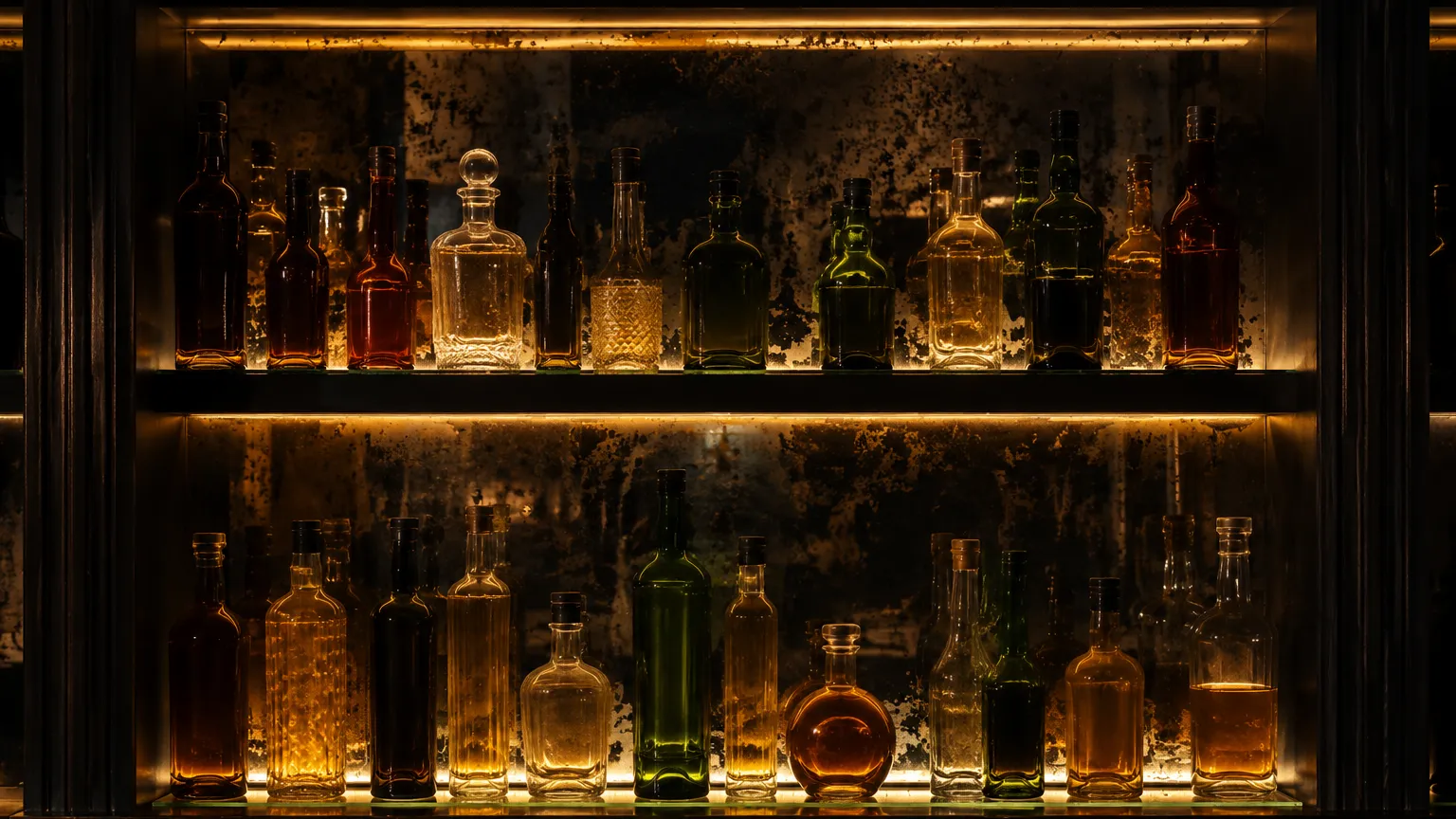
LED bar lighting is the layer nobody photographs on purpose and everybody notices when it is wrong: the concealed line of light under a shelf, behind a bottle row, or along the underside of the counter nose.
It is a different purchase from a lamp: a linear source, a driver, a channel to hold it and a control method, with failure modes that are installation failures rather than product failures. Three recur — visible dotting when a strip sits too close to the surface it lights, color mismatch between runs bought months apart, and adhesive letting go above a warm shelf. None are visible in a supplier photograph.
Three decisions carry most of the outcome. Density, because a low-density strip behind clear glass shows individual points. Channel, because an aluminium extrusion with a frosted diffuser hides the dotting and beats tape for holding a run. And ingress protection, because the wettest surface in the building is under the speed rail. Our LED strip spec decoder covers how those numbers appear on a datasheet, and the under-cabinet lighting primer covers shelf-mounting geometry.
One operational point saves arguments later: agree in writing where a run may be cut. Strips have fixed cut points, so the cut interval belongs in the drawing, not in the installer’s head. The practical version is in where LED strip can and cannot be cut.
Color Temperature and the Vintage Look From an LED Source
Almost every vintage-styled lamp shipping today has an LED inside it, which makes the period look a color decision rather than a bulb decision.
The physics behind the nostalgia is worth stating plainly. An incandescent bulb released about 90 percent of its energy as heat and only 10 percent as light, and that inefficiency produced the low orange glow people remember (U.S. Department of Energy). LEDs produce light up to 90 percent more efficiently (ENERGY STAR), and where a 75-watt incandescent gave roughly 1,100 lumens, an LED bulb can deliver that on as little as nine watts (U.S. Department of Energy). Efficiency is not the problem; matching the color of a deliberately inefficient source is.
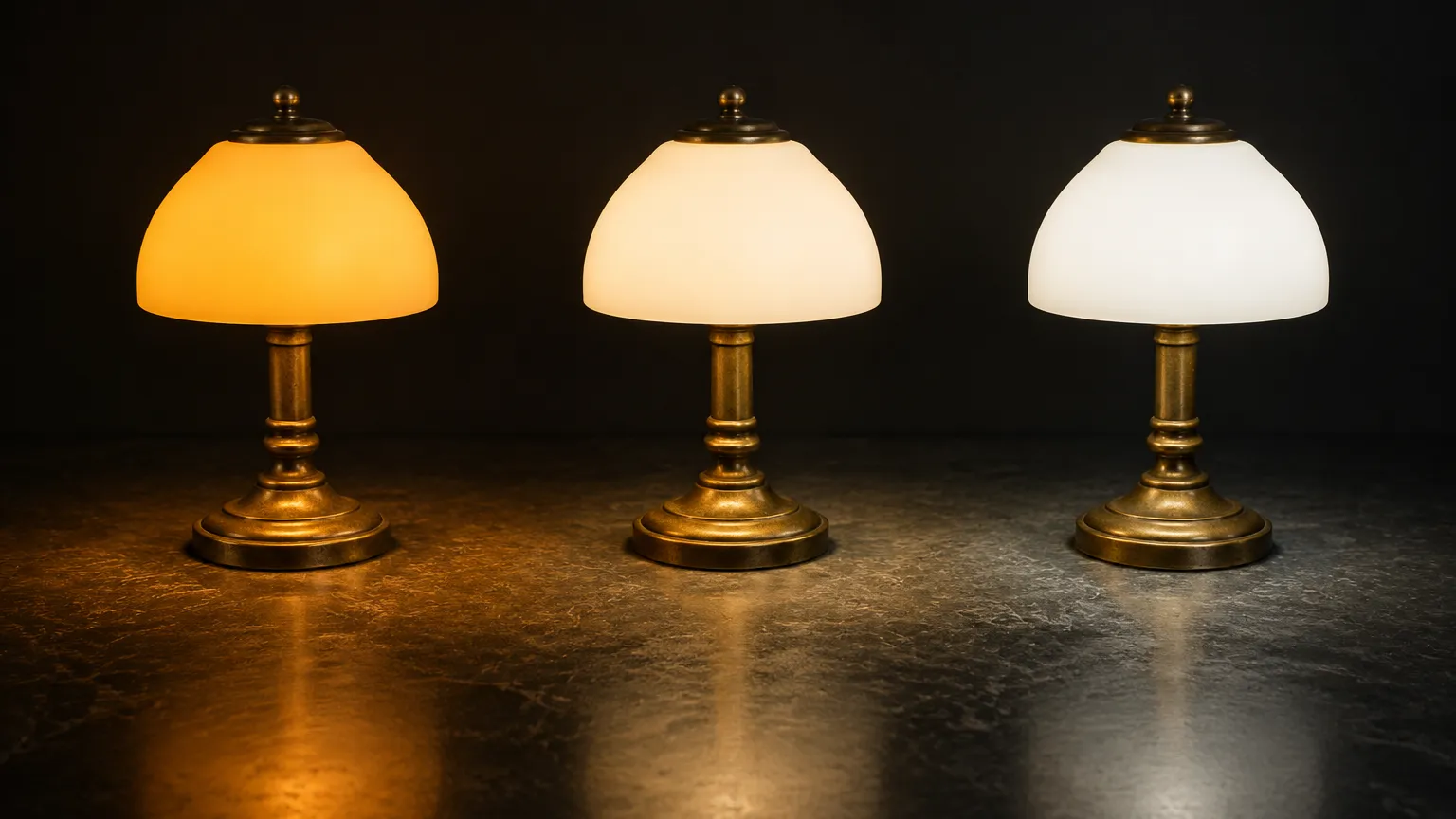
Color is measured on the Kelvin scale, where lower numbers look warmer and higher numbers cooler and bluer (U.S. Department of Energy). Filament-look products cluster around 2200K, general warm white sits near 2700K, and 3000K is where most hospitality specifications land. A period look wants the two lower bands, with one caveat: go too warm and white plates and shirt collars look dirty. Pick one number for the room and hold every fixture to it, including the strip behind the bottles.
Three points then decide whether a batch looks professional. Consistency across units, because lamps in a row show a mismatch the same lamps would hide in separate rooms. Dimming behavior, because LEDs respond almost instantly to whatever current a driver or dimmer sends them, so a poor pairing produces visible flicker — formally, temporal light modulation — worst at the bottom of the range, which is exactly where a bar runs (U.S. Department of Energy). And the definition of lifetime, since LEDs dim gradually rather than fail, with rated life commonly set where output has dropped by 30 percent (ENERGY STAR).
Flicker has a commercial edge now, because modulation a guest barely registers shows up as banding in a phone video. Run the sample at the bottom of your dimmer and film it. For the wider room brief, our overview of mood lighting across cozy retail categories covers the same decisions from the merchandising side.
Wiring, Plugs and the Part That Fails an Inspection
The look is the easy half. The electrical side is where a beautiful lamp becomes something you cannot put on a licensed floor.
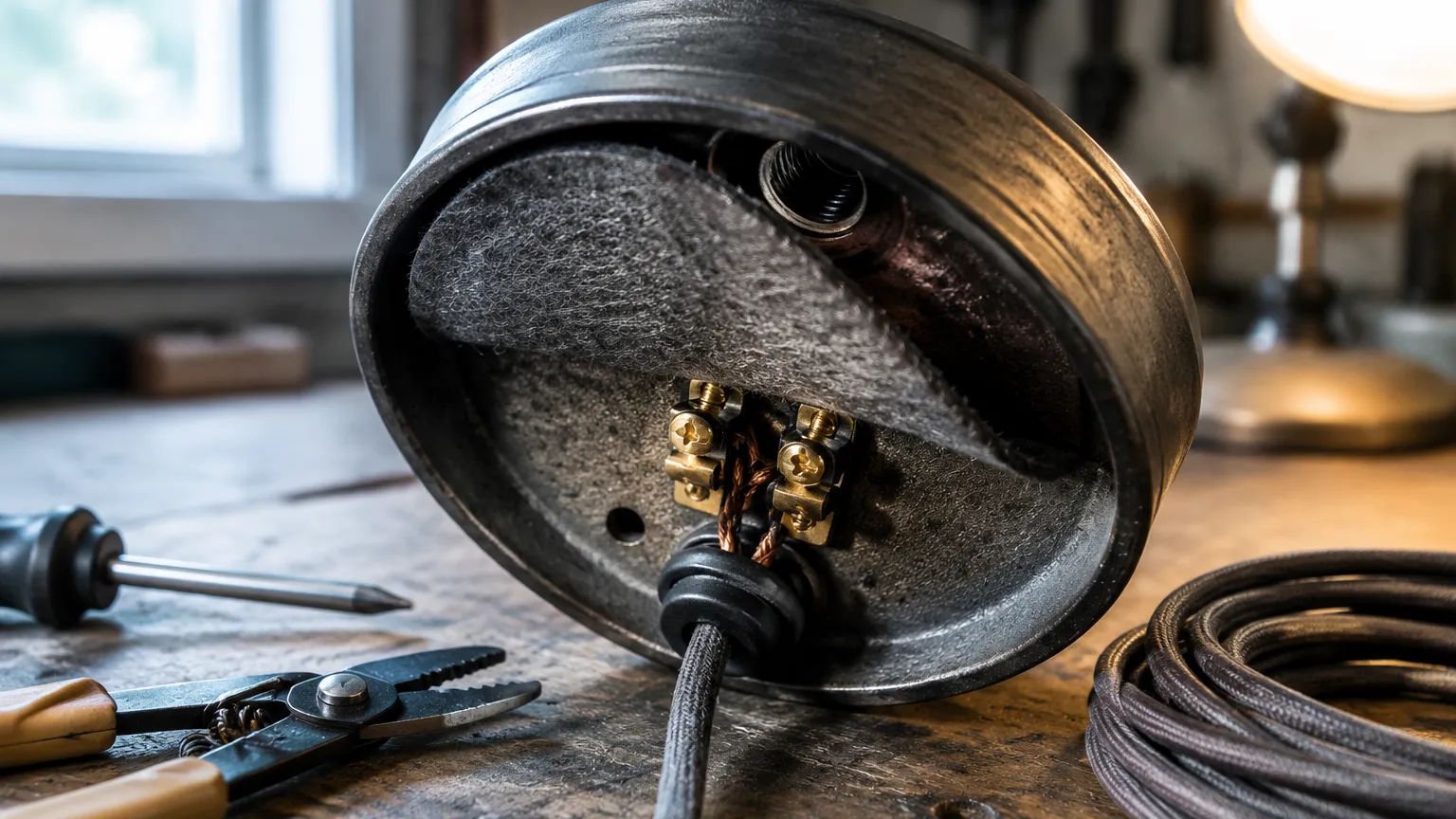
Portable lamps are a regulated category. IEC 60598-2-4:2017 sets requirements for portable general purpose luminaires on supply voltages up to 250 V; its 2017 revision raised the minimum ingress protection for outdoor portable luminaires from IPX3 to IPX4 and required the inclined-plane stability test to be run with the light source fitted (IEC). In North America, UL 153 covers portable electric luminaires intended for use in accordance with the National Electrical Code, NFPA 70, and its scope now includes battery-operated units powered only from integral batteries (UL Solutions). That is why a terrace lamp and a bar-top lamp are not interchangeable, and why a cordless lamp is a different compliance conversation from a corded one.
For a buyer the general rules are short. Buy the electrical side new, not restored. Ask which standard it was built and tested to for your destination market, and who holds the test file. Confirm plug type and voltage for every country in the order, and cord length against where the outlet actually is.
On genuine antiques the guidance is blunt: original cloth or rubber insulation degrades, and degraded insulation is a shock and fire risk, so a period lamp headed for a commercial floor needs its electrical parts replaced with new listed components and the work signed off by a licensed electrician for your jurisdiction. Do not do it in-house, and check with your local authority and insurer first. Ask early what happens when something breaks, too: shade, cord set, socket and switch fail first, and if none can be bought separately in two years you have bought consumables rather than lamps.
What to Check When the Sample Lands
Everything above collapses into one evaluation you can run on the first sample in twenty minutes, before anyone commits to a quantity.
Run it on a real bar top, not a desk. Height, footprint, weight and glare all behave differently at counter height with a stool in front of them, and a lamp that photographs well on a studio table can be unusable at 42 inches.
Put it on the actual surface
Counter height, with a stool. Check the footprint against a two-drink cover, and push it the way a guest will.
Sit down and look for the source
From a seated eyeline the filament or diode should be hidden. If you can see it, the room will complain.
Dim it to your service level
Take it to the bottom of the range you will run, film ten seconds on a phone, and look for banding.
Stand three units side by side
Color and finish consistency only shows in a row. One sample proves nothing about the batch.
Read the plug end and the label
Voltage, plug type, cord length, and the standard the electrics were built to for your market.
Clean it the way your staff will
Spirits, citrus and your own bar cleaner on the finish and the shade, then look again in the morning.
| Check | Why it matters | What to ask for |
|---|---|---|
| Shade geometry | Decides glare and where light lands | A lit photo from a seated eyeline, not a render |
| Color temperature | One number has to hold across the room | The Kelvin figure in writing, and its tolerance |
| Dimming and driver | Bars run where flicker shows | Compatible dimmers, tested on the sample |
| Unit consistency | A mismatch in a row looks like a mistake | Three units from one batch, shipped together |
| Base weight | Survivability on a working counter | Weight, base diameter, non-slip underside |
| Electrical build | Sets whether it is usable in your market | Standard, plug type, and who holds the file |
| Finish durability | Spirits and cleaners attack plating | A sample panel to test with your own cleaner |
| Spare parts | Shade, cord, socket and switch fail first | Confirmation each is orderable separately |
If the order will be manufactured rather than bought from stock, two guides carry the rest: importing lighting from China, and evaluating LED lighting manufacturers.
Build the look for your own rooms
We make decorative and ambient lighting in our own factory in Foshan — 4,000 square meters, 40 people, two production lines — and build to drawings as readily as to our own designs. Bring a silhouette, a finish, a color temperature and the market the electrics have to suit, and we will quote the build rather than sell you the nearest catalogue photograph.
Watch it work
Why a bar lamp carries character rather than brightness, in 37 seconds:
FAQ
What are vintage bar lamps?
Vintage bar lamps are small, low-output table, wall or shelf fixtures with a period design, used in bars and restaurants to carry the character of a room rather than to light it. The term covers three products: genuine antiques, current-production reproductions, and modern lamps that borrow period cues such as fluted glass and aged brass. Only the last two scale to a venue, because antiques cannot be matched or supported with spares. The light itself is a supporting layer: a dining surface calls for only 5 to 20 footcandles (IES).
What is LED bar lighting, and where does it go behind a bar?
LED bar lighting usually means the concealed linear layer rather than a lamp: a strip or rigid bar under a shelf, behind a bottle row, or along the underside of the counter nose. It is a different purchase from a table lamp, because you specify a source, a driver, a mounting channel and a control method together. Three problems recur: visible dotting when the strip sits too close to the surface it lights, color mismatch between runs bought months apart, and adhesive failing above a warm shelf. Higher density, a channel with a frosted diffuser, and the right ingress rating solve most of them.
Are vintage bankers lamps suitable for bar tables?
The silhouette suits a bar top unusually well. Vintage bankers lamps put a white opal inner layer inside a green cased-glass shade and slope it toward the user, so light falls on the surface and the source stays out of a seated guest’s eyes (The Bankers Lamp). They are compact too: a catalogued antique example stands 12.25 inches high (George Glazer Gallery). The cautions: the design is heavily reproduced and the quality gap shows in the glass, and a genuine antique needs new listed electrical parts and a licensed electrician’s sign-off before it goes near a commercial floor.
Why do two vintage-style lamps look different on the same bar top?
Almost always color, and almost always because nobody specified the tolerance. Two lamps quoted as the same warm white can come from different LED batches, and a difference invisible in separate rooms is obvious when the units sit two feet apart. Finish is the second cause, since plated brass shifts between runs. Fix it by putting one Kelvin figure and its tolerance in the purchase order, asking for three units from one batch at sample stage, and ordering the whole room at once.
How do I check a lamp’s finish will survive a bar top?
Test it with the chemicals it will actually meet, not with a cloth. Spirits, citrus juice, sugar syrup and your own bar cleaner attack lacquer and plating differently, and the damage usually shows as dulling or a ring rather than an obvious mark. Ask for a finish sample panel, or a spare shade and base you can ruin, leave the liquids on for a full service, then look in daylight the next morning. Ask what the finish is, too, because solid brass, plated steel and painted metal age differently.
Sources
Every external figure above was checked on 2026-08-28: light levels from the Illuminating Engineering Society, efficiency and flicker from the U.S. Department of Energy and ENERGY STAR, luminaire requirements from the standards themselves.
- Illuminating Engineering Society / Elite Lighting, IES Footcandle Recommendations (food service ranges, charted above), retrieved 2026-08-28.
- U.S. Department of Energy, Consumer Guide to Energy-Efficient Lighting (90% of incandescent energy released as heat; 1,100 lumens from nine watts), retrieved 2026-08-28.
- ENERGY STAR, U.S. Environmental Protection Agency, Learn About LED Lighting (up to 90% more efficient; rated life set at a 30% drop in output), retrieved 2026-08-28.
- U.S. Department of Energy, Solid-State Lighting Program, Flicker Research (temporal light modulation in LED systems), retrieved 2026-08-28.
- International Electrotechnical Commission, IEC 60598-2-4:2017, Portable general purpose luminaires (up to 250 V; outdoor minimum IPX4), retrieved 2026-08-28.
- UL Solutions, UL 153 Expanded to Add Battery-Operated Portable Luminaires, retrieved 2026-08-28.
- National Fire Protection Association, NFPA 70, National Electrical Code (the code UL 153 references), retrieved 2026-08-28.
- The Bankers Lamp, History of the original bankers lamp (the 1909 patent application; the Emeralite name; cased glass), retrieved 2026-08-28.
- George Glazer Gallery, Emeralite Bankers Lamp, Early 20th Century (patent date 1916; 12.25 inches high), retrieved 2026-08-28.
