




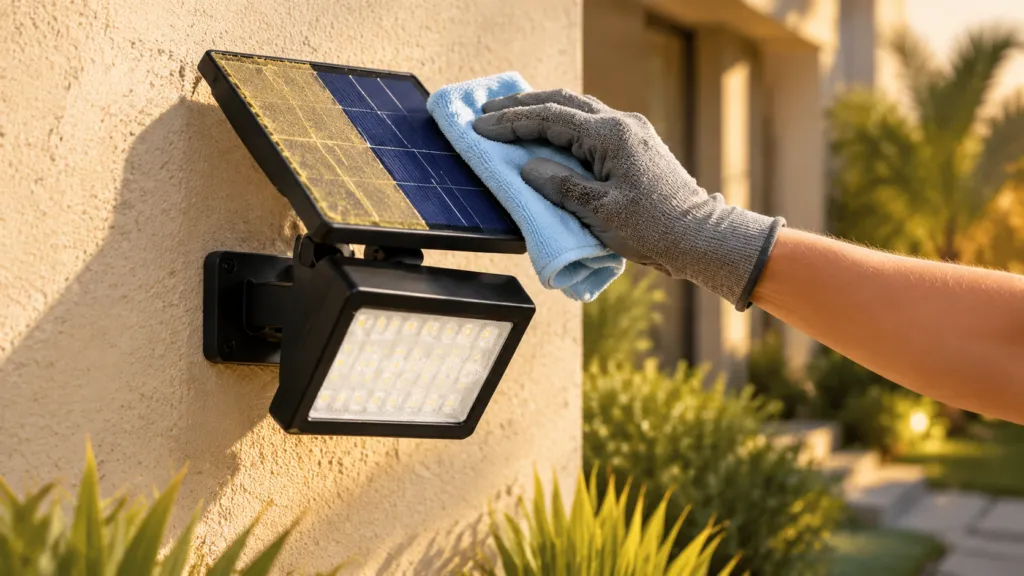
How to clean solar light panels properly matters more than most owners think, because a hazy panel can make a perfectly good light look broken. A film of pollen or dust means less charge by day and a shorter run at night, and sooner or later a customer at the returns desk with a light that only needed a wipe and a second look.
This guide is for the retailers and private-label buyers who take that call: how to clean a solar light without scratching it, how to find out why one will not come on, which repairs are worth the time, and what to write on the order so the next shipment ages better. Placement, shade and winter charging are covered in our guide to charging a solar light without sun; the fixtures we build sit in our solar flood lights range.
One finding frames the job. In December 2023 the National Renewable Energy Laboratory reported that pollen cut output by as much as 15% at five utility-scale solar plants in North Carolina during peak season, and that even frequent rain left output short of its pre-pollen level (NREL, Rain Not Enough To Wash Pollen From Solar Panels). Those were power-station arrays, not garden fixtures, so read the number as a direction, not a forecast: rain alone did not finish the job.
Key takeaways
Wash the panel with water, mild soap and a soft cloth, then take a light that stays dark through the five-step order: hand test, sensor and stray light, switch and mode, a full day’s charge, then battery and contacts. One that passes every check and still stays dark is worth a replacement claim.
- Wash, never scour. The 2018 NREL guidance for solar modules calls for plain demineralised water and a mild detergent, and rules out pressure washers, brushes, solvents, abrasives and harsh detergents.
- Rain is not a cleaning plan. In the 2023 pollen study output stayed down despite frequent rain, while mechanical wet-brush cleaning of the plant arrays won back 5% to 11%.
- Cover the panel after dusk: if the light comes on, the fixture works.
- Replace cells like for like: 1.2 V nickel-metal hydride, 3.2 V lithium iron phosphate and 3.6 V lithium-ion cells are not interchangeable.
- Yellowing inside a plastic cover cannot be cleaned off; it is settled when the cover is specified.
How to Clean a Solar Light Panel Without Scratching It
To clean a solar light panel, switch the light off, lift the loose dust away dry, wash the panel with lukewarm water and a few drops of mild dish soap on a soft microfibre cloth, rinse with clean water and let it dry. That is the whole method. Everything else is about what to keep away from the surface.
In 2018 the National Renewable Energy Laboratory’s best-practice guide for solar operations told operators to clean modules with plain demineralised water and a mild detergent, and not to use high-pressure water, brushes, solvents, abrasives or harsh detergents (NREL, Best Practices for Operation and Maintenance). A wall fixture deserves the same restraint.
Small lights are less forgiving than a rooftop module, because not all of them are fronted with glass. Grit dragged across a plastic or laminated face scratches it, and every fine scratch scatters light that should reach the cell. Paper towels, scouring pads, window sprays and solvent wipes all belong on that list.
Switch off and work cool
Set the switch to off and clean in the morning or evening, so water does not dry into spots on a hot panel before you rinse.
Lift the dust dry
Blow off loose grit, or lay a dry microfibre cloth flat and lift it away. Wiping grit sideways is what scratches a plastic face.
Wash with mild soap
Lukewarm water and a few drops of dish soap on a soft cloth, in straight strokes. Wipe the lens and the sensor window in the same pass.
Rinse and dry
Clean water, demineralised where the tap water is hard, then pat dry. Keep water away from the switch and any open seam.
Test before you walk away
Switch on, cover the panel with a hand, then give it a full day of sun before judging runtime.
Why bother, if it rains? The 2023 NREL work followed five utility-scale plants in four North Carolina counties, all in service for more than seven years. Rainfall carried off part of the pollen, yet output stayed below its pre-pollen level even after the season ended, despite frequent rain. Without planned cleaning the researchers put annual losses on the order of 10%, and mechanical wet-brush cleaning brought gains of 5% to 11% (NREL). That was machinery on utility arrays, not a hand brush on a light. Globally, the IEA Photovoltaic Power Systems Programme estimated in December 2022 that soiling cost at least 3% to 4% of the world’s PV output in 2018, adding that particles under 10 µm are rarely removed by wind (IEA PVPS, Soiling Losses report).
Source: NREL, Rain Not Enough To Wash Pollen From Solar Panels (December 2023); IEA PVPS Task 13, Soiling Losses report T13-21:2022 (December 2022). Retrieved 2026-10-12.
The Four Usual Causes When a Solar Light Stops Working
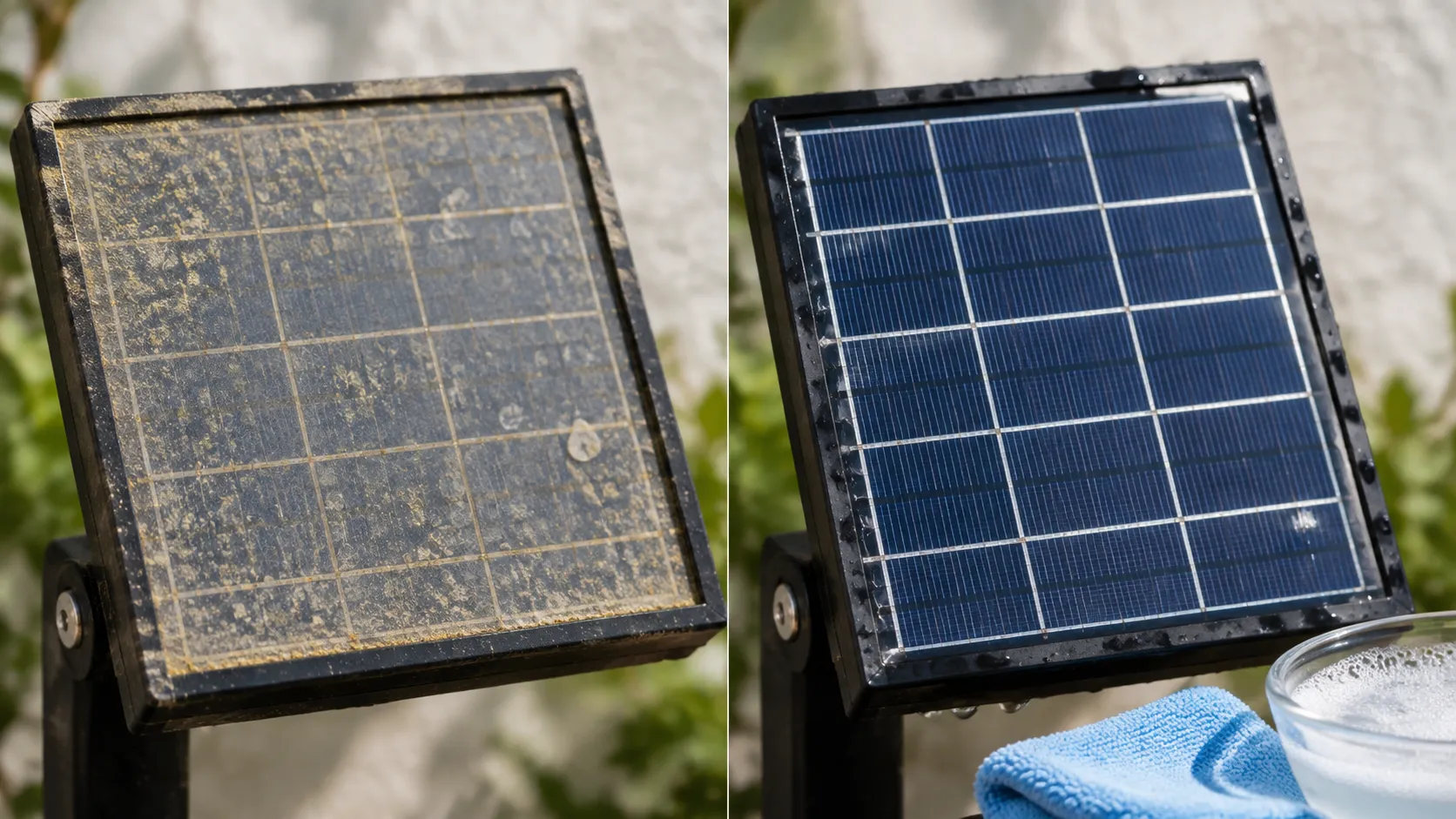
A solar light that will not come on usually has one of four problems: the panel is not charging, the sensor is being told it is still day, the switch or mode is wrong, or the battery and its contacts have failed. The first three cost nothing to fix; only the fourth needs a part, so blame it last.
For a retailer, that split decides the call. When a customer asks “why is my solar light not working”, the real question is refund, replace or a talk-through, and the three free fixes belong in the returns script before a unit goes back into a box.
Printed troubleshooting lists also put the free fixes first. A 2021 instruction sheet from UK retailer Coopers of Stortford, for a 20-LED solar string light, gives three steps: make sure the switch is on, keep the solar panel clean, and replace the rechargeable batteries if the light stops after around 8 to 12 months (Coopers of Stortford, H262 instructions for use).
The table sorts the four by symptom. Covering the panel after dusk splits them in two before anything is opened: if the light comes on, the fault is in charging or sensing; if it stays dark, the switch is off, the light is in motion mode with nothing moving, the battery is flat or worn, or a contact has corroded. How long a battery should last at all is a heat and depth-of-discharge question, set out in our page on why solar lights fail so quickly.
| Symptom | Most likely cause | Check first | Fix |
|---|---|---|---|
| Dark every night, even after sun | Panel dirty, shaded or still filmed | The panel at midday; any transit film | Wash, peel the film, move it into sun |
| Dark, but lights when the panel is covered | Stray light on the sensor, or motion mode over an empty yard | Porch lamps, streetlights, lit windows; the mode | Re-aim or shield; try dusk-to-dawn |
| Dark even with the panel covered | Switch off, motion mode with nothing moving, flat or failed battery, corroded contact | The switch and mode, then the battery bay | Clean contacts, recharge a full day, replace the cell like for like |
| Comes on, fades long before morning | Worn battery or part-day charging | Wash and retest after one sunny day | New battery if runtime does not recover |
| Flickers, or works some nights only | Water in the housing, loose contact | Condensation or crust inside | Dry and reseal; replace a corroded board |
How to Fix Solar Light Not Working at Night: A Five-Step Check
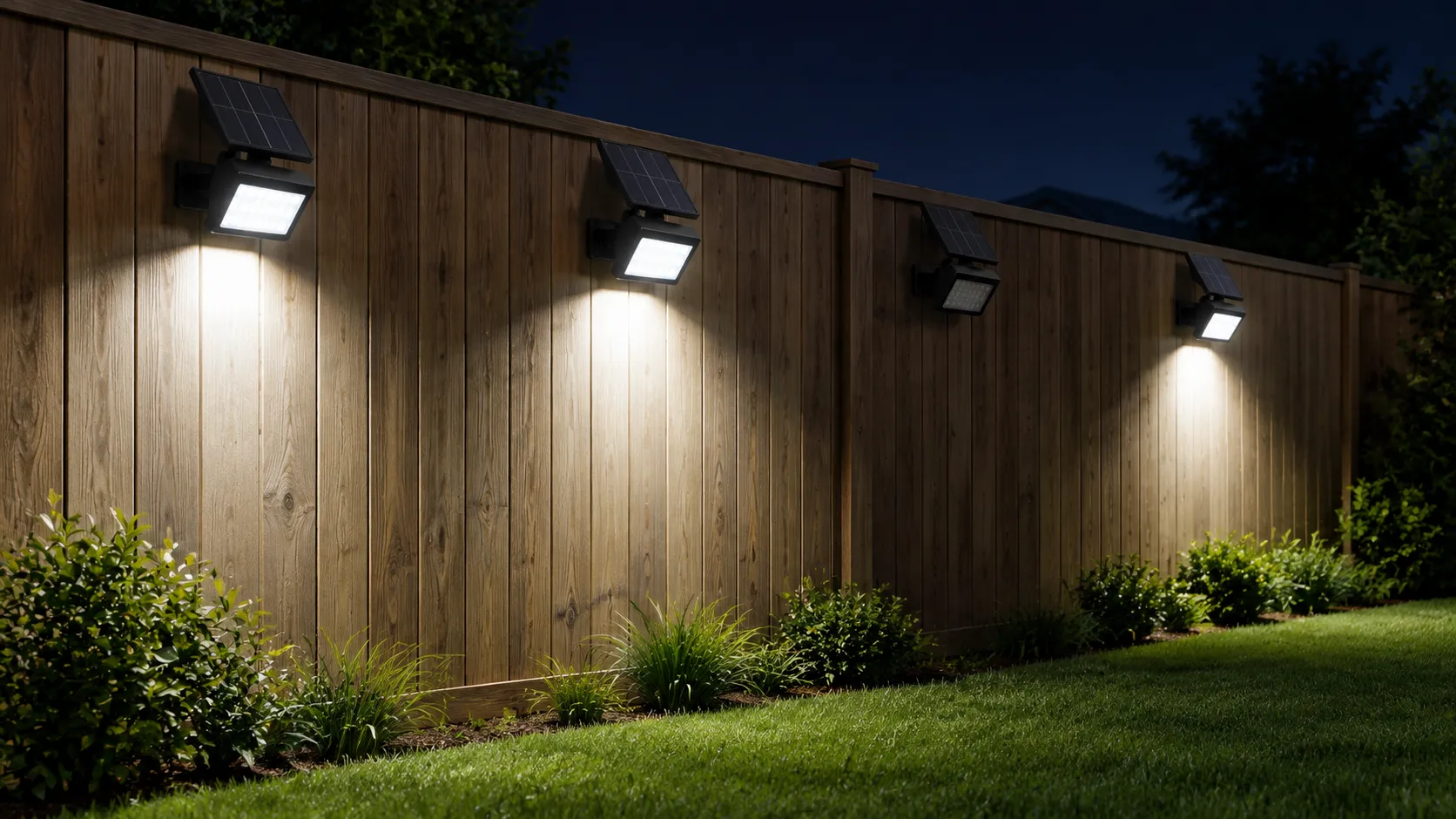
To fix a solar light not working at night, cover its panel by hand first. If it lights, the LED and battery work and the fault is in charging or sensing: too little charge by day, or a sensor that thinks the sun is still up. If it stays dark, move on to the switch and mode, the battery and the contacts.
The hand test is printed advice, not folk wisdom: Coopers of Stortford’s 2021 sheet for its H262 solar string light tells users to cover the panel with a hand to confirm the switch is on, warns that porch lights and streetlights may fool the sensor and keep the light off, and asks for at least 8 hours of direct sun (Coopers of Stortford, H262 instructions for use).
Cover the panel
After dusk, cover the panel, or the separate panel on split models, with a hand for a few seconds; on motion models, wave the other hand at the sensor too. Light on means the fixture works.
Clean the sensor windows
Wipe the motion sensor lens and any light-sensor window. A filmed motion lens dulls detection, so a light in motion mode may never trigger.
Look for light that is not the sky
Porch lamps, streetlights or a lit window falling on the fixture can hold it off. Re-aim, shield or move it; on split models, move only the panel.
Check the switch and mode
Switch on, transit film or pull tab gone, and the mode the customer expects. Motion mode stays dark until something moves.
Charge one sunny day, then retest
Wash the panel if it is filmed, give it a full day of sun, then repeat the hand test at dusk. Still dark with the panel covered: go to the battery.
Check the mode before blaming a part. Our Solar LED Flood Light runs in Motion, Dusk-to-Dawn and Always-On modes, and in Motion mode it waits in a low-power state until it detects movement, so a dark, empty driveway is the product doing its job. Our Motion-Activated Solar Flood Light mounts its panel apart from the head, which lets the head guard a shaded doorway while the panel finds sun on a roof edge or fence top.
For anyone asking how to fix solar light problems over the phone, steps one and four cost nothing and need no visit. Detection zones, mounting height and false triggers are a separate subject, covered in our guide to solar flood lights with a motion sensor.
How to Repair a Solar Light: Battery, Sensor, Switch, Contacts
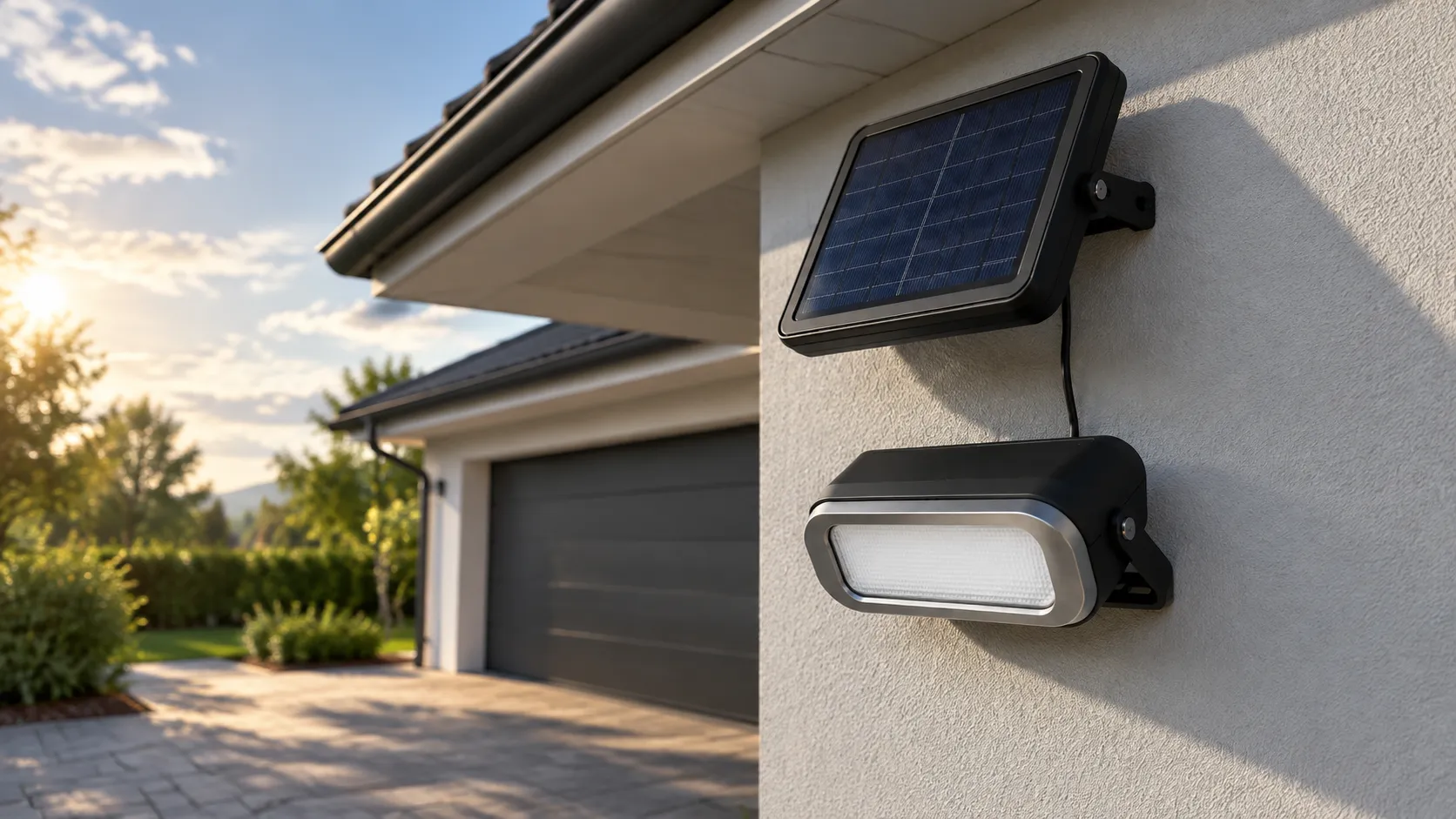
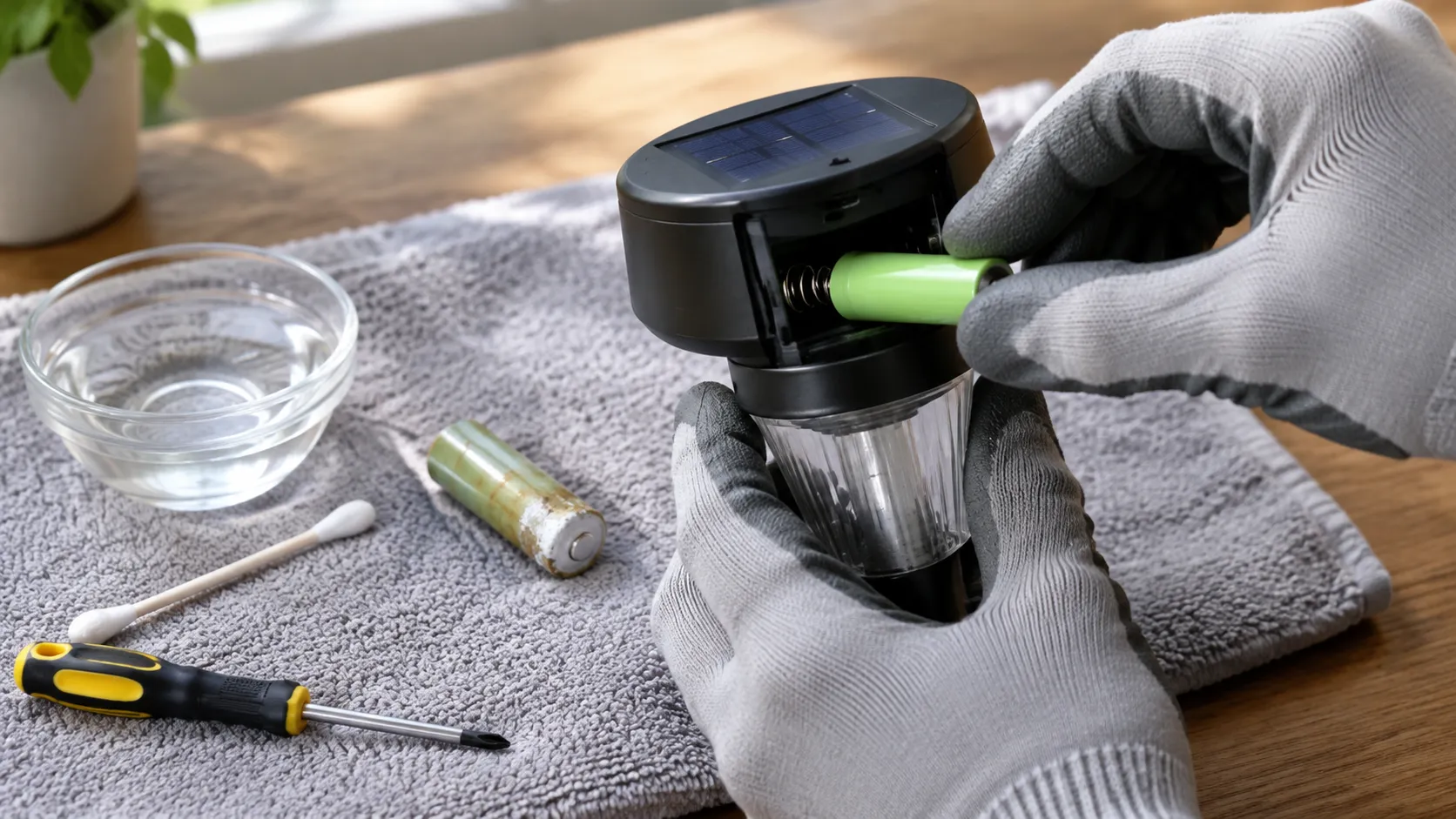
Repairing a solar light comes down to four parts you can test on a bench: the battery, the sensor, the switch and the contacts that join them. Switch it off, open it over a towel and work through all four before deciding that the board or the LED has failed.
Most guides on how to repair solar lights start with the battery, because it is the part that wears. A white crust on the terminals is usually leakage from a tired cell.
Duracell’s battery FAQ gives one clean-up for alkaline, NiCd and NiMH leaks: household gloves and glasses in a ventilated space, a cotton swab with vinegar or lemon juice diluted 50/50 in water to lift the residue off the contacts, and a fully dry fixture before a new cell goes in (Duracell, Battery FAQs).
Lithium packs get no vinegar. The U.S. Fire Administration’s battery safety page, checked in October 2026, tells users to stop using a lithium-ion battery that shows an odor, a change in color, too much heat, a change in shape, leaking or odd noises, and to recycle it rather than bin it (U.S. Fire Administration, Battery Fire Safety). A swollen pack is the one real hazard on this bench: out of the fixture, into recycling, never back on charge.
Replace cells like for like: same chemistry, same voltage, same size. Battery University’s voltage guide, retrieved in October 2026, lists nickel-based consumer cells at 1.20 V, standard lithium-ion at 3.60 V and lithium iron phosphate at 3.20 to 3.30 V per cell, and the charging algorithms differ as well (Battery University, BU-303 Confusion with Voltages). A cell that fits the holder can still be wrong for the circuit. Which chemistry outlasts the others outdoors is covered in our outdoor solar lights sourcing guide.
The other three are quicker. Work a damp slide switch back and forth and clean the contacts with a little isopropyl alcohol. Check the sensor lens for cracks. If water got in, leave the housing open somewhere dry until the condensation is gone, then reseal. A corroded board, a cracked panel or a damaged pack ends the repair, and a fixture wired into the house belongs with an electrician.
For a retailer, this applies only if the model on the shelf can be opened. On a sealed integrated fixture the battery may not be user-replaceable, which turns a quick fix into a return. Settle that, the battery chemistry and capacity, and whether spare cells can ship with the order on the enquiry, not after the first complaint.
Hazy or Yellowed Panels: Cleaning Limits and What to Specify Instead
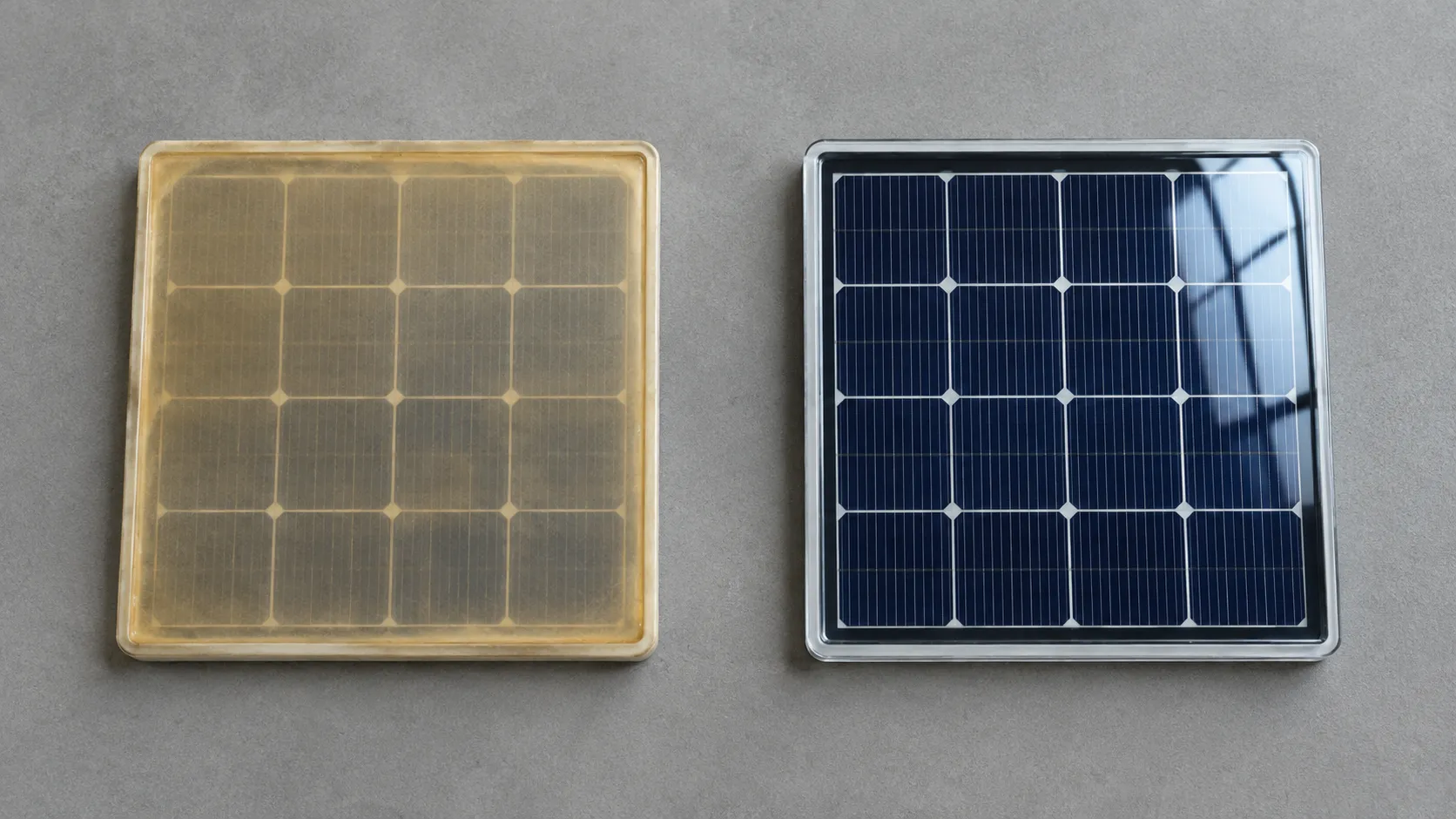
A hazy panel can often be cleared and a yellowed one usually cannot. Surface film and fine scratches respond to washing and a non-abrasive plastic polish; colour inside the material, cracks and deep scratches are permanent, and the fix for those sits upstream, in what the panel cover is made of.
Wash first, then look in daylight. Haze that stays as fine scratches is surface damage, which a plastic polish can improve. A yellow or brown cast that no cloth reaches is the plastic itself changing.
Ultraviolet light breaks polymer chains through photo-oxidation. A 2013 review in the journal SpringerPlus says UV damage is commonly the main cause of yellowing, lost gloss and cracking in plastics, and reports polystyrene under UV in air yellowing quickly (Yousif and Haddad, SpringerPlus). How fast a cover goes depends on the plastic and its stabilisers, so two panels left out for the same summers can come back one amber and one clear.
| Condition | Can cleaning fix it? | What to do |
|---|---|---|
| Dust, pollen or bird-dropping film | Yes | The soap-and-water wash above |
| Hard-water spots | Usually | Diluted white vinegar if the care instructions allow, then a plain rinse |
| Fine scratches on plastic | Partly | Non-abrasive plastic polish; expect better, not new |
| Yellow or brown inside the plastic | No | Replace the panel or fixture; specify the cover next time |
| Crack, deep scratch or moisture behind the cover | No | Replace; water follows a crack to the cells |
No retailer can polish its way out of a cover problem across a whole shipment, so the decision belongs on the order. Ask which cover the quoted model uses (tempered glass, a PET laminate or cast epoxy), whether a glass-fronted option exists, what UV stabilisation the plastic carries and, for split-panel models, whether a panel can be supplied on its own. Those answers differ by model and are confirmed on the quotation. Our spec floor for panels and water sealing is in the guide to the best outdoor solar lights.
A Maintenance Card Retailers Can Print
The maintenance card that works is short and triggered by events rather than a calendar: clean after pollen season and after storms, check before the first frost, and run the hand test whenever a light dims early. Print it on the insert or the shelf talker, and the “why my solar light is not working” call starts with three answers already tried.
The shelf card in our guide to charging a solar light without sun covers sun hours and winter runtime; this one covers cleaning and faults.
Events beat dates because rain is uneven help. The NREL operations guide notes that heavy rain gives a nearly complete clean, while light rain cleans much less and can even add soiling as dust sticks to sparse droplets.
NREL’s 2018 operations and maintenance guide reports a simulation for a system in Mesa, Arizona, where an annual soiling loss of 1.91% fell to 1.52% with one cleaning a year, 1.32% with two and 1.20% with three (NREL, Best Practices for Operation and Maintenance). Each extra wash bought less than the one before.
That data cuts against a sales pitch: the NREL guide also records a study that judged cleaning not cost-effective for residential, commercial or utility plants. A flood light is a different sum, with a small panel, a quick wash and a return as the cost of a dark night, but no card should promise that cleaning revives a worn battery. It restores the charge the dirt was stealing, nothing more.
Numbers on the card should be the product’s own. The 2021 Coopers sheet asks for a soft-sponge clean every couple of weeks and new batteries after around 8 to 12 months; that is one string light’s guidance, not a rule for a flood light. Take figures from the sample you tested.
| When | What to do |
|---|---|
| After pollen season | Wash the panel and the sensor lens; hand test at dusk |
| After a storm, snow or a dusty spell | Clear the panel; look for water behind the lens |
| Before the first frost | Clean the panel, check the seals, and move or re-angle any unit the winter sun will not reach |
| Light dims early or stays dark | Run the five-step check |
| A battery is swollen, hot or smells | Stop using it and recycle it; do not recharge |
Whether a quoted model’s charge controller stops charging in freezing weather is an enquiry question, along with the sensor window position, where modes are set, and whether a printed card can ship in the carton. For a two-head unit such as our Dual-Head Motion Sensor Solar Flood Light, add a line on re-aiming each head, since each pivots on its own.
For a buyer, the card is the short answer to how to clean solar lights and when to call it a fault. Every model in our wholesale solar flood lights line can be quoted with those answers written down.
Order solar flood lights with the care answers already written
We build our solar flood lights in our own factory in Foshan, 4,000 square metres with 40 people across two production lines. Every model is wire-free and charges from its own panel, and the cover material, the battery chemistry and capacity, whether the battery is user-replaceable, and a printed care card are lines we confirm on your quotation. Send your market, the placement and the runtime you need, and we will quote and sample against it.
Watch it work
Why a solar light carried back to the returns desk often only needed a wipe and a second look, in 40 seconds:
FAQ
How to clean a solar light panel with vinegar?
If the care instructions allow it, dilute white vinegar in water and save it for the hard-water spots and mineral rings that soapy water leaves behind. Apply it on a soft cloth, then rinse with plain water so nothing acidic dries on the panel or runs into the seals. It will not shift yellowing, which sits in the plastic rather than on it.
What is the best thing to clean a solar panel with?
Water with a drop of mild detergent on a soft cloth. For large arrays, the national laboratory guide names a bucket of water, a strip cleaner and a squeegee as the economical method, worked in overlapping vertical strokes. A small panel on a light fixture needs only the cloth and a dry wipe.
Can I use WD-40 to clean solar lights?
Not on the panel or the lens. WD-40 says its Multi-Use Product should be kept off polycarbonate and clear polystyrene, which can react poorly with petroleum-based products, and a clear solar light cover may be either. A stiff, damp switch wants a contact cleaner made for electrics.
Why do solar lights stop working after a year?
Usually because the battery wore out, not the LED: heat and a deep discharge every night shorten the life of a small cell, and our page on whether solar flood lights are worth it sets out the cycle data. A one-year-old light that passes the hand test but fades early needs a new cell before it needs a new fixture.
Sources
Every external figure above was checked on 2026-10-12: pollen losses and cleaning gains from the national laboratory’s 2023 release, global soiling losses from the IEA PVPS Task 13 report, cleaning practice and the cleaning-frequency simulation from the national laboratory’s operations and maintenance report, the hand test and stray-light warning from a retailer’s printed instruction sheet, leak clean-up from Duracell, battery handling from the U.S. Fire Administration and Battery University, plastic yellowing from a peer-reviewed polymer review, and the plastics warning from the maker of WD-40.
- National Renewable Energy Laboratory (now the National Laboratory of the Rockies), NREL Research Finds Rain Not Enough To Wash Pollen From Solar Panels, 18 December 2023 (five utility-scale plants in four North Carolina counties, each operating more than seven years; output down by as much as 15% in peak pollen season; annual losses on the order of 10% without planned cleaning; 5% to 11% gains after mechanical wet-brush cleaning; rain not enough to restore cleaned performance), retrieved 2026-10-12.
- IEA Photovoltaic Power Systems Programme, Task 13, Soiling Losses: Impact on the Performance of Photovoltaic Power Plants, executive summary, Report IEA-PVPS T13-21:2022, December 2022 (soiling the most influential factor on yield after irradiance; at least 3% to 4% of annual PV energy lost in 2018; 4% to 5% expected by 2023; particles under 10 µm rarely removed by wind), retrieved 2026-10-12.
- National Renewable Energy Laboratory, Sandia National Laboratory, SunSpec Alliance, Best Practices for Operation and Maintenance of Photovoltaic and Energy Storage Systems, 3rd Edition, NREL/TP-7A40-73822, December 2018, section 5.7.1 Cleaning (demineralised water and mild detergent; no high-pressure water, brushes, solvents, abrasives or harsh detergents; bucket, strip cleaner and squeegee method; heavy versus light rain; Mesa, Arizona simulation of 1.91% annual soiling loss falling to 1.52%, 1.32% and 1.20% with one to three cleanings; study judging cleaning not cost-effective), retrieved 2026-10-12.
- Coopers of Stortford, 20 LED Solar String Lights H262 Instructions for Use, v001 15/03/21 (remove the protective film; cover the panel with a hand to verify the switch; keep away from porch lights and streetlights that may fool the sensor; at least 8 hours of direct sun; clean the panel every couple of weeks; replace batteries after around 8 to 12 months), retrieved 2026-10-12.
- Duracell, Battery FAQs and Answers, battery leak clean-up (for alkaline, NiCd and NiMH leaks: work in a well-ventilated area wearing household gloves and glasses; one tablespoon of boric acid per gallon of water, or vinegar or lemon juice diluted 50/50 with water; toothbrush or cotton swab on the contacts; device completely dry before a new battery), retrieved 2026-10-12.
- U.S. Fire Administration, FEMA, Battery Fire Safety (stop using lithium-ion batteries on odor, change in color, too much heat, change in shape, leaking or odd noises; recycle lithium-ion batteries rather than putting them in the trash), retrieved 2026-10-12.
- Battery University (Cadex Electronics), BU-303: Confusion with Voltages (consumer NiCd and NiMH rated 1.20 V per cell; lithium-ion 3.60 V; lithium iron phosphate 3.20 V and 3.30 V; differing charging algorithms), retrieved 2026-10-12.
- Emad Yousif and Raghad Haddad, SpringerPlus, Photodegradation and Photostabilization of Polymers, Especially Polystyrene: Review, SpringerPlus 2, article 398, 23 August 2013 (UV radiation commonly the main reason for yellowing of plastics and loss of gloss and mechanical properties; photo-oxidative degradation breaks polymer chains; polystyrene under UV in air yellows rapidly and embrittles gradually; stabilising systems against photodegradation), retrieved 2026-10-12.
- WD-40 Company, What WD-40 Multi-Use Product Is Safe On (and What to Avoid) (avoid polycarbonate and clear polystyrene plastics, which can react poorly with petroleum-based products; spot-test if unsure), retrieved 2026-10-12.
