





How to charge a solar light without sun is mostly a question of where the panel sits and how much battery it has to fill, so the fixes start with placement and end with a spare battery. Cloudy days still charge it, only slowly: an overcast sky puts about 1,000 lux on the panel against 32,000 to 100,000 lux in direct sun (Wikipedia, Lux), so a light that ran all night after a clear day can be dark by midnight after a grey one. Indoor bulbs barely count as a fix: they return a sliver of daylight and turn most of their power into heat.
This page is written for buyers who stock solar fixtures as much as for owners. The questions reach a retailer every autumn, and the ones the box never answered come back as complaints. The solar flood lights we build obey the same physics as every garden stake on the market.
The fixes are ranked by how much charge each one realistically puts back for the effort and the cost; for the light-based ones the yardstick is lux at the panel, the one unit that puts sunlight and lamplight on the same scale. Strong direct sun means 100,000 lux throughout, just under the 107,527 lux Engineering ToolBox lists for full sunlight. Lux is weighted to the human eye, not to a silicon cell, so read the numbers as orders of magnitude, never as a charging rate.
Key takeaways
How to charge a solar light without sun, in order of payoff: get the panel into open sky, accept that cloud and winter shrink the daily deposit, check the battery and any charging input before blaming the weather, and treat an indoor bulb as a top-up of last resort.
- Move the panel first. Open shade under a clear sky measures 10,000 to 25,000 lux, a tenth to a quarter of strong direct sun at 100,000.
- Cloudy days still charge, at about 1% of strong direct sun and as little as 0.1% on a very dark day: an overcast day measures about 1,000 lux, and thick cloud can remove 100% of the direct beam, leaving only diffuse light (U.S. Department of Energy).
- Winter cuts hours and angle together: mid-latitude daylight falls from about 15 hours to near nine (National Weather Service), and in the U.S. Department of Energy example for Denver, December sun delivers roughly a third of the June total.
- Check the battery before blaming the weather: early fades after sunny days point to a tired cell, and only a fixture with a USB or DC input can be plugged in. Lithium-ion cells should not be charged below 0°C (32°F) (Battery University).
- An indoor bulb is the last resort: a 60-watt-class bulb rated at 800 lumens puts roughly 1,600 to 6,400 lux on a panel 10 to 20 cm away, about 2% to 6% of strong direct sun by our calculation, more lux than an overcast sky but paid for in electricity, and 90% of an incandescent bulb’s energy leaves as heat (ENERGY STAR).
Does Solar Light Need Direct Sunlight, or Will Bright Shade Do?
No, bright open shade will do, at a fraction of the charge: a solar light needs open sky more than it needs direct sun, and the gap between bright shade and deep shade is far wider than it looks.
The eye adapts, so a shaded patio seems only a little darker than the lawn beside it. A light meter disagrees. The standard illuminance tables put direct sunlight at 32,000 to 100,000 lux and full daylight out of the direct sun at 10,000 to 25,000 lux (Wikipedia, Lux), which means a panel in open shade on a clear day works on roughly a tenth to a quarter of what the same panel collects in strong midday sun. Under a porch roof or a dense hedge it lives on light closer to an overcast day.
The panel loses more than that ratio suggests. As light falls, a cell’s internal losses grow as a share of its output: the reference text by Christiana Honsberg and Stuart Bowden explains that shunt resistance matters more at low light, and that a cell with high shunt resistance keeps more of its efficiency under cloud (PVEducation). That parameter never appears on a shelf card, which is one reason two fixtures with equal panels behave differently in the same shady corner.
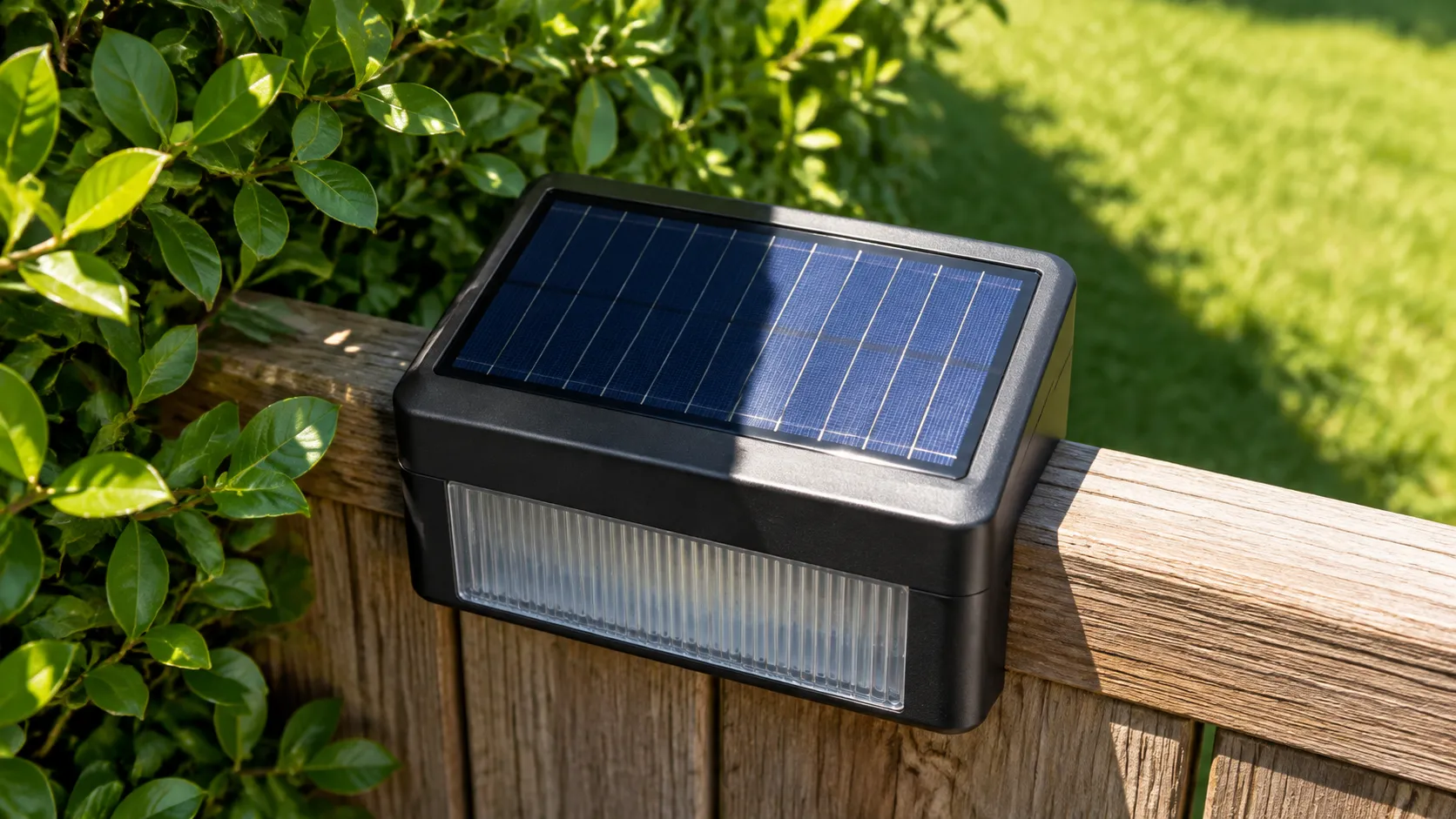
Partial shade has its own trap. The cells in a small panel are usually wired in series, so a fence post or a branch shadowing one strip of cells can drag down the whole panel. Watch a spot through a full day before fixing a light to it: a corner bright at noon in June can sit in a neighbour’s shadow by mid-afternoon in November.
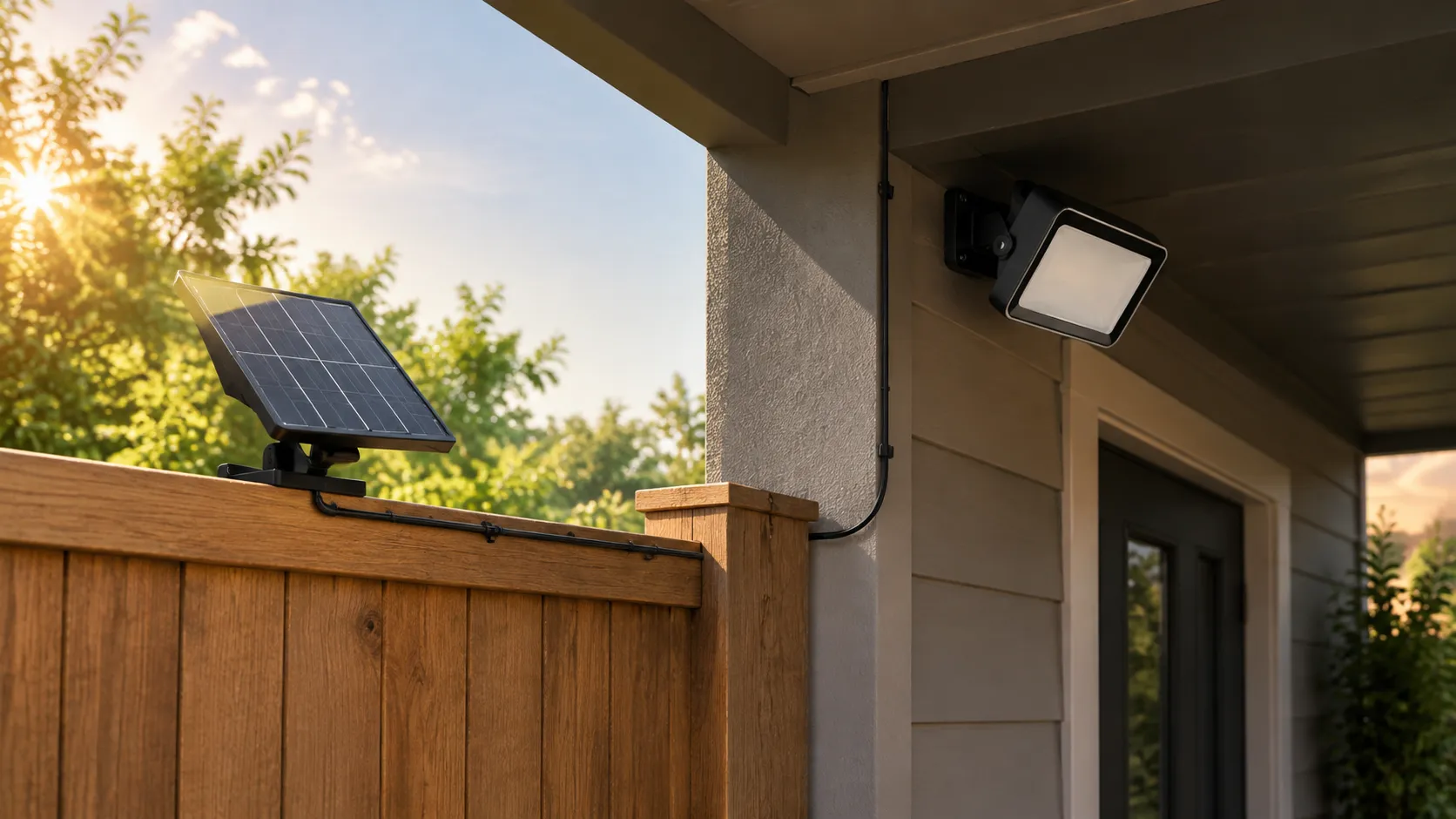
Reflected light helps, within limits. A pale wall or a sheet of foil behind the panel bounces existing daylight onto the cells; it moves light and makes none, so on a dark day it adds next to nothing. When the light itself has to live in shade, the cleaner fix is to separate the two jobs. Our motion-activated solar flood light carries a separate panel, so the lamp can sit under an eave or in a porch recess while the panel goes on a roof edge or a fence top where the sun actually reaches.
Does Solar Light Work in Winter? Day Length Versus Battery Size
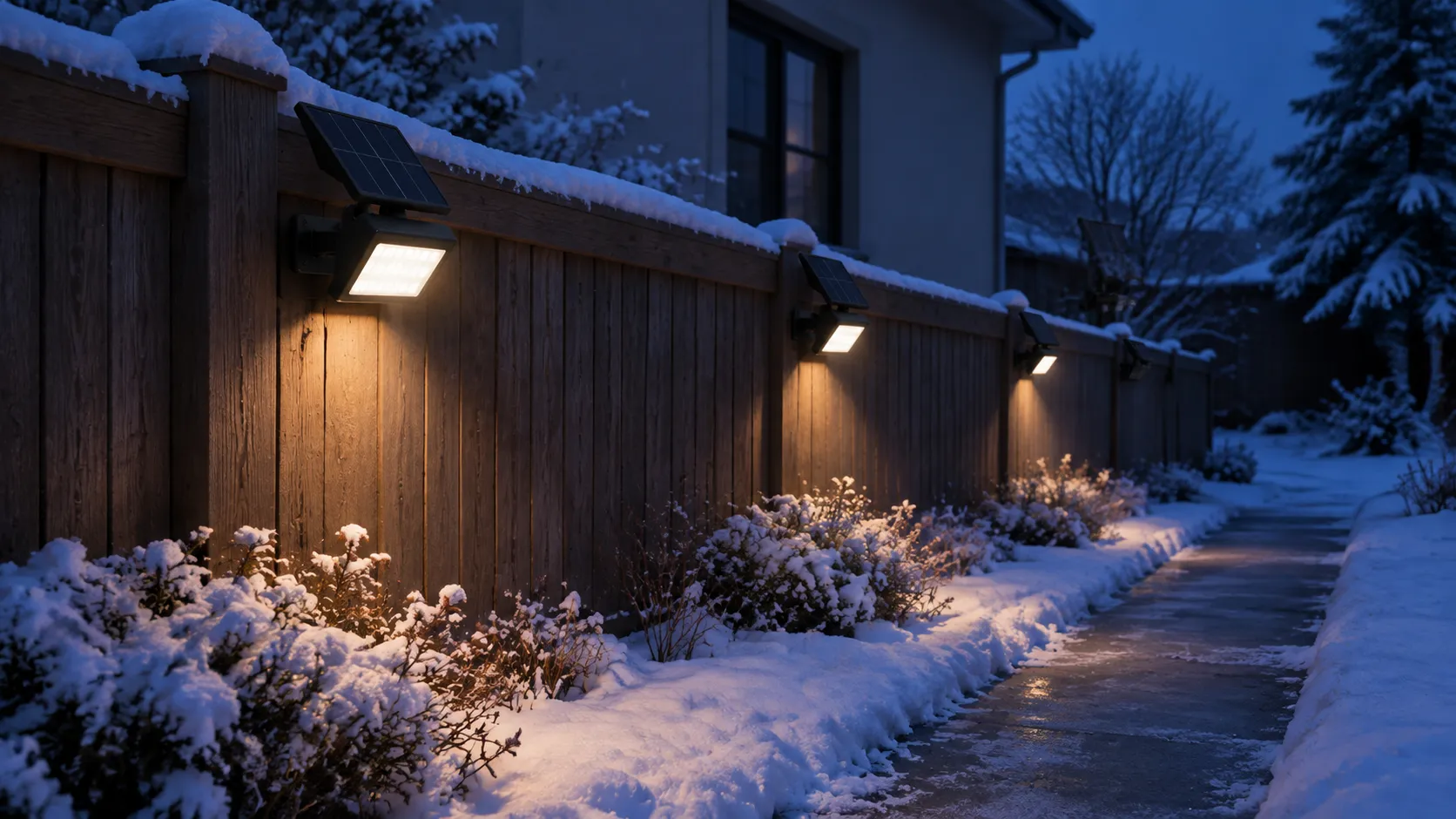
It works, but on a smaller daily deposit against a longer nightly withdrawal, so in winter the battery and the panel margin decide the runtime, not the forecast.
Two things shrink at once. Daylight at mid-latitudes ranges from about 15 hours around the summer solstice to near nine hours close to the winter solstice, according to the National Weather Service office in Sioux Falls, and the night lengthens by the same amount. The sun also sits lower. The U.S. Department of Energy explains that slanted rays travel through more atmosphere and arrive more scattered and diffuse, and gives an example: Denver receives nearly three times more solar energy in June than in December.
So a fixture that ran dusk to dawn in July is asked, in December, to cover a night some six hours longer on roughly a third of the June charge, if Denver is the yardstick. When a customer asks “do solar light work in the winter?”, they are usually describing that squeeze, not a faulty product. Sizing panel and battery against the worst month is worked through in our solar LED strip energy budget, where winter is the month that sets the specification.
The practical fixes work on the panel and on the load. Angle the panel toward the low winter sun if the bracket allows it, and brush off snow and fallen leaves, since a covered panel collects next to nothing. Then cut the demand. On our solar LED flood light, Motion mode keeps the fixture in a low-power state and floods the area only when something moves, which stretches a short day’s charge across a long night better than a steady output can.
Cloudy Days: How Much Charge Still Gets Through
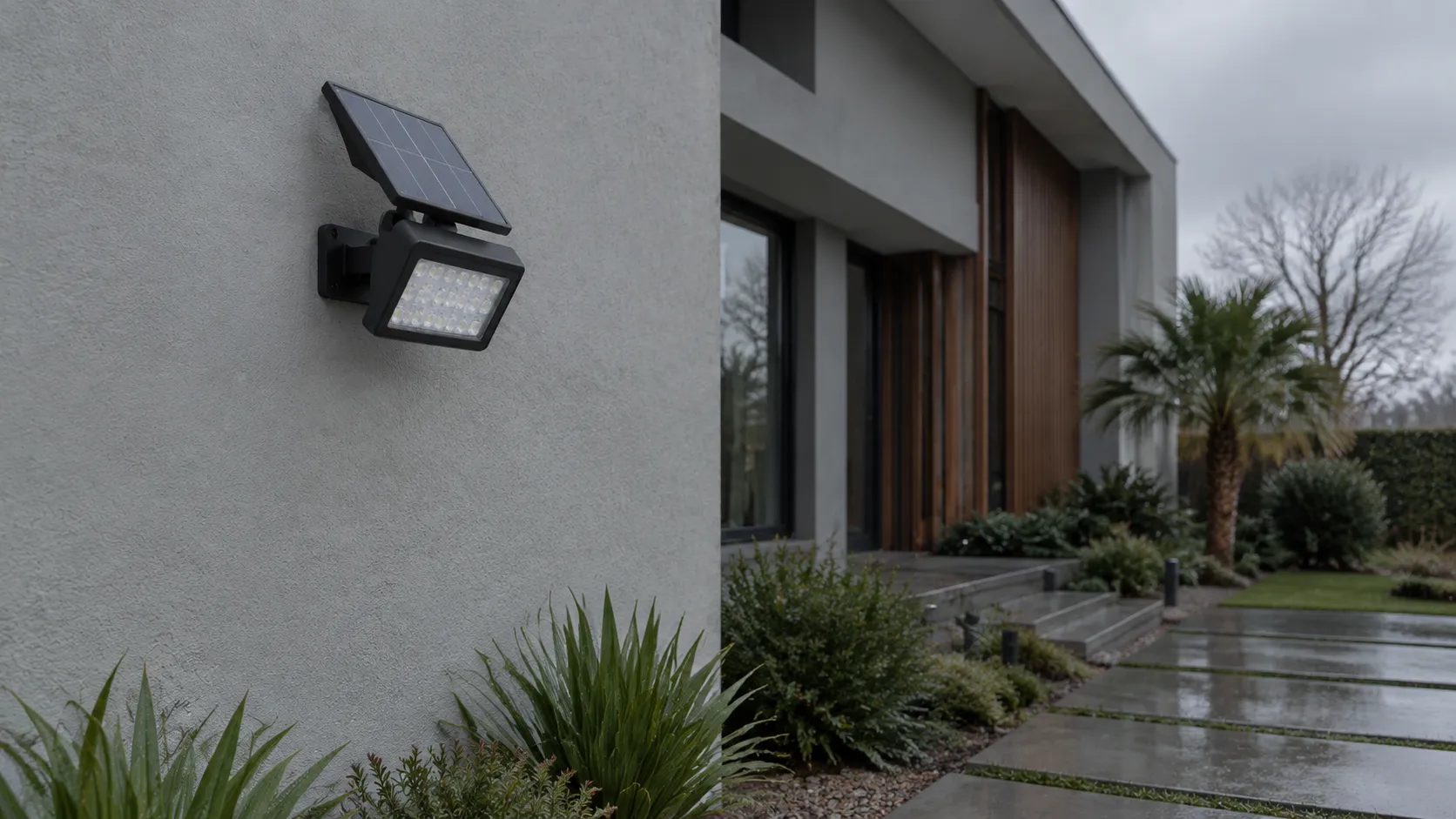
Do solar light charge on cloudy days? Yes, from diffuse light, at a fraction of a clear day’s rate, and the thickness of the cloud sets the size of that fraction.
The U.S. Department of Energy puts numbers on it: atmospheric conditions cut the direct beam by about 10% on a clear, dry day and by 100% under thick cloud. What still reaches the panel is diffuse light scattered by the cloud itself. The illuminance tables put an overcast day at about 1,000 lux and a very dark one at about 100 lux (Paul Schlyter via Wikipedia, Lux; Engineering ToolBox gives 1,075 and 107). Against strong direct sun at 100,000 lux, heavy cloud leaves the panel about 1% of its best light and a very dark day as little as 0.1%; even against weak direct sun at 32,000 lux, an overcast day is only about 3%.
We stop at illuminance on purpose: we found no primary measurement of cloudy-day output for small solar lights, so the shares above are shares of light, not of runtime. If a supplier quotes an overcast runtime, ask what sky it was measured under.
Where cloud really hurts is in a run. One grey day after a sunny week barely shows, because the battery starts the night close to full. Three or four grey days in a row each begin the evening lower than the last, and by the end of the spell the light that held all night is fading before midnight. Explain that pattern before a working unit comes back as faulty, and never judge a new fixture after a cloudy first day.
Can a Light Bulb Charge a Solar Panel? Indoor Charging Versus the Sun
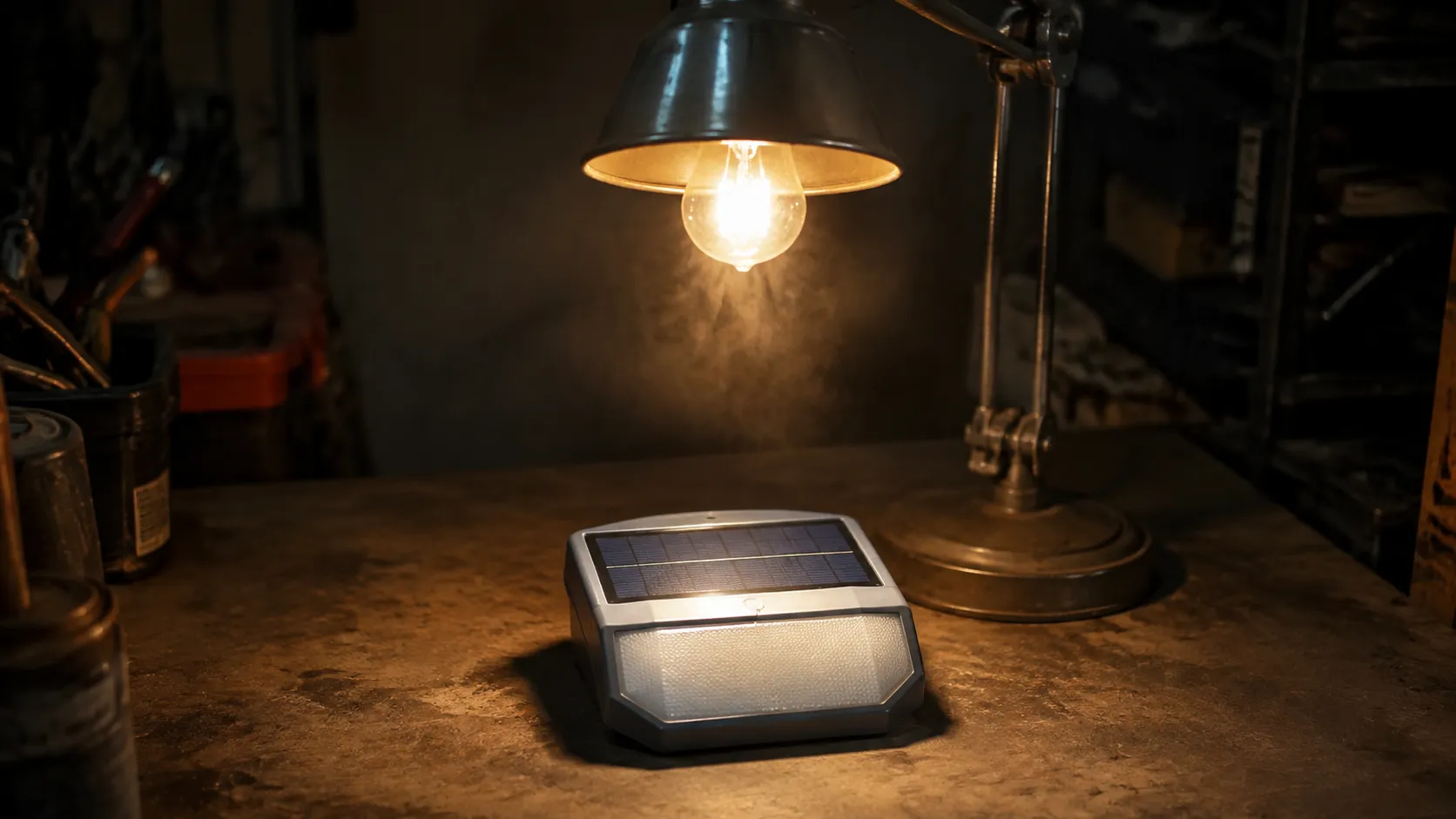
Yes, a light bulb can charge a solar panel, but it returns only a sliver of what the sun delivers, and the closer you hold it the more heat you add.
ENERGY STAR’s brightness chart pairs an old 60-watt incandescent with at least 800 lumens and a 100-watt with 1,600 lumens. Treat the bulb as a point source spreading those lumens evenly in every direction and a 60-watt-class bulb puts roughly 6,400 lux on a panel 10 cm away and 1,600 lux at 20 cm; a 100-watt-class bulb about doubles both. Those are our calculations, not measurements: about 2% to 6% of strong direct sun for the 60-watt case. Ceiling lights at room distance are weaker again: office lighting runs 320 to 500 lux and a family living room around 50 (Wikipedia, Lux), well under 1% of the sun.
Lux understates incandescent bulbs, because much of their output is infrared that a silicon cell can partly use; LED bulbs hide no such bonus. Neither correction changes the order of magnitude. So when a customer asks “can I charge a solar panel with a light bulb?”, the honest answer is yes, slowly enough to count as a top-up rather than a charge; for how to charge a solar light without sunlight, the battery checks below matter more than any lamp.
Source: Wikipedia, Lux, and Engineering ToolBox, Illuminance: Recommended Light Level (published values); bulb rows computed from ENERGY STAR, Learn About Brightness; all retrieved 2026-10-12
Cost is where the method stops making sense. ENERGY STAR notes that incandescent bulbs release 90% of their energy as heat, and at 10 cm that heat lands on a plastic panel cover built for sunlight, not for a hot lamp. The electricity is not free either: a 100-watt bulb left on for 12 hours draws 1.2 kWh, which at the U.S. Energy Information Administration’s July 2026 average residential price of 18.31 cents per kWh comes to about 22 cents, to put back a fraction of one clear afternoon. A cool LED lamp is fine for checking that a returned unit responds; it is never the way to charge one.
| Method | What reaches the panel | Share of strong direct sun (100,000 lux) | The catch | Use it for |
|---|---|---|---|---|
| Move the panel into open sky, or split it from the lamp | 10,000 to 25,000 lux in open shade, up to 100,000 in sun | About 10% to 100% | Needs a sunny spot within cable or bracket reach | Every fixture, before anything else |
| Reflect daylight from a pale wall or foil | More of the daylight already there | No fixed share; nothing on a dark day | Moves light, makes none | Shaded corners on bright days |
| Diffuse light on a heavy overcast day | About 100 to 1,075 lux | About 0.1% to 1% | Grey days in a row compound | Patience and a motion setting |
| 60 to 100 W-class bulb at 10 to 20 cm (computed) | About 1,600 to 12,700 lux | About 2% to 13% | 90% of the energy leaves as heat; about 22 cents per 12 hours at 100 W | A function check, not a charge |
| Ceiling or room lighting | 50 to 500 lux | Under 1% | Barely registers | Nothing useful |
| USB or DC input, where fitted | Bypasses the panel entirely | Not light-based | Only if the fixture has one | Before storage or a long grey spell |
| Fresh rechargeable battery | Restores storage, adds no light | Not light-based | Must match chemistry and voltage | Lights that fade early after sunny days |
Does Solar Light Need Battery Swaps? What the Battery Really Does
A solar light cannot run without its battery: the panel only works while there is light and the lamp only when there is none, so a swap is due when the battery, not the sky, ends the night early.
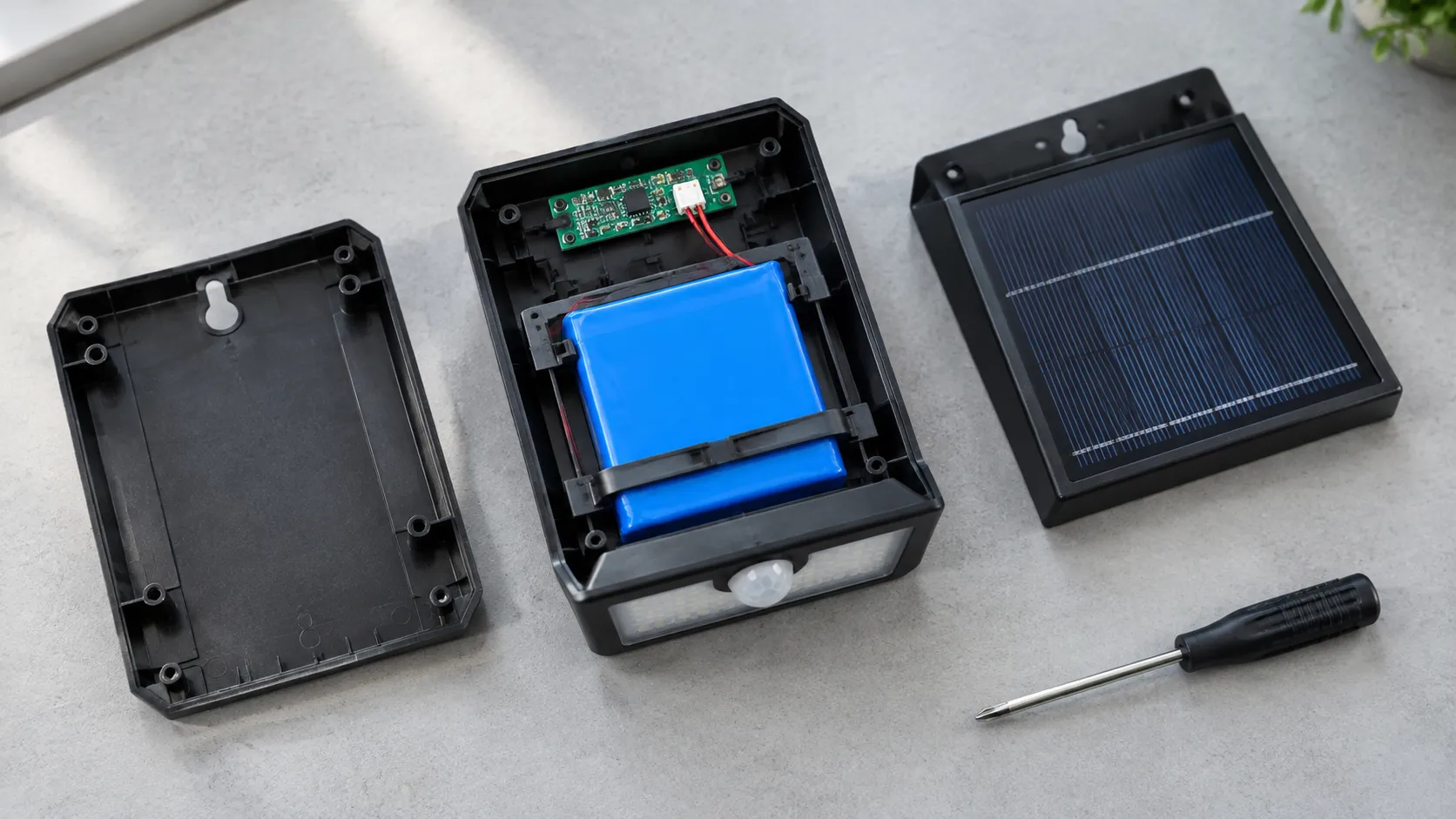
The battery is the bridge between the two halves of the day. Take it out and most solar lights will not come on after dusk at all, whatever the panel collected. It is also the part that ages fastest, and an aged battery looks exactly like a charging problem: the light quits early even after a cloudless June day, when the weather cannot be the suspect. The wider list of early failures is in our explainer on why budget solar lights die early.
Swapping is simple where the design allows it: same chemistry, same voltage, at least the same capacity, and only ever a rechargeable cell, since alkaline batteries are not built to take a charge. Where standard-size cells come out of the housing, a household charger for that chemistry is a genuine sun-free method. Which chemistry holds up best outdoors is a separate question, compared in our guide to which battery lasts longest in an outdoor solar light.
Plugging in is the only method that ignores light, and it depends entirely on the fixture. If the fixture has a USB or DC charging input, a wall adapter can fill the battery before a long grey spell or before the light goes into storage. If it has none, no forum workaround changes that, so buyers should treat the input as a specification line confirmed model by model.
Temperature is the battery limit almost nobody prints. Lithium cells will not take a charge below freezing (Battery University), a cold-morning case the strip guide cited in the winter section already builds into its sizing. NiMH, by the same source, still accepts a slow 0.1C charge between −18°C and 0°C. Cold also cuts capacity, as covered in the battery guide linked above; whether a cell accepts charge at all is a separate question, and on it lithium-based solar lights lose the frozen morning whoever builds them. Ask the supplier how the charge controller handles sub-zero mornings before selling into a cold region.
How a Solar Light Works, in One Paragraph
A panel turns daylight into current, a small controller stores it in a rechargeable battery, and when the panel goes dark at dusk the controller switches the LED on and runs it from the battery until dawn or until the charge runs out; the fuller version, with the parts that fail first, is our explainer on how a solar flood light actually works.
One consequence matters for charging without sun. In many small solar lights the panel doubles as the dusk sensor, so a light parked under a porch lamp or a streetlight may never decide it is night. It also gives a store the quickest showroom test there is: cover the panel with a hand, and a working light should come on.
What Retailers Should Print on the Shelf Card: Sun Hours and Winter Runtime
Print the conditions behind the runtime, not just the runtime: the sun hours the figure assumes, what cloud and winter do to it, and whether the fixture has any way to charge without light.
Light bulbs already have a template. The Federal Trade Commission’s Lighting Facts label, described in its consumer guide updated in August 2023, puts brightness in lumens, yearly energy cost, expected life, light appearance and wattage on the package (FTC). That label is written for bulbs, and many solar fixture boxes stop at a single runtime with no conditions attached. A customer whose light dies before midnight in December is often holding a box that never said December would be different.
Each line below is a question for the supplier before the card is printed, and none should be copied from a competitor’s box. For our own range every value is confirmed per model at quotation; we publish no generic panel, battery or runtime figures, because they change with the configuration a buyer chooses.
| Shelf card line | Why the shopper needs it | What to confirm with the supplier |
|---|---|---|
| Sun hours behind the runtime | A runtime with no charging condition cannot be compared | How many hours of direct sun on the panel the stated runtime assumes |
| Runtime per mode | Motion and dusk-to-dawn settings drain the battery at very different rates | Full-charge runtime in each mode the fixture offers |
| Winter and cloudy runtime | The complaint arrives in December, not in July | What was measured after a short or overcast day, and how |
| Panel position | Shade is the first cause of short nights | Integrated or separate panel, cable length, bracket adjustment |
| Battery type and access | A tired battery looks like a broken panel | Chemistry, capacity, user-replaceable or not, charging below freezing |
| Backup charging input | Can save a return during a long grey spell | Whether a USB or DC input is fitted at all; print nothing if it is not |
| First-charge instruction | A first night after a cloudy day starts the product badly | Insulation tab, switch position, and sun time before judging it |
On the insert card, print the checks in the order that recovers the most charge, with the indoor bulb at the bottom:
Look for shade on the panel
Move the light, or only the panel if it is separate.
Clean the glass
Dust, pollen, bird droppings and snow all stop light before it reaches the cells.
Allow for the season
Short days mean less charge. Use a motion setting and angle the panel to the low sun.
Test the battery
Quitting early after a sunny day means a fresh rechargeable cell of the same type.
Plug in only if there is an input
A USB or DC port is the one fix that needs no light. No port, skip the step.
Use an indoor lamp last
It confirms the panel responds. It does not replace a day outside.
The wholesale solar flood light range we build is quoted on exactly those lines, confirmed for the configuration you order rather than copied from a catalogue page.
Get the runtime conditions on the spec sheet, not just the runtime
We build solar flood lights in our own factory in Foshan, 4,000 square metres with 40 people across two production lines, from integrated wall units to separate-panel security lights. Send your market, the mounting positions and the runtime you want to print, and we will quote the configuration, with full electrical specifications on request.
Watch it work
Why a solar light that looks dead under a roof usually needs a better spot rather than a new battery, in 32 seconds:
FAQ
How to charge a solar light?
Out of the box, look for an insulation tab or a transport switch first, because many units ship with the battery disconnected. Then give the light one full clear day outside with the panel facing open sky before judging its runtime. From then on charging is automatic: the panel tops the battery up every day and the lamp draws it down every night.
How many hours of sun do solar lights need?
No single figure holds across products; it depends on panel size, battery capacity and how brightly the lamp runs. Count the hours of direct sun that land on the panel itself rather than the hours of daylight, then compare that with the sun-hours basis the manufacturer used to rate the runtime. If the two are far apart, expect shorter nights than the box promises.
Can solar lights be charged in the shade?
Yes, slowly. The useful line is between shade that still sees a wide patch of open sky, such as the north side of a low wall, and shade with a roof or a dense canopy overhead, which blocks most of the diffuse light as well. A phone light meter app held flat at the panel position at midday compares two spots before anything is screwed to a wall.
Can you recharge a solar light with a flashlight?
Only a little. A flashlight throws a bright but narrow spot, so most of the panel stays dark, and a small panel delivers very little when only some of its cells are lit. Treat it as a quick test that the panel responds, not as a way to fill the battery.
Sources
Every external figure above was checked on 2026-10-12: illuminance from the Wikipedia Lux table, Paul Schlyter’s photometry tables it cites for the shade and overcast rows, and the Engineering ToolBox light-level table, beam losses and the seasonal energy gap from the U.S. Department of Energy, day length from the National Weather Service, low-light cell behaviour from PVEducation, bulb lumens and heat from ENERGY STAR, the electricity price from the Energy Information Administration, charge temperatures from Battery University and the Lighting Facts label from the Federal Trade Commission. Shares of direct sun, the bulb illuminance at 10 to 20 cm and the 22-cent session cost are our own calculations from those figures.
- Wikipedia, Lux, illuminance examples table (direct sunlight 32,000 to 100,000 lux; full daylight, not direct sun, 10,000 to 25,000; overcast day 1,000; very dark overcast day 100; office lighting 320 to 500; family living room lights 50), with the shade and overcast rows taken from Paul Schlyter, Radiometry and photometry in astronomy, updated 2023 (full daylight, not direct sun, 10,000 to 25,000 lux; overcast day 1,000; very dark overcast day 100), both retrieved 2026-10-12.
- Engineering ToolBox, Illuminance: Recommended Light Level (sunlight 10,000 footcandles or 107,527 lux; overcast day 1,075 lux; very dark day 107 lux), retrieved 2026-10-12.
- U.S. Department of Energy, Solar Energy Technologies Office, Solar Radiation Basics (atmospheric conditions reduce direct beam radiation by 10% on clear, dry days and by 100% during thick, cloudy days; slanted rays arrive more scattered and diffuse; Denver receives nearly three times more solar energy in June than in December), retrieved 2026-10-12.
- National Weather Service, Sioux Falls, What Causes the Seasons? (at mid-latitudes daylight ranges from about 15 hours around the summer solstice to near nine hours close to the winter solstice), retrieved 2026-10-12.
- PVEducation, C. Honsberg and S. Bowden, Effect of Light Intensity (one sun equals 1 kW/m²; at low light the effect of shunt resistance becomes increasingly important; under cloudy conditions a cell with high shunt resistance retains a greater fraction of its efficiency), retrieved 2026-10-12.
- ENERGY STAR, U.S. Environmental Protection Agency, Learn About Brightness (old 60 W incandescent equivalent to a minimum of 800 lumens; 100 W to 1,600 lumens), retrieved 2026-10-12.
- ENERGY STAR, U.S. Environmental Protection Agency, Learn About LED Lighting (incandescent bulbs release 90% of their energy as heat), retrieved 2026-10-12.
- U.S. Energy Information Administration, Electric Power Monthly, Table 5.6.A, Average Price of Electricity to Ultimate Customers by End-Use Sector (U.S. total residential 18.31 cents per kilowatthour in July 2026), retrieved 2026-10-12.
- Battery University, BU-410: Charging at High and Low Temperatures (charge range 0°C to 45°C, 32°F to 113°F, for NiMH and Li-ion; no Li-ion charge permitted below freezing; NiMH charge at 0.1C between −18°C and 0°C), retrieved 2026-10-12.
- Federal Trade Commission, Consumer Advice, Shopping for Light Bulbs, updated August 2023 (the Lighting Facts label shows brightness in lumens, yearly estimated energy cost, expected bulb life, light appearance and wattage), retrieved 2026-10-12.
