





Key takeaways
Solar powered flood lights are worth it for off-grid, low-runtime spots where wiring is expensive, but not as a like-for-like swap for a bright wired security light. Battery chemistry, honest lumens, and where the panel sits decide the outcome.
- Worth it when there is no easy wiring, a genuinely sunny mounting spot, and only moderate nightly runtime is needed (sheds, gates, signage, motion security).
- Not worth it as a straight swap for an always-on wired security light.
- Real brightness runs far below the box: independent tests of “1000W-equivalent” units measured 300 to 480 lumens at the fixture.
- Most early failures trace back to the battery, not the LED: heat from a sun-baked housing plus chronic undercharging wear a cheap cell out within a summer or two, long before the diode itself ever dims.
- Spec that lasts: a lithium iron phosphate (LiFePO4) battery, an IP65 or higher housing, a real lumen figure, and a panel sized for your latitude.
01Are solar powered flood lights worth it?
Are solar powered flood lights worth it? For the right job, yes; as a wholesale replacement for every wired fixture, no. As a team that sources and private-labels these units for retail buyers, our honest answer is that solar flood lights earn their price in off-grid, low-runtime locations where trenching a cable would cost more than the light itself. For a low-runtime security spot, a motion-activated solar flood light is the right fit.
They fall short where a buyer expects a wired floodlight’s constant, high brightness. The value question is really three narrower ones: how bright is it really, how long will the battery last, and where will the panel sit. Get those three right and a solar flood light is a genuinely good product; get any one wrong and it becomes the one-star review that says “died after one summer.” Where the job does suit solar, an outdoor solar LED flood light covers it without any wiring.
The category is popular for good reason. Reolink’s solar flood light guide notes the main draw is zero wiring and lower bills with no dependence on mains electricity, because the panel recharges the pack each day (Reolink, The Ultimate Guide to Solar Flood Lights, retrieved 2026-07-18). But that same design is the root of every limitation below: a fixed daily energy budget set by a small panel and a small battery. A wired light draws as much power as it wants; a solar light spends only what the sun banked that day. Read the rest of this guide as a map of that tradeoff, not a verdict for or against.
02How a solar flood light actually works
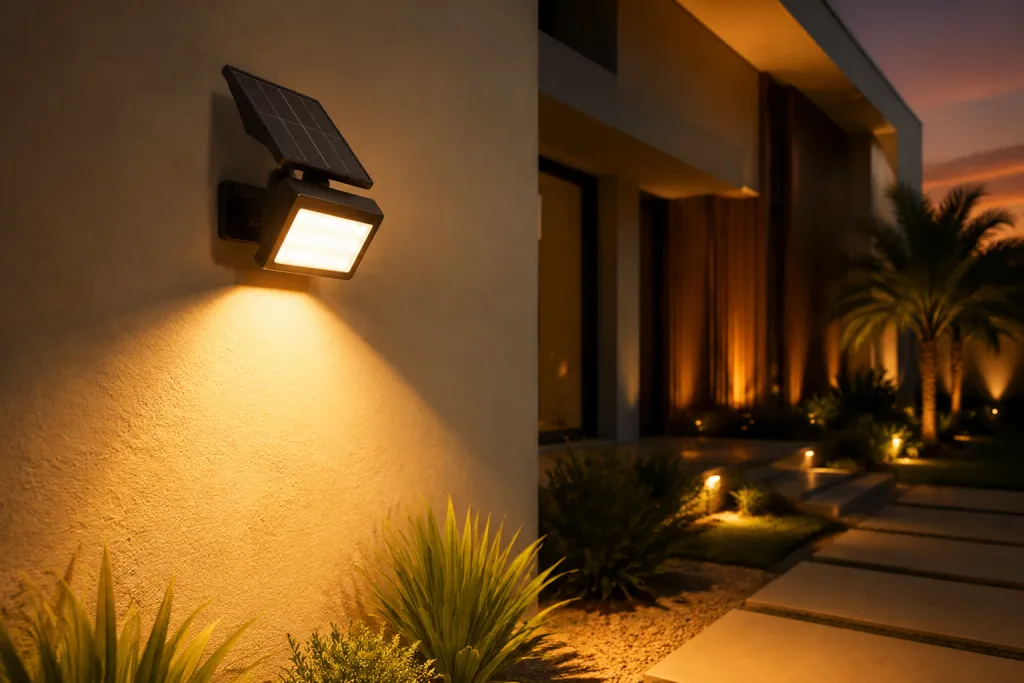
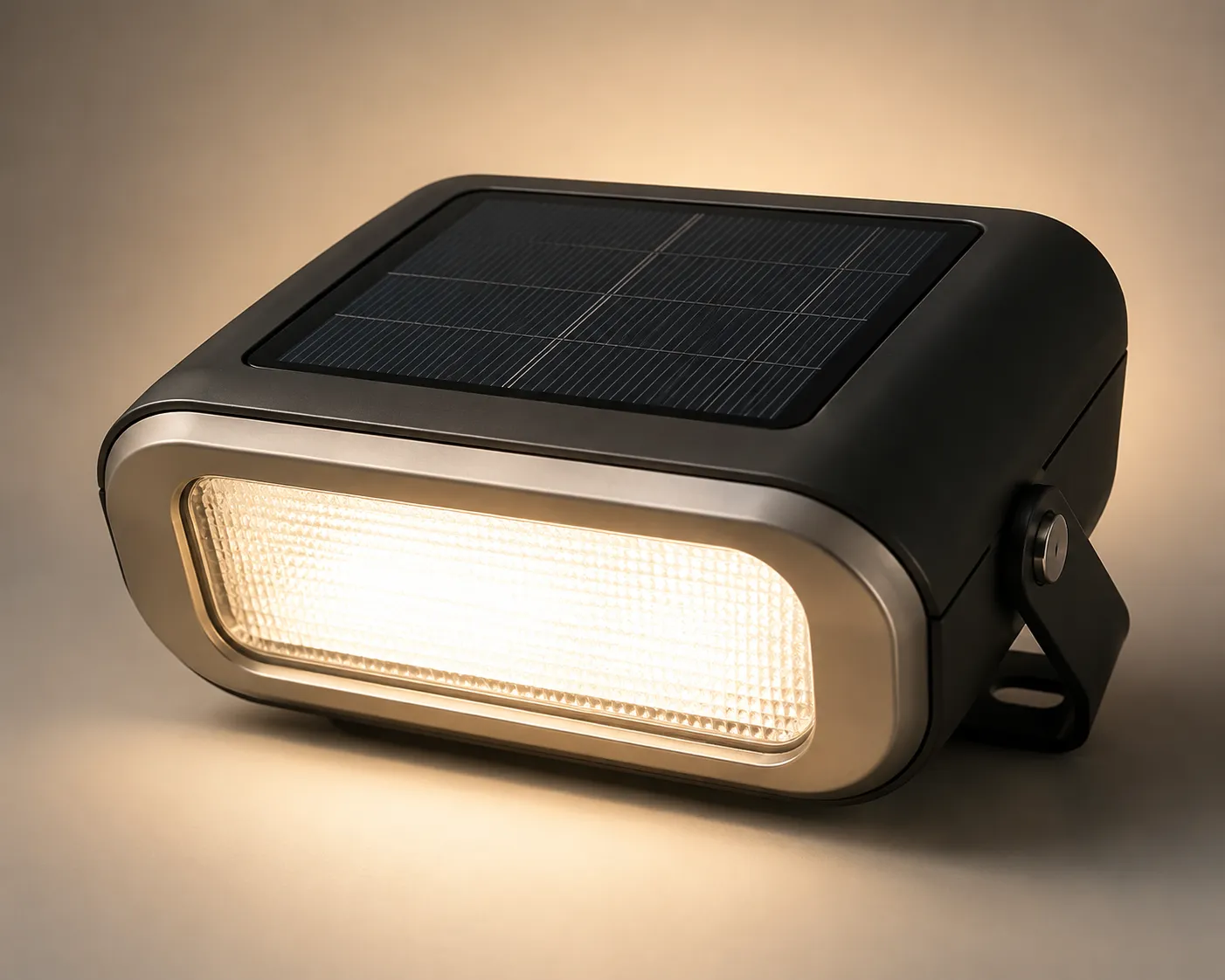
A solar flood light is four parts working on one daily cycle: a photovoltaic panel, a rechargeable battery, an LED array, and a small controller, usually with a PIR motion sensor and a dusk-to-dawn photocell. During daylight the panel charges the battery; after dark the controller drives the LEDs from that stored charge, often dimming or waiting for motion to stretch the runtime across the whole night.
Two of those four parts decide whether the light is worth owning: the battery and the panel. The LED chip and the housing are cheap to build well, so they rarely fail first. The battery and the daily charge budget are where corners get cut, and where returns come from. That is why the two questions buyers ask us most, what the disadvantages are and why these lights fail so fast, both come back to energy storage rather than the diode.
03What are the disadvantages of solar flood lights?
The main disadvantages of solar flood lights are lower and less predictable brightness, dependence on daylight and weather, a battery that wears out and needs replacing, and strict placement rules for the panel. None of these are dealbreakers, but each one is a reason a shopper leaves a bad review when the box oversold the light.
Start with brightness, because it is the most oversold spec. “Watt-equivalent” is not a regulated term, so any factory can print any number on the box. According to testing published by Homes & Gardens (Are lumen ratings fake?, retrieved 2026-07-18), six top-selling “1000W-equivalent” solar lights measured just 300 to 480 real lumens at the fixture, roughly a single 40-watt incandescent bulb, and even strong consumer floods top out near 2,000 to 3,500 lumens while holding that only for the first few hours after dark. The U.S. Department of Energy’s Energy Saver guidance gives the fix in one line: compare lumens, the true measure of brightness, not a watt-equivalent (U.S. Department of Energy, Energy Saver: LED Lighting, retrieved 2026-07-18).
The second disadvantage is reliance on daylight the panel can actually collect. Cloudy stretches, short winter days, and a partly shaded panel all cut the charge, which shows up as an earlier dim or a night skipped after grey weather. A wired floodlight never has that problem. The tradeoff below is the honest way to frame the choice for a buyer.
| Factor | Solar flood light | Wired LED flood light |
|---|---|---|
| Installation | No wiring, no electrician, mount and go | Cable run and often an electrician |
| Running cost | Near zero, recharges from the sun | Metered mains electricity |
| Brightness | Lower and it fades through the night | High and constant until switched off |
| Cloudy / winter | Runtime drops with the charge | Unaffected |
| Lifespan driver | Battery wears out first, may need replacing | LED and driver, typically longer |
| Best use | Off-grid, motion bursts, low runtime | Constant, high-output security |
The last disadvantage is that the light degrades on two clocks, not one. The battery loses capacity over years, and the LED itself dims: cheap LED chips can lose 30 to 50 percent of their initial brightness within 6 to 12 months of daily use (Homes & Gardens, Are lumen ratings fake?, retrieved 2026-07-18). A light that looked fine in week one can look tired by the next season, which is exactly the complaint that drives returns. The good news is that all of this is spec-able, which the next two sections cover.
04Why do solar lights fail so quickly?
Solar lights fail so quickly because the battery is the weakest link, and two things wear it out fast: heat and undercharging. The LED may be rated for years, but a small cell in a hot, sun-baked housing loses capacity long before the diode does. Fix the battery and the placement and most “it died in a year” failures disappear.
When a light has already stopped, three of the four usual causes cost nothing to fix: a dirty or shaded panel, a sensor that still reads daylight and a switch in the wrong mode, so they come before a new battery. How to check them in order is set out in how to clean solar lights.
Batteries age faster the hotter they run. Cadex Electronics’ Battery University reference treats anything above 30°C (86°F) as elevated temperature, and reports that a lithium cell held at full charge keeps about 80 percent of its capacity after a year at 25°C, but only about 65 percent at 40°C (Battery University, BU-808: How to Prolong Lithium-based Batteries, retrieved 2026-07-18). A solar flood light sits in direct sun, fully charged, all day, which is close to the worst case that data describes. That is why the same nominal battery lasts for years on a shaded north wall and dies in one summer baking on a south-facing fascia.
Depth of discharge matters just as much. The same reference shows a cell cycled to 100 percent depth of discharge every night lasts around 300 cycles, while one discharged only 20 percent deep lasts around 2,000 (Battery University, BU-808, retrieved 2026-07-18). A light with an undersized battery drains it fully each night and wears out in a year or two; one with a generous pack sips a shallow 20 to 30 percent and runs far longer. Battery size is not a spec sheet detail here, it is the lifespan.
Undercharging is often a placement problem before it is a hardware one: a panel in bright shade, or working through short winter days, never refills the battery it drains each night. How far shade, cloud and winter cut into the charge, and what to print about sun hours and winter runtime, is set out in how to charge a solar light without sun.
Source: Battery University (Cadex Electronics), BU-808, depth-of-discharge cycle table, retrieved 2026-07-18.
Chemistry sets the ceiling on all of this. The cheapest lights use nickel-metal-hydride packs or basic lithium (Li-cobalt) cells rated for 500 to 1,000 cycles, while better units use lithium iron phosphate (LiFePO4), rated 2,000 cycles and higher and far more tolerant of heat (Battery University, BU-205: Types of Lithium-ion, retrieved 2026-07-18). At one cycle a day, that is the gap between replacing a light inside two years and running it past five. It is also the single spec that separates a throwaway light from a keeper.
Cheap cell (NiMH / Li-cobalt)
- Rated roughly 500 to 1,000 cycles
- Loses capacity quickly in heat
- NiMH weakens sharply below freezing
- Lowest upfront cost, shortest life
LiFePO4 cell
- Rated 2,000 cycles and higher
- More stable at high temperature
- Holds usable capacity in the cold
- Costs more, lasts years longer
The other killer is undercharging. A panel in shade, behind a growing tree, or on a north-facing wall never tops the battery up, so the cell lives in a permanent state of partial charge and slowly loses capacity it can never recover. This is why placement is a spec, not an afterthought: the best battery in the catalog still fails early if its panel cannot see the sun for most of the day.
05When solar flood lights are worth the money
Solar flood lights are worth the money whenever wiring is the expensive part and constant brightness is not the point. That covers a surprising number of real jobs: a gate or fence line far from an outlet, a shed or barn, a remote parking bay, a sign that only needs lighting after dark, and motion-triggered security where the light is meant to flash on, not burn all night. Buyer guides such as Bob Vila’s solar flood light roundup point to exactly these off-grid, motion-first uses as the category’s sweet spot (Bob Vila, The Best Solar Flood Lights, retrieved 2026-07-18).
The reason those jobs fit is runtime. A PIR-triggered light spends its stored charge in short bursts, so even a modest battery covers a whole night of occasional events. A dusk-to-dawn light on full output does the opposite, draining the pack deeply every night, which is the 100-percent-discharge case that wears a battery out fastest. Matching the mode to the job is half of getting real value.
06How do you spec and source solar flood lights that last?
Speccing one that lasts comes down to four requirements: a real lumen figure, a LiFePO4 battery, an IP65-or-higher housing, and a panel sized for your latitude rather than the equator. Set a floor on all four before you request samples and you filter out most of the fragile, over-featured units that photograph well and disappoint in a real yard.
The housing rating uses the IEC 60529 IP code, where the first digit is dust protection and the second is water. IP65 is dust-tight and shrugs off rain and hose spray, which suits most walls and eaves; IP67 adds brief submersion for flood-prone or in-ground spots (IEC 60529, Degrees of Protection Provided by Enclosures, retrieved 2026-07-18). Below IP65, an outdoor light is asking for water ingress and an early death, so treat IP65 as the floor, not a premium.
This is where buying from the factory that builds the light earns its keep. We build our solar lights on our own Foshan lines, set the cell chemistry and IP rating before samples ship, and check real lumens with a meter rather than trusting the print on the carton. For buyers building a range, our commercial write-up in the best outdoor solar lights sourcing guide pairs with the live solar flood lights category so you can match a spec to an actual SKU.
Consolidating the whole outdoor and cozy-home range with one partner is the quieter win. Sourcing solar floods next to projectors, strips, and warmers from a single supplier collapses several minimums, freight lines, and quality standards into one relationship, which is easier to hold to a standard than five scattered orders. Start narrow, prove the spec on your shelves, then widen the assortment.
Source solar flood lights that survive the second summer
LiFePO4 packs, honest lumen ratings, IP65 and up, spec-checked before samples ship. Private-label and wholesale, quoted per project.
FAQ
Are solar powered flood lights worth it for home security?
They are worth it for motion-triggered security, less so for constant all-night lighting. A solar flood light only spends the energy its panel banked that day, so it shines brightest in short bursts when a PIR sensor trips. For a driveway or gate that needs a bright flash when someone approaches, a well-specified solar unit works well. For a yard you want lit steadily until dawn, a wired floodlight stays brighter and more consistent.
How long do solar flood lights last?
The LED array often outlives the battery by years. A cheap light with a nickel-metal-hydride or basic lithium pack may fade within one to two years, while a unit built on a lithium iron phosphate (LiFePO4) battery, rated for 2,000 cycles and higher, can run five years or more. Heat and a shaded panel shorten every estimate, so the mounting spot matters as much as the spec sheet.
Do solar flood lights work in winter or on cloudy days?
They work, but with less runtime. Short winter days and overcast skies give the panel fewer hours to charge, so the light may dim early or skip a night after a run of grey weather. Lithium iron phosphate cells hold up better in the cold than nickel-metal-hydride packs. Sizing the panel and battery for your latitude, not the equator, is what keeps a light running through a cloudy week.
How many lumens is a good solar flood light?
Judge the real lumen figure, not a watt-equivalent. Independent testing found many 1000W-equivalent units deliver only 300 to 480 real lumens, while strong consumer floods reach 2,000 to 3,500 lumens for the first few hours after dark. For a task light or motion security burst, we typically spec 800 to 1,500 real lumens; anything claiming a five-figure lumen count from a small panel deserves a lux meter before a bulk order.
Can a solar flood light replace a wired floodlight?
Not one for one. A wired floodlight draws as much power as it needs and holds full brightness all night; a solar light lives on a fixed daily energy budget set by its panel and battery. Solar replaces wiring, not raw output. It is the right choice where running a cable is expensive and constant peak brightness is not required, and the wrong choice where you need steady high output until morning.
Sources
- Battery University (Cadex Electronics), BU-808: How to Prolong Lithium-based Batteries (elevated-temperature capacity loss and depth-of-discharge cycle table), retrieved 2026-07-18.
- Battery University (Cadex Electronics), BU-205: Types of Lithium-ion (LiFePO4 rated 2,000 cycles and higher; Li-cobalt 500 to 1,000), retrieved 2026-07-18.
- Homes & Gardens, Are lumen ratings fake? A solar light promo trick revealed (six “1000W-equivalent” units measured 300 to 480 lm; LED loss 30 to 50% in 6 to 12 months), retrieved 2026-07-18.
- U.S. Department of Energy, Energy Saver: LED Lighting (lumens are the measure of brightness, not watts), retrieved 2026-07-18.
- International Electrotechnical Commission, IEC 60529: Degrees of Protection Provided by Enclosures (the IP Code, dust and water digits), retrieved 2026-07-18.
- Bob Vila, The Best Solar Flood Lights (off-grid and motion-first use cases), retrieved 2026-07-18.
- Reolink, The Ultimate Guide to Solar Flood Lights (zero wiring, lower bills, daylight dependence), retrieved 2026-07-18.
Security duty: where solar earns its place and where it does not
Most of this category is bought for security rather than for looks, so the honest question is not whether solar is impressive but whether it does the job on the worst night of the year rather than the best. Outdoor security lights are judged on one test: when something moves in the yard at three in the morning in February, does the fixture come on at full output, and will it still do so next February?
Where the fixture goes and how its detection zone is drawn — mounting height, tilt, and the outdoor sources that trip a PIR — is worked through in solar flood lights with motion sensor: a detection zone guide.
Where solar wins
Solar powered security lights make sense wherever running mains cable is the expensive part of the job: a detached garage, a gate, a side return, a boundary fence, any yard position with no circuit nearby. In those spots the alternative is not a cheaper wired fixture, it is a trench and an electrician, and the comparison swings decisively toward solar.
Where solar loses
Where a circuit already reaches the mounting point, solar is usually the weaker choice for genuine security duty. Battery-limited output means a shorter burn per trigger, and a panel that is shaded, poorly aimed or dirty becomes unreliable during exactly the short winter days when the light matters most. A shopper who expects mains-equivalent behavior from a battery-limited unit returns it and blames the whole category.
How to spec it for a retail assortment
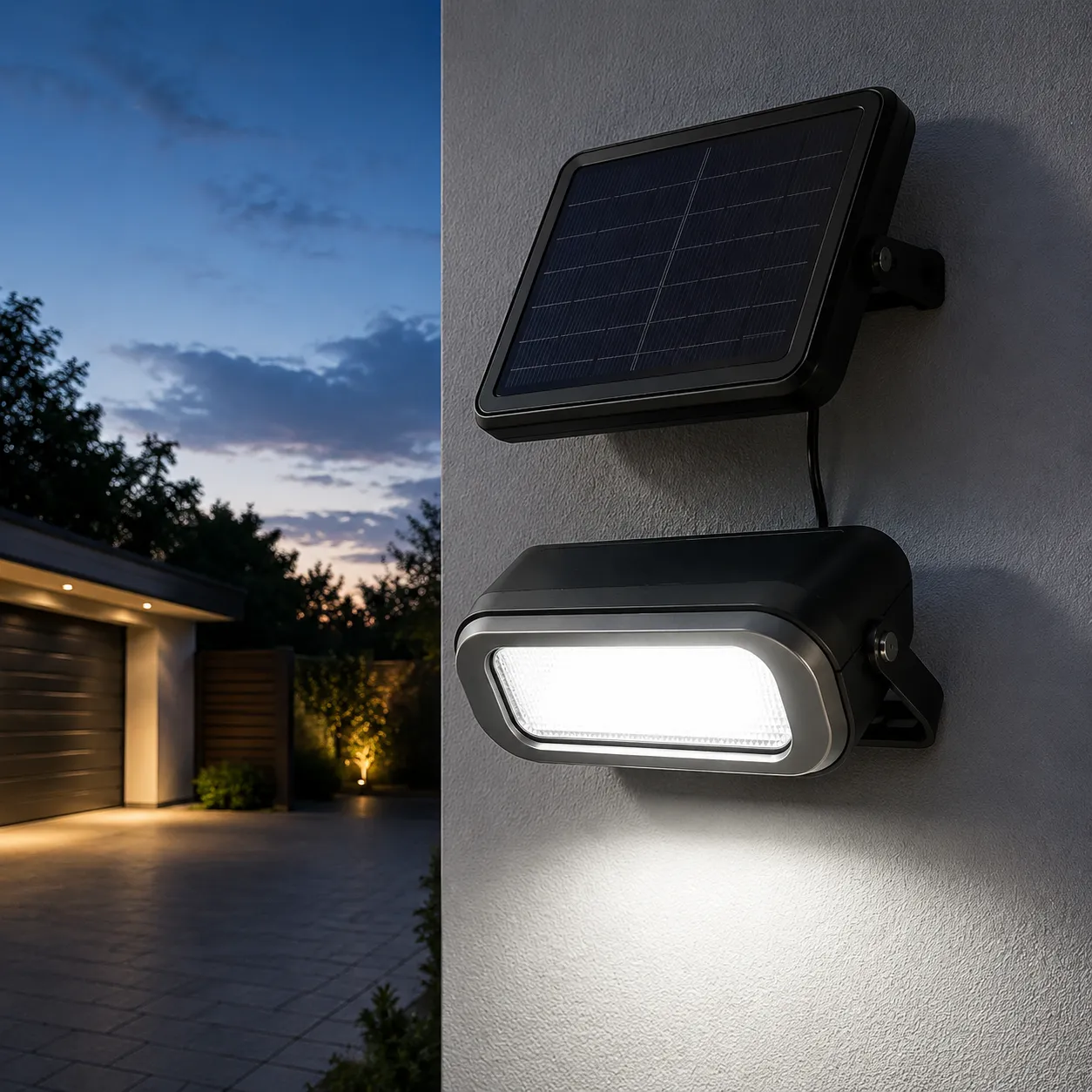
- Separate-panel designs on a lead, so the panel can be aimed at the sun while the fixture aims at the target.
- Motion behavior stated properly: trigger distance, detection angle, on-duration, and whether the unit holds a low idle level between triggers.
- Winter reserve, meaning how many nights the unit holds usable output with no meaningful charge.
- A replaceable cell, plus documented ingress protection for the assembled unit rather than the housing alone.
Solar flood lights are one of our own lines, built on the same Foshan floor as our warm-glow indoor range. On outdoor and security ranges that means the build is ours to set: housing and bracket finish, cell and driver selection, hi-pot testing on every run, and one consolidated wholesale quote. Tell us which mounting positions your shoppers are trying to light and we will come back through Request a Quote.
