


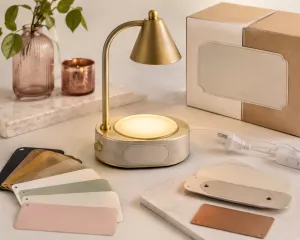

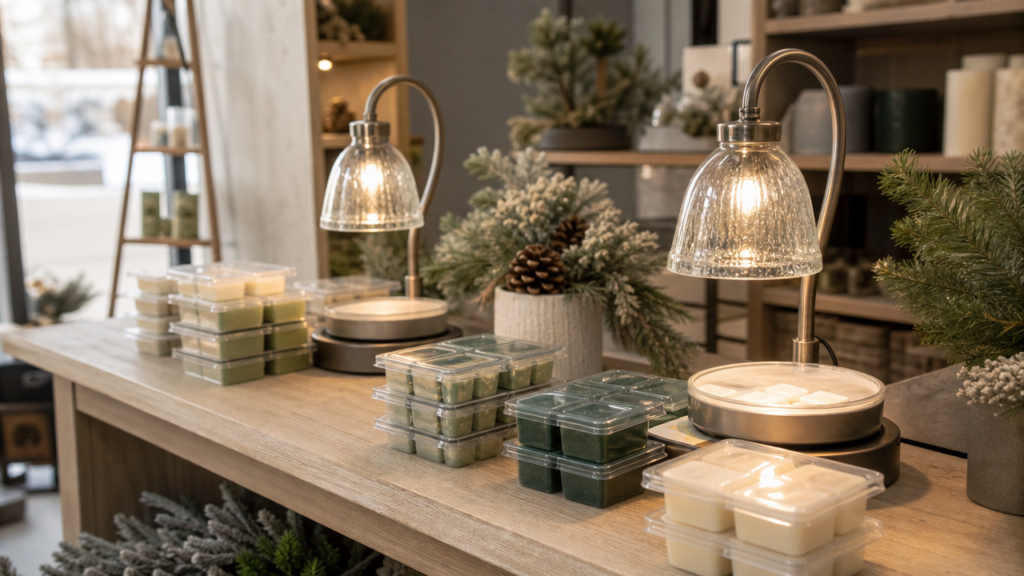
Christmas wax melts are the cheapest line in a Q4 fragrance buy and the one that decides whether the expensive line ever reorders. A warmer lamp sells once. The wax on top of it sells again in January, and again in March, and again every time a room stops smelling of anything. This guide is for the person placing the order at a gift shop, a fragrance chain or a marketplace brand: how to structure the seasonal wax assortment, what to settle with a supplier before a festive range is poured, where a novelty warmer shape earns a slot, and one customs clause that decides what a Chinese wax order costs to land.
Two things are deliberately out of scope. How to run a melt, how many cubes, how long, when to change the wax, is set out in our guide to how to use wax melts, written to be handed to staff rather than repeated here. The Q4 buying calendar and the gift-box tiers on top of it live on the giftable lighting page. What follows is the assortment logic in between.
Key takeaways
Christmas wax melts are a replenishment line, not a decoration line. Build the seasonal buy around the consumable, keep the novelty warmer count small, and settle the customs question about wicks before the purchase order, not after.
- About 35% of U.S. candle sales land in the Christmas and holiday season, against 65% across the rest of the year (National Candle Association).
- Fragrance closes the sale: three-quarters of candle buyers call it extremely or very important in their choice (NCA). Scent, not shape, is what a seasonal melt is bought on.
- 42% of U.S. holiday shoppers start browsing and buying before November (NRF, 2025 survey of 8,247 adults), so the shelf must be set for a season that opens in October.
- Novelty shape spends a decoration budget. Two recognisable silhouettes do the window work eight will not; the other six become January markdown.
- The U.S. antidumping order on Chinese petroleum wax candles is written around wicks and wax content, which makes classification a quote-stage question.
Where Christmas Wax Melts Sit in a Q4 Buy
They sit in the replenishment column, beside the jarred candles and underneath the fixtures, and they are the only line on that shelf a shopper can finish.
The seasonal concentration is real. Roughly 35% of U.S. candle sales happen in the Christmas and holiday season, with the other 65% spread across the remaining nine months (National Candle Association). A fragrance shelf earns about a third of its year inside one quarter, and a buyer who gets the depth wrong in October cannot fix it with price in December.
The lighting side of the same Q4 calendar — RGB kits for windows and stair rails, IP-rated runs for eaves, and the connector packs that stop returns — is worked through in our guide to LED strip lighting for the Christmas restock.
The money moving around it is measurable. In 2025 the National Retail Federation put planned holiday spending at $890.49 per person, split $627.93 on gifts and $262.56 on seasonal items such as food, candy and decorations. A three-pack of melts comes out of that second budget without a decision. NRF forecast the season itself, November 1 to December 31, at $1.01 to $1.02 trillion, up 3.7% to 4.2% on 2024’s $976.1 billion.
One note for whoever writes shelf tags and listing titles: shoppers type both word orders, christmas wax melts and wax melts christmas, and a listing carrying only one is half indexed.
Source: National Candle Association, Facts & Figures (retrieved 2026-09-05)
Read that chart as merchandising instruction. Nine in ten candle users say candles make a room feel cozy, and three-quarters say fragrance is extremely or very important in their selection (NCA), so the scent sells while the fixture displays. Three-quarters burn for four hours or less per sitting, which is the economic case for the consumable: short sessions mean the wax runs out, and running out brings someone back. The 42% who burn in the living room explain why the fixture is chosen with more care than its price suggests.

The Attach Sale: How a Melt Earns Its Shelf Space
A melt earns its space as the second item in the basket, never the first, and as the only thing on that shelf with a built-in reason to be bought again.
Category growth backs the split. The global wax melts market was valued at $3.55 billion in 2025 and $3.83 billion in 2026, growth of 7.9%, with a $5.14 billion projection for 2030 (Research and Markets). Consumables compound in a way appliances do not: the household buys wax repeatedly and the lamp once.
The mistake to avoid is treating the melt as a giveaway that props up the lamp. Priced properly it carries its own margin and keeps the customer coming back. Gift-set structure is deliberately absent from the table below: box tiers and what they cost are worked through on the giftable lighting page.
| Line | Job in the basket | How deep to buy | What tells you it worked |
|---|---|---|---|
| Evergreen warmer lamp | Anchor. Carries the price and the demonstration. | Deep. It still sells in February. | Units hold up after December 26. |
| Seasonal novelty warmer | Window draw and gift-table centrepiece. | Shallow. One or two silhouettes. | Sells at full price before the last posting week. |
| Christmas scented wax melts | Attach. The second item, and the third visit. | Deep on two or three scents, not thin across ten. | Attach rate against warmer units, weekly. |
| Jarred soy candle | Same-price alternative for the shopper who wants a flame. | Medium, weighted to scents that outlive the season. | It reorders in the new year. |
| Replacement bulbs | Service line. Stops a fault becoming a refund. | Thin, never zero. | Nobody asks and finds the peg empty. |
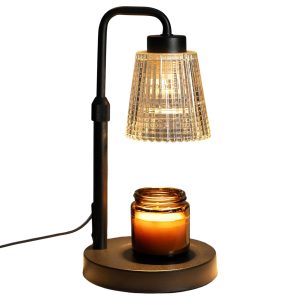
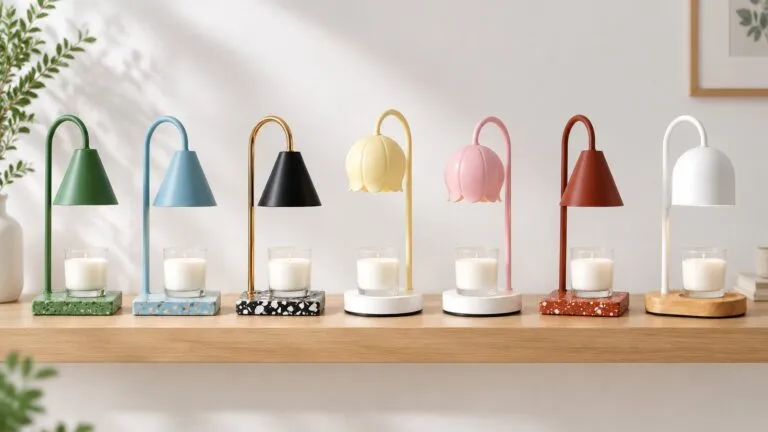
The evergreen anchor is where seasonal buys go wrong in the other direction. A shop that buys nothing but Christmas has nothing to sell on December 27. Most of the fixture money belongs in shapes from the candle warmer lamp range that still look right in April, with seasonal pieces earning their slot by pulling people to the display.
Festive Wax Melts and the Order of Operations Before a Season
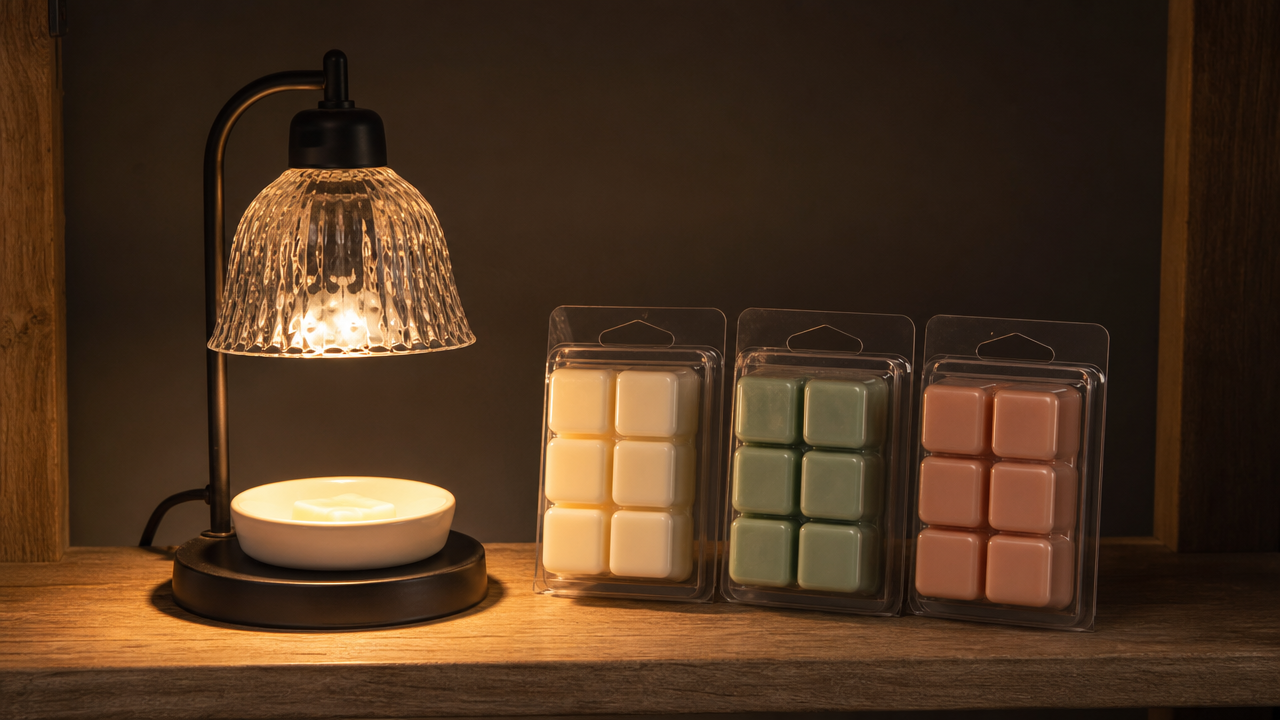
For festive wax melts the order you do things in matters more than the calendar, because every step that gets skipped comes back as a change request at the worst moment.
The reason to lead with scent rather than shape is memory, not taste. Odor-evoked memories are more emotional and evocative than memories triggered by any other cue, according to Rachel S. Herz writing in Brain Sciences in 2016. A Christmas fragrance does recall work that a printed snowflake cannot, which is why the scent brief is settled first and the artwork second.
Write the scent brief before the shape brief
Decide what the range should smell like in a warm room, and how many scents you can give real facings to.
Read last season by scent, not by SKU
Sell-through per scent tells you what to repeat. Per SKU only tells you which artwork you printed most of.
Ask for a pour against your own warmer
A melt that performs on a hot plate can underperform under a top-down lamp. Name the fixture you stock.
Lock label and pack copy while the sample travels
Ingredient wording, warnings and destination language are slower to fix than wax. Settle them in parallel.
Split the buy into an opening order and a call-off
One quantity that sets the shelf, one you release on real sell-through. Two decisions beat one guess.
Log the season while it is happening
Daily units by scent, staff questions, return reasons. Nobody reconstructs that in January.
Two of those steps get skipped most often. Sampling against the fixture you stock matters because a top-down lamp and a hot-plate warmer put heat into wax differently, so a melt made for one can read as weak under the other. Splitting the commitment turns a single forecast into one decision now and one later, on this year’s numbers instead of last year’s.
What to Specify Instead of a Christmas Scent List
Do not open a brief by asking a factory for its Christmas scent list, because the list is not the scarce thing.
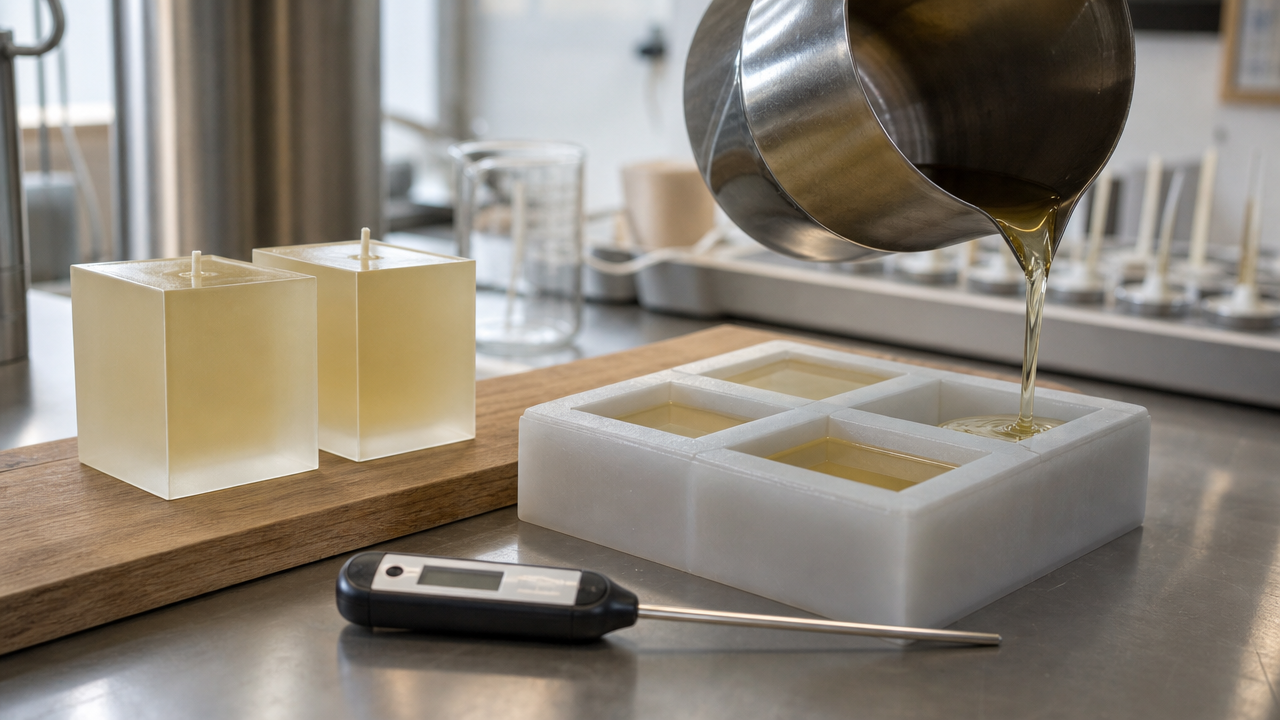
More than 10,000 different candle scents are already available to U.S. consumers (National Candle Association). Nobody is short of options. What is scarce is a scent that still reads as Christmas at the low, steady temperature of a warmer rather than the higher heat of a flame, that holds up across a living room, and that survives storage between the pour and the shelf. Those are performance requirements, and they belong in a brief as requirements rather than as adjectives.
So specify what a supplier can build to: the wax base, and whether you need one base across the range; the throw you expect in a room of a stated size; the pack format and how it sits on your fixture; the label surface and its languages. On our side the honest position is that the accessories line is poured to pair with the lamps rather than picked from a standing Christmas catalogue, and the finished jarred product we do hold, the soy wax scented candles in amber glass, is offered for private-label programmes on the same basis. Neither is a Christmas range waiting on a shelf.
Settle what the melts are made from early, because the answer travels to your label and, as the last section sets out, to your customs entry. If your copy is going to make claims about the wax itself, those questions are answered in our explainer on what the air-quality research shows about wax melts.
The Christmas Tree Wax Warmer, and Where Novelty Shape Stops Selling
A christmas tree wax warmer is a decoration that happens to heat wax, and it should be bought against a decoration budget with decoration risk, not against the fixture budget.
Novelty silhouettes do a specific job. They stop someone at a window, they photograph well, and they give a gift table a centre. What they do not do is sell in February. A moulded tree, gingerbread house or snowman is close to unsellable at full price once the season closes, which is a fine trade as long as the depth reflects it.
We do not make a tree-shaped warmer, so treat this as general sourcing guidance rather than a spec sheet. On any moulded or pierced novelty, check the geometry of the dish that carries the wax, because ornament shapes routinely compromise it; check the base is stable enough for a shop shelf that gets knocked; check where the cord leaves the body; and check the finish after a long warm session, since paint and plating on decorative shapes fail there first. Ask for a sample that has been run hot, not one straight off the line.
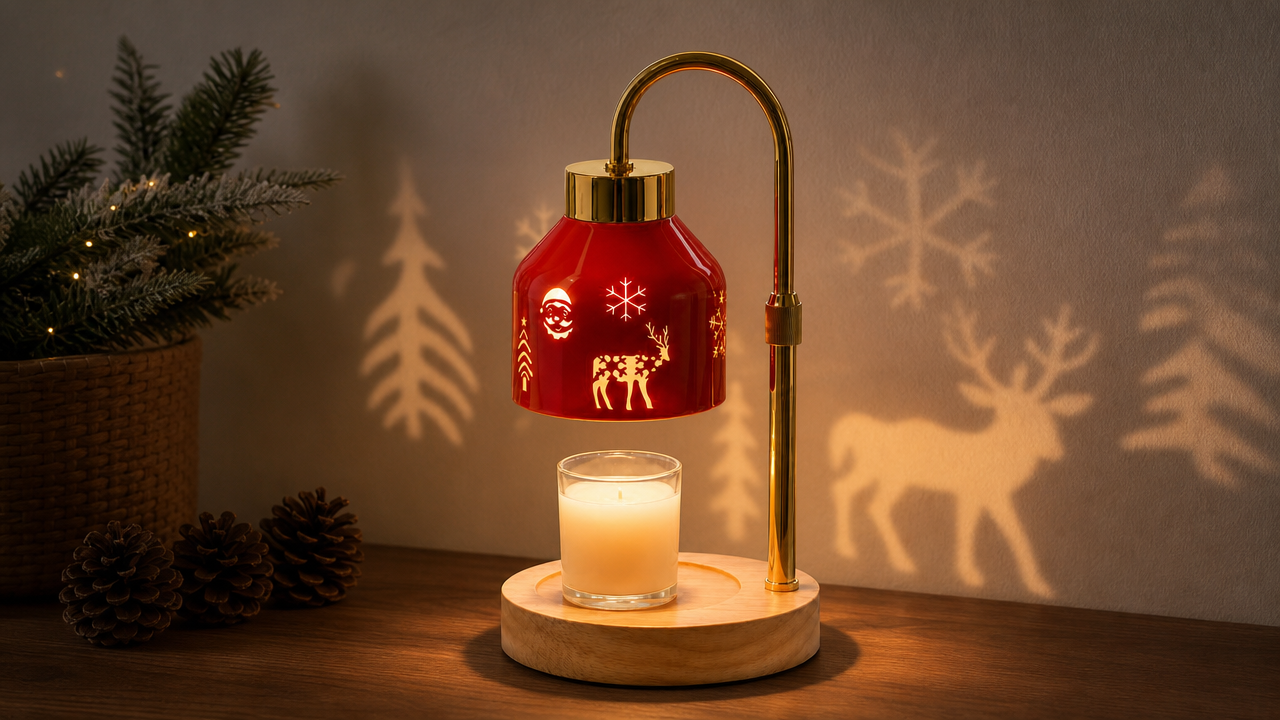
The only Christmas-cut silhouette on our own shelf is the christmas reindeer candle warmer lamp. The deer scene is pierced through an openwork metal shade on a natural wood base, so the lit lamp throws the pattern onto the wall behind it, and it packs at about one kilogram, light enough to gift-wrap. There is no wider Christmas family behind it, and we would rather say so than let a buyer plan around one. Display and volume ordering are both handled on that product page.
What Buyers Mean When They Search Christmas Candle Warmers Electric
The word doing the work in christmas candle warmers electric is the last one: the shopper is ruling out a flame before they have ruled in a design.
That changes what the shelf and the box have to say. Someone searching christmas electric wax warmers has already decided the gift is going to a home with a tree, a cat or a toddler, and they want confirmation rather than persuasion. So the pack has to answer the power question at a glance, before anyone reads a feature list: what plugs in, which destination plug it carries, whether the heat comes from a bulb above the wax or a plate beneath it, and whether the owner can replace that bulb. The reasoning behind the flame-free format itself is set out in our retailer safety explainer, and there is no need to relitigate it on a carton.
The second consequence is a gifting one, and it is easy to underestimate. A gift is unwrapped in a room where nobody from your shop is standing. Whatever your staff would have explained at the counter has to be on or in the box: what goes in the dish, what the switch does, what the timer does. That is the highest-value use of a shelf card and an insert, and the content for both is in our guide to how to use wax melts. A gift that works on the first evening becomes a repeat wax customer. One that confuses somebody on Christmas morning becomes a return in January.
Buyers who want the fixture-versus-format argument in full will find it in wax melt warmer vs candle warmer lamp, and the autumn equivalent of this shelf is in our Halloween restock guide.
The Wick Clause: What U.S. Duty Scope Actually Turns On
The U.S. antidumping order on petroleum wax candles from China is written around wicks, which makes it the most consequential paragraph here for anyone importing seasonal wax.
The order dates to August 28, 1986 and was continued with effect from October 29, 2021. Its scope covers, in the Federal Register’s own words, “certain scented or unscented petroleum wax candles made from petroleum wax and having fiber or paper-cored wicks,” classified under HTSUS subheading 3406.00.00, and the shapes it lists include tapers, pillars, votives and wax-filled containers. The U.S. International Trade Commission instituted a sixth five-year review of that order on September 1, 2026 under investigation No. 731-TA-282, with responses due by October 1, 2026. Its notice describes the covered product as candles with fiber or paper-cored wicks containing any amount of petroleum wax, except candles containing more than 50% beeswax.
Read those definitions and the relevance to a melt buyer is immediate: the scope language keeps returning to a wick, and a melt does not have one. That is not a clearance to assume anything. Classification is a customs determination, not a supplier’s opinion, and the composition of the wax you order is part of the picture. Put the question to your customs broker with the actual formulation and pack in front of them before the purchase order goes out, and where the volume justifies it, seek a binding ruling. Freight and carton questions are in our guide to cartons, packaging and freight.
Note the timing too. A five-year review is live as this is published, so the order is under active consideration rather than settled. Anyone pricing a multi-season wax programme around a landed cost should be watching it, not filing it.
What a Seasonal Wax Programme Costs You When It Goes Wrong
The honest number to plan against is the return rate, because seasonal gifting is the returns-heavy end of the shelf and nobody quotes you for that.
Retailers expect 17% of holiday sales to come back, against 15.8% of annual sales overall and 19.3% of online sales, according to the 2025 retail returns study from the National Retail Federation and Happy Returns. On a seasonal fragrance buy that is a real line item: one in six gifted units, arriving in January, in a category whose packaging has already lost its selling power. It is the strongest argument here for weighting the buy towards evergreen fixtures and a deep, narrow melt range.
Here is the part that works against us. We pour to a brief instead of holding a Christmas range in stock, which is why a buyer can have their own scents and label, and why a late reorder of a bespoke scent is not something anyone can conjure mid-season. If your programme depends on chasing a hero scent in December, either commit a call-off quantity at the start or plan the chase against a stock jarred candle. A supplier who says otherwise is describing a warehouse, not a factory.
One more limit: only 51% of holiday shopping is complete by early December (NRF), so a shelf that looks slow in mid-November is not yet evidence of anything. Read velocity per scent, and make the markdown call on data rather than on nerves. And markdown is not the only exit: the next seasonal window opens the moment this one closes, so neutral carry-over is often better re-merchandised than discounted, which is where our Valentine’s candles stocking guide picks up.
Plan the seasonal wax and the lamp it sits on with one factory
We build flame-free candle warmer lamps in our own factory in Foshan, 4,000 square metres and 40 people across two production lines, and we pour the candle and melt accessories that pair with them. Your order runs on the same line, and through the same checks, as our own retail brand, the one behind our top-selling position in Amazon’s candle-lamp category. Bring us a scent brief, your own label, or a shelf plan for next Christmas.
Watch it work
The one Christmas silhouette on our own shelf, lit, in 16 seconds:
FAQ
Do christmas wax melts have a shelf life?
Treat them as a dated line, not hardware. Fragrance oil is the part that fades, not the wax, and it fades fastest in warm storage and in daylight. Ask for a best-before window and a batch code on the pack, keep the reserve off a sunny stockroom wall, and rotate carry-over to the front.
What is the difference between a wax melt and a wickless candle?
Commercially, very little. Both names describe the same wickless block of scented wax, and shoppers use them interchangeably. The category definition is set out in our candle pairing guide, and the fixture-side comparison sits in wax melt warmer vs candle warmer lamp.
Can festive wax melts be poured under our own brand?
Yes. The sequence runs scent brief, sample pour, label approval, then production, and the label work usually sets the pace rather than the wax. We pour to a brief instead of picking from a standing range, so the brief has to exist before there is anything to quote.
Do christmas electric wax warmers use a different bulb from the rest of the range?
No. Our lamps run the same GU10 halogen accessory bulb across seasonal and evergreen models, which is why replacement bulbs belong on the same order rather than a separate seasonal line. That bulb is supplied as a warmer accessory, not as a room-lighting product.
Do you carry a Christmas collection of warmers?
No, and it would be easy to imply otherwise. There is one Christmas-cut silhouette in the range, the reindeer lamp. The pumpkin and skull pieces are autumn, everything else is evergreen. A seasonal shelf here is one festive shape plus fixtures that keep selling in January.
Sources
Every external figure above was checked on 2026-09-05. Season and shopper data come from the National Retail Federation and the National Candle Association; the duty scope from U.S. Federal Register notices.
- National Candle Association, Facts & Figures (the 35% holiday share, $3.14 billion U.S. retail, the fragrance and scent-count figures, chart rows), retrieved 2026-09-05.
- National Retail Federation, Consumers to Spend Second-Highest Amount on Record ($890.49 per person, the $627.93 and $262.56 split, 42% starting before November, 8,247 adults), retrieved 2026-09-05.
- National Retail Federation, NRF Expects Holiday Sales to Surpass $1 Trillion for the First Time in 2025 (the forecast and growth ranges, and 2024’s $976.1 billion), retrieved 2026-09-05.
- National Retail Federation, Winter Holiday Data and Trends (51% of holiday shopping complete by early December), retrieved 2026-09-05.
- National Retail Federation and Happy Returns, Consumers Expected to Return Nearly $850 Billion in Merchandise in 2025 (the 17%, 15.8% and 19.3% return rates), retrieved 2026-09-05.
- Research and Markets, Wax Melts Market Report 2026 (the 2025 and 2026 market values and the 2030 projection), retrieved 2026-09-05.
- U.S. Government Publishing Office, Petroleum Wax Candles From the People’s Republic of China: Continuation of the Antidumping Duty Order (the wick wording, HTSUS 3406.00.00, and the listed shapes), retrieved 2026-09-05.
- U.S. Government Publishing Office, Petroleum Wax Candles From China; Institution of a Five-Year Review (investigation No. 731-TA-282, instituted September 1, 2026, the October 1 deadline, the beeswax carve-out), retrieved 2026-09-05.
- Rachel S. Herz, Brain Sciences 6(3):22, The Role of Odor-Evoked Memory in Psychological and Physiological Health (odor-evoked memory being more emotional than other cues), retrieved 2026-09-05.
