






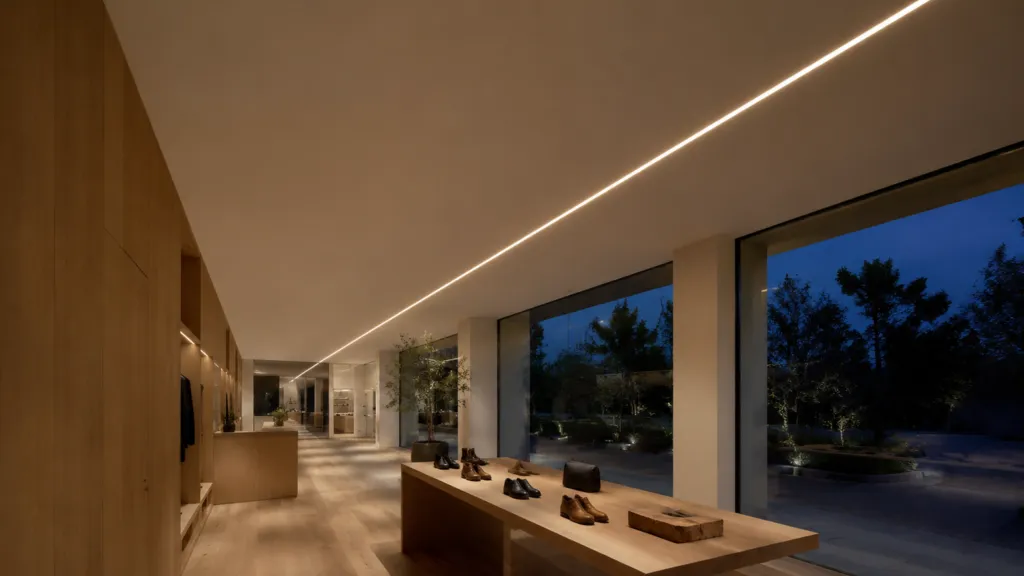
An LED channel for LED strip lights is the line item added last and the one that causes the most rework. The tape is the light source; the extrusion is what turns a row of exposed diodes into something that reads as a fixture. Get it wrong and every symptom is visible from across the room: dots showing through a cover that sat too close to the chips, a profile a millimeter too narrow to seat the tape, a run that stops short because the stock length did not divide the way the drawing assumed. This guide follows the order a buyer has to decide it in: the extrusion, the profile families, the cover, the depth, the fit, and the ordering math.
Key takeaways
Treat the channel as an optical and mechanical part first. Cover grade decides how it looks, depth decides whether it dots, slot width decides whether it fits at all, and the heat-sink argument matters less than the catalogs imply.
- Cover grade is the biggest lever: clear passes about 95 percent of the light, frosted 80 to 85 percent, opal 60 to 70 percent.
- Dotting is geometry, not brightness: the gap between chip and lens wants to be roughly the spacing between the chips.
- Size the slot from the tape at its widest point, pads and jacket included, not from the nominal width in the product title.
- Aluminum will not follow a curve, and a channel with a snap-on cover is not a sealing measure.
- Channel ships in fixed lengths, most often 1.0 meter, so divide the run, place the joints, and count caps, clips and joiners per section.
01What the extrusion is actually for
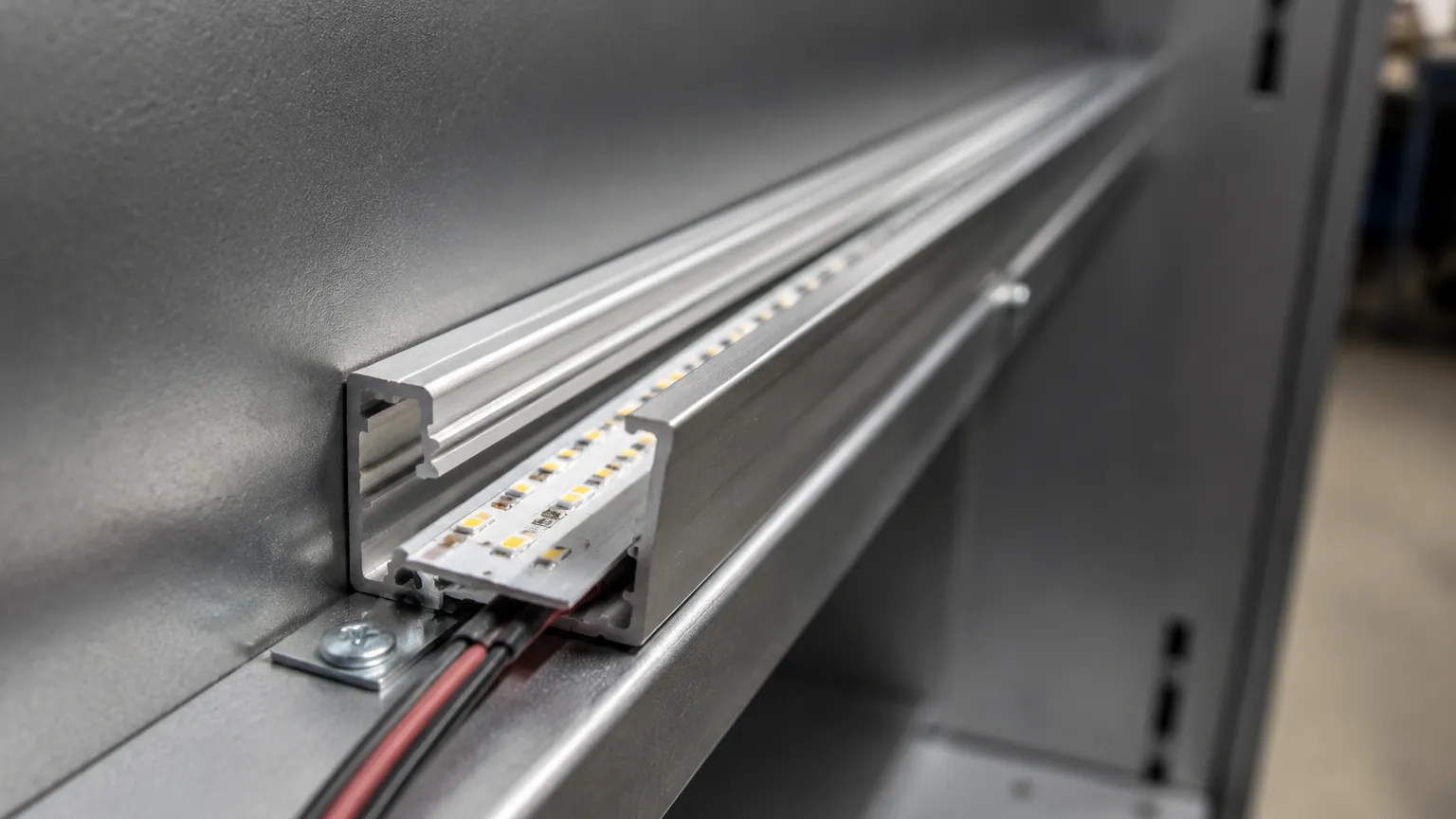
Strip an installation back to parts and the tape is a component, not a finished fixture. The channel finishes it: an extruded aluminum profile, usually U shaped, with a slot down its length for the tape and a snap-on plastic cover over the top. A general-purpose slot runs about half an inch wide, the common stock length is 3.2 feet, or 1.0 meter, and channels often ship in packs of five to match the 16.4 foot, 5.0 meter reel the tape arrives on (Waveform Lighting).
Three of its jobs are real and checkable on site. Optically, the cover hides the emitters, killing both the direct glare of a bare strip and the indirect glare of that strip reflected in a stone counter. Mechanically, it gives the tape a rigid base, keeps dust off the circuit board and absorbs the knock that would otherwise land on a diode. Aesthetically, it is the difference between architectural lighting and yellow phosphor dots stuck under a cabinet.
A fourth job, heat sinking, is oversold, and separating it from the other three changes what mass is worth paying for. What a channel is definitely not is a sealing measure: aluminum profiles and their polycarbonate covers are by no means water tight (Waveform Lighting), so ingress protection still has to come from the tape, which we set out in our guide to waterproof LED strip and IP ratings.
02The profile families, and where each belongs
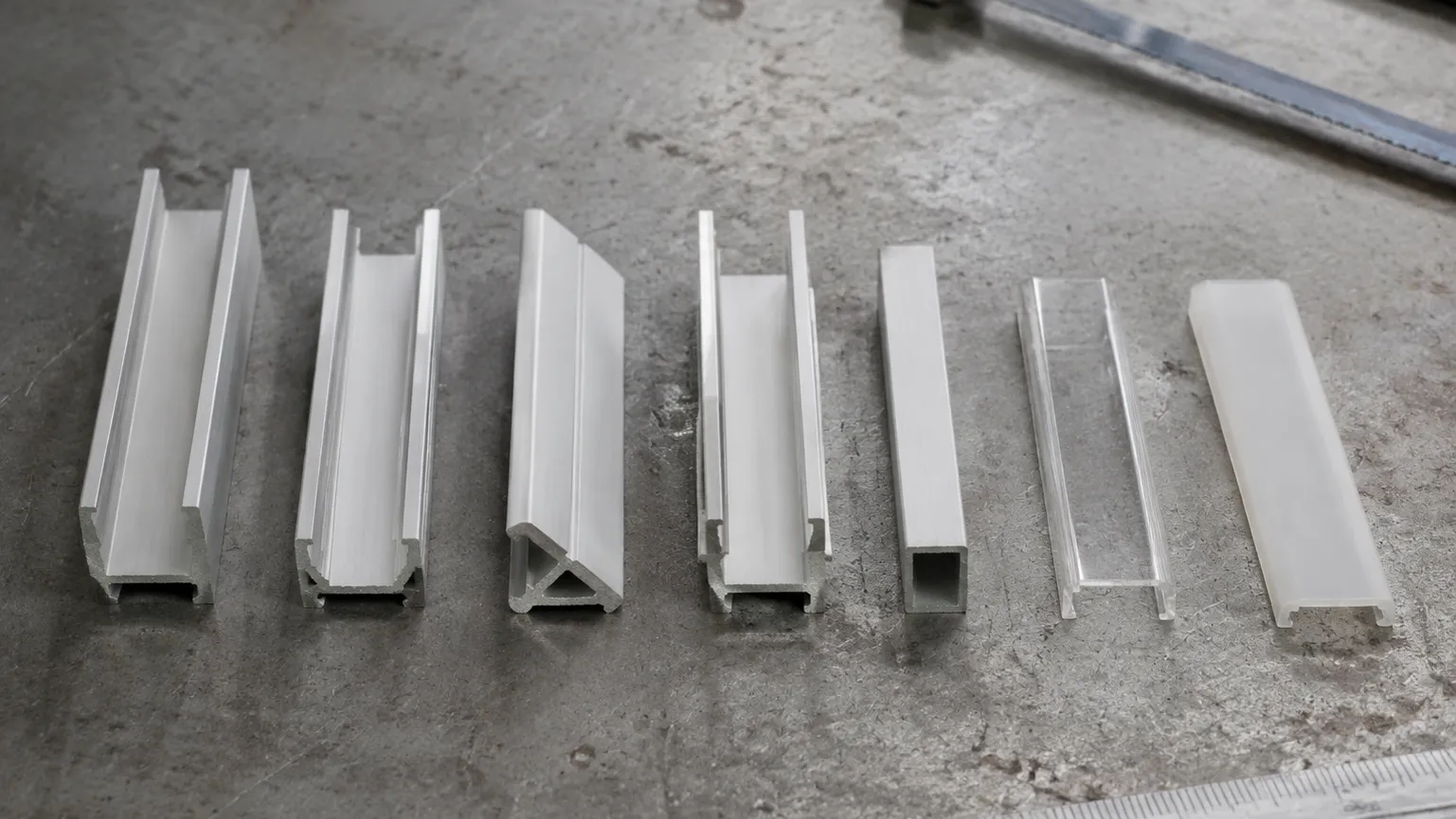
The channels for LED strip lights in any serious distributor catalog sort into a handful of families, and the family is decided by the surface the run lands on rather than by the tape. Diode LED, to take one architectural line, splits its profiles into surface mount, recessed, in-wall or mud-in, millwork, corner and suspended (Diode LED), and most rival catalogs are a subset of those six. Choosing the family first stops a specification turning into a shopping trip.
Surface mount is the default and the cheapest to install: a flat-backed U screwed or clipped to a cabinet bottom, a shelf or a beam, with no preparation of the substrate. Depth is the variable worth paying for, because it gives light room to mix before reaching the cover. The angled corner profile, usually a 45 degree V, is the same install with the aim built in, dropping into an internal corner and throwing the beam onto the work surface instead of into somebody’s eye.
Where those profiles end up on a ceiling — recessed cove, drop-ceiling edge, wall-wash slot — and how the beam angle is chosen is worked through in the LED strip lights ceiling guide.
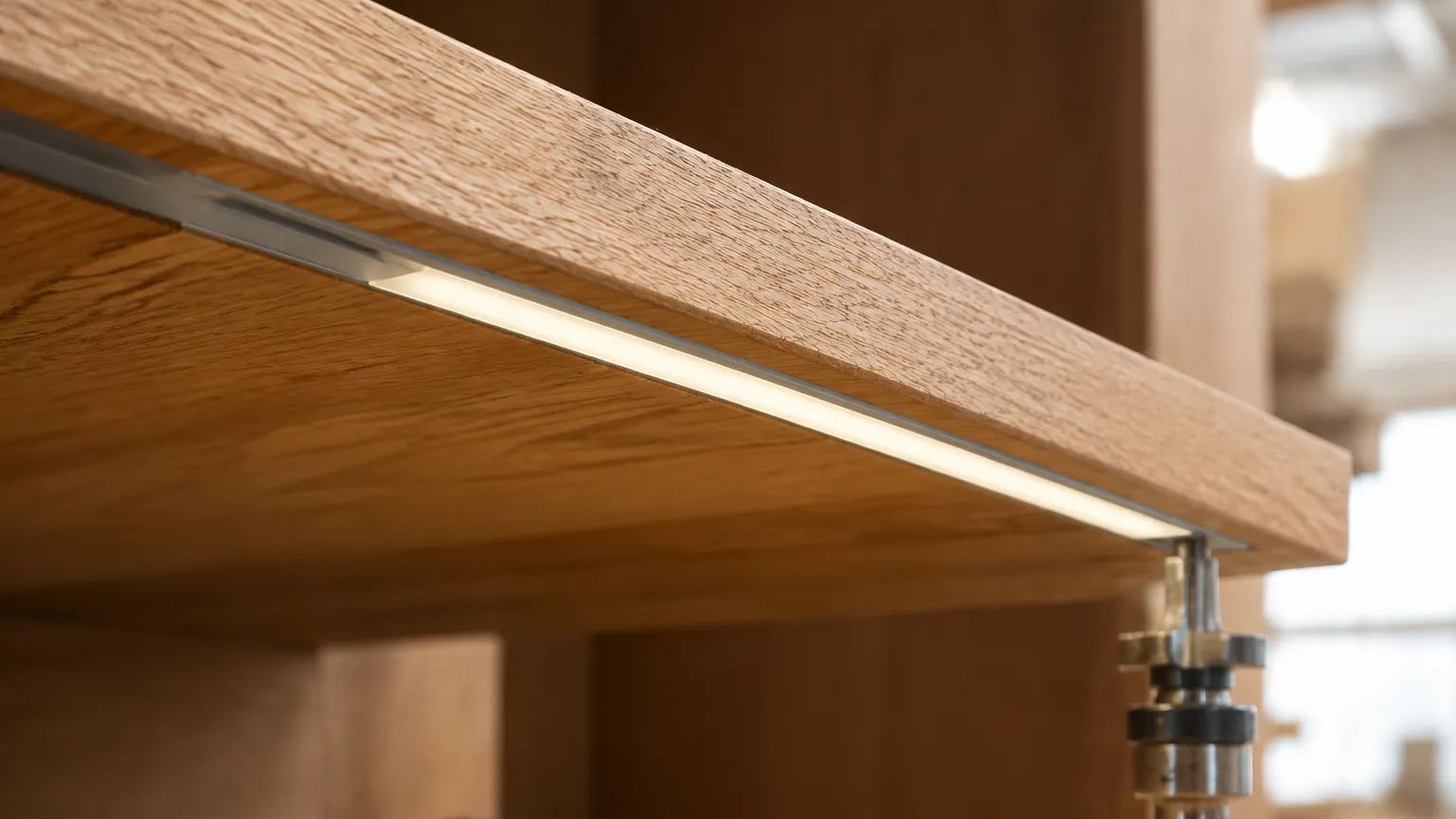
Recessed moves the labor to another trade. It needs a dado routed into millwork or a slot cut and lined in a ceiling, so the profile has to be specified before the joiner cuts anything, which is why recessed is the family most often chosen too late to use. It buys a lens flush with the surface and a light line invisible until switched on. Mud-in, suspended and walk-over profiles go further, each dragging its own trade, lead time or load rating onto the order.
| Family | Typical location | Who does the work | Watch for |
|---|---|---|---|
| Surface mount U | Cabinet undersides, shelves, ceilings | Installer, clips or screws | Shallow profiles dot with standard-density tape |
| Corner or V, 45 degrees | Internal corners, cabinet face frames | Installer | Aim is fixed by the extrusion, so check where the beam lands |
| Recessed | Routed millwork, lined ceiling slots | Joiner, before anything is finished | Groove must be specified before the millwork is cut |
| Mud-in or in-wall | Plaster and drywall, trimless light lines | Drywall trade, plus a plasterer | Lead time, and a wet trade in the program |
| Suspended | Open ceilings, linear pendants | Installer, plus fixings into structure | Suspension kit and cable drops priced separately |
03The LED aluminum channel with diffuser: what the cover costs
An LED aluminum channel with diffuser is the default configuration, and the cover is where the trade is measurable in both directions: every point of diffusion is paid for in output. Covers sort into three optical grades. Clear passes about 95 percent and suits indirect work where the strip is hidden anyway; frosted passes 80 to 85 percent and can still show shadowing; opal passes 60 to 70 percent and is the grade for anywhere the lens is looked at (Bees Lighting). A separate engineering guide puts clear at 90 to 95 percent and diffused at 60 to 70 percent (LED Linea), so two sources agree within a few points.
On a stair, the diffuser choice is really a glare choice; how nosing, riser and wall positions trade glare against a readable step edge is set out in LED strip stair lighting.
Source: Bees Lighting, “LED Channel Guide for Strip Lights” (clear, frosted, opal); Waveform Lighting, “Aluminum Channels for LED Strip Lights” (bundled frosted cover), retrieved 2026-08-28
The manufacturer accounting is the honest version of the same number. A bundled frosted polycarbonate cover transmits roughly 90 percent, so you take about a 10 percent drop in brightness and pay it back twice: once in the extra tape needed to reach the same output, and once in electricity for as long as the run is switched on (Waveform Lighting). A sign-industry guide arrives from the other end: about 10 percent lost through a clear cover, about 40 percent through an opal one (Wired4Signs USA).
One quieter effect shows up only on a meter: fitting the cover does not meaningfully change rendering, but it can pull measured color temperature down by roughly 150 to 300 K on daylight-white tape, far less on warm white (Waveform Lighting). What those reel numbers actually control is unpacked in our LED strip spec decoder. The rule falls out cleanly: match the grade to the sightline, then pay for the loss in tape rather than saving it on the cover.
04Depth, chip pitch and the dot problem
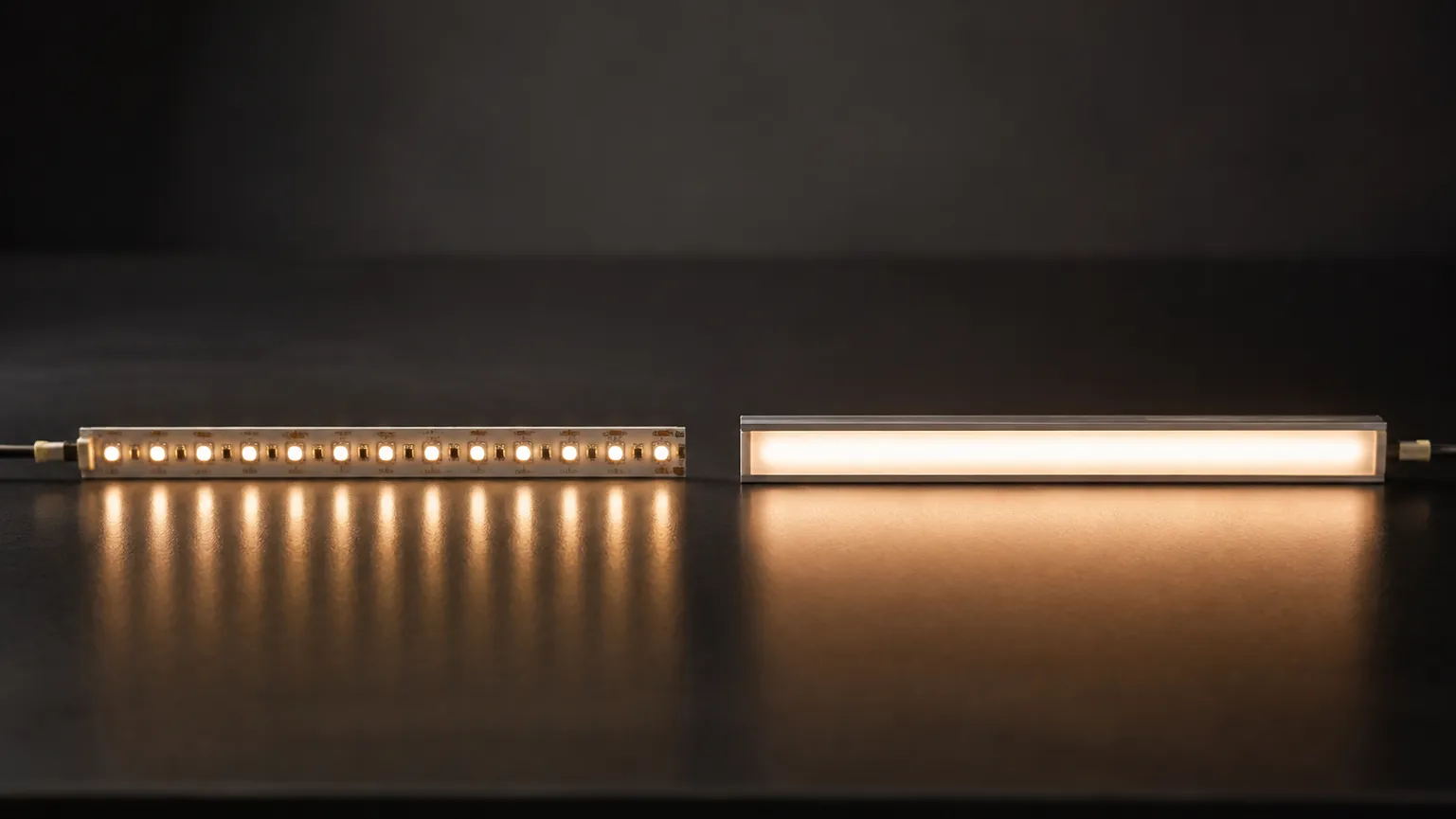
Dotting is geometry, and the rule that predicts it is short enough to keep in your head: for a smooth continuous line from standard SMD tape, the distance between the LED chip and the lens should be roughly equal to the distance between the chips themselves (Bees Lighting). Chips on wide centers under a shallow cover give a row of bright spots; the same tape in a deeper profile gives one line. Output does not change that, which is why turning the brightness up is the wrong first move when a mock-up dots.
Ordinary hardware is more forgiving than the rule sounds, because on a typical bundled profile the cover already sits about a quarter to half an inch above the tape, roughly 6 to 13 millimeters of mixing distance (Waveform Lighting). That covers most standard-density tape at a normal viewing distance, and it is precisely the margin a slim architectural profile gives away in exchange for looking slim.
When the profile has to be slim, both ways out are decisions about tape rather than extrusion: raise the chip count, since slim profiles need high-density or COB tape to avoid a dotted reflection (Bees Lighting), or drop to a deeper diffusion grade and pay for it in output. The cheapest insurance costs ten minutes: cut a 300 millimeter offcut of the real tape, drop it into the real profile under the real cover, and look at it in the dark from where people will stand.
05Fit: slot width, tape width and the millimeter that strands a shipment
Most channel decisions are reversible on paper. Fit is the one that leaves stock in a warehouse. The rule is trivial and still the most common purchasing error: match the printed-circuit width of the tape to the channel slot, so a 10 millimeter tape needs a profile that states 10 millimeters (LEDLightsWorld). What goes wrong is that the nominal width in a product title is not the widest real point of what gets slid into an extrusion.
Solder pads at a cut point sit proud of the track. A silicone jacket on damp-location tape adds material both sides. Multi-channel tape carries extra copper, so the same nominal family measures wider than a single-color one. Buy against a caliper reading and the extruder drawing, not the marketing width. Send us the profile drawing with the inquiry and we will confirm the printed width against it, whether the run is one smart LED light strip format or a mixed program.
| Tape width | Typical slot | Where it shows up | The measurement that traps people |
|---|---|---|---|
| 8 mm | 8 to 10 mm | Slim single-color tape, shallow profiles | Solder pads at a cut sit wider than the tape |
| 10 mm | 10 to 12 mm | The common single-color and COB width | A half-inch slot swallows it with room to spare |
| 12 mm | 12 to 15 mm | RGB and other multi-channel tape | Extra copper tracks push the printed width out |
| 15 mm and wider | 15 to 20 mm | High-output and addressable tape | Depth becomes the limit before width does |
| Any width, jacketed | Add the jacket both sides | Silicone-sleeved tape for damp areas | Jacket dimension is quoted separately from the tape |
The second fit question is what happens at the ends of a run, and it catches more projects than width does. Solderless connectors generally do not fit inside a channel, which is why manufacturers recommend soldering feed wires directly (Waveform Lighting). That makes feed points a design decision rather than a site improvisation. Where a run is shortened to suit a section, the tape only parts at its marked intervals, which we cover in cutting LED strip lights.
06Heat: what the aluminum buys, and what it does not
Aluminum earns part of its reputation honestly. The 6063 alloy used for architectural extrusion carries a thermal conductivity of 218 W/mK at 25 degrees Celsius (AZoM), orders of magnitude better than the still air a bare strip sits in, and the tape is in direct contact with it, so heat genuinely leaves the board and spreads down the profile.
Heat matters because junction temperature, not elapsed hours, ages a diode. In a Lighting Research Center comparison of two identical LEDs, the one running 11 degrees Celsius hotter at the junction lost more than half its functional life, and the 50,000 hour figure printed on most tape, the point at which output falls to 70 percent, assumes conditions that never get that hot (Flexfire LEDs).
The counterpoint comes from a strip manufacturer rather than a channel seller. Because cost per diode has fallen, tape now uses many more emitters each driven well below rated current, which spreads the heat; one manufacturer states its strips, at 37 diodes per foot, run safely with no thermal management at all, and answers whether strip lights need channels for heat sinking with a plain no, as long as the tape is well made and not over-driven (Waveform Lighting). Heat is therefore a supplier question first: ask for watts per meter and whether the tape is rated for free air, then reserve the thermal argument for high-output tape, sealed voids, and tape stuck onto timber or plastic.
07The ordering sequence
Once the family and the cover grade are settled, the rest is arithmetic anyone can check. Five decisions, in this order, produce a bill of materials that survives contact with a site.
Fix the sightline
Decide whether anybody will look at the lens. That answer sets the cover grade and half the profile choice.
Match the slot to the tape
Measure the tape at its widest point, pads and jacket included, then read the extruder drawing, not the product title.
Check depth against chip pitch
Chip-to-lens distance roughly equal to chip-to-chip spacing, or move to denser tape before slimming the profile.
Divide the run by the stock length
Count sections, place the joints and the offcut, and mark feed points before anything is ordered.
Order the small parts per section
End caps, clips, joiners and feed wire counted per section, never estimated per project.
Step four is where most bills of materials go wrong, because channel is sold in fixed lengths and rooms are not built in them. A 3.6 meter cove built from 1.0 meter sections is four pieces, one of them cut, and where that cut lands belongs on the desk, not a ladder: put the joint where a corner or a cabinet return hides it. Aluminum cuts with a hacksaw, slower than trimming tape, so price it as labor instead of assuming it disappears into the install (Waveform Lighting).
Then count small parts against sections rather than the project: end caps in pairs for every section that terminates, clips at the drawing’s spacing, joiners wherever the run turns. When the job is a whole room, settle the zones first. Our kitchen zone guide works through how a room splits into runs, and the under-cabinet buyer primer covers the zone where mounting position and channel choice do most of the work.
08Where a channel is the wrong answer
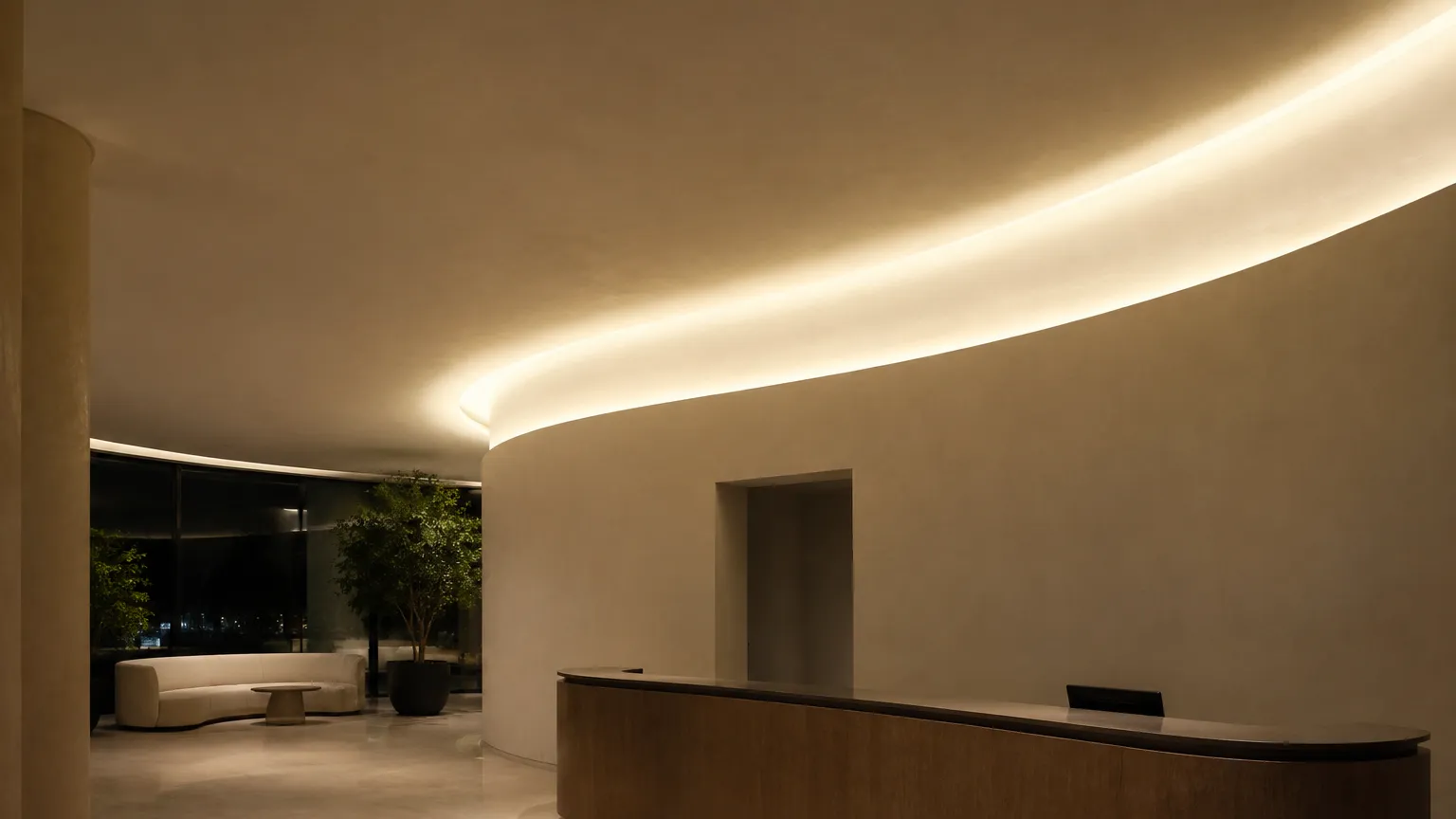
Aluminum is rigid, and that is a hard constraint rather than an inconvenience. An extrusion cannot be curved or bent, which rules it out of radiused coves, curved reception desks and any signage-style bend; those runs need a flexible profile, a site-built shadow gap, or bare tape behind a detail. Name it early, because no supplier can quote around it.
When a channel is overkill, the choice between factory tape and clip fixing is set out in LED strip lights with double sided tape.
Wet and outdoor locations are the second exclusion, for the reason given at the top: the channel and its snap-on cover are not water tight (Waveform Lighting), so a profile buys mechanical protection and nothing else. Ingress protection is a property of the tape and its jacket, chosen against a class rather than a look, which we set out in the guide to waterproof LED strip and IP ratings.
The third case saves money rather than costing it. When a strip fires upward at a matte ceiling from inside a cove, nobody sees the emitters and nothing glossy reflects them, and a manufacturer recommends skipping the channel and cover altogether in exactly that case (Waveform Lighting). Under-cabinet is the mirror image: a polished counter reflects every diode straight back at eye level, which is why that zone earns a channel even on a tight budget.
Sourcing the tape that goes inside the channel
We do not extrude aluminum profile. What we build at our own factory in Foshan is the tape that sits inside it, on the same lines and through the same checks as the products we sell under our own retail brand. If you are specifying channel for a program and need the tape to match the slot, send the profile drawing and the run lengths and we will quote against them. Pricing is per project.
09Watch it work
Why the dots appear, and what depth does about them, in 37 seconds:
FAQ
Do I need an LED channel for LED strip lights?
It depends on what the run has to look like, not on whether the tape survives without one. A channel earns its cost when someone can see the emitters directly, when the light lands on a glossy surface that reflects them back at eye level, or when the tape needs protection from dust and knocks. It is worth skipping where a strip fires up into a cove at a matte ceiling, and the manufacturer recommendation there is to mount the tape on its own adhesive and save the money (Waveform Lighting). Heat is the weakest of the four reasons: well-made tape driven below its rating runs safely in free air, so a channel is a finish and a mount before it is a heat sink.
Is an LED aluminum channel with diffuser worth it?
For anything on a sightline, yes, and the price is measurable. A bundled frosted polycarbonate cover transmits about 90 percent of the light, so you lose roughly 10 percent of output and pay that back twice, once in extra tape to hit the same brightness and once in running cost (Waveform Lighting). Heavier diffusion costs more, with opal covers passing only 60 to 70 percent (Bees Lighting). What the money buys is the removal of visible diode dots and the glare with them, the clearest difference between a job that looks specified and one that looks improvised. Budget the loss into the tape rather than saving it on the cover.
How do you cut aluminum channels for LED strip lights?
With a hacksaw, or a miter saw fitted with a blade for non-ferrous metal, cutting square and deburring the ends so the cover still snaps home and the end cap sits flush. It is slower than trimming tape, which is why it belongs in the labor line of a quotation rather than being assumed into the install (Waveform Lighting). Two habits keep it clean: cut the plastic cover slightly long and trim it back once the channel is fixed, and place the offcut so any joint falls where nobody reads it as a seam.
How many channel sections does one 5 meter reel of tape need?
Five, if the run is continuous, which is why channel is so often sold in packs of five: the common stock length is 1.0 meter, or 3.2 feet, and a standard reel holds 5.0 meters, or 16.4 feet (Waveform Lighting). Real jobs are messier. A room is a set of separate lengths, each rounded up to a whole number of sections with one offcut, so the section count runs higher than the tape math suggests and leftovers are rarely long enough to use. Count sections per run, add caps and clips per section, and treat the reel length as a coincidence rather than a plan.
What happens if the channel is narrower than the tape?
Nothing good, and it gets discovered on site rather than at the desk. Tape forced into an undersized slot buckles, lifts off its adhesive at the edges, or has to be trimmed at the margins, which risks the copper tracks and voids most warranties. A slot slightly too wide is the far cheaper error, since the tape simply sits with a gap either side. The dimension that causes it is almost never the nominal width in the product title but the widest real point: solder pads at a cut, a silicone jacket, or extra copper. Measure the actual article, read the extruder drawing, and dry-fit both parts before shipping a program order.
Sources
Every external figure above was checked on 2026-08-28. Optical and dimensional data comes from channel and strip manufacturers’ own engineering guides; the alloy property from a materials datasheet.
- Waveform Lighting, Aluminum Channels for LED Strip Lights: Are They Worth It? (slot and stock-length figures, the quarter to half inch cover gap, 90 percent transmissivity, the 150 to 300 K color shift, connectors, water tightness, and when to skip a channel), retrieved 2026-08-28.
- Bees Lighting, LED Channel Guide for Strip Lights (clear, frosted and opal transmission figures; chip-to-lens distance roughly equal to chip pitch; slim profiles with high-density or COB tape), retrieved 2026-08-28.
- LED Linea, Clear vs Diffused LED Channel Covers: Engineering Guide (clear covers at 90 to 95 percent, diffused at 60 to 70 percent), retrieved 2026-08-28.
- Wired4Signs USA, A Buyer’s Guide to LED Diffusers (clear diffusers reduce output by about 10 percent, opal by about 40 percent), retrieved 2026-08-28.
- Flexfire LEDs, LED Strip Light Thermal Management (the Lighting Research Center 11 degree Celsius junction-temperature comparison, and the 50,000 hour to 70 percent output claim), retrieved 2026-08-28.
- AZoM, Aluminium / Aluminum 6063 Alloy, UNS A96063 (thermal conductivity of 218 W/mK at 25 degrees Celsius, the architectural extrusion alloy), retrieved 2026-08-28.
- Diode LED, Channel Profiles (a catalog split into surface mount, recessed, in-wall or mud-in, millwork, corner and suspended families), retrieved 2026-08-28.
- LEDLightsWorld, LED Aluminum Channel Buyer’s Guide (match circuit-board width to channel slot, so a 10 mm strip needs a 10 mm channel; U, V and recessed families), retrieved 2026-08-28.
