


Do LED lights get warm? Yes, but far less than a filament bulb, and in different places: an LED sends almost no heat forward in its beam, so the warmth gathers behind the light, in the circuit board and metal it sits on and in the driver or adapter that powers it. In 2007 a U.S. Department of Energy fact sheet put it in one line: LEDs won’t burn your hand like some light sources, but they do produce heat.
For a retailer or importer the useful questions are narrower: which part of the product gets warm, what the rated power tells you, and what the listing should say. We build LED strip lights, LED neon signs, star and galaxy projectors, sunset lamps and decorative table lamps, not LED bulbs, and we have no surface-temperature measurements of our own to publish. Every temperature and fire statement below comes from the Department of Energy, ENERGY STAR or UL.
Key takeaways
LEDs do get warm, but the warmth sits behind the light, not in it: most of the power still becomes heat, conducted into the board, heat sink and housing instead of being thrown forward as infrared.
- Do LED lights get warm? Yes. The Department of Energy’s 2007 fact sheet put the heat share of a white LED at 75 to 85% of input power, against 19% conducted and convected heat plus 73% infrared for a 60 W incandescent.
- The beam carries almost no heat, because LEDs generate little or no infrared, so the front of a lit LED feels cool while its body warms.
- Heat matters more to the LED than to the user: ENERGY STAR calls thermal management generally the single most important factor in LED performance over its lifetime.
- Drivers and adapters are heat sources too, and they often sit outside the product, at the wall socket.
- On a listing, say where the product gets warm and where it should not be enclosed, rather than printing “cool to the touch” as a blanket promise.
Do LED Lights Get Hot? Warm at the Back, Cool in the Beam
In normal use LED lights get warm rather than hot, and the warm part is the body behind the light rather than the light itself. The Department of Energy has stated both halves. Its 2021 Consumer Guide to Energy-Efficient Lighting tells households that, unlike CFLs or incandescent bulbs, LEDs are cool to the touch, while its 2007 fact sheet on white LEDs says they do produce heat. The two statements fit together once you know where to put your hand.
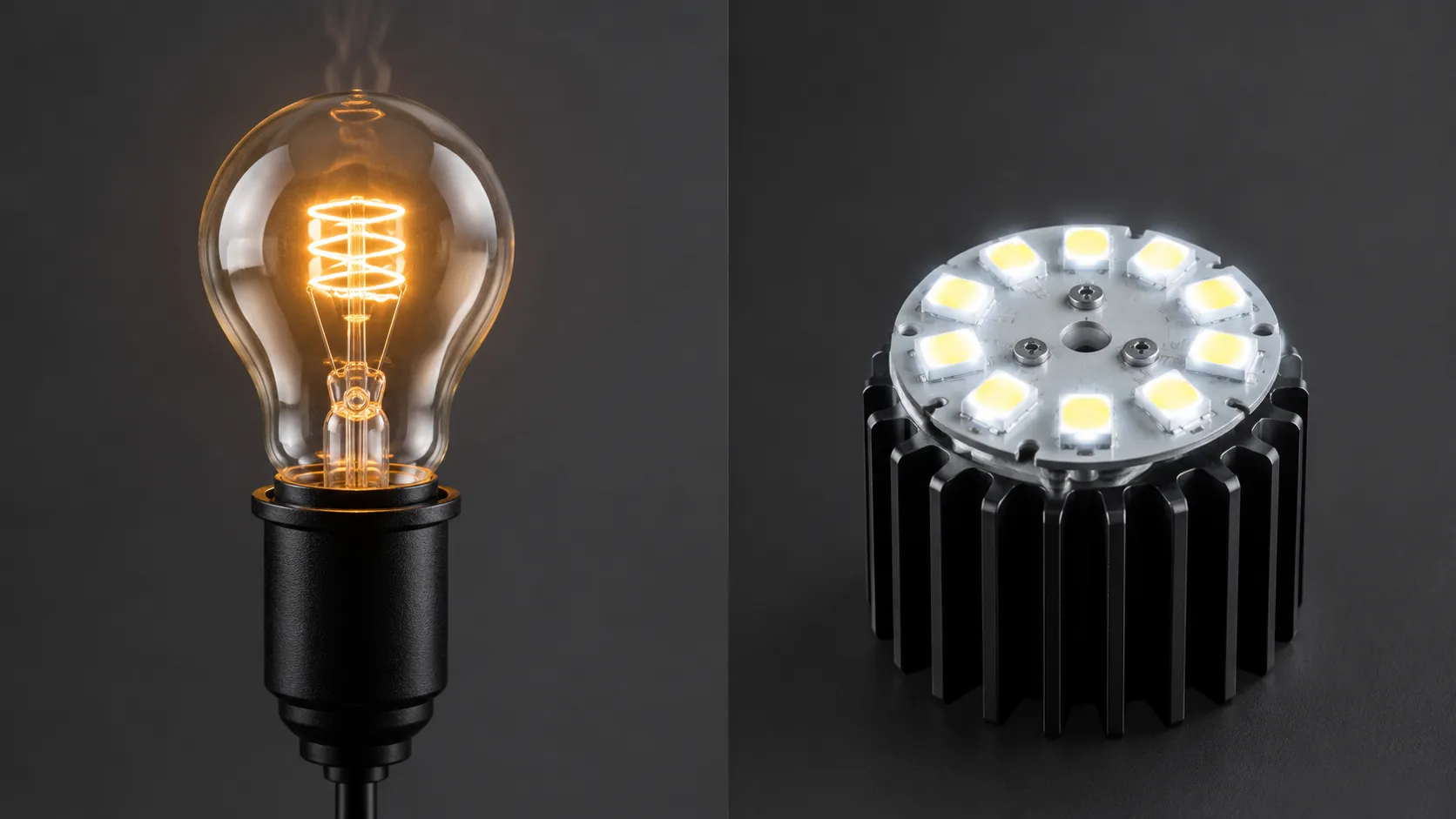
Hold a hand near a lit filament bulb and most of what you feel is radiation. In the 2007 fact sheet’s table, drawn from the IESNA Handbook, a 60 W incandescent lamp sends 73% of its input power out as infrared, which warms whatever it shines on, skin included. LEDs, the same sheet says, generate little or no infrared or ultraviolet. Their beam carries light and little else, so the lens in front of the diodes stays comfortable to touch.
The heat an LED does make stays in the product and travels backwards by conduction, from the chip into the circuit board, the heat sink and the housing. That is why the warm spot on an LED product is its metal body, the back of a lamp head, the underside of a strip or the adapter at the wall socket. Touch the front and then the back of the same product and you get two answers to one question; a good listing explains which is which.
The one product we make that wants a filament’s heat is the candle warmer lamp, which melts wax with a GU10 halogen bulb on purpose; why an LED cannot do that job is explained in our guide to LED light bulbs.
Do LED Lights Produce Heat? Most of the Power Still Becomes Heat
Yes, LED lights produce heat, and by the Department of Energy’s 2007 estimate most of the electricity a white LED draws ends up as heat rather than light. The fact sheet put the visible share at 15 to 25% of input power and the remaining 75 to 85% as heat that has to be conducted from the LED die to the underlying circuit board and on to heat sinks, housings or the frame of the fitting (U.S. Department of Energy).
That looks worse than a filament until the routes are compared. The same table gives a 60 W incandescent 8% visible light, 73% infrared and 19% heat lost by conduction and convection, so it wastes about 92% of its power by our arithmetic, but throws most of that waste across the room. The 2014 lifetime guide from the Next Generation Lighting Industry Alliance and the Department of Energy describes the LED side plainly: LEDs do not radiate heat but rather retain it, so it has to leave by convection or conduction, which generally raises local temperatures inside the fitting.
Source: U.S. Department of Energy, Thermal Management of White LEDs (PNNL-SA-51901), February 2007. Retrieved 2026-10-21.
Two cautions on reading the chart. The first is its date. The LED range reflected the best white LEDs available in 2007, and the fact sheet’s footnote says the figure varies with LED efficacy, so a more efficient chip sends a larger share to light and a smaller share to heat. The second is that percentages hide size. A product cannot shed more heat than the power it draws, so the wattage on a spec sheet is the ceiling: a 60 W incandescent has about 55 W of infrared and conducted or convected heat to lose, again by our arithmetic from the DOE percentages, while our desk sunset lamp is rated at 5 W in total. A few watts, concentrated in a small part, is the LED pattern.
Where LED Heat Collects: Chip, Board, Driver and Power Supply
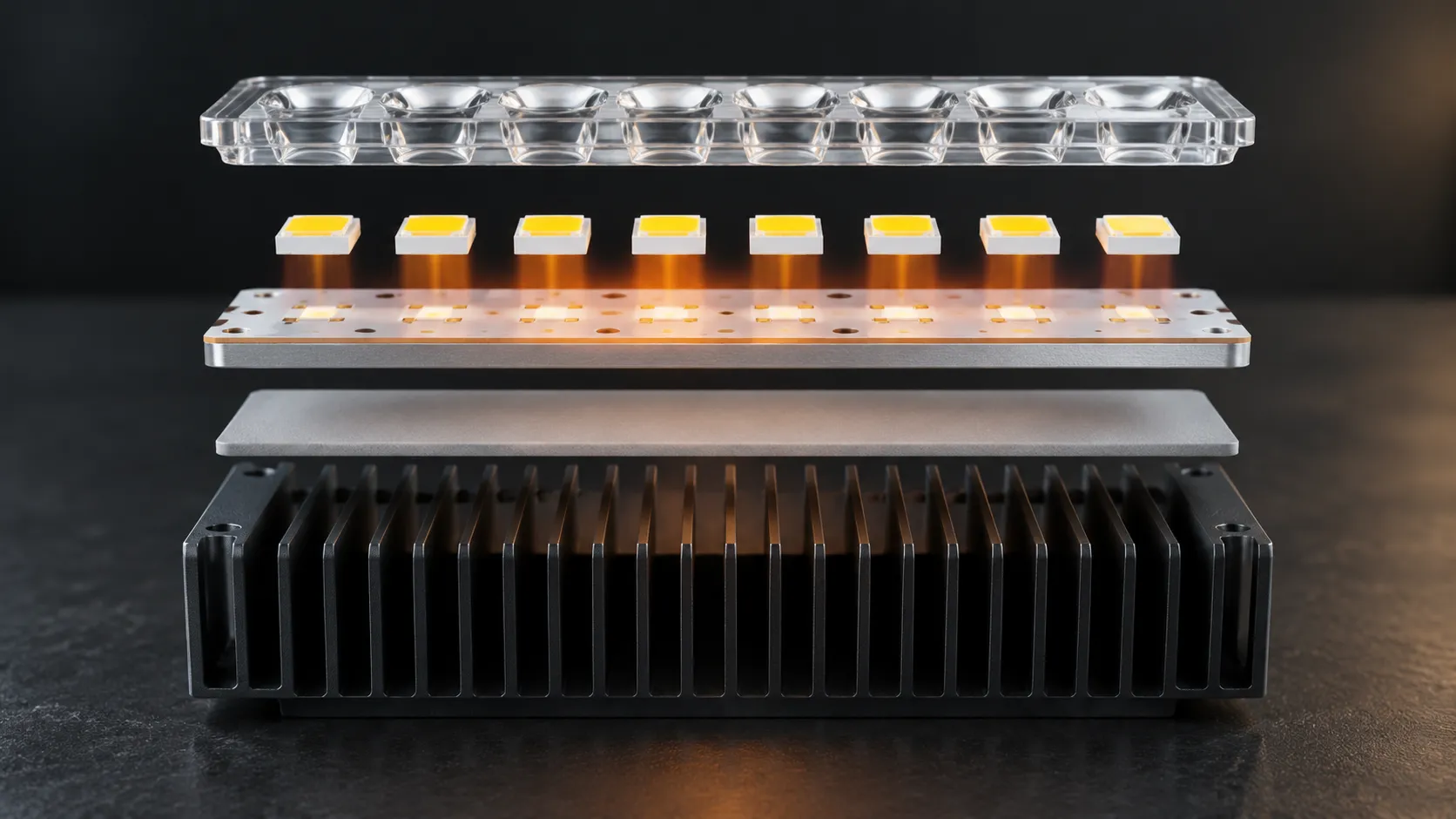
LED heat collects at three points: the junction inside the chip where light is made, the board and metal that pull heat away from it, and the driver or power supply that turns mains electricity into the low-voltage direct current the LEDs need.
The junction is the hottest point and the hardest to reach. The 2007 DOE fact sheet defines junction temperature as the temperature within the LED device, notes that measuring it directly is impractical, and says it is calculated from a known case or board temperature. In 2007, the sheet notes, LED makers sorted their chips for brightness and colour at a fixed junction temperature of 25°C (77°F), yet under constant current at room temperature, with heat mitigation designed in, the junction typically ran at 60°C or more, so white LEDs delivered at least 10% less light than the maker’s rating, which is why a buyer should ask at what temperature a chip’s rating was measured. Three things set that temperature, according to the same sheet: drive current, the thermal path and the ambient temperature.
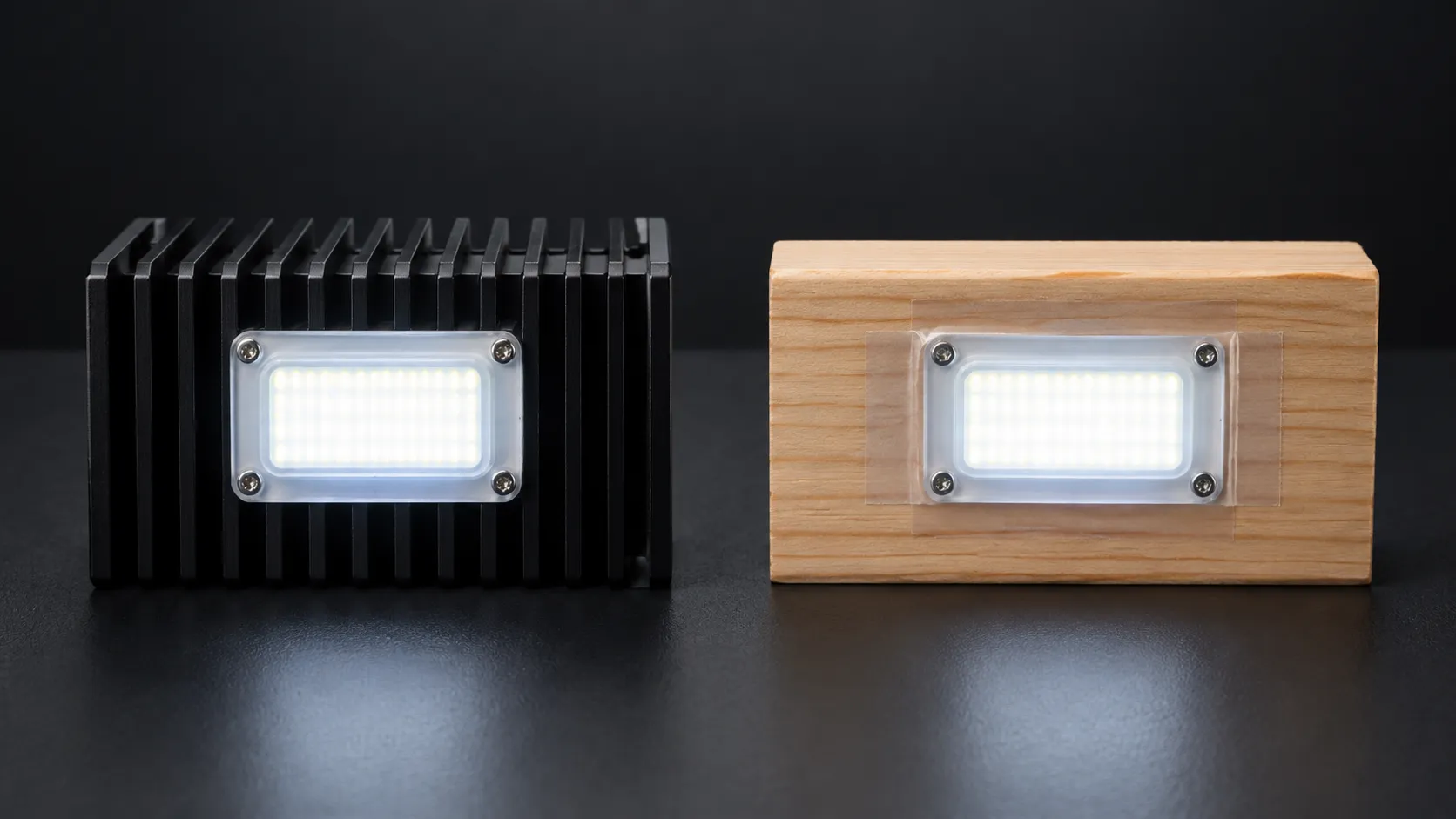
The board and heat sink are the thermal path. A typical high-output LED sits on a metal-core circuit board whose metal layer is usually aluminium, fixed to an external heat sink that can be a dedicated part or the body of the fitting itself (U.S. Department of Energy). ENERGY STAR describes the job: heat sinks absorb the heat produced by the LED and dissipate it into the surrounding environment, which keeps LEDs from overheating and burning out. In decor products the housing often is the heat sink, which is why a metal lamp head feels warm. Whether a strip needs an aluminium channel to do the same job is a separate question, answered in the heat section of our LED channel guide.
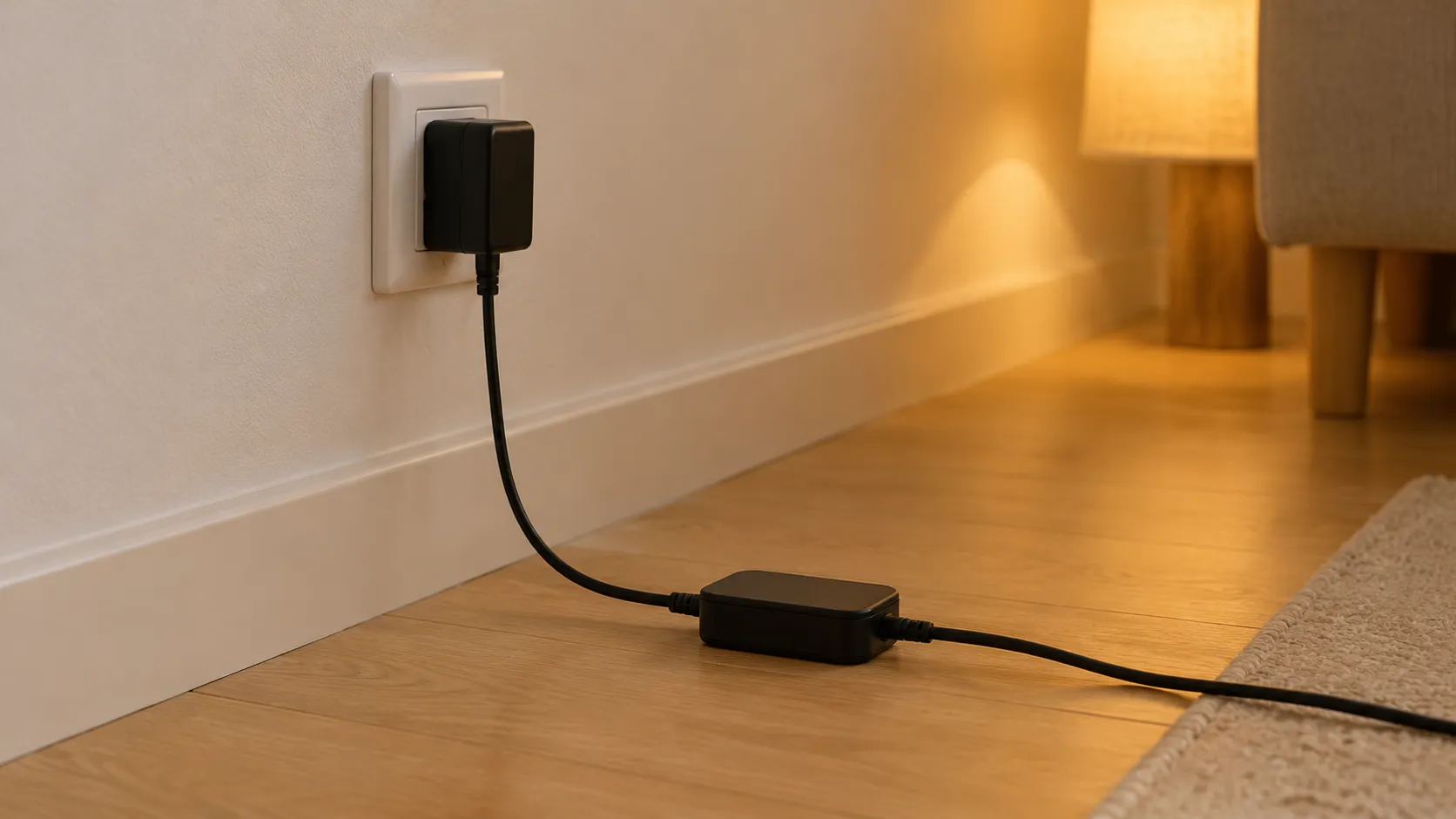
The driver is the heat source buyers forget. The 2014 lifetime guide lists what a contemporary driver contains, including input conditioning, an AC/DC converter and current regulation, and states that contemporary power supplies, to one extent or another, generate heat. It adds that a fitting’s thermal design should account for the power supply’s heat load, not only the heat from the LEDs. In plug-in products that load often sits outside the product: in the adapter at the wall or, for a 5 V USB product, in whichever USB charger the customer uses.
Why Heat Matters More to the LED Than to Your Hand
The 2007 DOE fact sheet puts the two points side by side: LEDs won’t burn your hand like some light sources, but thermal management is arguably the most important aspect of successful LED system design. ENERGY STAR calls thermal management generally the single most important factor in the successful performance of an LED over its lifetime, and says that the higher the temperature at which LEDs are operated, the more quickly the light will degrade and the shorter the useful life will be.
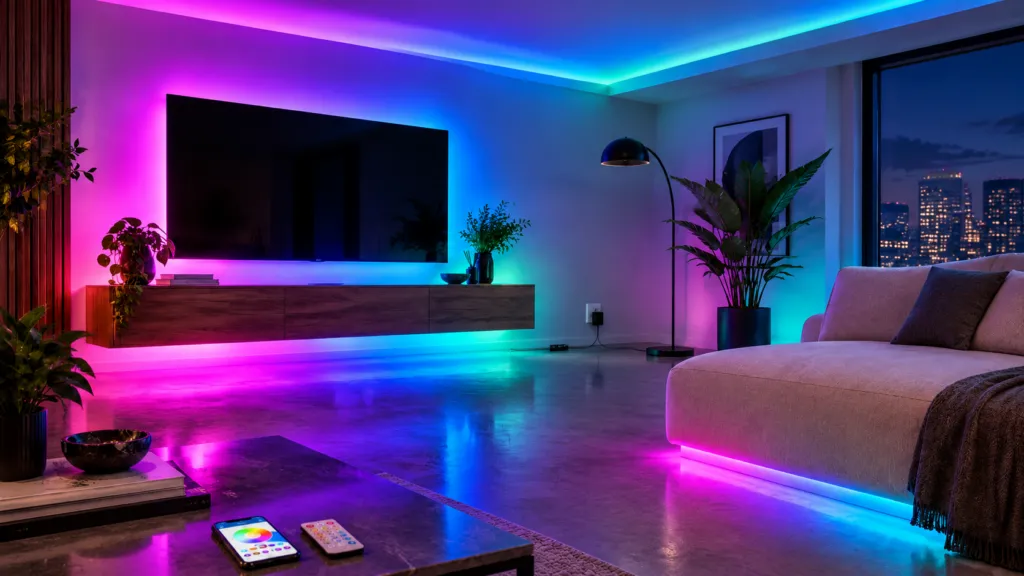
The 2007 DOE fact sheet splits the damage in two. Short term and reversible: colour shift and less light while hot. Long term: faster loss of output and a shorter useful life. Colour is the part decor buyers should watch. The sheet says the light output of amber and red LEDs is the most sensitive to temperature and blue the least, which can cause noticeable colour shifts in RGB-based white light when the junction temperature differs from the design value. The same uneven response matters for anything that relies on red and amber: our sunset lamps live on oranges and reds, and our strips and neon rope mix RGB colours, as does the RGB LED in our star projector night light, so a hot-running sample can show a different sunset from the one in the photograph.
The electronics follow the same rule. The 2014 lifetime guide quotes the “10-degree rule” for electronic components: for every 10°C of operating temperature reduction, a component’s life can effectively double. The guide calls the rule an over-simplification, but a useful one.
Enclosure is where all three effects stack up. For enclosed fixtures shipped with ENERGY STAR certified lamps, version 2.0 of ENERGY STAR’s luminaires specification, in effect from June 2016, did not allow a lamp marked “not for use in totally enclosed fixtures”, and it required an in situ test showing that the air inside the enclosure stays at or below 45°C. Decor products meet the same physics less formally. A projector pushed to the back of a bookcase needs no fault to run hotter than it would in open air; the heat simply has nowhere to go.
Where Our Products Get Warm: Strip, Neon, Projectors, Sunset Lamps and Table Lamps
In each of our lines the warmth sits where the light source and its power conversion sit, and the published wattage caps how much heat there is to lose. The table uses each product’s published voltage and power; anything unpublished is confirmed on the quote, not guessed here.
| Product | Published power | Where the warmth sits | Listing note |
|---|---|---|---|
| Smart LED strip kit | 24 V kit with a plug-in power adapter; 3535 RGB LEDs, 16 per metre | Along the strip backing and at the adapter | Indoor only, no water protection; keep the adapter in open air |
| RGBIC neon rope light | 5 V; about 1.6 W per metre | Along the rope | Fix it with the supplied clips to an open surface |
| LED neon bar sign, made to order | 12 V; 8 W per metre of neon; IP67 acrylic housing | Along the neon and at the 12 V supply | Covered semi-outdoor positions only; give the supply air |
| Stock LED neon motifs | Battery or USB, 36 V or less; IP20 | Inside the PVC housing, and in the USB charger used | Indoor display only |
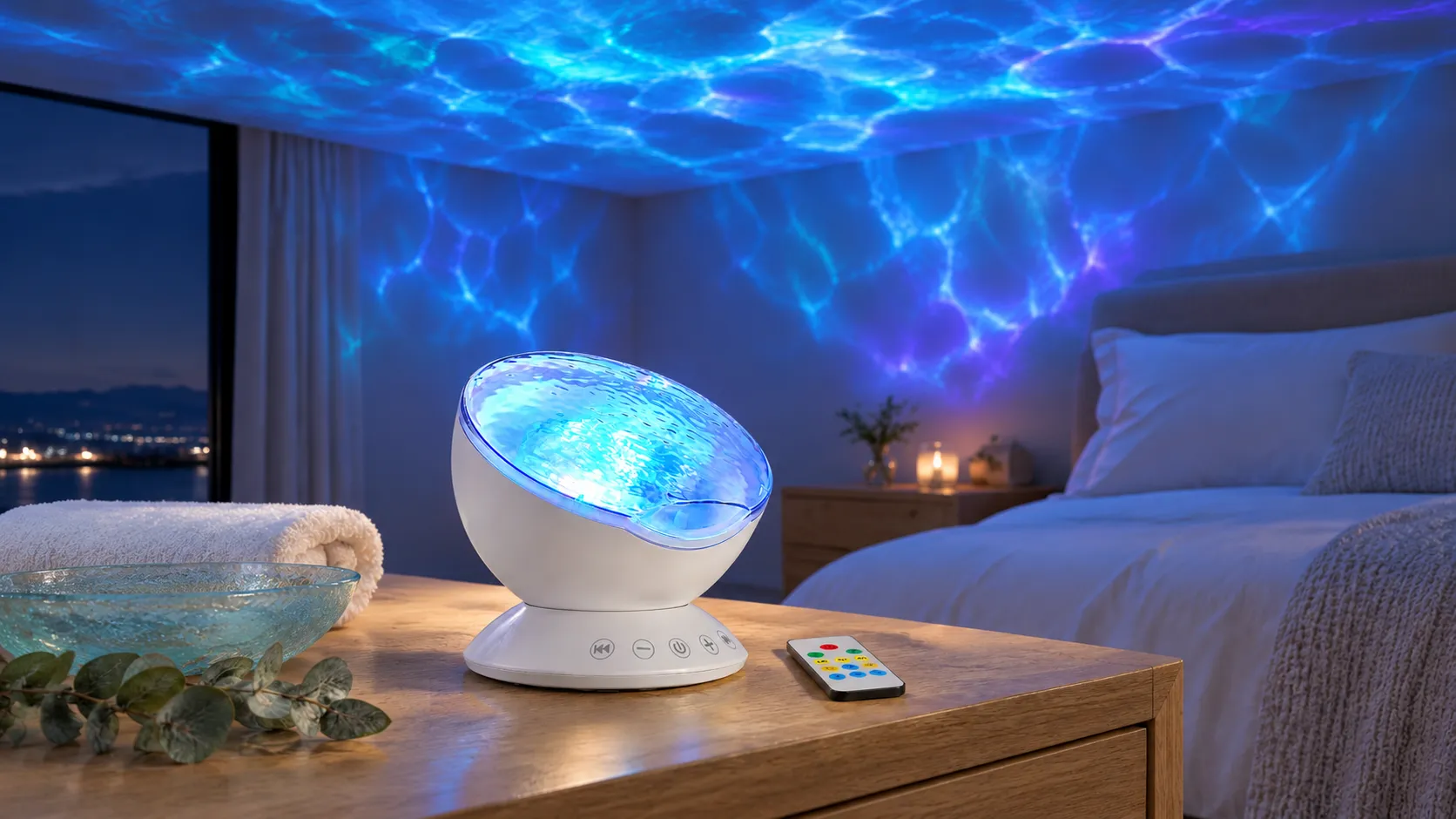
| Ocean wave projector | DC 5 V, 1 A (5 W) over a USB-C cable | Inside the shell, around the LED, motor and speaker | Stand it in open air on a hard surface |
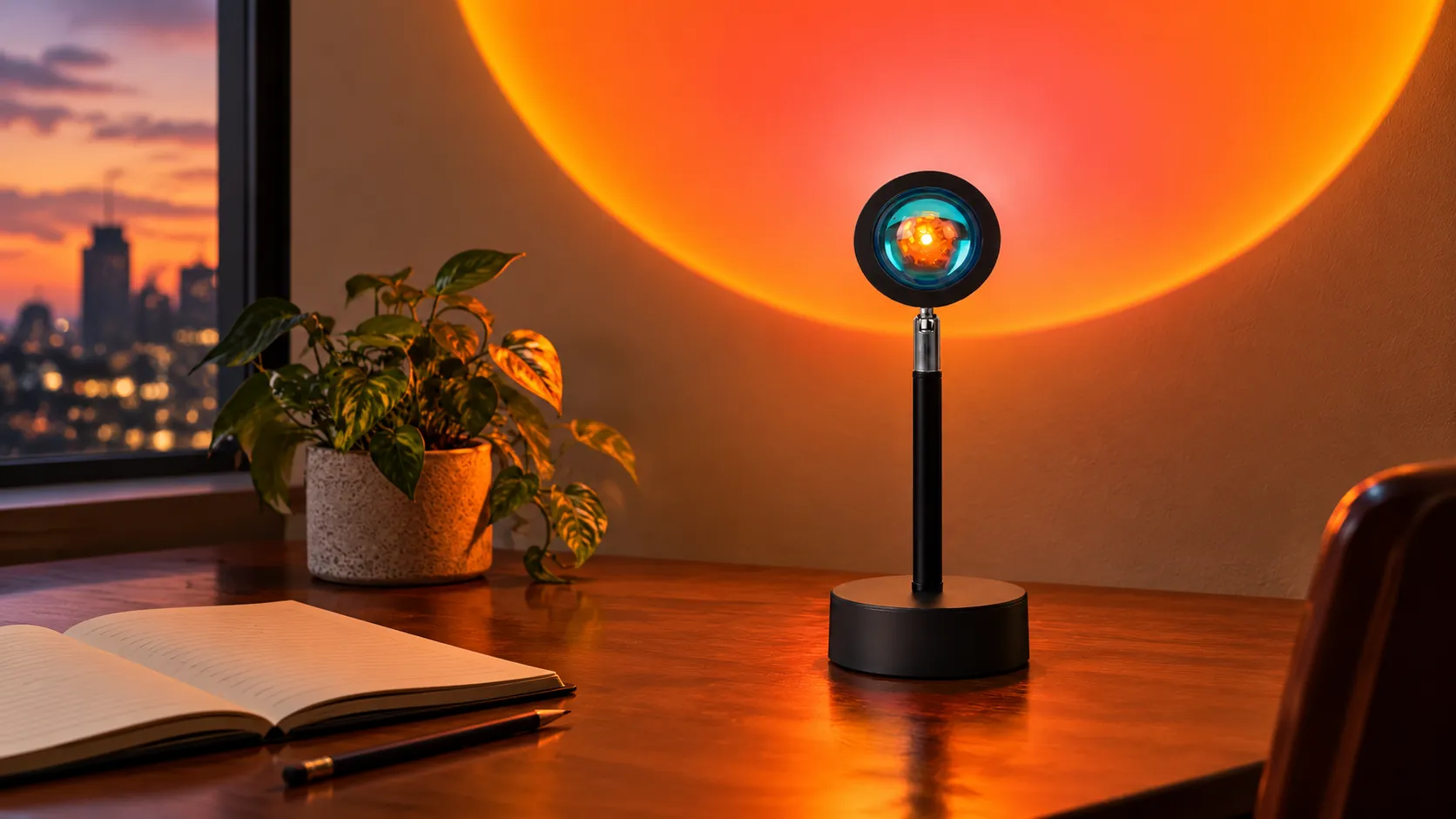
| Desk sunset lamp | USB 5 V, 5 W; one LED | In the 7 cm aluminium head | Aim it at a wall; do not cover the head |
| Sunset wall lamp | 3 W per head; rechargeable | In the aluminium head | Mount it on an open wall |
| Rechargeable night light | 3 W LED; built-in rechargeable battery; 36 V or less | In the frosted plastic body around the LED | Leave it on an open surface |
Strip runs warm along its backing, and the heat questions specific to LED tape, including what a waterproof jacket does to it, are answered in our waterproof LED strip guide.
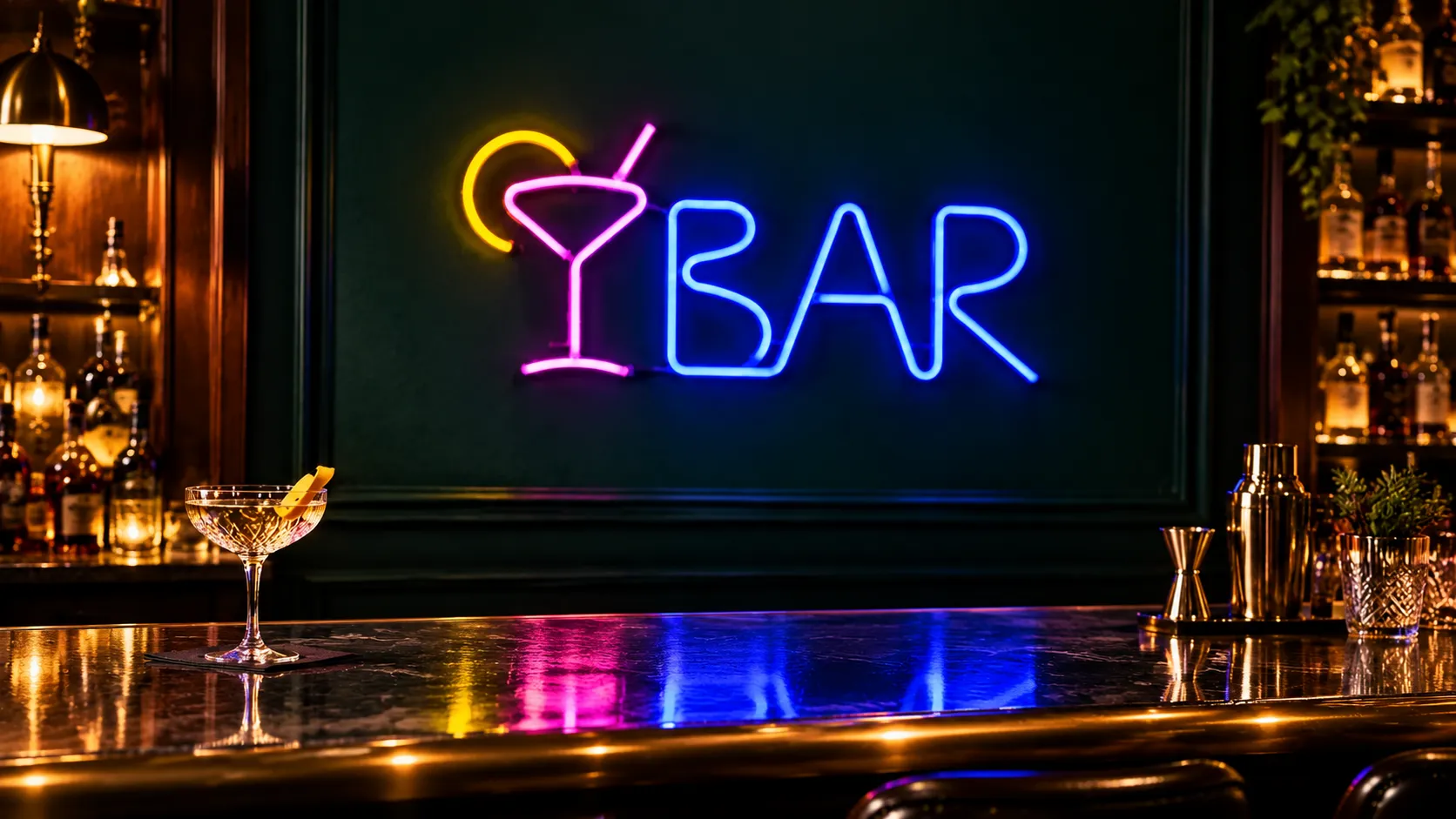
On the LED neon signs we make, the published inputs are low, as the table shows, so the warmth spreads along the neon and gathers at the supply. What runs warm on a venue sign, and whether it can stay on through service, is covered in our bar neon sign guide.
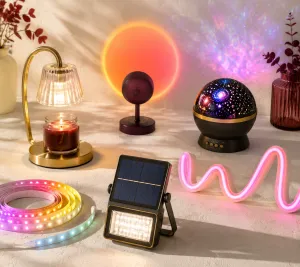
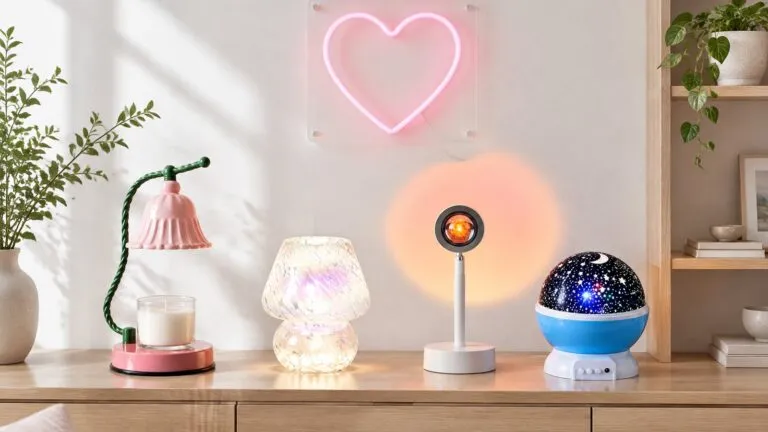
Our star and galaxy projectors include an ocean wave model that packs its LED, a geared motor and a speaker into one small shell, and a star-and-moon night projector that runs a 3 W RGB LED in a compact dome, so their heat has little room to spread. The sunset projection lamps concentrate their light source in the head instead, which makes the head the part that warms.
Among the decorative table lamps, the rechargeable night light keeps its LED and battery inside a frosted plastic body, so that body is where any warmth shows. For the ceramic table lamps we confirm the light source, and where its power is converted, on the quote.
Here is the limit of this section: we have not measured surface temperatures on these lines and do not quote any, so the table shows where heat is made, not how hot each part gets. Compact products deserve the closest look at sampling, because a small plastic shell has little of the surface area that finned heat sinks exist to add, in the DOE fact sheet’s terms, and ENERGY STAR’s rule that hotter LEDs degrade faster applies to an LED bedside projector as much as to a ceiling fitting. The practical answer is placement: open air on a hard surface, written into the listing.
How to Describe LED Heat on a Product Listing
Say where the product gets warm, what it runs on and where it should not be enclosed. That avoids promising that an LED never warms up.
The phrase to handle with care is “cool to the touch”. ENERGY STAR uses it for its certified LED light strings and the Department of Energy for LEDs against CFLs and incandescents, yet the 2014 lifetime guide notes that power supplies generate heat, and a metal lamp head is where an LED sends its own. A listing that promises a cool product invites a return from the first customer who picks up the adapter. Keep the phrase to the surface the light comes out of, or describe the product as running warm, not hot.
Name the warm parts
Write which part warms in use, such as the metal head, the strip backing or the plug-in adapter, so the first touch is not a surprise.
Print the published power
Give input voltage and wattage exactly as specified, for example 5 V and 5 W. The wattage is the ceiling on the heat the product can make.
State placement limits
Open air, not enclosed and not covered, plus the indoor or outdoor rating as published: IP20, IP65 or IP67.
Say what powers it
Name the adapter if one is in the box. If the product runs on USB, say that the customer’s own charger does the power conversion.
List only marks the product holds
Name a safety mark only if the complete product, adapter included, carries it, and keep the certificate on file.
How to Check an LED Sample for Heat Before You Order
Run the sample the way your customer will, in the position and enclosure it will live in and at full brightness, until it stops warming up, and only then judge the housing, the head, the adapter and the cable ends.
That is a buyer’s version of how ENERGY STAR checked drivers. Its luminaires specification, Version 2.0, measured driver case temperature at thermal equilibrium, at the hottest point the driver maker designates, with the driver installed in the fitting, and required the reading to stay at or below that maker’s recommended maximum. It also told labs to test the model with the highest operating temperature in a product family. For a sample order, the equivalent is the longest strip in the range, the brightest setting and the highest-power version, tested where it will be used rather than on an open desk.
Then vary the three things the DOE fact sheet says drive junction temperature. Current follows the brightness setting. The thermal path changes when a strip goes onto wood instead of metal or a sign goes flat against a wall. Ambient temperature rises in a shop window or a closed cabinet. The fact sheet’s line quoted above, that LEDs won’t burn your hand like some light sources, sets no touch limit and does not cover the adapter. Our own rule at sampling, not a DOE threshold: if any part gets too hot to keep a hand on, stop the test and send us photographs before the order goes ahead.
Our samples are made before any order, and the sample fee is refunded when an order follows. Tell us where the product will be installed. For strip, that means lengths, plug versions and where the adapter will sit: our smart LED light strips ship as matched 24 V kits of strip, WiFi controller and plug-in adapter, and lengths and US or EU plug versions can be combined on one quote.
Source LED strip, neon, projectors and sunset lamps from the factory that builds them
We make LED strip lights, LED neon signs, star and galaxy projectors, sunset lamps and decorative table lamps in our own factory in Foshan: 4,000 square metres and 40 people on two production lines. Send the product, the market and where it will be installed, and voltage, power and placement notes are confirmed on the quote.
Watch it work
Where the warmth really is, in 39 seconds:
FAQ
Can LED lights catch fire?
Yes. When UL published UL 8750 in November 2009, its first safety standard for LED equipment used in lighting products, it said that as LED technology moved into newer, high-voltage and high-output applications, overheating, electric shock and fire were among the potential safety concerns that needed to be addressed. ENERGY STAR describes its certified LED light strings as cool to the touch, reducing the risk of fire, which is a reduction rather than an absence. Ask which standard a safety listing covers, and look the listing up in the directory kept by the certifier rather than trusting the packaging.
Do LED bulbs get as hot as regular bulbs?
No. The 2021 Department of Energy consumer guide says that, unlike CFLs or incandescent bulbs, LEDs are cool to the touch. We do not make LED bulbs; the full comparison with filament and halogen bulbs is in our guide to LED light bulbs.
What is the downside of LED lights?
For a buyer, the weak points sit in the electronics and in colour over time rather than in the diodes. The Department of Energy LED Basics page notes that the long life of an LED leaves ample opportunity for the electronics to fail before the LEDs go bad, and that the colour of the light may shift to an unacceptable degree before the LED fails. Ask suppliers how the driver or adapter is rated, and judge colour on a sample that has been running for some weeks.
Sources
Every external figure above was checked on 2026-10-21. Temperature, heat-share and fire statements come only from the U.S. Department of Energy, ENERGY STAR and UL: the infrared and heat shares, junction temperature, binning and colour behaviour from the 2007 DOE fact sheet; the heat-sink role and the thermal-management ranking from ENERGY STAR; driver heat and the 10-degree rule from the DOE-backed industry lifetime guide; the enclosure and driver-case tests from the ENERGY STAR luminaires specification; and the UL 8750 scope from UL itself. Product voltages and wattages are the published specifications of our own product lines.
- U.S. Department of Energy, Building Technologies Program (Pacific Northwest National Laboratory), Thermal Management of White LEDs, PNNL-SA-51901, February 2007 (LEDs will not burn your hand like some light sources but do produce heat; LEDs generate little or no infrared or ultraviolet and convert 15 to 25% of power into visible light, the rest into heat conducted from the die to the board, heat sinks, housings or luminaire frame; power-conversion table for a 60 W incandescent, linear fluorescent, metal halide and LED; junction temperature defined and calculated from case or board temperature; binning at 25°C, typical operating junction temperature 60°C or greater, at least 10% less light than rated; colour shift, with amber and red the most sensitive; drive current, thermal path and ambient temperature set junction temperature; metal-core boards usually aluminium; finned heat sinks add surface area), retrieved 2026-10-21.
- ENERGY STAR, U.S. Environmental Protection Agency, Learn About LED Lighting (heat sinks absorb the heat produced by the LED and dissipate it into the surrounding environment, keeping LEDs from overheating and burning out; thermal management is generally the single most important factor in LED performance over its lifetime; the higher the operating temperature, the faster the light degrades and the shorter the useful life), retrieved 2026-10-21.
- U.S. Department of Energy, Energy Saver, Consumer Guide to Energy-Efficient Lighting, DOE/EE-2465, 2021 (unlike CFLs or incandescent bulbs, LEDs are cool to the touch), retrieved 2026-10-21.
- Next Generation Lighting Industry Alliance LED Systems Reliability Consortium and U.S. Department of Energy, LED Luminaire Lifetime: Recommendations for Testing and Reporting, third edition, September 2014 (LEDs do not radiate heat but retain it, so dissipation is by convection or conduction, raising local temperatures; a contemporary driver includes input conditioning, an AC/DC converter and current regulation; contemporary power supplies generate heat; the 10-degree rule for electronic components; thermal design should account for the power supply heat load and its temperature rating), retrieved 2026-10-21.
- ENERGY STAR, U.S. Environmental Protection Agency, Program Requirements, Product Specification for Luminaires (Light Fixtures), Eligibility Criteria Version 2.0, effective June 1, 2016 (an enclosed luminaire may not ship with a lamp marked not for use in totally enclosed fixtures; in situ test that the air inside the enclosure does not exceed 45°C; driver case temperature measured at thermal equilibrium at the hottest designated point, installed in the luminaire, not to exceed the driver maker’s maximum; test the luminaire with the highest operating temperature in a product family), retrieved 2026-10-21.
- ENERGY STAR, U.S. Environmental Protection Agency, Decorative Light Strings (ENERGY STAR LED light strings are cool to the touch, reducing the risk of fire), retrieved 2026-10-21.
- UL, UL publishes first safety standard for LED lighting products and components, 30 November 2009 (ANSI/UL 8750 published as a safety standard for LED equipment used in lighting products; potential safety concerns including the risk of overheating, electric shock and fire needed to be addressed), retrieved 2026-10-21.
- U.S. Department of Energy, Solid-State Lighting Program, LED Basics (the long life of the LED leaves ample opportunity for the electronics to fail before the LEDs go bad; the colour of the light may shift to an unacceptable degree before the LED fails), retrieved 2026-10-21.
