


The best bedside lamps earn their ratings on five specifications a product photo never shows: how low the light dims, whether the switch can be reached from the pillow, where the power comes from, how hard the base is to knock over, and how the shade handles glare. Get those five right and the shape can be almost anything. Miss one and the lamp ends up on a shelf across the room.
The checks below are written for whoever signs off the sample, whether a home-decor or gift buyer, a hotel purchaser or an online seller, because these five lines are where a lamp that looked fine in a showroom goes wrong in a bedroom. We build bedside and table lamps in our own factory in Foshan, so the angle is the build sheet, not a review lab. The designs below sit in our decorative table lamps range.
Anyone typing bedside lamps best into a search bar wants a shortlist; this page gives the checks behind one instead. Each section below covers one check, with what to test on a sample and where our three bedside designs stand.
Key takeaways
The best bedside lamps share five specifications: a bottom setting far dimmer than room light, a switch reachable from the pillow, power matched to where the outlet is, a base that does not tip, and a shade that hides the bare source from someone lying down. Shape comes after.
- Dim beats bright. In a 2011 study, room light under 200 lux in the eight hours before bedtime shortened melatonin duration by about 90 minutes against dim light under 3 lux (Journal of Clinical Endocrinology and Metabolism).
- Reach is a safety line: the CDC tells older adults to keep a lamp close to the bed where it is easy to reach, and more than one in four people aged 65 and older falls each year.
- ENERGY STAR rates a 60 W-equivalent bulb at a minimum of 800 lumens; we treat that as a reference point for a bedside lamp’s top setting, not a target.
- CPSC flags cords pinched behind furniture or crossing foot traffic, the layout a bed against a wall creates, which is the practical case for cordless lamps.
- Our three designs give three power answers: USB-charged cordless with 6–8 hours per charge, AC mains with a replaceable 5 W bulb, and 220 V mains.
What the Top-Rated Bedside Lamps Get Right
Top-rated bedside lamps get five things right, each mapping to a moment the reviewer lived through: winding down, reaching out in the dark, finding the lamp flat or the cord in the way, bumping the nightstand, and lying back with the shade in view. Shape and price decide the purchase. These five decide the review written a week later.
Each of the five is also a part on the bill of materials: the dimming circuit, the switch, the battery or cord set, the base and the shade. Written into a purchase order, they give samples that can be compared, and quoted, line by line.
| Specification | What the good ones do | What to test on a sample | Our three bedside designs |
|---|---|---|---|
| Dimming | Dim far below room light; offer a warm tone for the last half hour | Lowest step in a dark room; number of steps | Touch dimming with three color temperatures; a remote-dimming version; a single-color dimmer version |
| Switch reach | Switch on the base or in the hand, reachable lying down | Switch off from the pillow without sitting up | Touch control; button switch or remote-dimming version; toggle, dimmer or USB-with-timer versions (switch position confirmed at sampling) |
| Power | Matched to where the outlet is | Time a full charge; confirm plug and voltage for the market | USB 5 V with 6–8 hours per charge; 220 V mains; AC mains with US, EU, UK or AU plug, or USB-powered |
| Base | Mass low, footprint small | Nudge the shade rim, slide it, weigh it | Pink ceramic ball; ceramic base, a green teardrop in the version pictured; hand-blown glass foot |
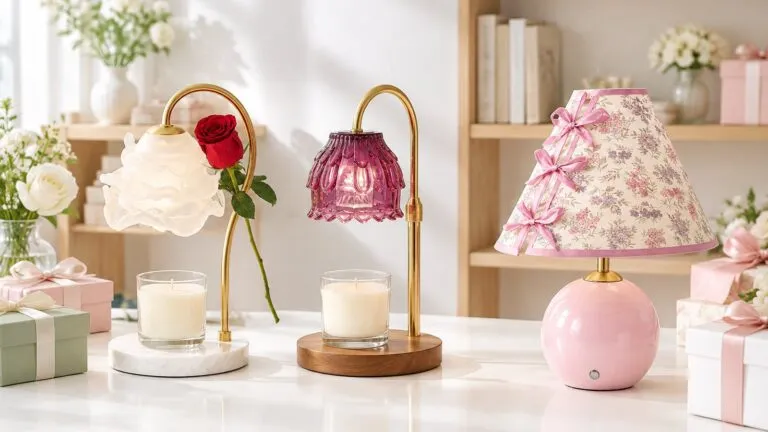
| Shade | Hides the bare source from the pillow | Lie back and look at the lamp lit | Printed cone; frosted ribbed glass dome; speckled or iridescent glass that glows whole |
None of the five needs a premium price. Touch sensors, ceramic bases and frosted shades are ordinary parts; what separates a well-rated lamp from a returned one is usually that somebody specified them, tested them in a dark room and sent back the sample that failed.
Dimming Steps: How Low Does the Bottom Setting Go?
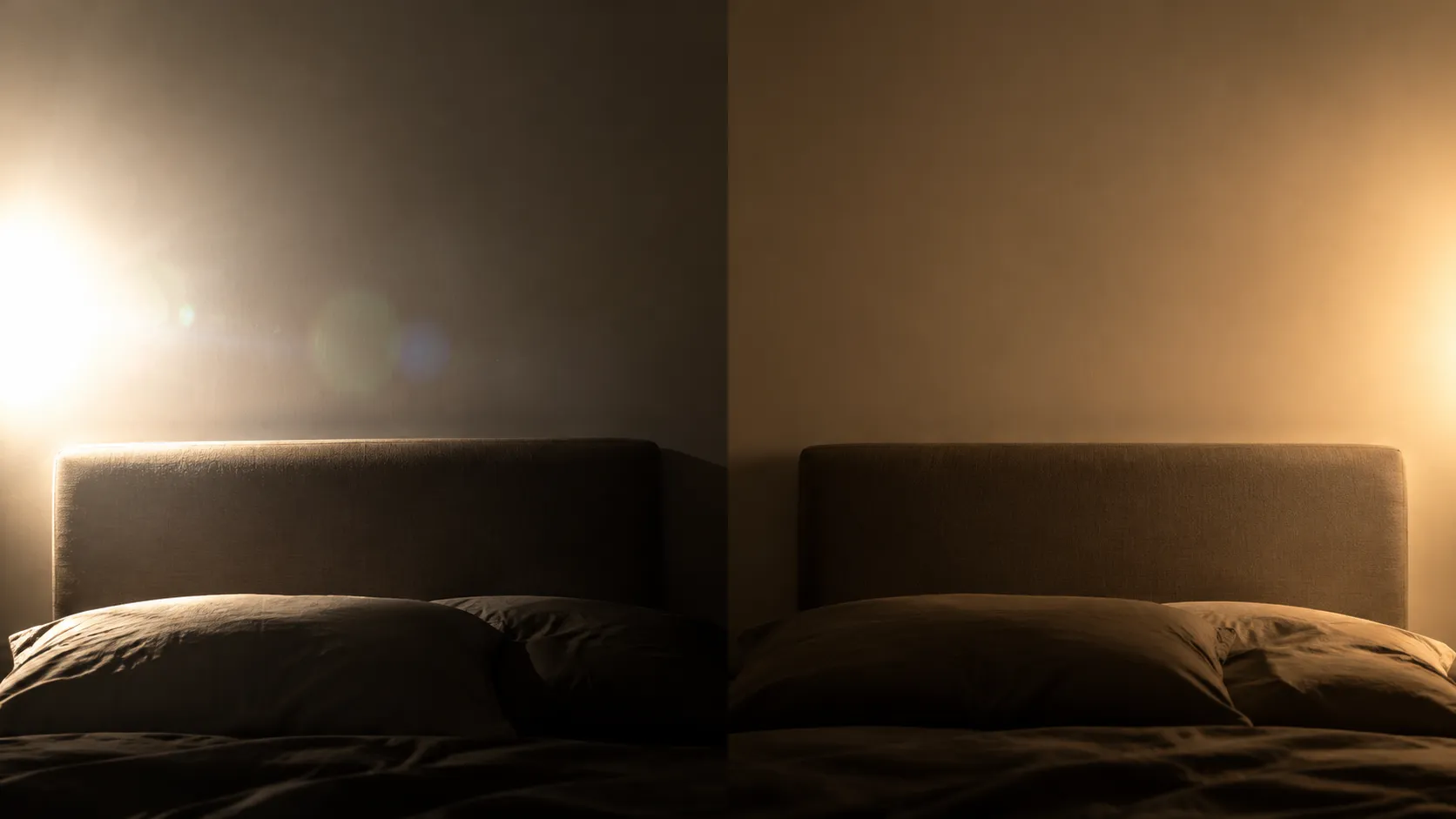
The bottom of the dimming range matters more than the top, because a bedside lamp spends most of its working life in the half hour before sleep. A lamp that only dims to slightly less bright is a reading lamp with ambitions.
The case for dim is well documented. In 2011, researchers compared ordinary room light, under 200 lux, with dim light under 3 lux in the eight hours before bedtime: room light delayed melatonin onset in 99% of the people tested and shortened melatonin duration by about 90 minutes (Journal of Clinical Endocrinology and Metabolism). A bedside lamp is not room light, but the lesson carries: the setting someone falls asleep beside should sit far below it, so check the bottom step first.
Tone counts too. In an article updated in 2024, Harvard Health Publishing reports that blue light suppressed melatonin about twice as long as green light (Harvard Health Publishing). Hence the case for more than one color temperature at the bedside: ENERGY STAR’s bulb guide puts warm white at the incandescent end of its 2700K to 6500K scale and marks daylight as good for reading (ENERGY STAR). A lamp that offers both ends lets one product serve the book and the last half hour.
Our touch-dimmable bedside lamp dims by touch across three color temperatures; the ceramic glass-dome lamp has a remote-dimming version, and the glass mushroom lamp a single-color dimmer version. Ask for the step count and the lowest output as the first two lines on any quotation, ours included. A dimming benchmark and a phone-camera flicker test for that line are in our bedroom mood lamp guide.
The top of the range needs less attention than the bottom. ENERGY STAR rates a 60 W-equivalent bulb at a minimum of 800 lumens (ENERGY STAR). For a bedside lamp’s top setting we treat that 60 W-class figure as a reference point, not a target: ask for full output in lumens and compare samples against it.
Source: ENERGY STAR, Learn About Brightness, retrieved 2026-10-21
Switch Reach: Can You Turn It Off Without Sitting Up?
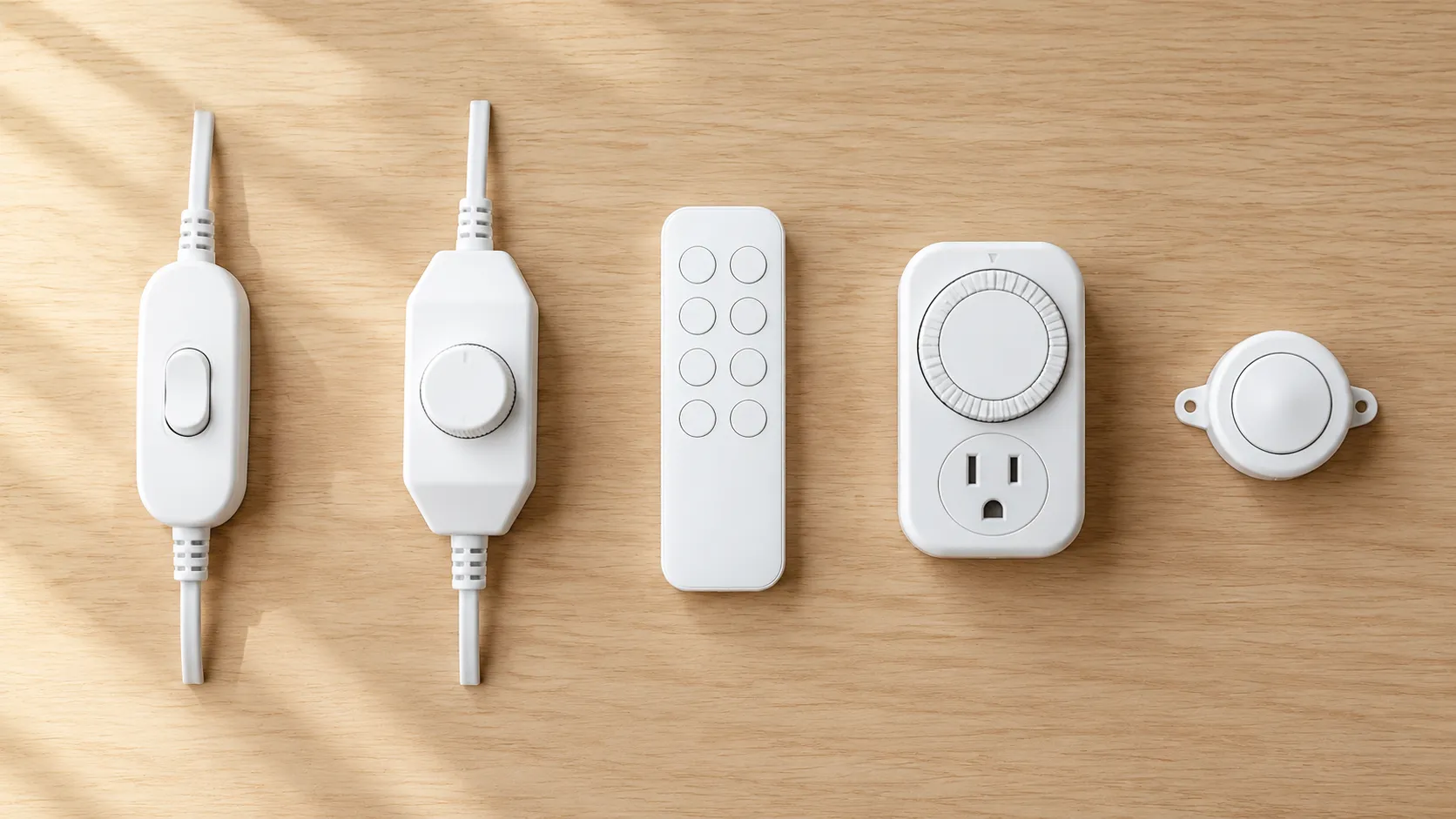
A well-rated bedside lamp can be switched off by someone lying down with their eyes half closed, which rules out a switch tucked under the shade and an inline cord switch that has slid behind the nightstand. Touch bases, front-facing buttons and remotes all pass that test. Where they differ is in what goes wrong later.
For some buyers, reach is a safety line. The CDC’s fall-prevention checklist for older adults asks whether the light near the bed is hard to reach, and answers: place a lamp close to the bed where it is easy to reach (CDC). The CDC also counts more than one in four people aged 65 and older falling each year, and about 4.5 million emergency department visits a year from those falls. In senior living and in hotel rooms that sleep older guests, switch position is part of the safety plan.
Each switch type has its own failure, and our three bedside designs cover most of them:
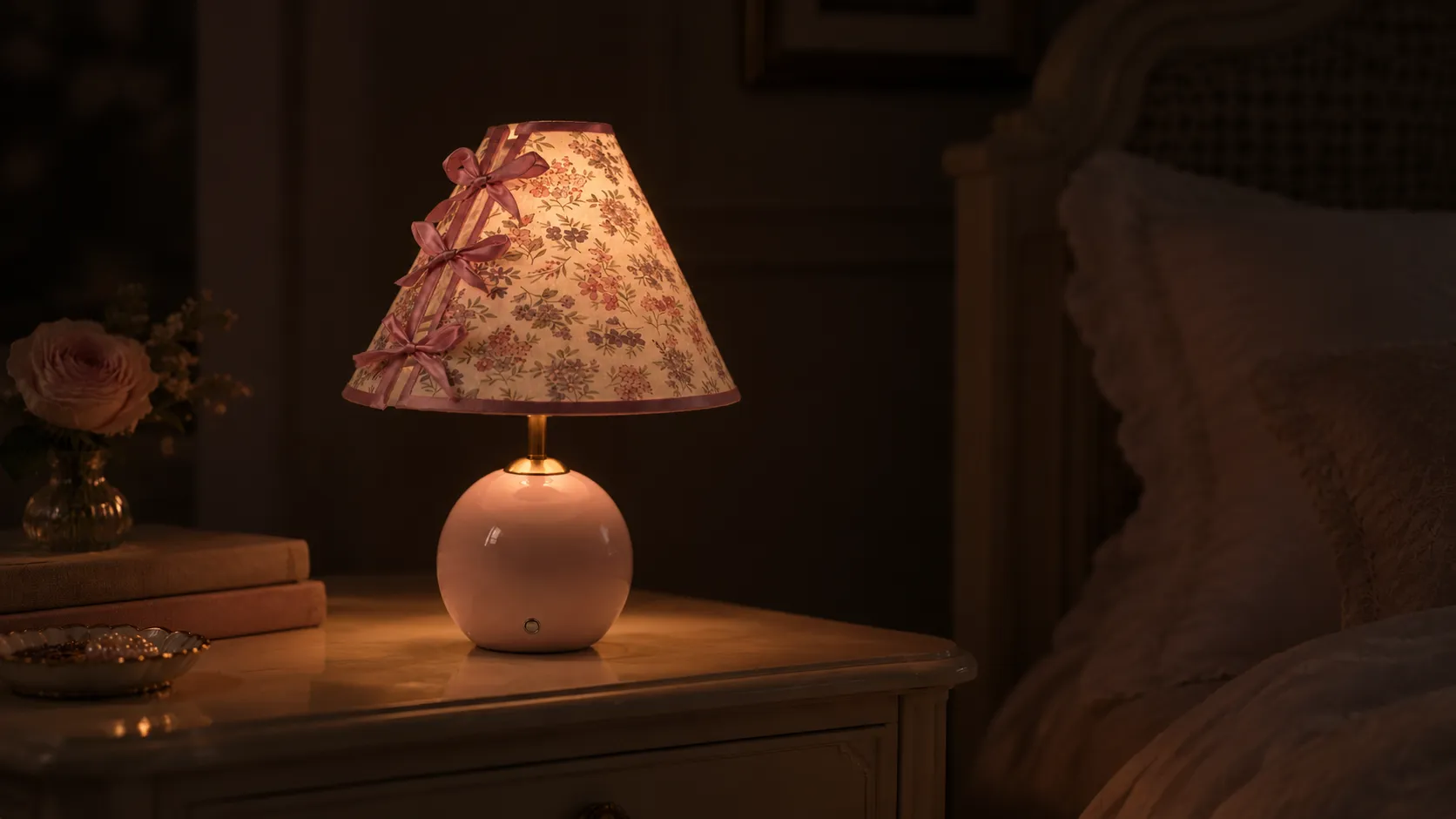
- Touch. Works at any angle with no aim needed. On the sample, test whether a cleaning cloth sets it off, so housekeeping knows what to expect. Our pink ceramic lamp switches and dims by touch.
- Button. Positive and quiet, but found by feel, so where it sits decides how usable it is in the dark. The glass-dome lamp is switched with a button; confirm where it sits before sampling.
- Toggle or dimmer on the cord. Cheap and familiar; where the cord switch ends up decides whether it can be reached. The mushroom lamp comes in toggle and dimmer versions; ask whether the switch is on the cord or the base, and how far from the lamp.
- Remote. Works from anywhere in the room, as on the dome lamp’s remote-dimming version.
- Timer. Can switch the light off after the user falls asleep. The USB-powered mushroom version has a timer; confirm what it does and for how long before sampling.
If switching the sample off from the pillow in a dark room takes two tries, the customer will notice on the first night.
USB, Cordless or Corded: Match the Power to the Outlet
Choose the power source from where the outlet is, not from the feature list: a cordless lamp earns its place when the socket sits behind the headboard, and a corded lamp wins when the light must never run flat. A USB-powered lamp sits between the two, corded but happy on a phone charger.
The cord is the part safety agencies worry about. CPSC’s electrical checklist says to move furniture off cords, because the weight can crush insulation, and to keep cords out of foot traffic, where they become tripping hazards (CPSC). Its checklist for older consumers adds that falls are associated with more than half of product-related emergency room visits among adults aged 65 to 74, and more than three quarters among those 75 and older, with tripping over cords a common scenario. A bed pushed against a wall with a lamp cord pinched behind it is exactly that arrangement.
Our pink touch lamp runs from a built-in battery charged over USB at 5 V, giving 6–8 hours per charge, so it stands where it looks right rather than where the socket is. That is an evening, not a night: it is no all-night light, and a hotel using it needs a charging routine. Ask which USB connector it takes. The EU’s common charger rules have covered phones, tablets, cameras, headphones, speakers, e-readers, keyboards and mice since 28 December 2024, with laptops from 28 April 2026 (European Commission); lamps are not on that list, so the common charger rules do not decide the port; it is a buying choice. Cordless trades the cord risk for a cell; the recalls and the battery clause to ask about are in our bedroom mood lamp guide.
The glass mushroom lamp is corded: AC mains with a toggle switch and a US, EU, UK or Australian plug, a single-color dimmer version with a US or UK plug, or a USB-powered version with a timer. There is no battery version. The ceramic glass-dome lamp is wired for 220 V mains with a button switch, and that is the limit to raise early. Check it against the mains voltage of the market the lamp is going to before ordering, because a 220 V build is not a drop-in for every country.
Base Weight: Why Good Bedside Lamps Stay Upright
A well-rated bedside lamp keeps its weight low and its footprint small, so a hand reaching for a phone in the dark nudges it instead of knocking it over. A tall shade on a light, narrow base is the combination that tips.
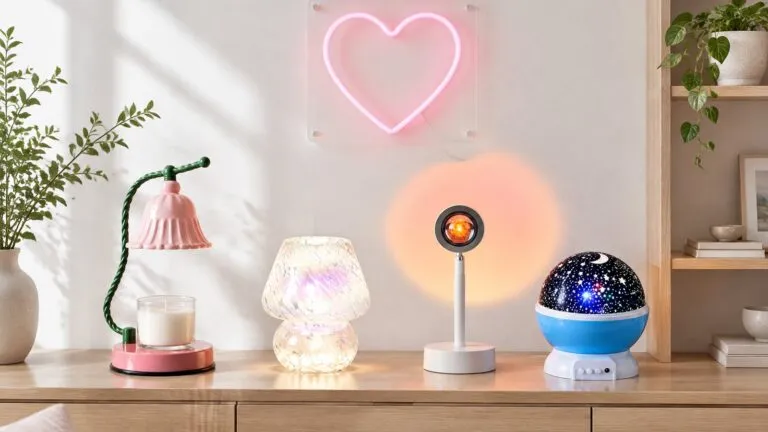
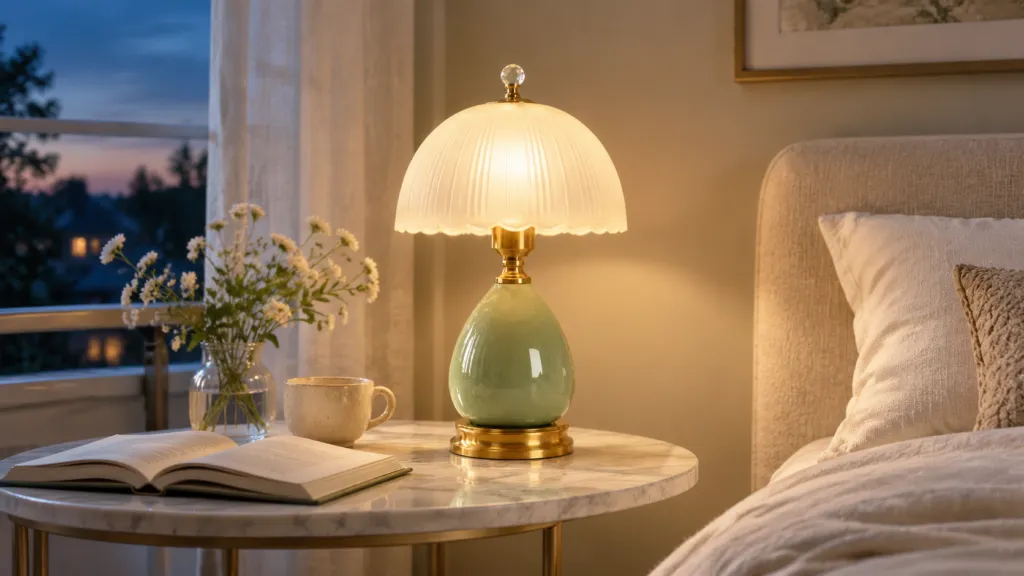
Material helps, but a photo cannot show it: ceramic and glass bases can be hollow or filled, and the difference shows only on a scale. Our three bedside designs stand on a glossy pink ceramic ball under a short gold-tone stem, a ceramic base that, in the version pictured, is a green teardrop on a round gold-tone plinth, and a rounded hand-blown glass foot under the mushroom shade. Ask for net weight and base diameter on the quotation, ours included, and compare samples on a kitchen scale.
The cord is a lever too. A cord that drops behind the nightstand can be caught by a foot, a pet or a vacuum, and then it pulls the lamp sideways at the base, where even a heavy lamp is weakest. A cordless lamp removes the lever; a corded one should have its cable run down the back leg of the nightstand rather than across the floor.
On the sample, push the shade rim sideways with one finger: the lamp should rock and settle, not walk. A glossy ceramic or glass underside with no pads will also skate on a polished top, so put felt or rubber pads on the order.
Shade Glow: Hide the Bulb From the Pillow
The shade is where a bedside lamp gets judged lying down: good ones hide the bare source from the pillow and turn the light into a glow, while bad ones leave a bright point in the corner of the eye. CPSC’s checklist for older consumers puts it in one line: indirect lighting or frosted bulbs can be used to reduce glare (CPSC).
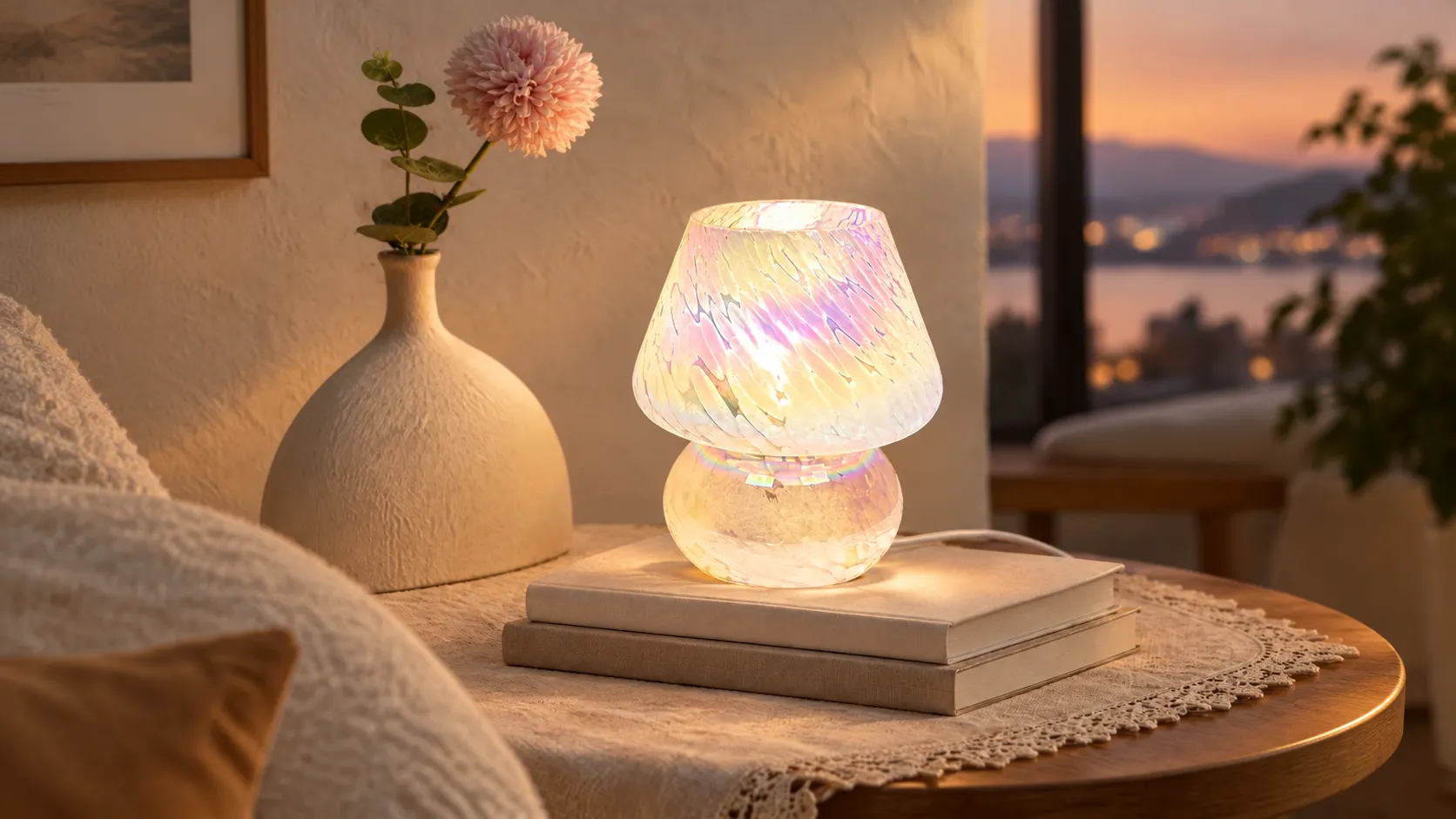
Shades split into two jobs. One open at the bottom and dense at the sides throws light onto a page and keeps the bulb out of view, which suits a reader. A diffusing shade of frosted or speckled glass glows all over and turns the lamp into an object in the dark, which suits the hour before sleep. Trouble starts when a glow lamp is listed as a reading lamp.
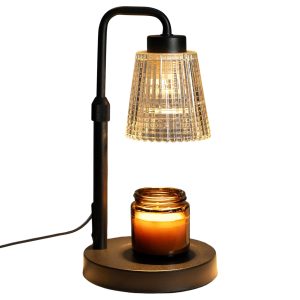
Our three sit at different points on that line. The glass-dome lamp’s half-round frosted shade, ribbed and scalloped at the lower edge, spreads light across the whole dome. The mushroom lamp’s shade and base are both hand-blown glass, so the entire outline glows and the speckles break the light into a soft pattern; it is a night light and mood light, and we would not sell it as a reading lamp. The pink lamp has a cone-shaped printed shade, and its brightness can be turned up for reading or down for a low glow before sleep. How a bedside lamp layers with a reading light and the ceiling light is laid out in bedroom lighting ideas.
Ask about the light source while the shade is in hand. The mushroom lamp takes a replaceable 5 W bulb, so a spent bulb is swapped rather than the lamp thrown away, which matters to hotels maintaining rooms over years. For the other two, confirm on the quotation whether the source is integrated or replaceable, and order spares if it is replaceable.
The Coolest Bedside Lamps Are Objects First, and Still Pass the Checks
The coolest bedside lamps look like objects first and lights second, and the ones that keep good ratings still pass the same five checks as a plain lamp. Shape sells the lamp in a photo; the switch, the dimmer and the base decide whether it stays on the nightstand.
What reads as cool is usually a material and a silhouette that hold up with the light off. Our glass mushroom lamp is hand-blown from shade to foot and comes in four finishes, iridescent, black speckle, white speckle and multi-color speckle, so one design can fill a small shelf display. The pink lamp pairs a glossy ceramic ball with a cone shade printed in pink and lilac flowers on a cream ground. The dome lamp, in the version pictured, sets a ribbed frosted dome with a clear faceted finial on a glossy green ceramic teardrop. Judge each sample switched off, in daylight and from across the room, as it is seen most of the day.
Hand-blown glass carries a tradeoff to settle before the order, not after delivery: it varies from piece to piece, so the lamp in a listing photo is one piece out of a run. Ask how much the speckle and sheen vary across a run, approve a range on two or three samples instead of a single photo, and tell online shoppers the pattern varies from lamp to lamp; it heads off the return that begins with the lamp not matching the picture.
Statement lamps also travel as gifts. The pink lamp is aimed at birthdays, housewarmings and holidays, and all three designs take a logo print or label for private-label ranges, so a gift shop can carry them under its own name. The five checks still apply: a gift that cannot be switched off from bed ends up in a cupboard.
Best Nightstand Lamps: Placement, Pairs and a Sample Check
The best nightstand lamps are placed for the hand that reaches for them: on the sleeper’s free side, close enough to touch from the pillow, with any cord kept off the floor path. Height follows the bed rather than the lamp, and the shade-rim rule that settles it is in how tall should bedside lamps be.
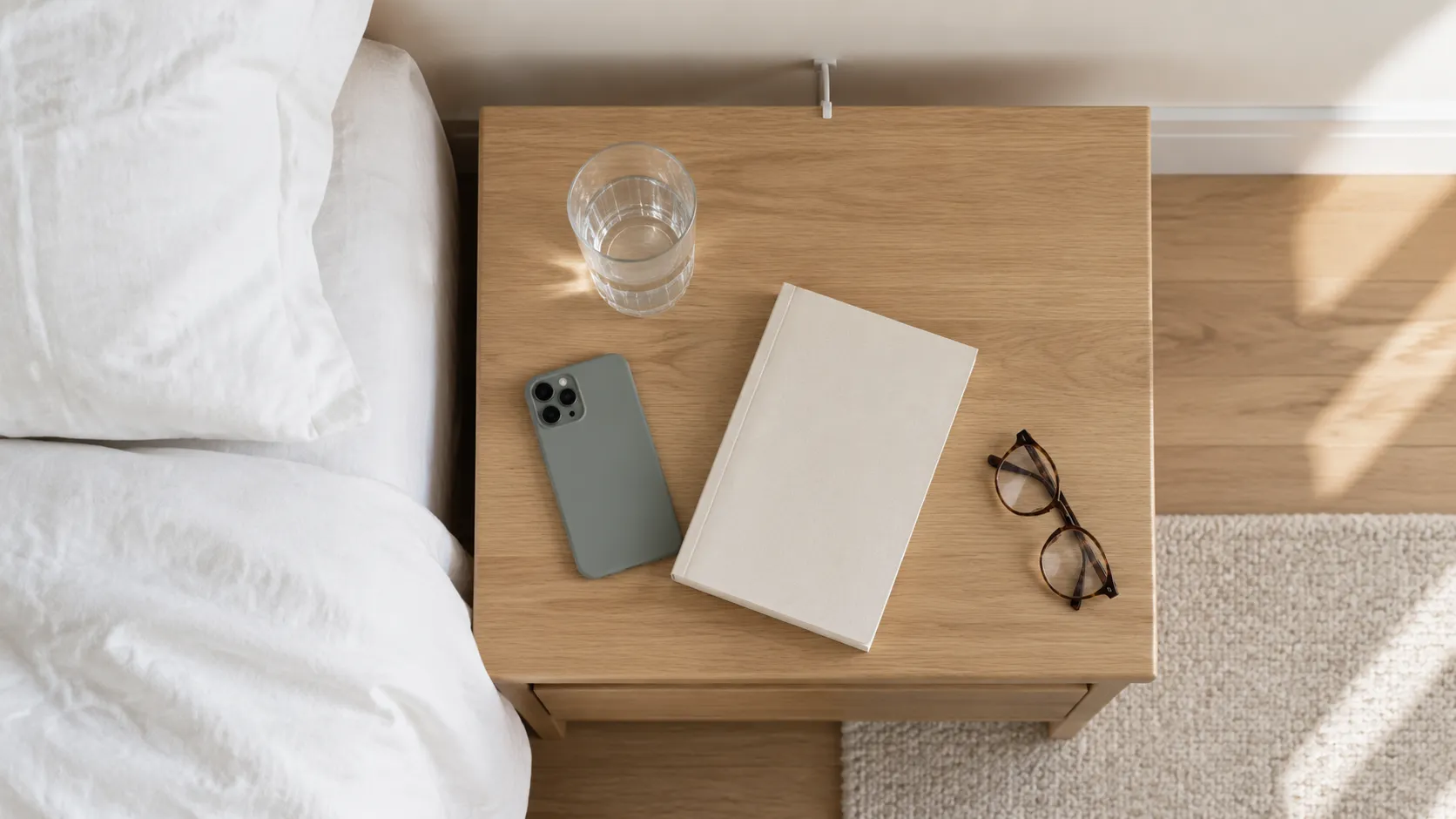
Pairs are the normal case in a double room, and that is where cordless pays off: with no cord to route, two lamps stand where they look balanced rather than where the outlets are. For hotels, one lamp style can run through a block of guest rooms; our ceramic glass-dome table lamp is made for hotel rooms as well as bedrooms, with the voltage check above coming first. Leave room on each nightstand for a phone, a book and a glass of water, because a lamp that crowds them out gets moved.
Run every sample through the same five steps before the order goes out:
Dark room, lowest setting
Room lights off, sample on its lowest step for ten minutes. Count the steps and note whether the bottom one is a glow or just a little less bright.
Reach from the pillow
Lie down on the side the lamp serves and switch it off without lifting your head; repeat with the remote or timer if fitted.
Power for the real room
Time a fully charged cordless sample against the stated hours. For a corded one, confirm plug and voltage for the destination market in writing.
Nudge, slide and weigh
Push the shade rim sideways, slide the lamp across a polished top, then weigh it. At equal height, the heavier sample is usually the steadier.
Look up from the pillow
Lie back with the lamp lit. If the bare source shows, the shade fails at the bedside, however good it looks across the room.
Record the results per sample and send them with the order; a production line can only hold to what it was told. The designs these checks apply to are in our bedside and decorative table lamps line.
Have your bedside lamps built to the five checks
We make bedside and decorative table lamps in our own factory in Foshan, 4,000 square metres with 40 people across two production lines. Dimming, switch, power version, plug and glass finish are chosen per market on the order. Send the rooms, the target markets and the versions you want compared, and we will quote the range.
Watch it work
Five checks a product photo never shows, in 44 seconds:
FAQ
What is the best night lamp for a bedroom?
One much dimmer and warmer than the bedside lamp, because it stays on while you sleep or lights the walk to the bathroom. Harvard Health Publishing advises dim red lights for night lights, since red light is less likely to shift the body clock and suppress melatonin. Place it low, below the line of sight from the pillow.
What kind of lamp is best for a bedroom?
Usually two, because one lamp cannot both light a page and guide a sleepy walk. The CDC fall-prevention checklist pairs the lamp by the bed with a night-light on any dark path to the bathroom, and notes that some night-lights switch on by themselves after dark. The ceiling light is for cleaning and dressing, not the last hour of the day.
What are some unique and interesting lamps for my bedroom?
Pick one you would keep on the nightstand even unlit: hand-blown or speckled glass, glazed ceramic, a printed or ribbed shade. If you want variety across rooms, choose a design that comes in several finishes rather than mixing unrelated lamps. And make sure it dims low, because an interesting lamp that is too bright at night is the first one unplugged.
Sources
Every external figure above was checked on 2026-10-21: light levels and melatonin from the 2011 study cited in full below, the blue and green light comparison from Harvard Health Publishing, lamp reach and fall figures from the CDC, glare and cord guidance and the share of product-related emergency visits linked to falls from two CPSC checklists, lumen equivalents and the color scale from ENERGY STAR, and the charger device list from the European Commission. Product details are those of our own three lamps.
- Gooley, J.J. et al., Journal of Clinical Endocrinology and Metabolism (via PubMed Central), Exposure to Room Light before Bedtime Suppresses Melatonin Onset and Shortens Melatonin Duration in Humans, 2011, volume 96, issue 3, pages E463–E472 (room light under 200 lux against dim light under 3 lux in the 8 hours preceding bedtime; later melatonin onset in 99.0% of individuals; melatonin duration shortened by about 90 minutes), retrieved 2026-10-21.
- Harvard Health Publishing, Blue light has a dark side, updated 24 July 2024 (blue light suppressed melatonin about twice as long as green light of comparable brightness; use dim red lights for night lights), retrieved 2026-10-21.
- Centers for Disease Control and Prevention, STEADI, Check for Safety: A Home Fall Prevention Checklist for Older Adults, 2018 (place a lamp close to the bed where it is easy to reach; a nightlight on a dark path from bed to bathroom, some of which go on by themselves after dark), retrieved 2026-10-21.
- Centers for Disease Control and Prevention, Facts About Older Adult Falls (more than one out of four people aged 65 and older falls each year; about 4.5 million emergency department visits a year due to older adult falls), retrieved 2026-10-21.
- U.S. Consumer Product Safety Commission, Home Electrical Safety Checklist, Publication 513 (move cords or furniture so cords are not covered, since heavy weights can crush insulation; move cords out of the path of foot traffic, where they are tripping hazards), retrieved 2026-10-21.
- U.S. Consumer Product Safety Commission, Safety for Older Consumers: Home Safety Checklist, Publication 701 (indirect lighting or frosted bulbs can be used to reduce glare; cords are not pinched against the wall by furniture and are out of the flow of foot traffic; falls are associated with more than half of product-related emergency room visits among adults aged 65 to 74 and more than three quarters among those 75 and older; tripping over cords is a common fall scenario), retrieved 2026-10-21.
- ENERGY STAR, U.S. Environmental Protection Agency, Learn About Brightness (brightness is measured in lumens, not watts; minimum lumens for 40, 60, 75 and 100 W incandescent bulbs are 450, 800, 1,100 and 1,600), retrieved 2026-10-21.
- ENERGY STAR, U.S. Environmental Protection Agency, Bulb Purchasing Guide (light color on the Kelvin scale from 2700K to 6500K; warm or soft white is the standard color of incandescent bulbs; natural or daylight is good for reading), retrieved 2026-10-21.
- European Commission, EU common charger rules: Power all your devices with a single charger, 28 December 2024 (devices covered from 28 December 2024, with laptops from 28 April 2026), retrieved 2026-10-21.
