



Key takeaways
The best outdoor solar lights are judged on second-year survival, not first-night brightness. Battery, heat, sealing and panel quality decide whether a SKU restocks or fills a returns bin.
- Most early failures are engineering, not luck: a panel sitting on the battery can reach 70℃, and cycle life roughly halves for every 10℃ of extra heat.
- For a flood light, require a monocrystalline panel, an IP65-or-higher seal and a LiFePO4 or quality lithium-ion pack, never a tiny NiCd cell.
- Match the fixture to the job: flood and security lights need a motion sensor and 1,000 lumens or more; path and string lights trade brightness for run-time.
- Solar has honest limits (winter daylight, shade, sealed batteries). Set buyer expectations, then consolidate the category with one vetted supplier.
01What makes the best outdoor solar lights worth stocking?
The best outdoor solar lights are the ones still working in their second winter, and that is a different shortlist from the ones that look brightest on night one. A shopper buys the unit with the widest beam in a product photo. A buyer is choosing a fixture to put a brand and a warranty behind, so the winning spec sheet is the one that keeps returns low and restocking simple. This guide is a sourcing framework for that decision, not a paid ranking of consumer picks.
The demand is real and growing. In 2025, Grand View Research valued the outdoor solar LED market on a path to about USD 41.12 billion by 2030, a growth rate near 27.5 percent per year (Grand View Research, Outdoor Solar LED Market, 2025). Free daylight and no wiring make the pitch obvious to end shoppers, which is exactly why cheap units flood the category and why a returns-driven buyer needs a filter. The filter is a short list of specs that separate a fixture that lasts from one that photographs well and dies.
There is a tradeoff worth naming up front. The brightest, most feature-loaded unit on a listing is often the worst one to stock, because the parts that create the spec-sheet wow (an oversized LED array on a tiny panel, a sealed non-replaceable battery) are also the parts most likely to fail in year two. A buyer’s shortlist should start from reliability and end at brightness, not the other way around. The rest of this guide walks the specs in that order.
02What separates the best solar flood light from a cheap one?
The best solar flood light wins on heat management and sealing long before it wins on lumens. Most early failures are engineering, not bad luck. On cheap designs the solar panel sits directly above the battery with no insulation, and during peak sun that panel can reach 70℃ (158℉) or higher, radiating heat straight into the cell (intelamp, Why Do Solar Lights Fail So Quickly, retrieved 2026-07-18). That heat is the quiet killer of the category. Our solar wall-wash light is engineered around exactly that priority.
The physics are unforgiving. Battery lifespan is roughly cut in half for every 10℃ of extra operating temperature, so a cell rated for 1,000 cycles at 25℃ might deliver only about 250 cycles at 45℃ (intelamp, retrieved 2026-07-18). Pair that with splash-only IP44 sealing that lets moisture corrode the control board, and undersized NiCd cells of roughly 600 to 1,200 mAh, and the fixture dies in one to two years, while the LEDs themselves would have run for 100,000-plus hours. A well-built unit isolates the battery from panel heat, seals to IP65 or better, and uses a real lithium pack, so it can run five to ten years with basic care.
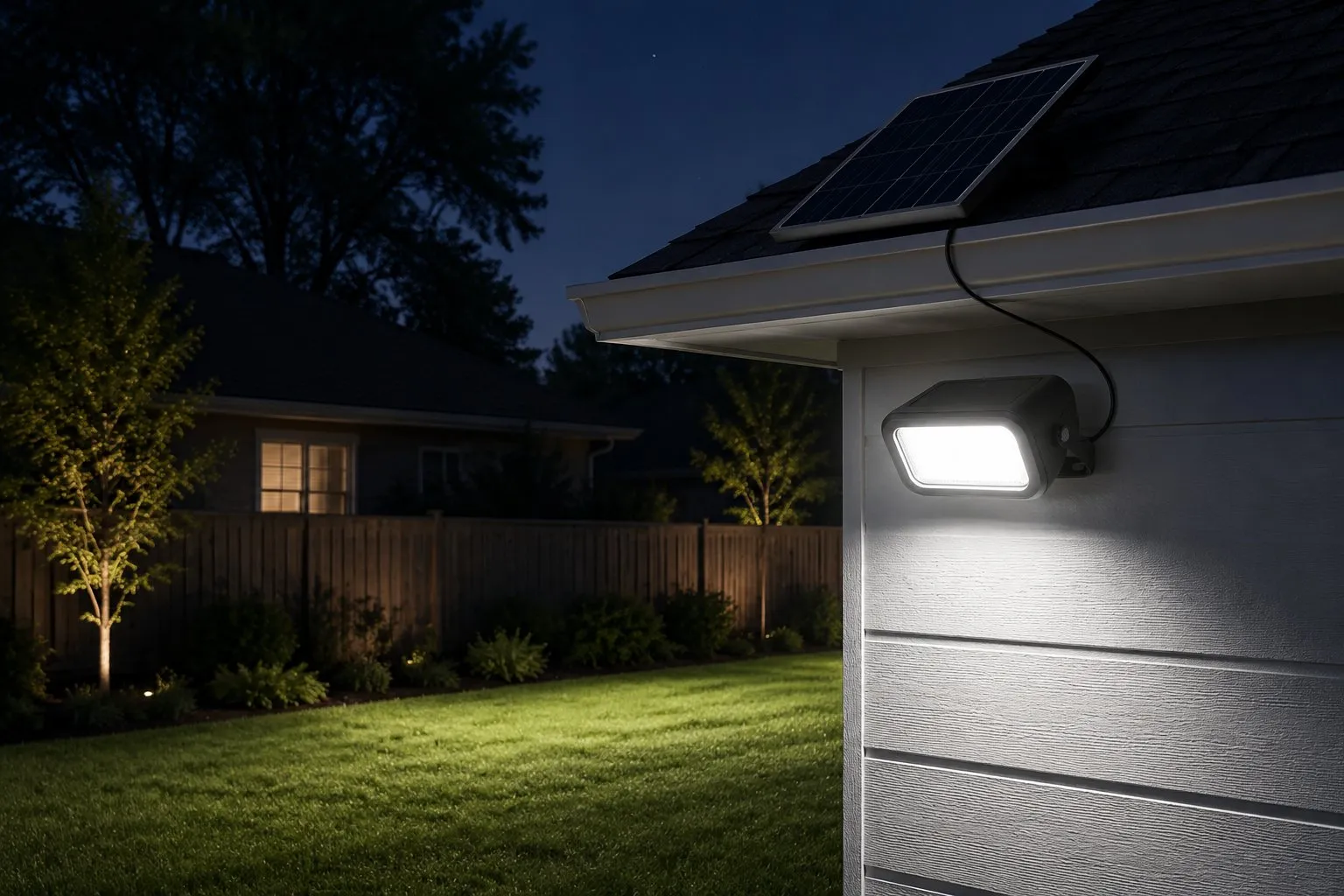
Cheap solar flood light
- Panel bonded onto the battery; runs hot at 60℃ and above
- Splash-only IP44; corrodes after rain
- Tiny NiCd or NiMH cell, sealed and non-replaceable
- All-in-one body forces a compromise on panel placement
Well-built solar flood light
- Battery isolated from panel heat; runs cooler at 35 to 40℃
- IP65 or higher; dust-tight and rain-jet proof
- LiFePO4 or quality lithium-ion pack, three to five times the life of NiMH
- Separate panel on a cable, so light and panel place independently
For a buyer, the separate-panel design is the single most useful format signal. An all-in-one fixture ties the light and the panel to the same wall, so a shady mounting spot starves the charge. A model with the panel on a two-to-five-metre cable lets a store promise reliable charging even when the light itself hangs under an eave. Our own solar flood light range leads with separate-panel, motion-sensor units for that reason.
03Which battery lasts longest in an outdoor solar light?
LiFePO4 lasts longest, and the battery is where most of a fixture’s real lifespan is decided. Battery makers’ guidance puts standard NiMH cells at roughly one to two years of outdoor service, while a quality LiFePO4 pack runs three to five years or longer, on the order of three to five times the life of NiMH (Linkind, Rechargeable Batteries for Solar Lights, retrieved 2026-07-18). Lithium-ion sits between those two on both price and lifespan. A buyer who reads only the lumen number and ignores the chemistry is reading the wrong spec.
Cold weather widens the gap. A LiFePO4 pack holds up better than NiMH when temperatures drop, which is why cheap NiMH path lights fade first in winter (Linkind, retrieved 2026-07-18). LiFePO4 costs more per cell, so value units still ship with lithium-ion or NiMH, but on a cost-per-cycle basis the longer-lived chemistry usually wins for a fixture that charges and discharges every single day.
Chemistry sets how long the pack lives; the panel’s daily charge sets whether it fills at all. What shade, cloudy days and short winter days do to that charge, and what the battery is really doing when a light dims early, is covered in charging a solar light without direct sun.
Source: Linkind, Rechargeable Batteries for Solar Lights (retrieved 2026-07-18); ranges are directional industry figures.
04Lumens, panel and IP rating: the spec floor to require
Set a floor on four specs before you request a single sample, and most of the fragile units filter themselves out. Brightness is the spec buyers most often over-weight: solar flood lights typically deliver between about 500 and 2,200 lumens, and a security fixture wants the top of that range while a wash or accent light can sit lower (Guangqi, Best Solar Flood Lights, retrieved 2026-07-18). More lumens on a small panel just drains the battery faster, so brightness has to be read together with panel size, not alone.
The panel and the seal are where quality hides. A monocrystalline panel is more efficient, converting north of 20 percent of sunlight and above 23 percent in some cases, while polycrystalline panels top out below 20 percent, so mono charges a given battery faster from the same footprint, which matters on a compact fixture (EnergySage, Monocrystalline vs Polycrystalline Solar Panels, retrieved 2026-07-18). For sealing, IP65 is the practical outdoor minimum: under IEC 60529 it means dust-tight and protected against water jets from any direction, while IP67 adds survival of temporary immersion for flood-prone or ground-level installs (IEC 60529, IP Code, retrieved 2026-07-18).
| Spec | Why it matters to a buyer | What to require |
|---|---|---|
| Battery | Decides real lifespan and cold-weather run-time; top return driver | LiFePO4 or quality lithium-ion, isolated from panel heat |
| Solar panel | Charge speed from a small footprint; separate panel beats all-in-one | Monocrystalline (over 20 percent, above 23 percent in some cases), on a cable where possible |
| Waterproof rating | Moisture ingress corrodes the board and kills the fixture | IP65 minimum; IP67 for ground-level or flood-prone spots |
| Brightness | Security needs punch; accent lighting does not | 1,000 lumens or more for security; lower for wash and path |
| Motion sensor | Extends run-time and adds a security use case | Adjustable PIR, roughly 5 to 8 m range, wide angle |
The honest limitation is that more of everything is not free. Each added lumen, sensor and radio draws more power and adds one more part that can fail. A fixture with a right-sized monocrystalline panel, a LiFePO4 pack and a clean IP65 seal will out-earn a 3,000-lumen unit on a starved panel that dims by 10 pm. Set the floor, then add brightness only where the panel and battery can actually feed it. A well-matched example is a dual-head motion-sensor solar flood light, where the sensor earns the extra draw.
05Best outdoor solar lights by category, and the job each one does
There is no single best fixture, only the best fit for a job, so a strong assortment covers the main outdoor jobs rather than stacking one type. The spec floor above stays the same across all of them; what changes is which spec leads. Matching the fixture to the job is how a store keeps reviews high, because a path light judged as a flood light will always disappoint.
For the motion-sensing end of that range, the questions to put to a supplier about detection zone, false triggers and where the settings live are covered in solar flood lights with motion sensor.
- Solar flood and security lights: the brightness and motion tier. Require 1,000-plus lumens, an adjustable PIR sensor and a separate monocrystalline panel. Multi-head models cover driveways and yard corners; this is the tier where the best solar flood light earns its place.
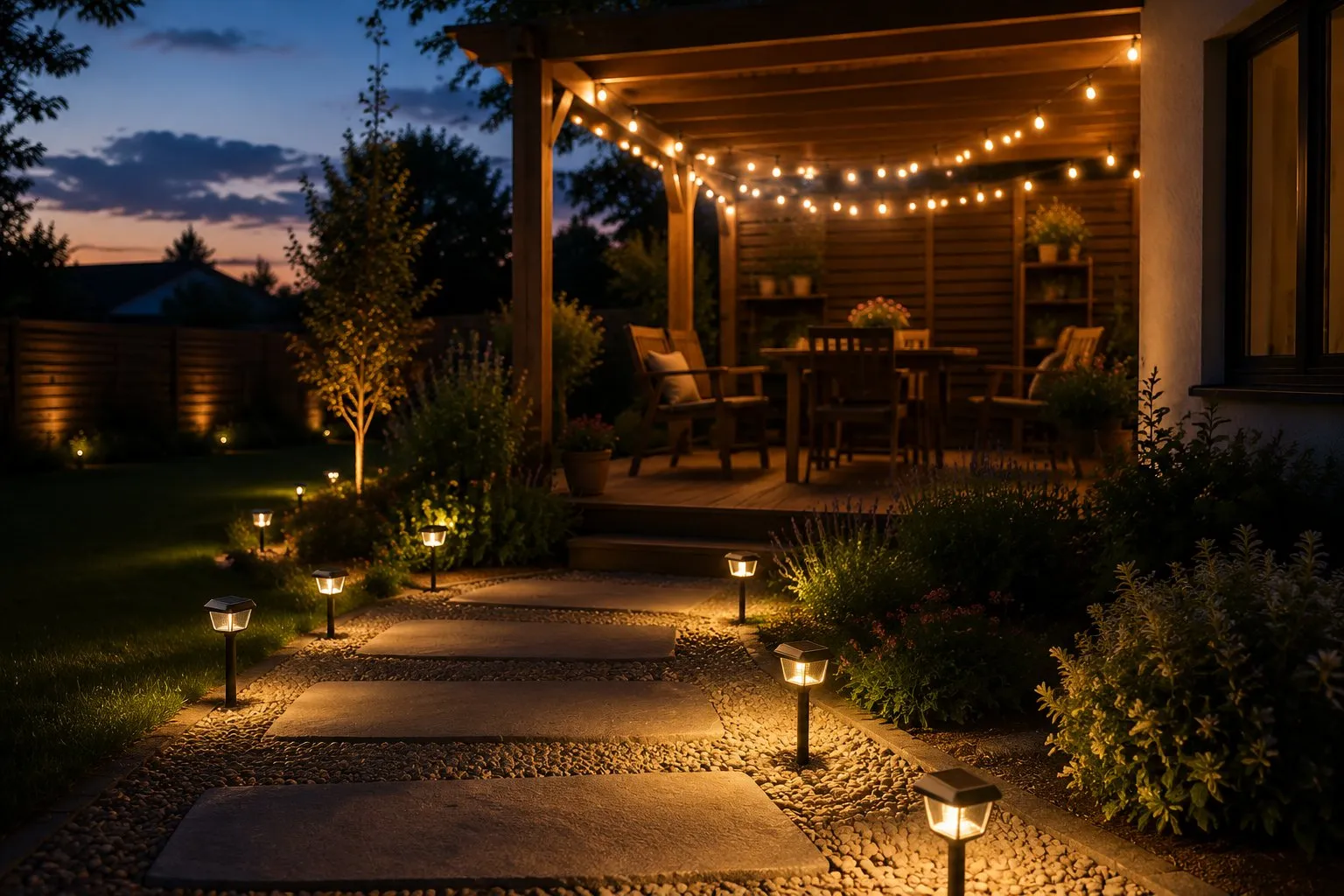
- Solar path and bollard lights: run-time over brightness. Lower lumens, warm color, and a battery that holds an even glow from dusk to dawn. Winter charge windows matter most here, so LiFePO4 pays off.
- Solar spot and accent lights: aimed wash for trees, signage and facades. An adjustable head and a separate panel let a buyer light a feature from an unshaded angle.
- Solar string and decorative lights: ambiance for patios and gift retail. Judge them on the same sealing and battery floor, since decorative units are the ones shoppers most often return water-damaged.
For a retail buyer, the practical move is to carry one reliable option per job and resist the urge to list a dozen near-identical SKUs. A tight range built on a shared spec floor is easier to restock, easier to support and easier to private-label, which is the same logic behind sourcing the wider ambient-lighting basket from one partner rather than five, covered in our wholesale lighting overview.
06Is a solar flood light worth stocking?
For most yards, driveways and signage, a well-specified solar flood light is worth it, because it removes wiring and trenching and then runs on free daylight for years. The value case is strongest where mains power is far away or expensive to reach, and where the fixture gets real, direct sun for most of the day. That is the honest boundary of the category, and stating it up front is what keeps reviews high. For the full payback math and the real-world lumens behind the numbers on the box, see our companion guide on whether solar powered flood lights are worth it.
The limits are just as real, and a buyer should sell against them, not around them. Shade is the biggest one: because solar cells wire in series, a shadow over just 10 percent of the panel can cut output by 50 to 80 percent (intelamp, retrieved 2026-07-18). Winter shortens the charge window, so run-time drops in the exact season buyers want more light. And many units seal the battery in, so when the cell dies the whole fixture does. None of this makes solar a bad category; it makes placement, panel quality and a replaceable-or-durable battery the things worth paying for.
07How to source the best outdoor solar lights at wholesale
Source the fixture and the supplier together. Beyond the five specs, a buyer should check the sealing test, the sensor firmware, the retail packaging and whether one partner can run the whole outdoor and ambient basket instead of a single hero SKU. The goal is a supplier you can restock and extend, not one viral unit you cannot get again next season.
A short, disciplined process keeps that objective. Define the job and the mounting conditions, set the spec floor on battery, panel, IP rating and lumens, request samples and test them through a real rain and a real night, then consolidate to one quote. Sourcing solar flood lights, string lights, candle warmers and neon from one partner collapses five minimums, five freight lines and five quality standards into a single relationship.
BeginLighting builds outdoor solar and flood lighting on its own Foshan lines and consolidates it with the rest of your ambient-lighting order, quoted per project rather than listed. We build to the spec floor in this guide, so a store can carry a coherent solar range under one brand without chasing five suppliers. Start narrow, prove the sell-through against your existing shelves, then widen the range.
Source outdoor solar lights, wholesale
Separate-panel solar flood lights, path, spot and string lighting to the spec floor in this guide, built on our own Foshan lines, consolidated with your wider ambient order. Prices are quoted per project.
FAQ
What are the best outdoor solar lights for a retail assortment?
The best outdoor solar lights for resale are the ones that survive their second season, not the brightest on night one. Require a monocrystalline panel, an IP65-or-higher seal and a LiFePO4 or quality lithium-ion battery, then match the fixture to the job: flood and security lights need a motion sensor and 1,000 lumens or more, while path and string lights trade brightness for run-time. Judging a range on those floors filters out the fragile, over-cheap units that drive returns.
What is the best solar flood light spec to require before sampling?
For the best solar flood light, set a floor of a monocrystalline panel, an IP65 or higher waterproof rating, a LiFePO4 battery, an adjustable PIR motion sensor and at least 1,000 lumens on the security tier. Separate-panel designs (panel on the roof, light on the wall) charge better than all-in-one units in shaded yards. Anything below that floor tends to fail inside one to two years and belongs off the shortlist.
Which battery lasts longest in outdoor solar lights?
LiFePO4 lasts longest. Battery makers’ guidance puts standard NiMH cells at roughly one to two years of outdoor service, while a quality LiFePO4 pack runs three to five years or longer, on the order of three to five times the life of NiMH. LiFePO4 also holds up better in the cold, which matters for winter yards. Cheap NiCd or tiny NiMH cells are the single biggest reason budget solar lights die early.
Is a solar flood light worth stocking for resale?
For most yards, driveways and signage a good solar flood light is worth it, because it removes wiring and runs on free daylight. The honest limits are winter daylight (shorter charge windows cut run-time), shade sensitivity (a shadow over 10 percent of the panel can drop output 50 to 80 percent) and non-replaceable batteries on many units. Set buyer expectations around placement and season, and the category earns its shelf space.
Why do cheap solar flood lights fail so quickly?
Most early failures are engineering, not bad luck. On cheap designs the panel sits directly on the battery and can reach 70 degrees Celsius, and battery cycle life roughly halves for every 10 degrees Celsius of extra heat, so a cell rated for 1,000 cycles may deliver only 250. Add splash-only IP44 sealing and undersized NiCd cells, and the fixture dies in a year or two while the LEDs themselves would have lasted far longer.
BeginLighting builds outdoor solar and flood lighting on its own Foshan lines. Product specifications in this guide are drawn from published manufacturer data and the industry references cited below; verify final specs against samples before ordering.
Sources
- intelamp, Why Do Solar Lights Fail So Quickly (panel 70℃, cycle life halves per 10℃, 10 percent shade cuts output 50 to 80 percent, IP44 vs IP65, LEDs 100,000-plus hours), retrieved 2026-07-18.
- Grand View Research, Outdoor Solar LED Market to reach USD 41.12 billion by 2030 at 27.5 percent CAGR, 2025, retrieved 2026-07-18.
- Linkind, Rechargeable Batteries for Solar Lights (NiMH, lithium-ion and LiFePO4 cycle life and cold-weather capacity), retrieved 2026-07-18.
- EnergySage, Monocrystalline vs Polycrystalline Solar Panels (monocrystalline over 20 percent, above 23 percent in some cases; polycrystalline below 20 percent), retrieved 2026-07-18.
- IEC 60529, IP Code (IP65 dust-tight and water-jet proof; IP67 temporary immersion), via Wikipedia, retrieved 2026-07-18.
- Guangqi, Best Solar Flood Lights (typical brightness range about 500 to 2,200 lumens, motion-sensor and separate-panel formats), retrieved 2026-07-18.
Best solar garden lights: how the sub-categories split on the shelf
Solar is one aisle to a shopper and four different buys to a retailer. The best solar garden lights for one household are useless in the next, because the jobs are not interchangeable: marking a path, lighting a seating area, washing a wall and covering an unwired outbuilding each need different runtime, optics and mounting. Splitting the assortment along those jobs is what keeps the return rate down.
Path and border
Stake lights are the volume tier and the one most exposed to disappointment, because shoppers judge them on how they look after one winter rather than on day one. Solar led outdoor lights in this tier should be specified with a replaceable cell wherever the price band allows: a sealed unit becomes landfill at the first battery failure, and the review reflects that far more than the original brightness did.
Patio and seating areas
Solar patio lights are bought for atmosphere rather than for visibility, which changes the specification completely: warm color temperature, diffused optics, and enough runtime to cover an evening rather than a whole night. String and lantern formats dominate the tier. The failure mode to screen for is a panel too small to recharge the declared runtime in shoulder seasons, which is precisely when a patio gets used.
Wet zones and exposed mounting
Led solar lights outdoor waterproof is one of the highest-intent phrases shoppers use in this category, and it is also where claims are most often overstated. Ask for the ingress rating of the assembled unit rather than of the housing alone, ask how the cable gland and the battery hatch are sealed, and require a sample that has been through a real ingress test rather than a datasheet line. The gasket on the panel joint is the most common failure point in this tier.
Sheds, garages and unwired outbuildings
A solar light for shed is a job-to-be-done SKU rather than a decorative one: a separate panel on a lead, an indoor fixture, and usually a pull cord or a remote. Because the panel mounts on a roof while the light hangs inside, this is the format where lead length, connector weatherproofing and mounting hardware decide whether the shopper finishes the install or repacks the box.
What to require before sampling
| Sub-category | Spec that decides returns |
|---|---|
| Path and border | Replaceable cell, stake strength, panel area |
| Patio and seating | Warm color temperature, diffusion, shoulder-season runtime |
| Wet and exposed | Assembled-unit ingress rating, gasket and gland detail |
| Shed and outbuilding | Lead length, connector sealing, mounting kit completeness |
Solar is one of the categories we build ourselves, on the same Foshan floor as our warm-glow indoor lighting. What we offer buyers on this range is a specification we can change, samples off the line that will run the order, and one consolidated wholesale quote across the outdoor line-up. Tell us which sub-categories your aisle needs and we will come back through Request a Quote.
