



LED strip stair lighting is bought for how it looks in a showroom photograph and judged on something the photograph never shows: whether a person coming down the flight at night can see where each tread ends. That is the whole brief, and a run that is bright and handsome but aimed at the wrong surface is the usual reason for a callback.
It is written for the trades that specify and resell it: stair and millwork contractors, lighting installers, and home-improvement buyers adding a stair kit to a range. It covers where tape goes on a stair, which direction of travel sees the diodes, what the residential code asks, and what belongs on the purchase order. The formats we build sit in our LED strip lights range.
Key takeaways
Specify led strip stair lighting around the step edge and the direction of travel: each nosing readable on the way down, no bare diodes in the line of sight, switching that meets the code, and runs cut to the stair rather than to a reel.
- Stairs sent an average of 1,076,558 people a year to US emergency departments from 1990 to 2012 (American Journal of Emergency Medicine).
- The 2021 IRC asks for light capable of 1 footcandle (11 lux) at the center of treads and landings, with a wall switch at each floor level once a flight has six or more risers.
- Every placement shows its source to at least one direction of travel; protect the view going down first.
- Under-nosing tape needs a nosing, and the IRC stops requiring one where treads are at least 11 inches deep.
- Sell a plug-in stair kit as guidance light added to the fixture the code requires.
What Goes Wrong on a Dark Stair Is the Edge, Not the Brightness
A buyer asking for stair lighting is usually answering a complaint about one thing: somebody could not see where the step ended. More brightness is the obvious fix and often the wrong one.
The scale is large. In 2018 the American Journal of Emergency Medicine published a national estimate from emergency department records: 24,760,843 people treated for stair-related injuries between 1990 and 2012, an average of 1,076,558 a year, with the annual rate up 24.0% from 1996 to 2012 (Blazewick and colleagues). Older adults sustained fractures more often than younger patients. For installers selling into remodels where the owners plan to age in place, that is the background to every stair conversation; the CDC’s falls data, updated in 2026, counts more than 14 million adults aged 65 and over, one in four, reporting a fall each year (Centers for Disease Control and Prevention).
The mechanism was worked out in 1979, when the National Bureau of Standards, now NIST, published Guidelines for Stair Safety, drawing partly on about 40 hours of videotaped stair use. A user has to find the precise location of each tread edge before stepping, and in descent the edge must stand out as the figure against the tread below (National Bureau of Standards). The report cites a 1961 study by Miller and Esmay, who put about 60% of the stair accidents they examined down to missing a step, and a 1978 survey of stairs in 253 Milwaukee County homes. Flooding a flight evenly from above can flatten exactly the contrast the eye was using.
Source: Archea, Collins and Stahl, Guidelines for Stair Safety, NBS Building Science Series 120, National Bureau of Standards, 1979, retrieved 2026-09-29
These are a 1961 accident study and a one-county 1978 survey, and the numbers belong to that era. The geometry of a foot finding a nosing in poor light has not changed, which is why placement matters more than the lumen figure printed on the reel.
Three Places the Tape Can Go: Nosing, Riser, or Handrail and Wall
Almost every stair strip job is one of three placements, and each lights a different surface and fails from a different direction of travel.
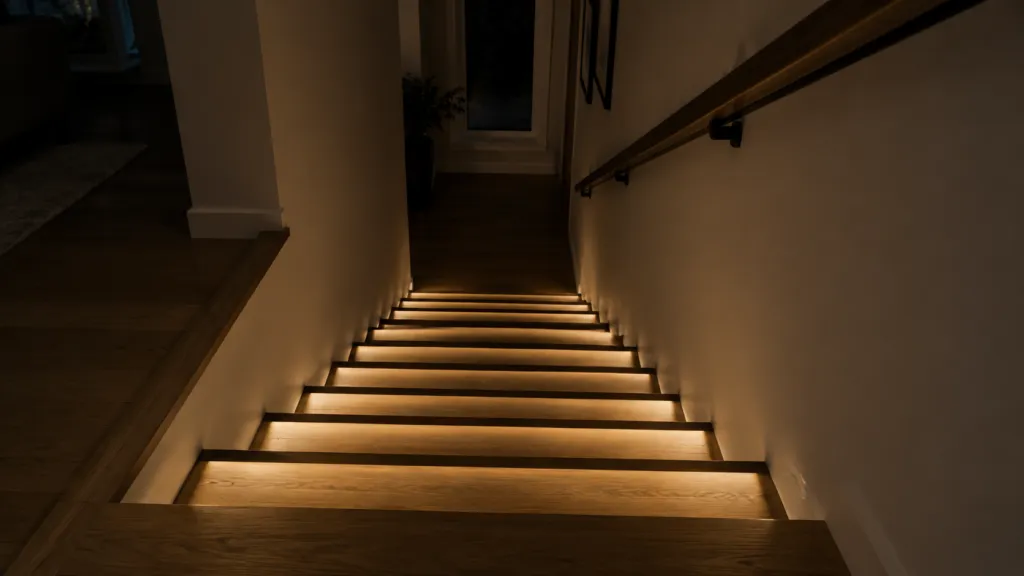
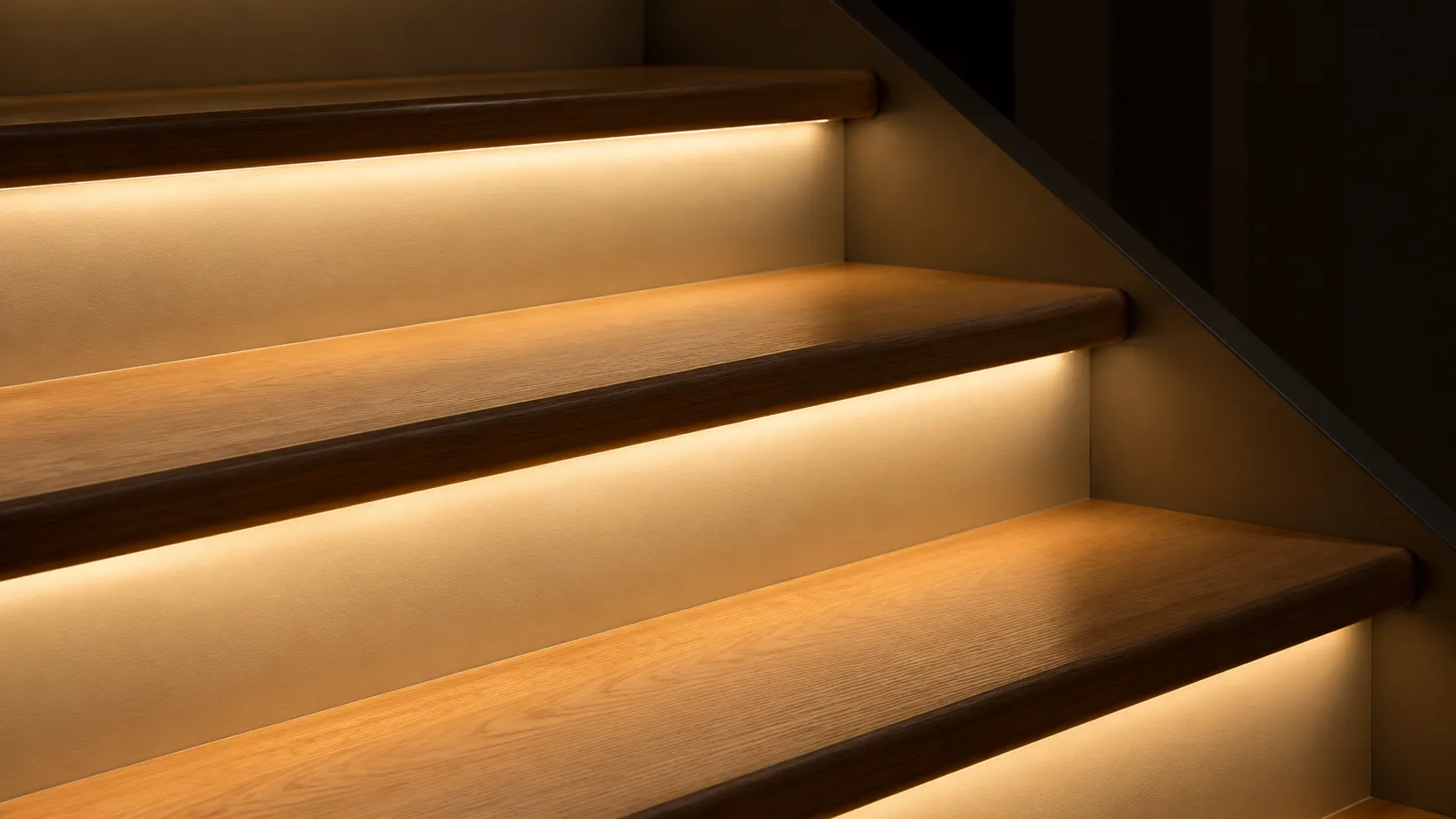
Under the nosing, tape on the underside of the tread lip is aimed down and back, washing the riser and the rear of the tread below. The front of each tread stays darker while the back of the next tread down is its brightest part, so someone descending sees every edge as a dark line against a lit band, the edge-against-background contrast the 1979 guidelines describe. It needs a lip deep enough to hide a covered profile.
On the riser, tape in a routed groove or a shallow profile just below the nosing lights the tread from behind. It is simple on closed risers and hard to hide, because the riser faces straight at anyone climbing; unless the profile is recessed and covered, the diodes show on every trip up. Open risers rule it out.
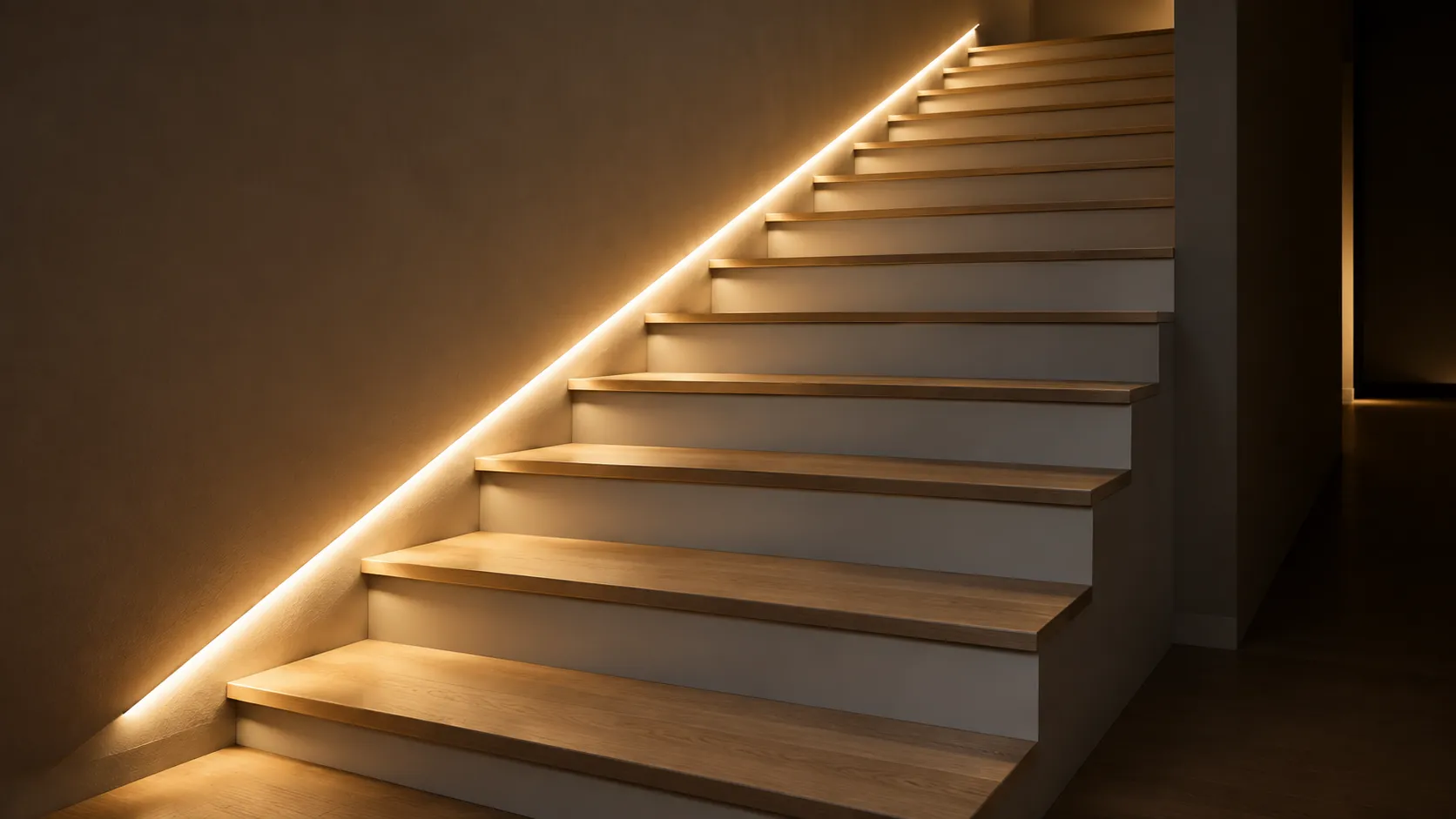
Along the handrail or the side wall, one continuous run beside the stringer lights the walking line from one side and from a single feed, which makes it the cheapest per stair. Light arriving low across the treads throws a shadow from every nosing, though, and a lit wall line shows where the flight is rather than where each tread stops. Retail listings sold as LED strip lighting stairs kits usually show this version, the one least able to answer the complaint.
The building code’s own marking scheme uses the same three reference lines. Where the 2021 International Building Code requires luminous egress path markings, in the exit stairs of high-rise buildings such as offices, stores, schools and hotels, it asks for a stripe 1 to 2 inches wide along the leading edge of every step, within 1/2 inch of that edge, a stripe along the top of the handrail, and wall lines with their bottom edge no more than 4 inches above the floor (International Code Council). Those markings are photoluminescent or self-luminous, not electric, but they mark the same places a stair strip does.
| Placement | What it lights | What the eye reads | Where the source shows | What the order states |
|---|---|---|---|---|
| Under the nosing | Riser and back of the tread below | A darker edge against a lit band | Upper treads, to someone climbing | Nosing depth, profile, cover, length per tread |
| On the riser | Tread from behind, riser face | A lit band at each riser foot | Every step, face-on when climbing | Closed risers, groove or profile, recess depth |
| Handrail or low wall run | The walking line, from one side | Where the flight runs, not each edge | The whole flight, from both ends | Mount height, aim, shielding, feeds |
Glare on the Way Down, and on the Way Up
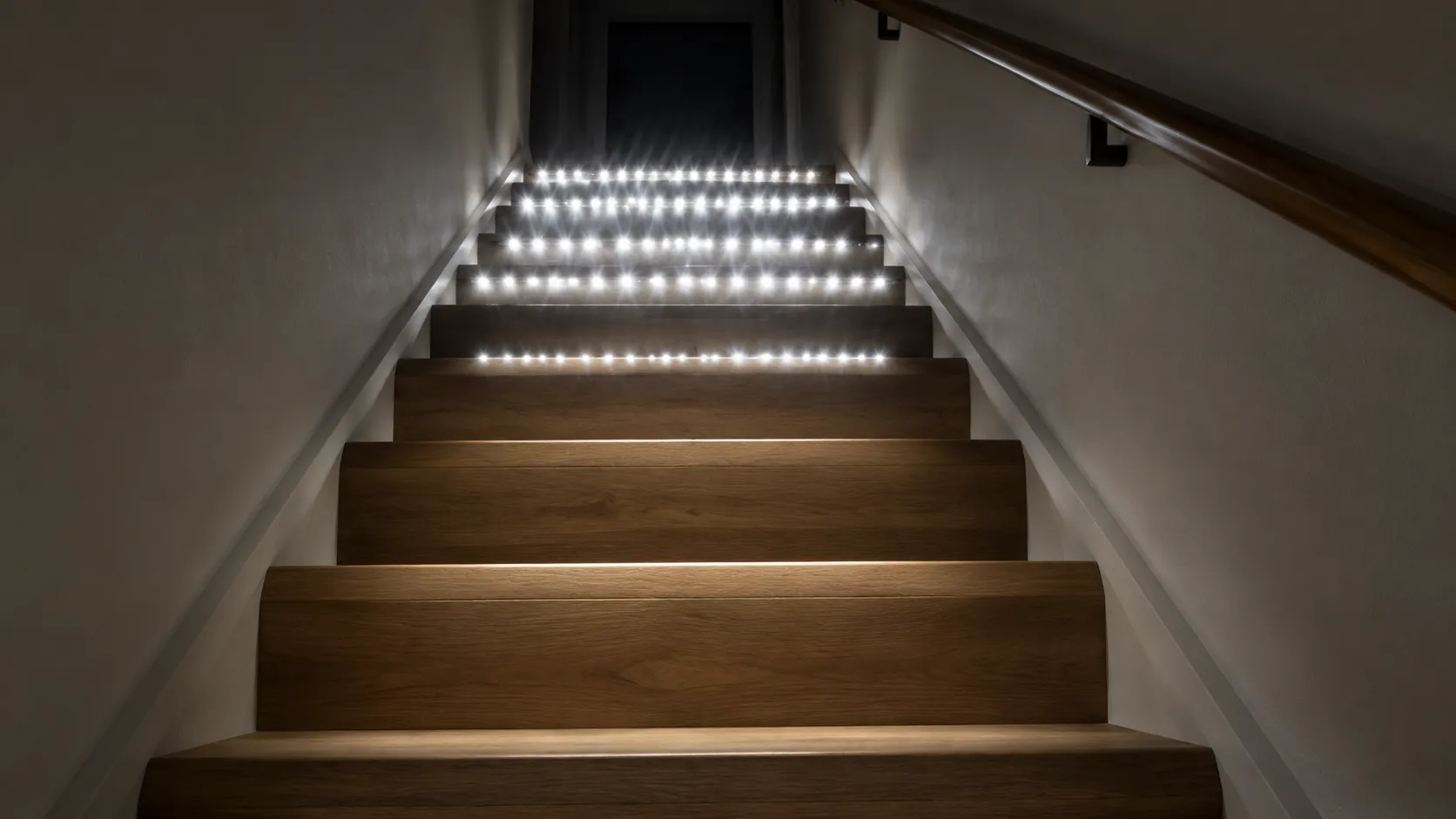
Glare is where good-looking stair runs fail in use, and it depends on which way the person is walking more than on how bright the tape is.
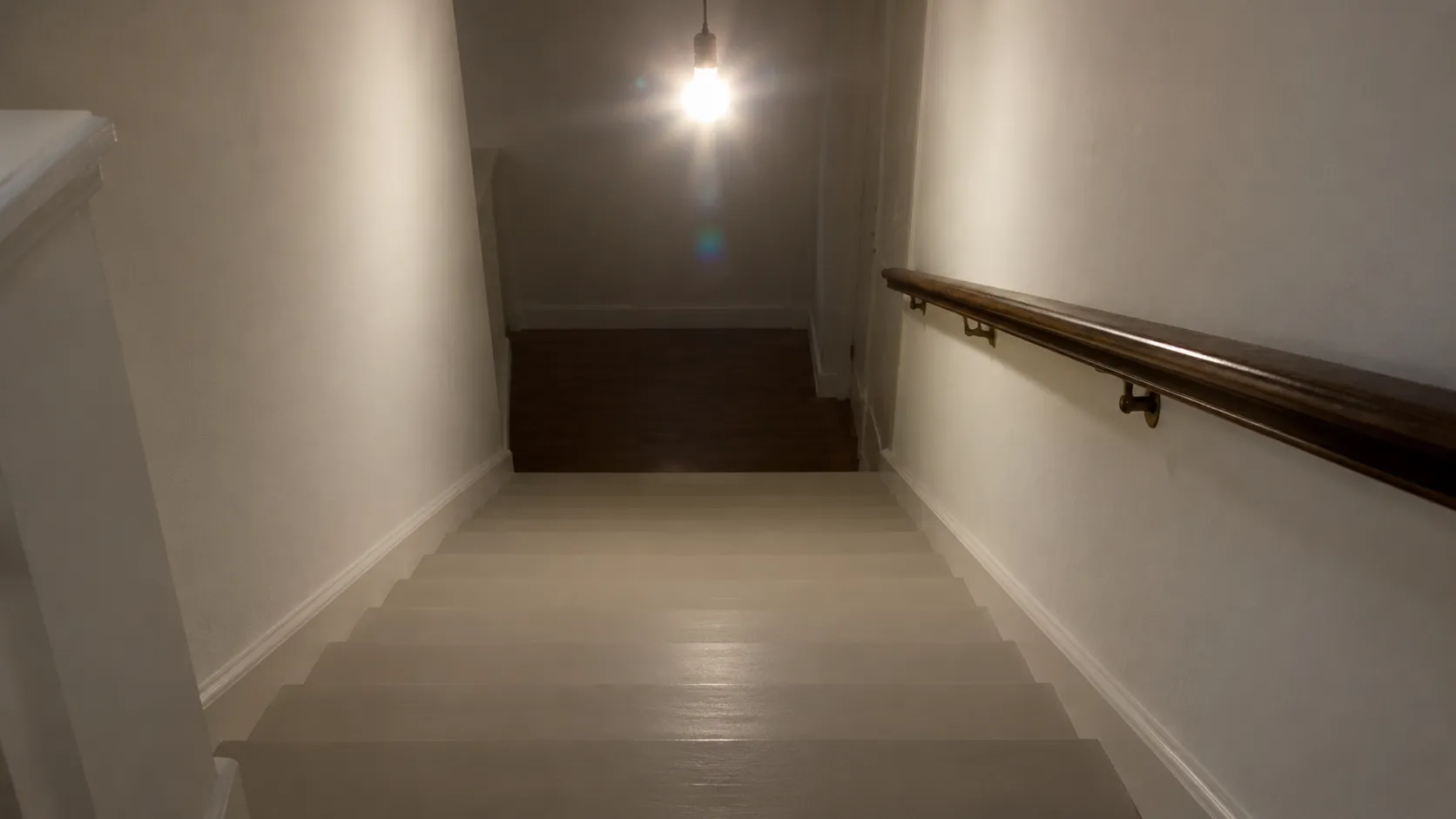
The 1979 guidelines describe the domestic case precisely. On many residential flights the stair fixture is plainly visible to someone looking down the stairs, which can cut their ability to see detail and leave an afterimage lasting several seconds; during ascent, the report adds, the same problem comes from lights over an upper landing or from decorative lighting beneath stair treads (National Bureau of Standards). It also cites Silvers, who found that a 5 footcandle glare source near the line of sight reduced visibility as much as cutting the surrounding light to one hundredth. A badly placed source makes a stair harder to read however bright it is.
So the direction of travel settles the design, and descent comes first: a fall going down can carry on down the flight, as the report notes. Under-nosing tape is hidden from above by the tread itself, which makes it the default for a flight used at night. Its weak view is from the bottom, once a nosing sits above a climber’s eye height. Riser tape is the reverse, hidden from above and face-on from below. Wall and handrail runs are seen obliquely from both ends, so bare tape there shows as a line of dots either way.
The cure is shielding and diffusion rather than lower output alone. A cover is a channel decision with a measurable cost in light, set out in our LED channel guide. Then mock up two treads with the real tape, profile and cover, switch the room light off, and look from the top step and the bottom step. If you can count diodes from either, the homeowner will too.
Making Each Step Edge Readable
The aim is a stair where the edge of each tread is the most obvious line in view. Brightness helps only when it builds that contrast.
For treads with strong patterns, the NBS guidelines recommend a plain surface, a directional light that reaches each tread, or a single contrasting stripe at the edge running no more than 1-1/2 inches into the tread and flush with it. They also warn that a crisp shadow lying parallel to a tread edge can be misread as the edge, or as an extra step, and should be removed or softened (National Bureau of Standards). An under-nosing run that throws a hard-edged pool halfway across the tread below draws exactly that line; the pool should end at the riser or fade out as a gradient.
Research on older adults supports lines of light as cues, with a limit that matters for how a kit is sold. In 2011 a Lighting Research Center team walked 24 older adults, half of them at risk of falling, along a level walkway, not a stair, lit by ceiling fixtures, by plug-in night lights, and by night lights plus laser lines outlining the path (BMC Geriatrics). For the higher-risk group the lines raised walking speed and cut step-length variability compared with night lights alone, but the ceiling fixtures still gave the best results. An edge line adds a cue to real illumination; it does not replace it, and a box that implies otherwise invites the wrong complaint.
Consistency does the rest. A tread brighter or warmer than its neighbors reads as a different step, so a flight gets one reel lot and one output setting, and a landing edge is lit like a tread, the same way the high-rise marking rules stripe a landing edge like a step.
What the IRC Asks of Stair Lighting, and Where a Strip Fits
Most stair strip jobs are in houses, so the residential code is the reference. It asks for less light than buyers expect, and more switching.
The 2021 International Residential Code, section R303.7, requires an artificial light source for interior stair treads and landings, capable of not less than 1 footcandle (11 lux) measured at the center of treads and landings. With six or more risers, a wall switch at each floor level must control it, unless remote, central or automatic control is provided (International Code Council). Exterior stairs need a light at the top landing, and at the bottom landing for a basement stair from grade (R303.8). The 2024 edition keeps the wording as R325.6 and R325.7, so check the adopted edition before citing a section on a submittal.
The electrical chapter is what catches strip kits. Section E3903.3.1, which mirrors the National Electrical Code, requires a listed wall-mounted control at each floor level and each landing level with an entryway, again for six or more risers, and accepts wall dimmers for that light only where each location gives the full range of dimming. A kit with a dimmer at the foot of the flight and a plain switch at the top fails that if the strip is the required light. Remote, central or automatic control is allowed in stairways instead, which is where a sensor earns its place; delay and sensor position for a flight are covered in LED strip lighting with motion sensor. The 1979 guidelines said the same in plain words: switches at every landing, reachable a stride before the first riser, so nobody crosses a stair in the dark because the switch is at the other end.
Commercial flights have a different number. The 2021 International Building Code requires 10 footcandles (108 lux) on exit access and exit stairways while in use, against 1 footcandle elsewhere on the egress path (International Code Council), so a decorative strip on a hotel or multifamily stair is quoted as its own circuit. Whether a strip counts toward the residential requirement is the inspector’s call: meter the center of the tread, not the pool behind the nosing, and sell plug-in kits as guidance light added to the required fixture.
| What is regulated | Requirement | Where it sits | What goes on the order |
|---|---|---|---|
| Interior stair light | Capable of 1 footcandle (11 lux) at the center of treads and landings | 2021 IRC R303.7 | Meter the tread center, not the pool behind the nosing |
| Switching and dimming | Wall control at each floor level for six or more risers, automatic control allowed; dimmers full-range at each location | 2021 IRC R303.7, E3903.3.1 | Control at both ends, or a sensor that sees each end; full-range dimming at every wall control |
| Exterior stairs | A light at the top landing; also the bottom landing of a basement stair from grade | 2021 IRC R303.8 | Outdoor-rated tape and joints, rating confirmed per order |
| Commercial exit stairs | 10 footcandles (108 lux) at the walking surface while in use | 2021 IBC 1008.2.1 | Strip quoted as its own decorative circuit |
Stair Dimensions That Change the Cut List
A stair is a run of short, identical segments, and the code sizes them tightly enough to plan most of the order before a site visit.
Under the 2021 IRC a riser is at most 7-3/4 inches (196 mm) and a tread at least 10 inches (254 mm), with no more than 3/8 inch between the largest and smallest in a flight. Nosings project 3/4 inch to 1-1/4 inches (19 to 32 mm), the handrail sits 34 to 38 inches above the nosing line, and headroom is at least 6 feet 8 inches (International Code Council). Tread width sets the segment length, and each segment must end on a marked cut point, covered in our note on cutting LED strip lights. The projection rule decides whether under-nosing tape is possible at all: no nosing is required where treads are at least 11 inches (279 mm) deep, so a square-edged modern stair may have no lip to hide anything under.
Per-tread segments mean per-tread feeds. A 13-riser flight lit under every nosing is twelve or thirteen short runs, depending on whether the top landing edge is lit, each with a lead back to a driver or a bus behind the stringer, and that wiring, not the tape, is most of the labor; a wall run is one feed. Sequential step-by-step effects add a controller and one output per tread and belong on a separate quote line. Settle the fixing method at the same stage, using the substrate rules and install order in our guide to LED strip lights with double sided tape; for LED strip lighting on stairs, shoe and vacuum wear argue for a profile over bare tape.
Exterior steps take rain, frost and grit, so tape, joints and power unit are specified for the position. Our outdoor waterproof strip comes in 10-metre and 20-metre kits for long runs, with its ingress protection rating confirmed per order against where the run sits.
The Order Sheet for a Stair Lighting Program
Staircase LED strip lighting is quoted well when the enquiry describes the stair and the people using it, and badly when it describes only the tape.
The six decisions below run in the order that stops a later one undoing an earlier one.
Name the flight and its users
Interior or exterior, riser count, open or closed risers, who uses it at night. Six or more risers brings in the switching rules.
Pick the view to protect
Descent first. Choose the placement from the direction that must never see a diode.
Measure the stair, not the plan
Tread width, nosing projection, riser height, handrail line. No nosing, no under-nosing run.
Fix control at both ends
Wall control at each floor level and entry landing, or a sensor that sees each end; any dimming full-range at each point.
Cut and feed per tread
Segments ending on cut points, one lead per tread or one feed per wall run, and a driver someone can reach later.
Mock up two treads at night
Real tape, profile and cover, seen from the top step and the bottom step in a dark room. Count diodes, then check the edge.
For a retail stair kit, the same list becomes box copy: a guidance light that plugs into an outlet, not the fixture the code requires; the number of treads covered; and how it is controlled from both ends. Our motion strip kit already lists hallways and stairs among its placements and packs strip sections, a sensor unit, mounting hardware and a plug-in adapter with Motion, Touch and Always-On modes, with length and pack contents set per program. For a feature stair with color scenes, the smart light strip adds app, voice and remote control.
Contract work runs the other way, with reels and profiles cut to a stair schedule and drivers sized to the flight. Both routes are quoted through our strip range, where LED stair lighting is an application rather than a separate product: step-edge and riser runs priced with channel, cover and driver as one package, so LED strip lighting for stairs arrives fitted to the flight rather than as a reel someone has to make fit.
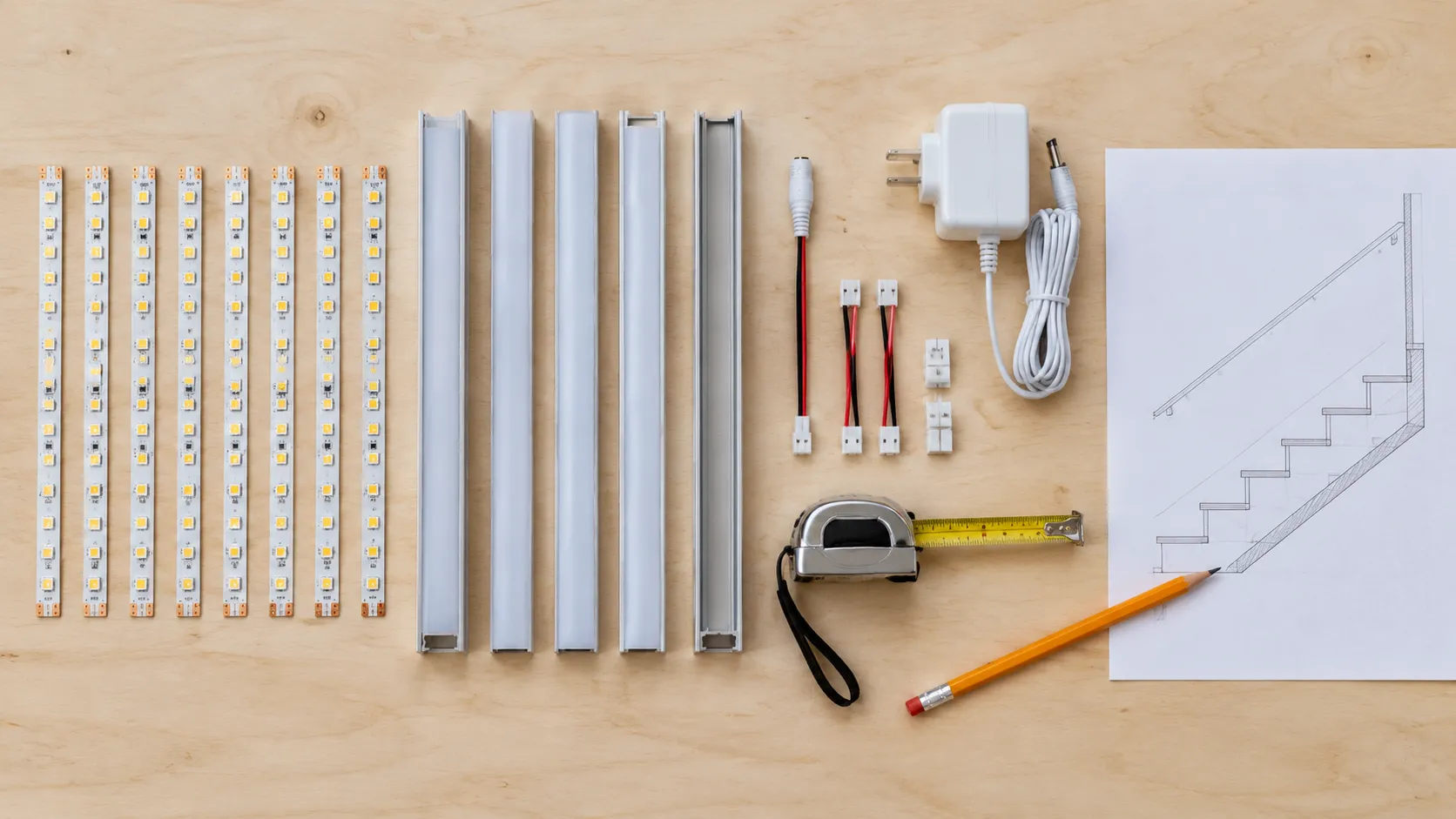
Have stair runs cut to the flight, not to a reel length
We build LED strip in our own factory in Foshan, 4,000 square meters with 40 people on two production lines, so tread segment lengths, control, profile, cover and pack contents are lines you write rather than a catalogue you pick from. Send the stair type, riser count, tread width and placement, and we will quote the run.
Watch it work
Why a dark stair fails at the edge rather than the brightness, and what tape under the nosing does about it, in 34 seconds:
FAQ
Can LED strips be fitted to carpeted stairs?
Not onto fitted carpet that wraps over the nosing: the adhesive has nothing stable to grip and the pile swallows the light. Two versions work. A runner that leaves hard nosing exposed at each side gives the tape a timber edge to sit under, or a nosing profile fixed to the tread before the carpet goes down can carry the strip inside it. Agree it with the carpet fitter first, because it changes their cut as much as yours.
Does every step need a light, or can we light alternate treads?
Light every tread you expect people to read. An unlit step between two lit ones becomes the single edge nobody can find, and among nosing lights a dark tread can look like a missing step. If the budget will not stretch that far, move the light to one continuous run beside the flight and put the contrast into the nosings with a finish or an inlaid stripe.
Can LED strips be fitted to open-riser or floating stairs?
Yes, but only on the treads themselves, because there is no riser to carry tape. The workable positions are under the front edge of each tread, in a routed groove or a slim profile, or along the wall end of a floating tread, and both need a cover because the underside of every tread is on show from below. Plan the cable route before the treads go in: on a floating stair the lead has to run inside the tread or the wall, and adding it later means taking a tread off.
Warm white or cool white for stair strips in a home?
Start from the rooms at either end of the flight, because the stair is always seen from one of them. A color temperature that differs from the hallway or landing makes the run look like a separate fitting rather than part of the house. For night guidance, keep output low and even instead of chasing a cooler tone for apparent brightness; an eye coming out of a dark bedroom needs contrast at the edges, not a bright stripe.
Sources
Every external figure above was checked on 2026-09-29: stair lighting, switching, dimming and stair dimensions from the International Code Council’s public code text, stair behavior and survey figures from the National Bureau of Standards guidelines, injury counts from the peer-reviewed emergency department study and the CDC, and the edge-line findings from the Lighting Research Center study cited in full below.
- International Code Council, 2021 International Residential Code, Chapter 3 Building Planning (R303.7 interior stairway illumination: 1 footcandle, 11 lux, at the center of treads and landings, wall switch at each floor level for six or more risers, no switch where remote, central or automatic control is provided; R303.8 exterior stairway illumination; R311.7.2 headroom 6 feet 8 inches; R311.7.5.1 riser 7-3/4 inches maximum; R311.7.5.2 tread 10 inches minimum; R311.7.5.3 nosing projection 3/4 to 1-1/4 inches, not required where treads are 11 inches deep; R311.7.8.1 handrail 34 to 38 inches), retrieved 2026-09-29.
- International Code Council, 2024 International Residential Code, Chapter 3 Building Planning (the same stairway illumination text renumbered as R325.6 interior and R325.7 exterior), retrieved 2026-09-29.
- International Code Council, 2021 International Residential Code, Chapter 39 Power and Lighting Distribution (E3903.3.1 stairway lighting outlet control: a listed wall-mounted control device at each floor level and each landing level with an entryway for six or more risers, dimmers only with the full range of dimming at each switch location, automatic control permitted in stairways), retrieved 2026-09-29.
- International Code Council, 2021 International Building Code, Chapter 10 Means of Egress (1008.2.1 egress illumination 1 footcandle at the walking surface and 10 footcandles, 108 lux, on exit access and exit stairways in use; 1025.1 luminous egress path markings in high-rise Group A, B, E, I-1, M and R-1 buildings; 1025.2.1 step-edge stripe 1 to 2 inches wide within 1/2 inch of the leading edge; 1025.2.2 landing edges; 1025.2.3 handrail stripe; 1025.2.4.2 wall lines within 4 inches of the floor), retrieved 2026-09-29.
- National Bureau of Standards (now NIST), Archea, J., Collins, B. L. and Stahl, F. I., Guidelines for Stair Safety, NBS Building Science Series 120, 1979 (tread-edge detection in descent; glare from the stair fixture in descent and from decorative lighting beneath treads in ascent; Silvers on a 5 footcandle glare source; shadows parallel to tread edges; edge stripes no more than 1-1/2 inches deep; switches at every landing one stride before the first riser; figures in the chart from Carson and colleagues’ 1978 Milwaukee County survey of 253 homes, 54 measured, and from Miller and Esmay, 1961), retrieved 2026-09-29.
- Blazewick, D. H., Chounthirath, T., Hodges, N. L., Collins, C. L. and Smith, G. A., Stair-related injuries treated in United States emergency departments, American Journal of Emergency Medicine, 2018, volume 36, issue 4, pages 608 to 614, doi:10.1016/j.ajem.2017.09.034 (24,760,843 patients from 1990 to 2012, an average of 1,076,558 a year, rate up 24.0% from 1996 to 2012, older adults more often fractured), record checked 2026-09-29.
- Figueiro, M. G., Plitnick, B., Rea, M. S., Gras, L. Z. and Rea, M. S., Lighting and perceptual cues: effects on gait measures of older adults at high and low risk for falls, BMC Geriatrics, 2011, volume 11, article 49, doi:10.1186/1471-2318-11-49 (24 older adults; ceiling fixtures best; night lights plus lines outlining the path improved gait speed and step-length variability over night lights alone in the higher-risk group), record checked 2026-09-29.
- Centers for Disease Control and Prevention, Older Adult Falls Data (over 14 million, or 1 in 4, older adults report falling every year; falls are the leading cause of injury for adults 65 and older), retrieved 2026-09-29.
