






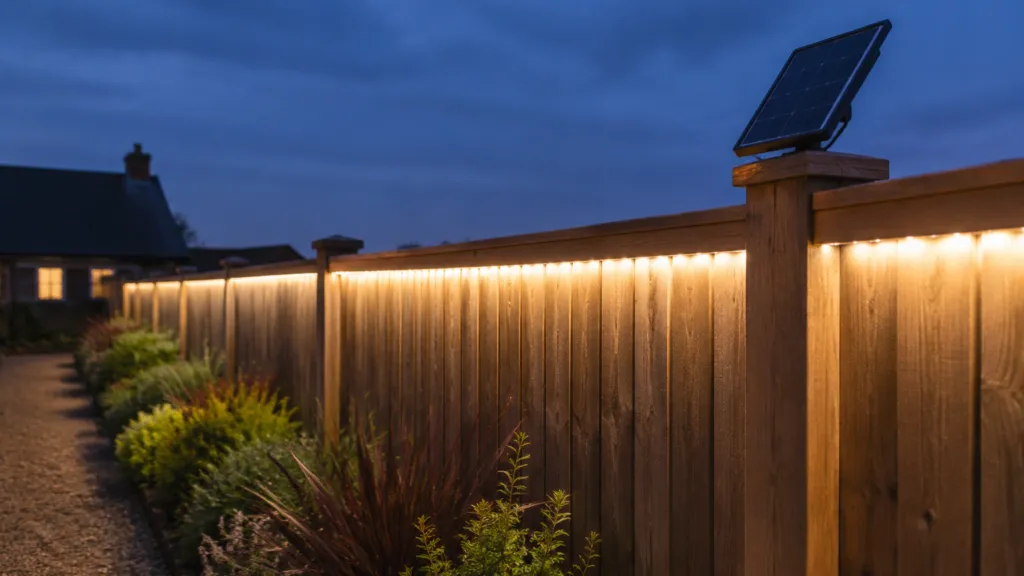
Solar powered LED strip lights are the first thing a buyer asks about when a brief says outdoor and there is no power at the fence line. The pitch is clean: no trench, no transformer, no electrician. The catch is that tape fed by a palm-sized panel and a small cell is a different product class from the low-voltage strip that goes on a building, and the gap shows up in three places — lumens on day one, harvest in December, and brightness at the far end of a long run.
Key takeaways
Treat a solar strip as a sealed energy budget with tape attached, not as tape you can feed harder. Size on the darkest month and the longest run, and put the wired option beside it before committing a program.
- A solar kit is one closed system — panel, cell, controller, sensor, tape — nothing separately specifiable.
- Market-typical solar output sits an order of magnitude below a professional 24 V architectural strip.
- Peak sun hours swing by more than 2x across the United States, so one SKU behaves like two products.
- Winter is the sizing month: harvest bottoms out in the weeks the nights run longest.
- Lithium cells are not permitted to charge below freezing, a limit no panel size engineers around.
- Long runs are a wiring problem, and only the wired format lets you add a feed point.
01What solar powered LED strip lights actually are
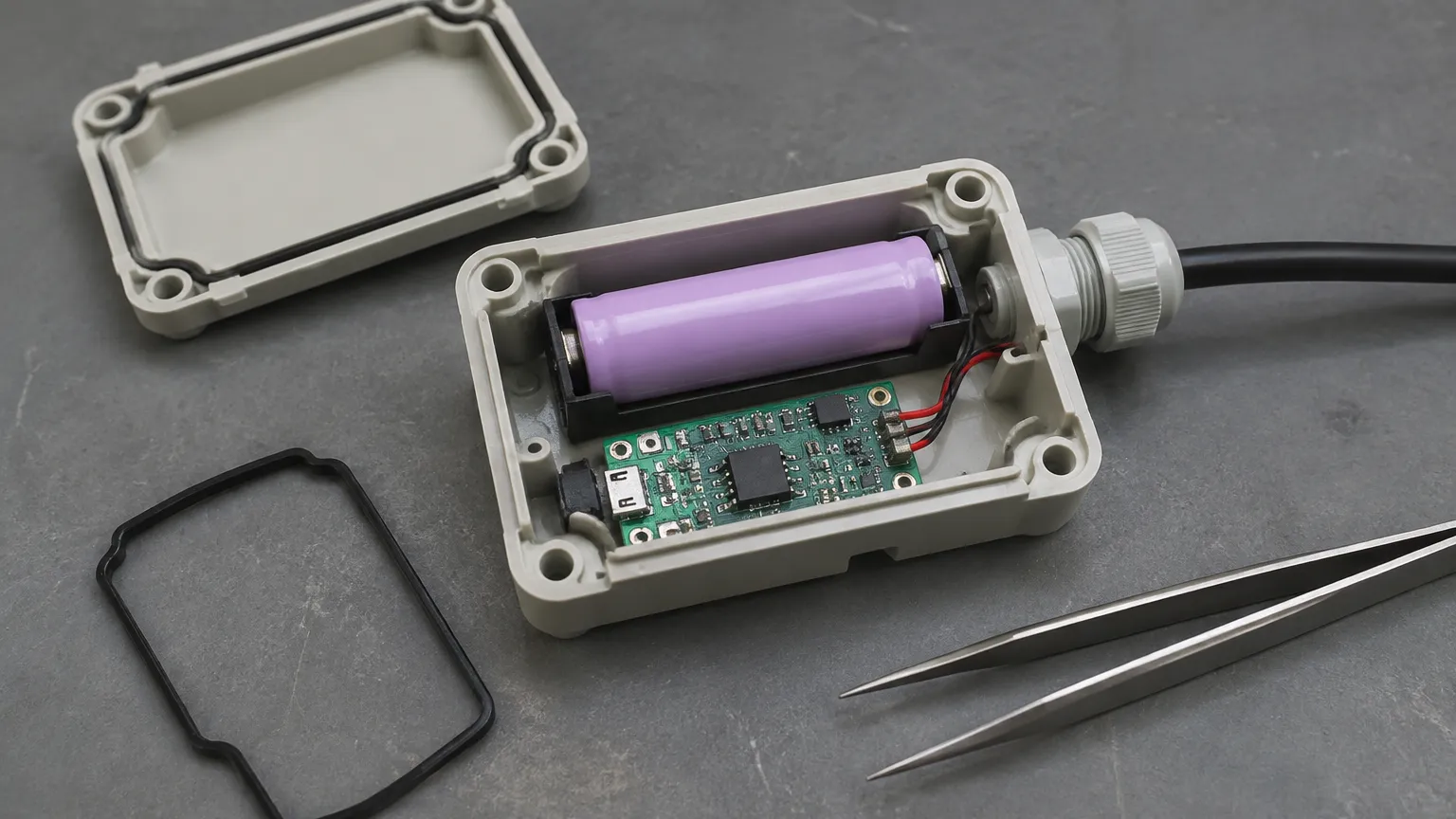
Strip that runs on sunlight is not the same component as strip that runs on a driver, and the difference is structural rather than a matter of grade. A wired run is a system you assemble: tape, channel, power supply, control path. A solar product arrives as one sealed kit — panel, charge controller, lithium cell, dusk-to-dawn sensor and a short length of low-current tape, matched at the factory and none of it separately specifiable. You are not buying tape and choosing how hard to feed it; you are buying a closed energy budget.
Published figures from the consumer end of the market show the scale. One widely sold outdoor solar strip ships 9.8 ft, or 3 m, of tape with an 800 mAh cell, a stated 6 to 8 hours of run time, eight preset modes and an IP65 rating (Aduro Products). Trade sources put market-typical output for a consumer-grade solar strip at 50 to 100 lumens per meter, against roughly 1,000 lumens per meter where a professional 24 V architectural strip merely starts, and give 10 to 20 feet as the usual solar strip length (RH Strip Lighting). None of those are our numbers: we do not build solar tape, and every solar figure here is either a stated market-typical range or a named third-party product.
Separate the format from the technology, because solar itself is not the weak link. It works well outdoors when the fixture is a discrete point with room for a real panel and a real battery, which is why the solar flood light is a mature category — see whether solar flood lights are worth it and the broader outdoor solar lighting overview. Stretch that budget along ten meters of tape and the arithmetic stops cooperating.
02The energy budget is the whole story
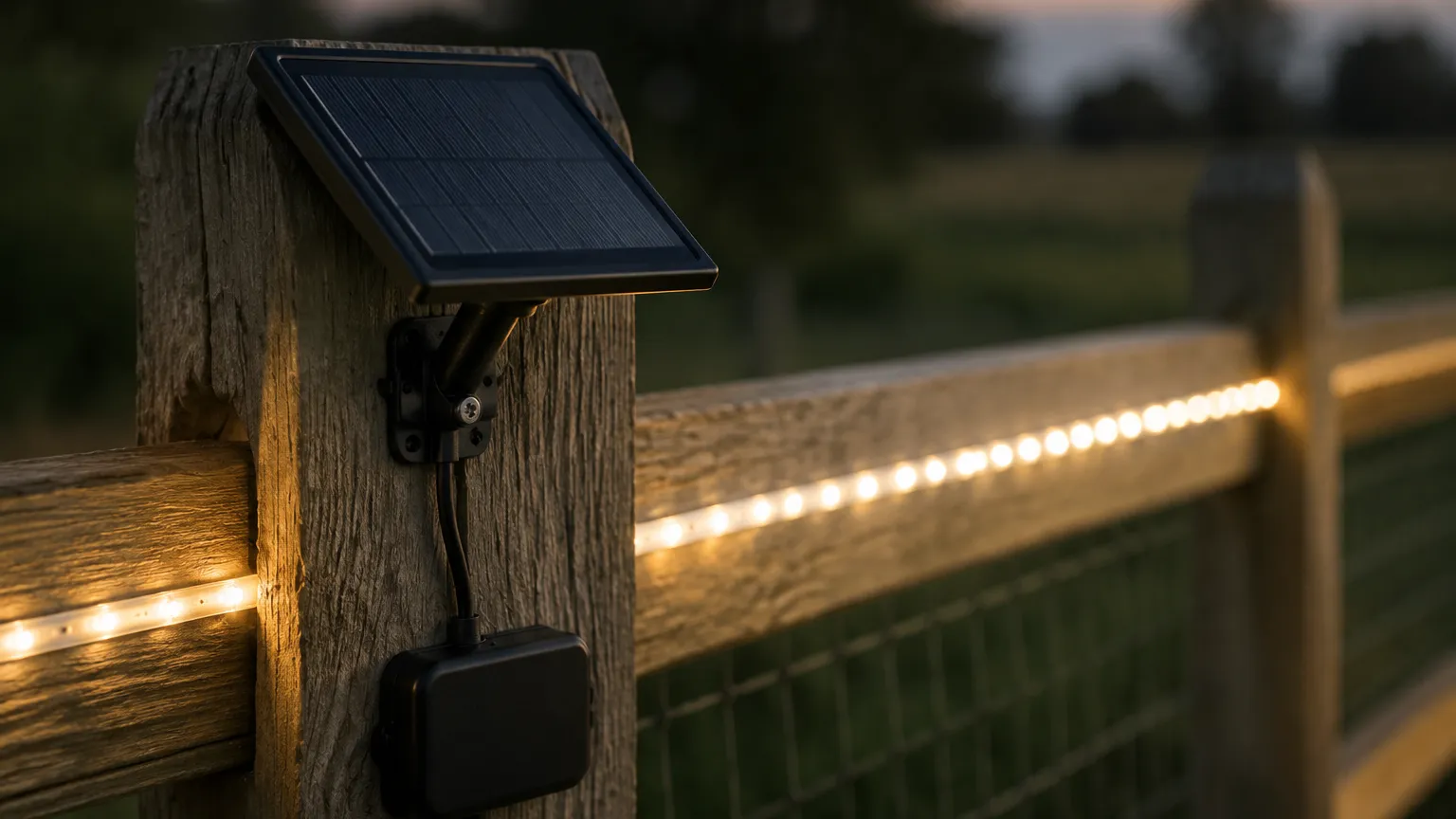
Every argument about solar tape reduces to one line of arithmetic that has nothing to do with LEDs. Panel watts multiplied by peak sun hours gives the watt-hours harvested in a day, and that has to cover what the tape draws overnight, with margin for the days it rains. Both sides are small by necessity: the panel has to clip to a fence and the cell has to sit in a housing beside it.
Convert the published figures into watt-hours and the ceiling stops being theoretical. An 800 mAh lithium cell of the kind quoted on that 3 m kit stores single-digit watt-hours at cell voltage, and that is the entire budget for a full night (derived from the capacity published by Aduro Products). A wired run has no equivalent constraint: the driver is sized to the load, and when the load grows you specify a larger driver. On a solar product the store is fixed at the factory, so the only variable left is how dim the tape must run to survive until morning. Brightness is what gets spent.
That is why the output gap reads as a class gap rather than a quality gap. Fifty to 100 lumens per meter against about 1,000 is a factor of ten to twenty, and the trade-off repeats in color: solar strips commonly sit at 70 CRI or below where professional strips treat 90-plus CRI as the baseline (RH Strip Lighting). For an accent tracing a fence that is fine. For a facade, a canopy soffit, a signage band or a hospitality terrace it is not.
03Outdoor solar LED strip lighting is a map problem first
Outdoor solar LED strip lighting has one input no catalog page and no factory can control: where the end customer installs it. The industry measures it in peak sun hours, meaning hours per day equivalent to full-strength sun, and across the United States it swings by more than a factor of two. Arizona and New Mexico sit at 6.5 hours a day, California at 5.6, Texas at 5.3, New York at 4.0 and Alaska at 3.0, against a national average near 5.0 (Unbound Solar). One SKU on a national account is two different products depending on the destination.
Shading makes the local number worse than the state number, and that is where returns come from. A fence under a tree canopy, a north-facing wall or a balcony under an overhang can all sit well below the regional average even in a sunny state. The fix is obvious in principle — site the panel where the sun is and run a lead to the tape — but whether the product allows it is a purchasing question, because many kits tether the panel on a short fixed lead. Ask for the panel rating and the lead length first.
For a buyer that becomes a merchandising decision rather than a technical one. Into Sun Belt garden centers, a solar accent strip is a reasonable line item. Into the Pacific Northwest, the Northeast, or a commercial spec with a performance expectation attached, the same SKU generates support tickets worth more than its margin.
Source: Unbound Solar, “Peak Sun Hours by State” (retrieved 2026-08-28)
04Winter is the month that sizes the product
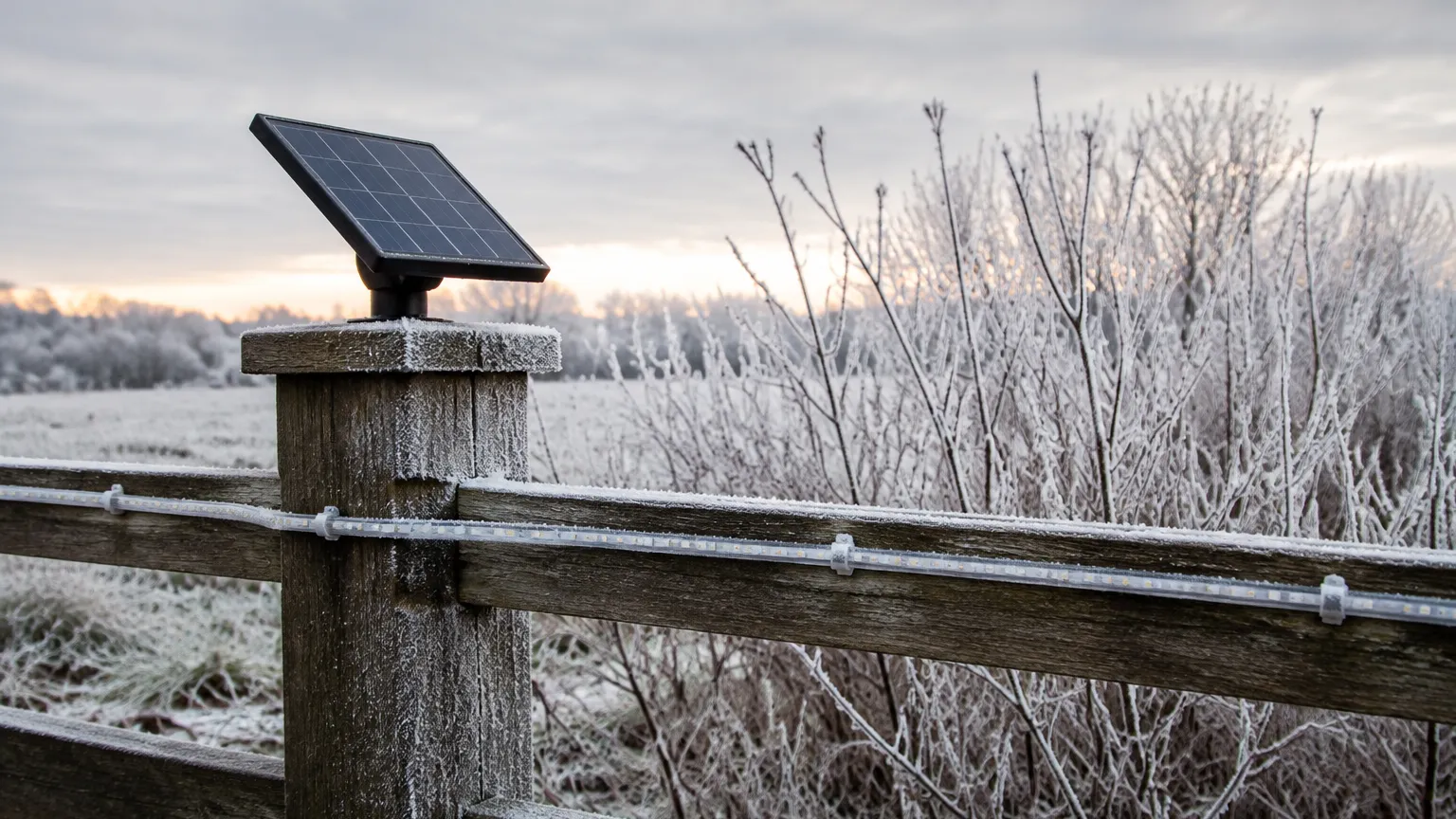
Annual averages are the most misleading number in solar lighting, because a strip does not have to work on average — it has to work on the worst night of the year. Modeled monthly data makes the swing concrete: for Charlotte, North Carolina, harvest peaks at 6.63 peak sun hours in June and bottoms out at 3.43 in December — a swing of roughly 48 percent from the June peak — against a 5.25 annual average (The Green Watt, using NREL PVWatts v8 and NSRDB). As a planning figure, winter daily gain runs 25 to 50 percent below the yearly average (Unbound Solar).
The squeeze is double, and that is what gets missed in sample season. The weeks that cut harvest nearly in half are also the weeks with the longest darkness, so the cell has less charge and more night to cover at once. Any run-time claim quoted without a season attached was almost certainly measured in good conditions — and a holiday display is bought precisely for those weeks.
Cold chemistry adds a limit no panel size engineers around. Lithium-ion cells have a permissible charge range of roughly 0 to 45 degrees C, or 32 to 113 degrees F, and charging below freezing is not permitted at all, because metallic lithium plates onto the anode and permanently degrades performance and safety (Battery University, BU-410). A well-designed controller refuses to charge on a freezing morning — correct engineering, and still no harvest that day. Cycle life compounds it: a low-cost outdoor cell has a realistic life of 300 to 500 charge cycles, about one to two years of nightly use (RH Strip Lighting). The battery, not the diode, is the service-life item.
05Long runs: the ceiling both formats share
Voltage drop is the physical limit on any low-voltage tape. Current traveling down thin copper traces loses voltage along the way, so the far end of a long run is dimmer than the feed end and, on white tape, drifts warmer as it fades. The root cause is too much current for too little copper, which is why Waveform recommends 2.0 oz copper and ideally 3.0 oz on higher-power strip, and lists running 24 V instead of 12 V — typically the same light output at half the current — connecting a second supply at another point along the strip, and heavier connecting wire as the standard mitigations (Waveform Lighting). Electrical practice supplies the target: the branch-circuit informational note recommends holding the drop to 3 percent at the farthest outlet, and 5 percent across feeder and branch circuit together (NEC 210.19). None of that is specific to solar; it applies equally to the tape we build.
The difference is what you can do about it. On a wired run the fixes are routine: inject at both ends, add a feed point in the middle, move up to 24 V, use heavier feed wire, or split across two drivers. On a solar kit the source is one small pack fixed at one end and there is no second feed to add. That is the real reason solar strips sell at 10 to 20 feet rather than in 30 m reels (RH Strip Lighting) — the length is where the energy budget and the voltage drop meet, not a marketing choice.
Buyers regularly try to solve this by chaining kits, so it is worth naming why that disappoints. Two kits end to end are two batteries, two controllers and two sensors with independent states of charge: they come on at different moments, sit at different brightness once the cells diverge, and shut off at different times. Along one continuous fence rail that reads as a seam, and it surfaces in reviews rather than in QC. Where a run must be shortened, tape only cuts at its marked intervals in either format — our guide to cutting LED strip lights covers where those points fall.
06What a wired low-voltage run buys you
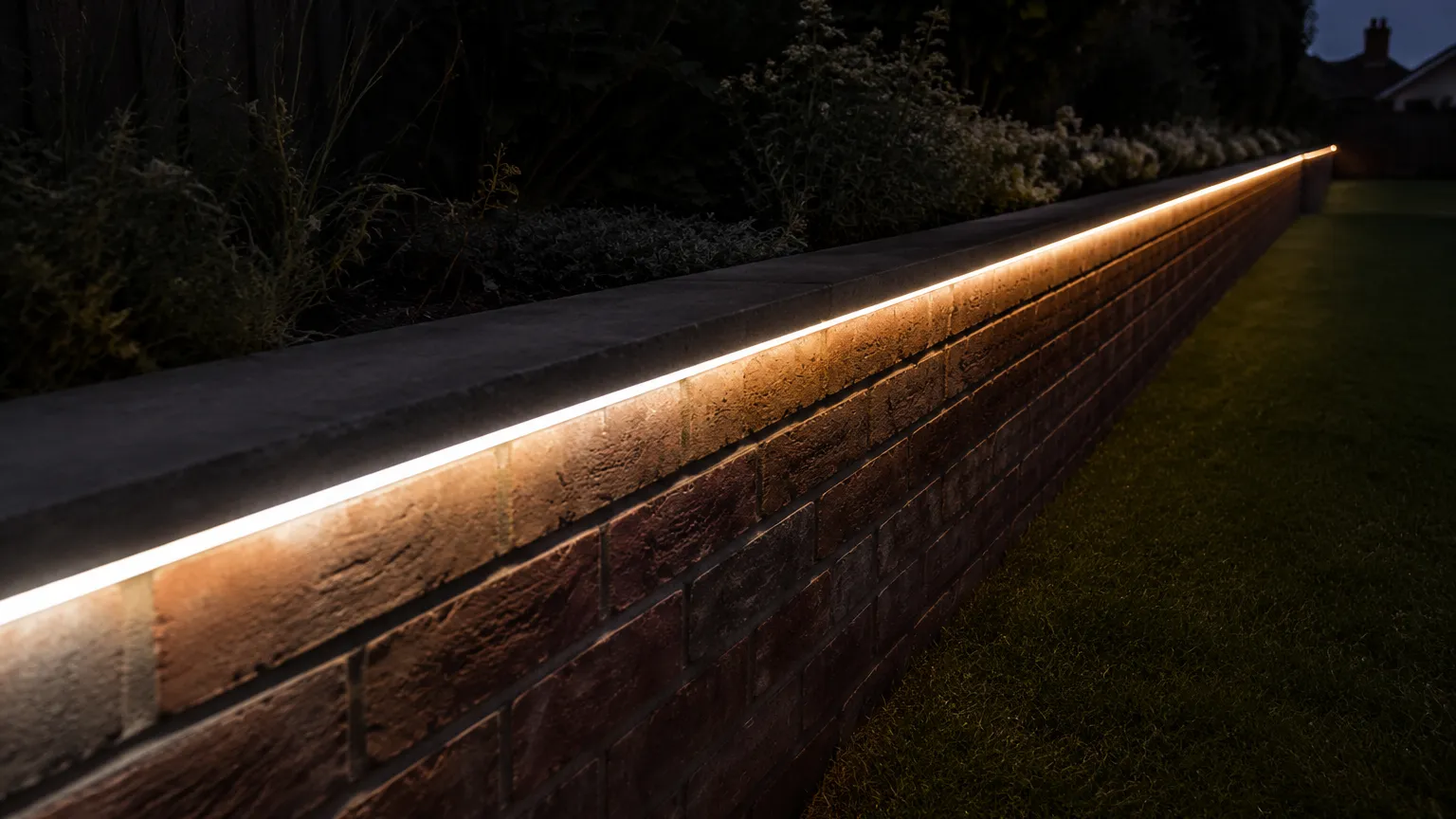
Put plainly, the wired format buys output, color and control, and charges for them in installation. A professional 24 V strip starting near 1,000 lumens per meter with 90-plus CRI diodes is not competing with a solar accent strip; it is competing with the fixture the architect drew (RH Strip Lighting). If the brief says wash a facade, light a canopy or make a signage band legible from the road, the solar option has failed before anyone opens a price list.
Control is the second thing being paid for, and the one commercial specifications refuse to compromise on. A wired run can be dimmed, scheduled and zoned, provided the wall control and the driver are chosen to work together — a forward-phase dimmer on a driver built for reverse phase produces buzz, flicker and dead travel, and phase dimmers carry a minimum load a short run can fall below (Lutron Electronics). Decide the control method before the driver. A solar kit answers this with preset modes and a light sensor: right for a garden, wrong for a terrace.
Weather resistance deserves a line rather than a marketing word. Ingress protection is defined under IEC 60529, first digit solids and second digit water, so IP65 survives water jets while IP67 tolerates temporary immersion (IEC 60529), and outdoors the joints, end caps and driver enclosure matter as much as the tape — the classes are broken down against real situations in waterproof LED strip lights and IP ratings. The honest cost note is that the other side of this trade cannot be priced in an article: trenching, conduit, a transformer and licensed labor vary by market and season, and deleting them is the solar format’s real advantage. Running cost stays small either way, since LEDs use up to 90 percent less energy than the incandescent sources they replaced (U.S. Department of Energy).

| Decision line | Solar strip kit | Wired low-voltage strip |
|---|---|---|
| Light output | 50 to 100 lm per meter, market-typical | From roughly 1,000 lm per meter on a 24 V strip |
| Color rendering | Often 70 CRI or below | 90-plus CRI treated as standard |
| Usual run length | 10 to 20 ft per kit, not extendable | Set by drop and feed points, extendable by design |
| Winter behavior | Harvest down 25 to 50 percent; no charge below freezing | Unchanged year round |
| Dimming and zoning | Preset modes plus a dusk sensor | Phase, 0-10 V or low-voltage PWM paths |
| Service-life item | The cell: 300 to 500 cycles, 1 to 2 years | The driver: rated past 50,000 hours, often with a 5 or 7-year warranty (RH Lighting) |
| Install cost driver | Mounting time only | Trenching, conduit, transformer, licensed labor |
Solar kit and wired run, side by side for the RFQ
A solar kit is an accent product for sunny destinations; a wired run is the format for any brief that has to read as light.
Solar powered LED strip kit
- Where it sells: outdoor-living assortments shipping into high-sun regions, as a fence-rail or path-edge accent at a length a single kit covers.
- Ask the kit’s maker: how many sample rounds the quote covers; who owns the pack artwork; whether the printed insert puts mode and season beside run time; whether a panel extension lead exists as a separate SKU; how cold-weather no-charge returns are logged; who holds replacement cells.
- Pass when: the brief asks for illumination rather than accent, the run is a continuous line longer than a kit, or most units ship to low-sun states.
Wired low-voltage outdoor run
- Built for: installers and contractors lighting facades, soffits, terraces and signage bands, and retailers stocking strip for eaves, pergolas and deck rails.
- Pin down with the supplier: whether the power unit is quoted as its own line with its outdoor rating; the connector set and mounting hardware; plug type, voltage, insert language, barcode and carton artwork per market; how many sample rounds come before sign-off.
- Not the pick when: power can only reach the run through trenching across hardscape or electrical work the job cannot carry, or the site is a rental where permanent wiring is not an option.
07The decision, in the order a buyer should run it
Most bad outcomes come from running this decision backwards — picking the format because it installs easily, then discovering the brief needed light. Run it in this order and the answer usually declares itself in the first two steps.
Write the brief in lumens, not adjectives
Accent, wayfinding or real illumination. If it is illumination, the format question is already settled.
Look up peak sun hours where it ships
Between 6.5 and 3.0 hours a day is one product with two outcomes. Check the destination, not the average.
Size on the darkest month
December harvest, longest nights, no charge below freezing. Fail there and you fail in the season that sells.
Measure the longest continuous run
Past 10 to 20 feet a solar kit stops being one run. Wired lets you add a feed point; solar does not.
Sample through a bad week, not a good day
Bench the full length, then site it through overcast days before the order is placed.
There is also a legitimate hybrid answer that gets overlooked. Solar handles the outbuilding, the far fence corner and the stretch where a trench would cross a driveway, while the wired run does the facade, the terrace and every sightline that matters — provided the two are not asked to sit end to end on the same visual line.
Solar or wired, by channel and job site
Read the brief first: illumination points to wired, whoever is buying. For an accent, what matters next is the sun reaching the panel where it is installed.
- If you run garden centers in the Sun Belt and want a fence-rail accent, a solar strip can earn its place; size the sample for December, not for the week it lands.
- If you buy for stores in the Northeast or the Pacific Northwest, start those doors on a wired outdoor kit and treat solar strip as a regional line, not a national one.
- If you sell online and ship to every state, you cannot choose where the panel ends up, so lead with the wired kit or print mode and season beside every solar run-time claim.
- If you are a landscape installer quoting a facade, a canopy soffit or a hospitality terrace, quote it wired and settle the control method before picking the driver.
- If that same job has an outbuilding or a stretch where the trench would cross a driveway, put solar there and break between formats at a corner or a level change.
- If you are a contractor whose commercial spec names dimming, schedules or zones, choose the wired run; a solar kit has preset modes and a dusk sensor instead of a control path.
- If you manage properties where every dead fixture becomes a work order, agree who replaces cells before choosing solar, since on a solar kit the battery is the wear part.
08The spec sheet: what to pin down before you sample
A solar LED strip light kit and a wired run share almost no spec lines, which is why one generic template produces bad quotes for both. On the solar side the deciding lines are the panel rating, whether the panel detaches and on how long a lead, cell capacity and chemistry, the low-temperature cutoff, and the exact conditions behind any run-time claim. Ask for the battery warranty as its own line: that is the 300 to 500 cycle component sitting inside a product sold on a longer headline number (RH Strip Lighting).
On the wired side the sheet is the familiar one: voltage, watts per meter, CRI and binning tolerance, IP class, maximum run length and feed-point plan, driver rating and control path. Load a driver to roughly 80 percent of its rating, and order every continuous visible surface from one production run so no seam appears between reels. If those terms need unpacking, our LED strip spec decoder works through what each number controls before it goes into an RFQ.
Then sample as though the failure modes are real, because they are. Bench the full length before anything is stuck down, since adhesive comes off cleanly exactly once. Site the sample through a run of overcast days rather than judging it on the first clear evening, and photograph the far end of the longest run beside the feed end. Those checks cost days; the alternative costs a season.
| Line to pin | What to ask for | What it prevents |
|---|---|---|
| Panel rating and mounting | Rated watts, and whether the panel detaches with a stated lead length | Shaded installs that can never be fixed on site |
| Cell capacity and chemistry | Capacity in mAh or Wh, chemistry, and the low-temperature charge cutoff | Winter complaints that read as defects but are physics |
| Run-time claim conditions | Which mode, which brightness, which ambient temperature | Summer figures quoted against a Q4 display |
| Ingress, part by part | Separate IP class for tape, panel, controller and connectors | A sealed strip failing at an unsealed junction |
| Battery warranty, separately | Term for the cell, distinct from the term on the strip | A 1 to 2 year wear item inside a longer headline |
| Wired: voltage and load | 12 V or 24 V, watts per meter, run length, feed-point plan | The far end dimming and drifting warm |
Sourcing outdoor strip for a program
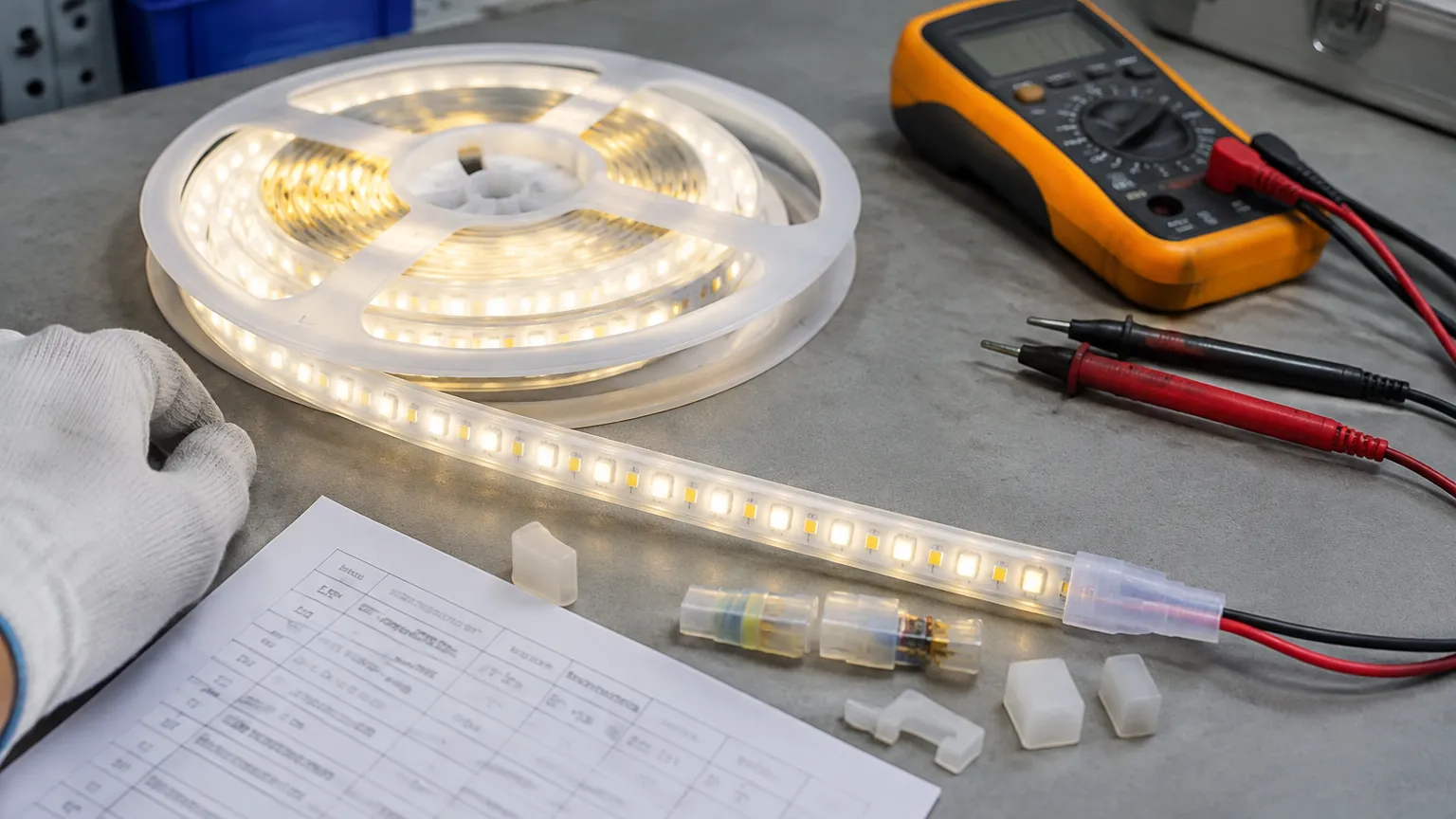
BeginLighting builds low-voltage LED strip at our own factory in Foshan, including the outdoor waterproof strip on the wired side of this comparison, and we build solar in the format where it performs — the solar flood light range. We do not make solar-powered tape. If you are specifying an outdoor run, send the lengths, the destination market and the brief, and we will spec against them. Pricing is per project rather than listed.
What changing format involves
A format change moves the failure points, so the work is retesting outdoors and rewriting what the end customer reads.
From wired to solar strip
- Repeat the sampling above in the destination climate, at full selling length.
- Rewrite the listing and pack insert so run time carries its mode and season, and add panel siting guidance.
- Brief store staff on what drives returns: shade over the panel, run length, winter behavior.
- Decide what the wired stock becomes: the line for illumination briefs, or sell-through in the spring and summer window.
From solar strip to a wired run
- Map where power reaches each run, and fix the control method before ordering drivers.
- Add the power unit, its outdoor rating and the connector set to the RFQ as separate lines.
- Rework packaging and inserts around the driver and feed-point plan, and take any no-wiring claim off the listing.
- Walk installers through feed points and joint sealing on the opening jobs.
- Move leftover solar kits to where they still fit, such as sunny regions and outbuildings.
Changing supplier within a format is narrower: mount your current unit beside the new sample on the same fence or eave, and compare them over the same nights before artwork moves.
Is a format change worth it?
Change format only when the brief or the destination has outgrown what you carry now. If your solar strip sells as an accent into sunny regions with quiet returns, or your wired runs already do the job, leave them: when a change would not pay back its sampling and relabeling, keeping the current setup is a sound choice.
Where the answer is wired, write each run’s position (eave, pergola beam, step, deck rail) and its destination market into the RFQ; on our outdoor waterproof strip the ingress rating is confirmed per order against that exposure. Where the brief really needs off-grid light on a far garden wall or a fence panel, look at the solar wall wash light.
09Watch it work
Which part of the yard takes solar, and which stays wired, in 37 seconds:
FAQ
How to power LED strip lights with batteries?
From a stored budget rather than a driver, and that budget then decides everything else about the product. Solar powered LED strip lights are the packaged version of it: panel watts multiplied by peak sun hours has to cover what the tape draws all night, and both sides of that sum are small, because the panel has to clip to a fence and the cell has to sit in a housing beside it. A representative consumer kit runs 3 m of tape from an 800 mAh cell with a stated 6 to 8 hours of run time (Aduro Products) — single-digit watt-hours for an entire night. The design pays for that run time in brightness, which is why market-typical solar output sits at 50 to 100 lumens per meter against roughly 1,000 where a professional 24 V strip starts (RH Strip Lighting). Size any battery-fed run on the darkest month, and treat the cold limit as a spec line: lithium cells are not permitted to charge below freezing (Battery University, BU-410).
What are the brightest LED strip lights?
Mains-fed low-voltage tape on a properly sized driver, and not by a small margin. A professional 24 V architectural strip starts near 1,000 lumens per meter with 90-plus CRI diodes, while consumer-grade outdoor solar LED strip lighting sits at 50 to 100 lumens per meter and commonly 70 CRI or below (RH Strip Lighting) — a factor of ten to twenty. The cause is stored energy rather than diode quality: on a wired run the driver is sized to the load, so output is a specification decision, while on a solar kit the store is fixed at the factory and brightness is what gets spent to survive the night. For a facade, a canopy soffit or a signage band that has to read from the road, the wired format is the only one in the conversation.
What is usually in a solar LED strip light kit?
Five parts sold as one sealed system: a small photovoltaic panel, a charge controller, a lithium cell, a dusk-to-dawn sensor and a length of low-current tape. Nothing on that list is separately specifiable, which is the defining difference from a wired run. A representative consumer kit ships 9.8 ft, or 3 m, of tape with an 800 mAh cell, eight preset modes, a stated 6 to 8 hours of run time and an IP65 rating (Aduro Products). The panel rating and the ingress class of the controller housing tell you more than the LED count on the box.
Are LED strip lights dimmable?
On a wired low-voltage run, yes — provided the wall control and the driver are chosen to work together. A forward-phase dimmer on a driver built for reverse phase produces buzz, flicker and dead travel, and phase dimmers carry a minimum load that a short run can fall below (Lutron Electronics), so the control method has to be decided before the driver rather than after it. Wired runs also take scheduling and zoning, which is why commercial specifications will not trade them away. A solar kit answers the same question with preset modes and a dusk-to-dawn sensor: no dimmer line, no schedule and no zones — right for a garden, wrong for a terrace.
Does a hybrid layout make sense, with solar in the far corner and wired everywhere else?
Often it is the best answer on the table. Solar earns its place where a trench would cross a driveway, reach an outbuilding or serve a fence corner nobody looks at directly, while the wired run covers the facade and every sightline that matters. The one rule is not to put the two end to end on the same visual line: a run at 50 to 100 lumens per meter meeting one near 1,000 reads as a fault, not a design choice. Break between formats at a corner or a level change.
Sources
Every external figure above was checked on 2026-08-28. Solar strip specifications come from published third-party product pages and lighting trade sources; solar resource data from NREL-derived modeling. No figure here describes a solar strip we build, because we do not build one.
- RH Strip Lighting, Solar Powered vs. Electric Outdoor LED Strip Lights: Which Should You Choose for a Professional Project? (lumens per meter, CRI, cycle life, typical length, driver life), retrieved 2026-08-28.
- Aduro Products, Aduro Solar Powered Outdoor LED Strip Lights product page (3 m, 800 mAh, 6 to 8 hours, 8 modes, IP65), retrieved 2026-08-28.
- Unbound Solar, Peak Sun Hours by State: Map, Table and Calculator (the state figures charted above; winter gain 25 to 50 percent below the yearly figure), retrieved 2026-08-28.
- The Green Watt, Peak Sun Hours in North Carolina, 2026 NREL data (Charlotte monthly figures; dataset NREL PVWatts v8 and NSRDB), retrieved 2026-08-28.
- Battery University, BU-410: Charging at High and Low Temperatures (permissible charge range 0 to 45 degrees C; no charge below freezing; lithium plating), retrieved 2026-08-28.
- Waveform Lighting, What is LED strip voltage drop (voltage-drop cause in copper trace resistance and current density; 2.0 to 3.0 oz copper recommendation; 24 V in place of 12 V and multi-point feeding as mitigations), retrieved 2026-08-28.
- EE Power, National Electrical Code Basics: Computing Voltage Drop in Branch Circuits and Feeders, Part 1 (NEC 210.19(A) informational note: 3 percent at the farthest outlet, 5 percent across feeder and branch circuit), retrieved 2026-08-28.
- Lutron Electronics, Controlling LEDs technical white paper (phase control against driver type; buzz, flicker, dead travel, minimum load), retrieved 2026-08-28.
- ENERGY STAR / U.S. Department of Energy, Lighting fact sheet (LEDs use up to 90 percent less energy than incandescent sources), retrieved 2026-08-28.
