






Candle wax looks like a disaster and is usually a ten-minute fix. Every answer to how to get wax out of clothes, carpet, fabric or wood uses the same two physical levers: cold, which makes wax brittle enough to snap off a fiber, and gentle heat, which makes it thin enough to wick into paper. Everything below is which lever, in which order, for which surface.
Key takeaways
Cold makes wax brittle enough to flake off; gentle heat through paper wicks out the film. Nothing hot touches the mark until the wax is gone, and dry-clean-only goes straight to a professional.
- Start cold on anything that can take it: freezer, or an ice pack in a bag, until the wax clicks under a fingernail.
- Absorb the film with a warm, dry iron through paper towels, moving to clean paper as each patch darkens. No steam.
- Heat sets whatever you leave behind, so check the spot in daylight before it goes anywhere near a dryer.
- Wood flips the order: warm and wipe, or ice and lift. Never a blade, never an iron on the surface, never a soak.
- A shadow left after the wax is out is oil or dye, not wax, and that is a job for the care label or a professional.
01The 30-second version
Before you touch the spill: how to remove candle wax depends almost entirely on what it landed on, so find your surface below and start there.
| Surface | First move | What you need | If a mark stays |
|---|---|---|---|
| Clothes, washable fabric | Freeze it hard, then flake it off | Freezer or an ice pack in a bag, a blunt edge | Warm dry iron through paper towels, then treat it as oil or dye |
| Upholstery, curtains, dry-clean-only | Do not soak it. Absorb through paper, brief warm passes | Paper towels or kraft paper, warm dry iron | Stop, and say it is candle wax when you hand it in |
| Carpet and rugs | Ice it, lift the lump, then iron through paper | Ice in a bag, kraft paper, warm dry iron | Fresh paper, repeat. Colored wax leaves dye |
| Wood, sealed hard surfaces | Warm with a hairdryer and wipe, or ice it and lift | Hairdryer, soft cloth, an old card | Buff along the grain with the maker’s polish. Never a blade |
| Glass jars, holders, ceramic | Soften in hot water, then wipe out | Hot tap water, paper towel | Repeat. Never water into anything electrical |
One rule sits above all of it: heat sets whatever you leave behind, so look before you dry.
Source: Hywax, “Paraffin Wax Melting Point”; GINETEX, care labelling symbols (retrieved 2026-08-25)
Let it set
Wet wax spreads, and pressing anything into it drives it deeper. Wait.
Go cold
Freezer or an ice pack in a bag, until the wax looks dull and clicks under a fingernail.
Flake it off
Bend the material so the wax cracks, then lift with a blunt edge. No sharp blades.
Paper and a warm, dry iron
Press through paper towels from the back where possible, fresh paper as it darkens.
Daylight check
Look before anything hot touches it again; a remaining shadow is dye or oil, not wax.
02How to get wax out of clothes
Start cold. The whole answer to how do you get wax out of clothes is to make the wax more brittle than the fabric, so it snaps off in flakes instead of smearing deeper into the weave.
If the spill is fresh, how to get melted wax out of clothes begins with waiting. Wet wax spreads, and pressing anything into it drives it through to the other side. Let it set.
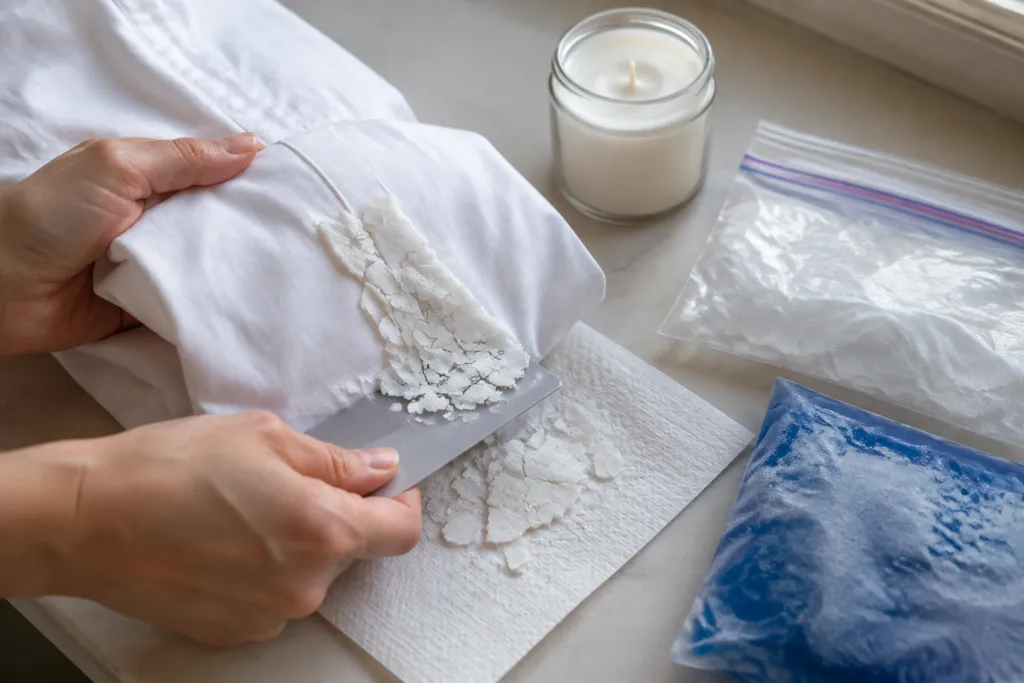
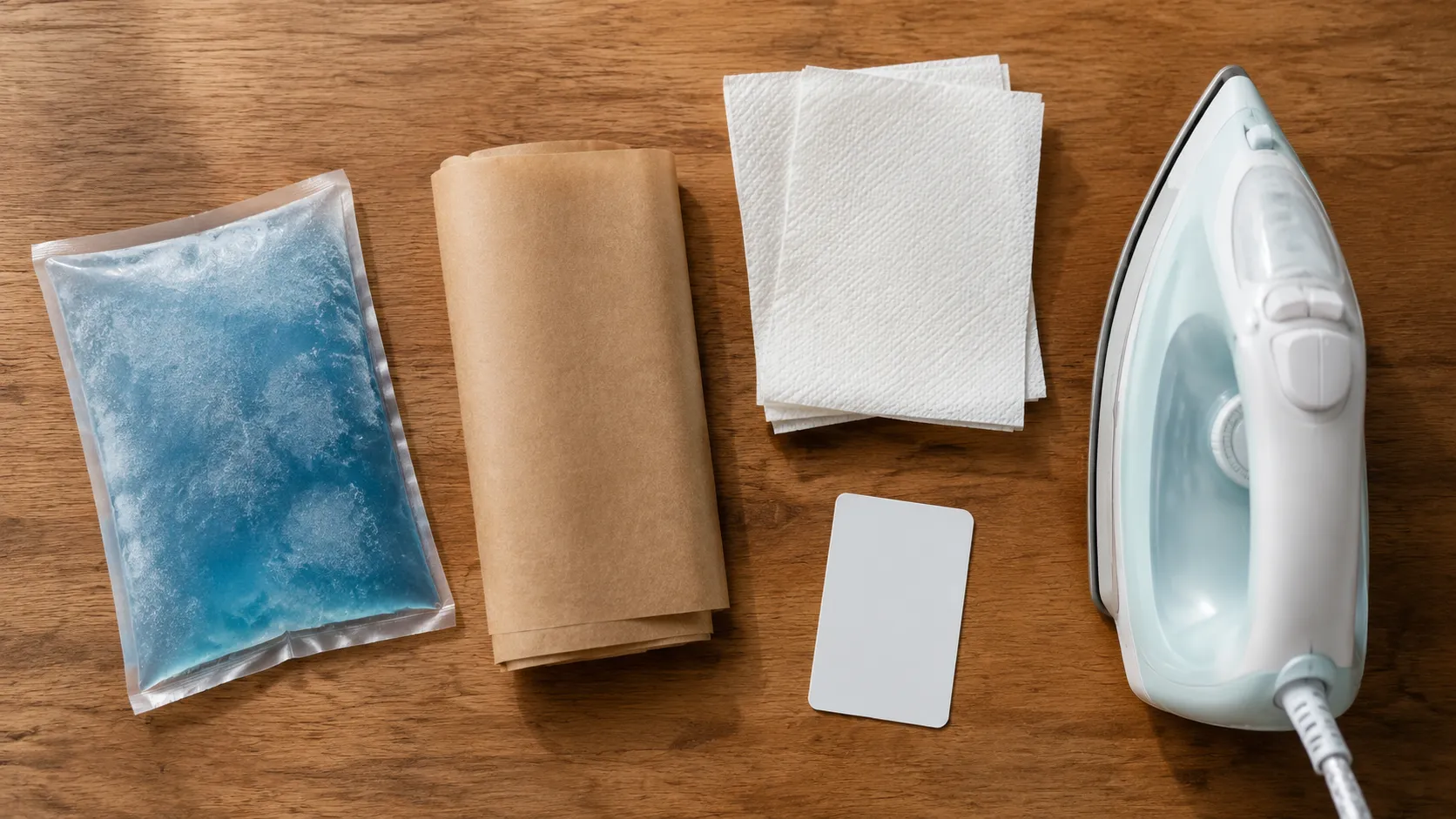
- Harden it. Bag the garment and freeze it for twenty minutes, or hold an ice pack in a bag against the wax. It is ready when the wax looks dull and clicks under a fingernail.
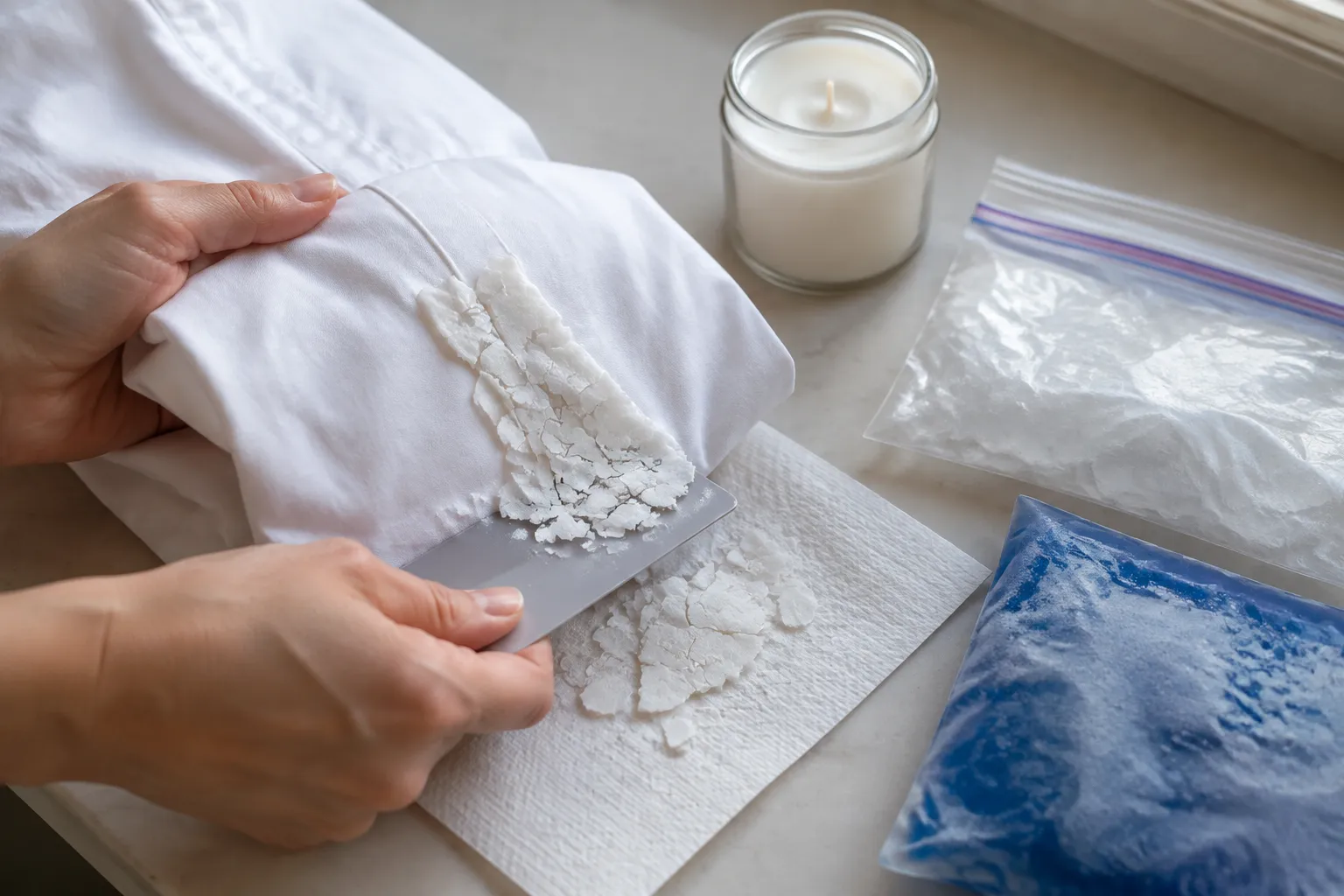
- Flake it off. Bend the fabric so the wax cracks, then lift the pieces with a blunt edge: a butter knife, an old card, the bowl of a spoon. No sharp blades.
- Absorb the film. Lay the fabric between white paper towels or kraft paper and press from the back with a warm, dry iron. No steam. Move to clean paper as each patch darkens, and check the spot in daylight before it goes anywhere near a dryer.
Those are the two moves UGA Cooperative Extension gives for apparel: scrape with a dull knife, then “press with a warm iron from the back of the fabric to remove the wax” (UGA Cooperative Extension, Remove Stains From Candle Wax, Paraffin, retrieved 2026-08-21). Freezing just gets you to the scraping stage sooner.
The variations barely change the method. With no freezer space, how to get candle wax off of clothes is the ice-pack route. Weeks later, when it arrives as “how can i get candle wax out of clothes” and the wax has gone gray and hard, the steps are identical and often easier, because old wax is already brittle. The same sequence answers how to get wax off clothing of any weight, cotton shirt or wool coat, since what changes is the wax and not the fiber. The iron finishes how to get candle wax out of clothes when a film has soaked in.
Colored wax and care labels. Get the wax body out first: a colored shadow left afterwards is a dye mark, and more heat only sets it. Anything labeled dry-clean-only skips all of this. Take it in and say it is candle wax.
03How to get candle wax out of fabric you cannot freeze
Sofa cushions, curtains and car seats change the problem, because how to get candle wax out of fabric that is attached to something else has to be solved by absorption alone.
The cold lever survives in a smaller form: an ice pack in a bag, held against the wax for five minutes, hardens it enough to lift the raised lump with a blunt plastic edge. Do not wet the area to speed it up, because water carries the fragrance oil sideways and foam backing holds it for days.
Then the paper does the work: two or three folded sheets over the film, a dry iron on its lowest setting, short passes, fresh paper as it darkens. Test on a hidden panel first, because synthetic upholstery can glaze under heat cotton would shrug off. Loose weaves hold fragrance oil, so expect a faint shadow and stop while it is faint. Velvet, silk and colored wax go to a professional.
04How to get wax out of carpet
Carpet takes both levers in sequence, and the reason how to get wax out of carpet goes wrong is that people skip the cold stage and start with a hot iron.
UGA Cooperative Extension sets the order out plainly: “Put an ice cube in a plastic bag and place over wax to harden it. Gently scrape off wax from the carpet surface using a metal spatula,” then “Press with a warm iron (not hot), moving the blotter materials as wax is absorbed” through folded paper towels laid over the spot (UGA Cooperative Extension, retrieved 2026-08-21). On a soft or looped pile a blunt plastic edge is kinder than that metal spatula and lifts the lump just as well.
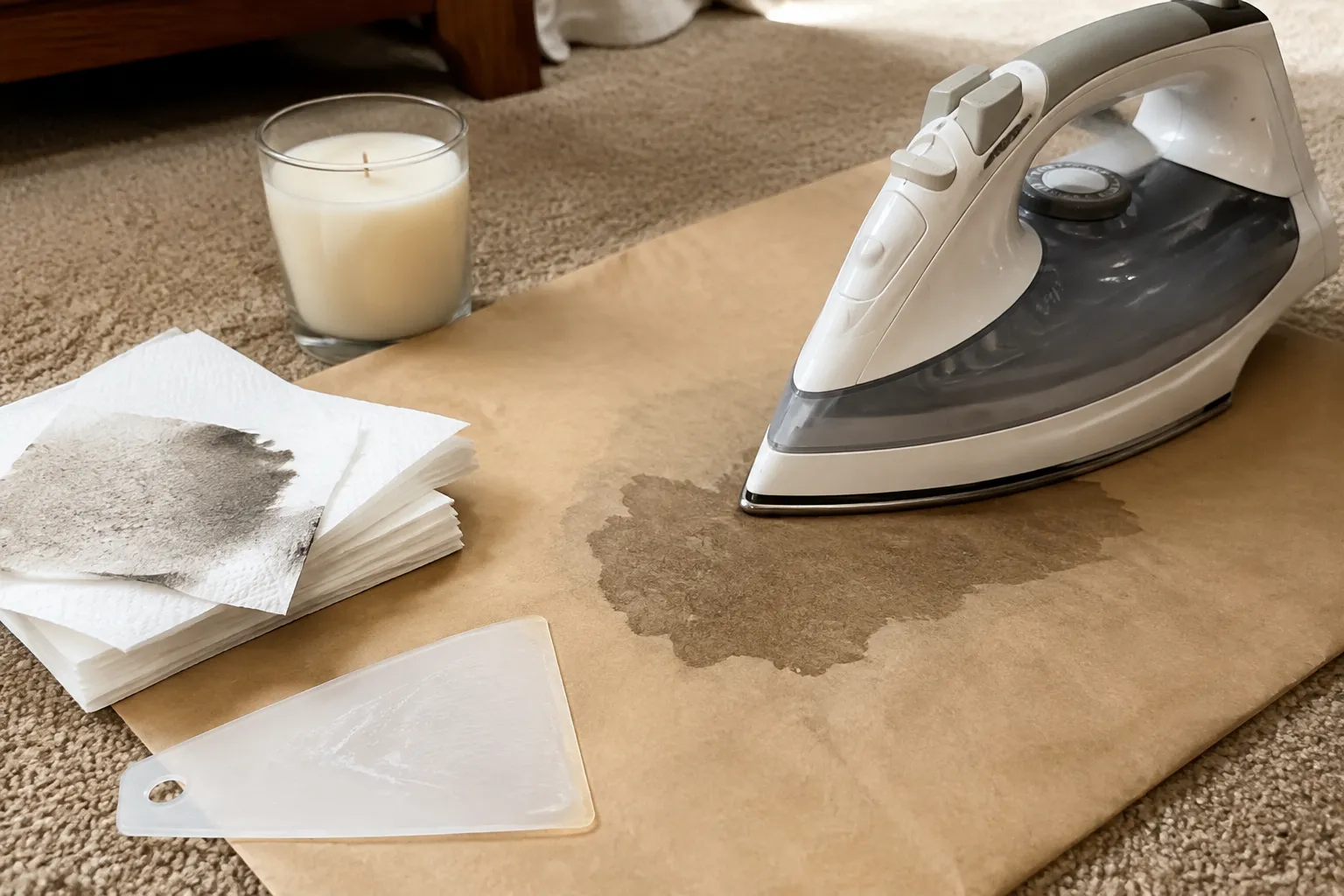
Three cautions decide whether this is a repair or a second problem. Keep the iron dry, because steam drives oil deeper. Keep it moving, because synthetic pile melts into a glazed patch nothing reverses. Test at the edge of the room first. The usual version of this question, “how do i remove wax from a carpet” without wrecking the pile, has a tool answer rather than a technique one: the metal edge is the risk, not the wax.
Everything about how to remove wax on carpet after that is repetition: fresh paper, warm iron, lift, look, working from the outside inwards. Colored wax leaves dye in the fiber once the wax is gone, which is a job for a carpet professional rather than another pass with the iron.
05How to get candle wax off wood
Wood flips the order, because you cannot freeze a table: how to get candle wax off wood is a choice between warming the wax until it wipes away and chilling it until it lifts off whole.
The warm route suits a thin film or a dribble down a table leg. Set a hairdryer low, hold it a few inches away and keep it moving, so you warm the wax and not the finish under it; as the wax turns glossy, wipe it away with a soft cloth. The cold route suits a thick blob: ice in a bag on top for a few minutes, then lift the hardened lump with an old card. Both are standard for wood (HGTV, How to Remove Candle Wax From Wood, retrieved 2026-08-21).
The prohibitions matter more than the method. No metal blade or razor, which cuts a sealed finish faster than it cuts wax. No iron on the surface. No soaking: water in a seam swells wood and lifts veneer. A dull haze usually stays where the wax sat, and that is a polish job, buffed along the grain with whatever the furniture maker specifies. Unfinished, oiled or waxed wood is the exception, because it absorbs the wax rather than holding it on top, and a dark patch there is a question for a restorer.
Glass, ceramic and stone are the easiest of the lot, and hot tap water around a jar loosens the plug of wax until it lifts out whole.
06What not to do: the moves that set the stain
Nearly every wax spill that becomes permanent got there through one of five well-meaning moves, all of them heat or steel applied too early.
Hot water is the most common. Poured over a waxed garment or carpet it does melt the wax, and then carries the molten film and its fragrance oil deeper into the fiber, turning a surface flake job into a full-depth stain. Steam does the same through an iron, which is why every ironing pass in this guide is dry. The margin is wide enough without it: paraffin softens through the mid-40s Celsius and is fully liquid by about 68 °C (Hywax), while even the lowest one-dot iron setting is allowed to reach 120 °C (GINETEX), so a dry iron on low already carries more heat than the wax needs. Second is ironing colored wax directly: heat sets dye, so the wax body must come off cold before any paper-and-iron pass, or the shadow becomes part of the fabric.
Third is steel. A razor or metal scraper cuts sealed wood finishes faster than it lifts wax, and on fabric it cuts fiber; every scraping tool in this guide is deliberately blunt and plastic. Fourth is the hairdryer held close enough to gloss paint or bubble a lacquer, when a low setting at a few inches does the same work safely. And fifth is the dryer: a garment with any wax residue that goes through a hot tumble cycle comes out with the residue melted into everything it touched. Daylight check first, dryer last, always.
07Leather, painted walls and the other awkward surfaces
The same two levers work on surfaces the standard advice skips; what changes is how gently each one can be applied.
Leather takes the cold route only: an ice pack in a bag until the wax is brittle, then lift with a fingernail or the edge of a card, working from the edge of the drip inward. No iron, because heat drives wax and dye into the grain, and no soaking. A faint dark patch after the lift is oil in the surface; leave it, since leather absorbs and redistributes small amounts over days, and hand anything valuable to a leather specialist rather than experimenting.
Painted walls and drywall flip to the warm route, because pressing anything cold and hard dents the surface. A hairdryer on low from a few inches softens the drip until a soft cloth can wipe it downward in one pass; follow with a barely damp cloth once the wax is gone. An iron never touches a wall, and neither does a scraper on matte paint, which burnishes to a shiny patch under pressure. Car interiors behave like a mix of the two: cold pack and plastic card on hard trim, and the upholstery sequence from the fabric section on seats.
08Why the wax got there in the first place
Wax on a carpet is rarely bad luck. It is what happens when a pool of liquid sits in an open container next to something that can move it.
The National Candle Association names the three usual causes. Drafts first: its guidance is to “avoid drafts” and to keep candles away from open windows, fans and air vents. Moving air pulls the flame sideways, the melt pool heats unevenly, one wall collapses and the wax runs out over the low edge. Then the wick, which the association says to trim to a quarter inch before each use to prevent high flames and soot: a long or mushroomed wick burns tall and melts more wax than the container can hold. Then handling, where the wording is blunt, “Don’t move a candle while the wax is liquid,” because a full melt pool only has to tip a few degrees (National Candle Association, Candle Safety Tips, retrieved 2026-08-21).
Read together, they describe one arrangement: an open flame heating liquid wax that is free to leave its container.
09The version of the evening where nothing drips
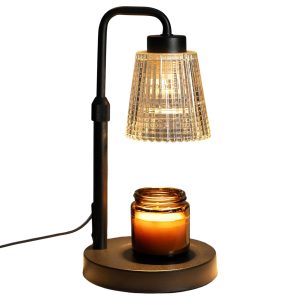
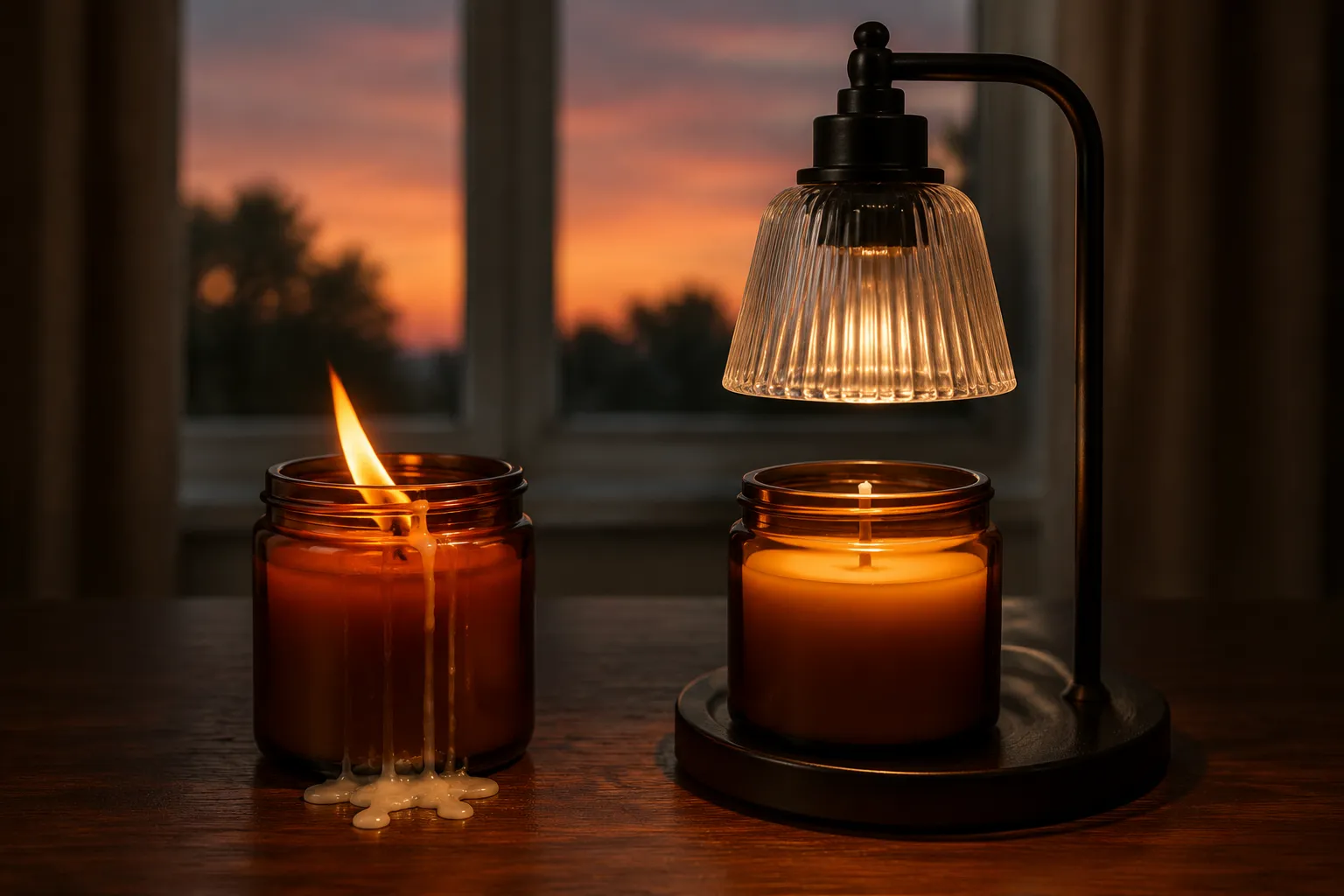
Take the flame out of that arrangement and the drip goes with it, which is the whole idea behind a candle warmer lamp.
A warmer lamp heats a jar candle from above with a bulb instead of lighting it. The wick is never lit, so there is no flame for a draft to tilt and no wick to flare, and the wax stays in the jar it was poured into until it cools solid. The top-down format behaves most like a burning candle, because the heat arrives from above and the pool forms at the surface as it would under a flame.
One honest boundary: removing the flame removes the fire risk, the soot and the drip, but it does not change what warmed scented wax puts into the air, which we set out in our safety explainer for retailers. We build flame-free warmer lamps as a factory and supply matched candles and melts through our accessories range; the format itself is our candle warmer lamps category.
People who switch tend to reach the same three questions within a week: how to get wax out of candle warmer dishes once the wax is spent, do candle warmers evaporate wax the way a flame consumes it, and do wax warmers turn off automatically if the evening runs long.
10Watch it work
Freeze, flake, then press the rest into paper: the whole rescue in 32 seconds.
FAQ
How to get wax out of candle warmer?
Let it cool completely, with the lamp or dish unplugged. Cooled wax shrinks slightly as it hardens, so on a warmer with its own dish the hardened disc will usually pop out in one piece if you flex the dish or slide a plastic edge underneath. If it does not, warm it for a minute, switch off and unplug, then wipe the softened wax out with a paper towel while it is still fluid. Never run water into an electrical dish, and never pour melted wax down a drain. With a top-down lamp that warms a jar candle there is nothing to clean out at all: you replace the jar.
Do candle warmers evaporate wax?
Not the way a flame does. A burning candle consumes its wax as fuel, which is why the jar empties. A warmer only melts it, so the wax stays in the vessel and the level barely changes. What does deplete is the fragrance: the scented oils carried in the wax release into the room and, over enough sessions, stop releasing. That is the point at which a jar that still looks full no longer smells of anything. Spent wax is not a fault. It is the warmer version of a candle reaching the end of its life, and the moment to swap in a fresh jar or melt.
Do wax warmers turn off automatically?
Some do and many do not, so treat it as a feature to check rather than something to assume. Timer functions appear on some models and not others, even within a single range, and the only reliable answer for a specific unit is its own listing or manual. Where a timer exists it removes the left-it-running worry, which is why some people put a warmer on a timer plug instead. Whatever the model, the habit is the one you would apply to any heat appliance: switch it off at the wall when you leave for the evening, and keep it clear of fabric and curtains.
Does candle wax stain clothes permanently?
The wax itself almost never does: it is a surface film that cold makes brittle and a warm iron lifts into paper, which is why even weeks-old drips come out. What can be permanent is what the wax carried, the dye in a colored candle and the fragrance oil, and both are set deeper by heat. Get the wax body off cold, absorb the film through paper with a dry iron, and check the spot in daylight before any dryer cycle. A remaining shadow at that point is a dye or oil mark, which is a job for the care label or a professional cleaner, not for more heat.
How do you remove wax from a tablecloth?
A tablecloth is the clothes sequence on a bigger canvas. Fold it so the drips sit on top, freeze the folded section or hold an ice pack in a bag against each drip until the wax clicks, and flake the pieces off with a blunt edge over a bin. Then work drip by drip between paper towels with a warm, dry iron, moving to clean paper as it darkens. Wash on the label’s normal cycle only after the daylight check, and take runners with metallic thread or delicate weaves to a professional instead, since embroidery traps wax the iron cannot reach.
Stocking the flame-free format
We manufacture flame-free candle warmer lamps and supply matched candles and wax melts alongside them, for buyers who want the scent category without the drip and fire questions that come with an open flame. Private label and wholesale, quoted per project.
These are general physical methods, not a guarantee. Fabrics, finishes and dyes differ, so test any heat or cold on a hidden area first, stop if the material reacts, and hand valuable or dry-clean-only items to a professional rather than experimenting on them.
Sources
- UGA Cooperative Extension, Remove Stains From Candle Wax, Paraffin (apparel: scrape with a dull knife, press between white paper towels with a warm iron from the back; carpet: ice cube in a plastic bag to harden, then folded absorbent paper under a warm, not hot, iron), retrieved 2026-08-21.
- National Candle Association, Candle Safety Tips (trim the wick before each use to prevent high flames and soot; avoid drafts, open windows, fans and air vents; do not move a candle while the wax is liquid), retrieved 2026-08-21.
- HGTV, How to Remove Candle Wax From Wood (two standard routes: soften with a hairdryer held a few inches away and wipe with a soft cloth, or harden with ice and lift with a plastic edge), retrieved 2026-08-21.
- GINETEX, International care labelling symbols (one-dot, two-dot and three-dot iron ceilings of 120, 160 and 210 degrees Celsius), retrieved 2026-08-25.
- Hywax, Paraffin Wax Melting Point (typical paraffin melt range of 46 to 68 degrees Celsius), retrieved 2026-08-25.
- National Candle Association, Candle FAQs (a burning candle consumes its wax as fuel; a warmer only melts it, background to the FAQ answers above), retrieved 2026-08-25.
- UGA Cooperative Extension, Stain Removal from Textiles (general fiber-safe stain removal practice behind the fabric and tablecloth sequences), retrieved 2026-08-26.
