


A golden hour sunset lamp is bought off a fifteen-second video and judged on a bare wall at nine in the evening. That gap is where the returns live: the disc lands smaller than the clip promised, the color cannot be dialed back, and an object that read as designed on camera turns out to be a plastic barrel on a stamped base. This is written for the person placing the factory order, not the person buying one unit.
Three neighbouring questions are out of scope. What the product is, how the lens and emitter build the disc, and how it gets used on a shoot are answered in our guide to what a sunset projection lamp is and who buys it, and the category sits under sunset projection lamps. The star and galaxy side of projection is a separate buy, covered in our piece on the galaxy projector night light format.
Key takeaways
Four forks decide the whole range: one fixed color or a full color head, cable or cell, one head or several, button or radio. Everything after that is finish and packaging.
- Disc size is arithmetic, not marketing. A 45 degree beam throws a circle about 0.83 times the distance to the wall, so 1.2 m of setback gives roughly a 1 m disc.
- The port is the ceiling. A USB 2.0 host supplies up to 2.5 W and a USB 3.x host up to 4.5 W, while a USB-C port without Power Delivery supports up to 15 W (Cambrionix).
- No Lighting Facts panel arrives with this product. The FTC rule reaches lamps with medium screw, candelabra, GU-10 and GU-24 bases between 310 and 2,600 lumens, which this is not.
- Color consistency is a batching decision. Most LEDs are binned at 4 to 7 steps and a gap above 60 K at 3000 K is likely to show (Photometric Testing), which a facing row exposes at once.
- A cell in the housing buys an end-of-life duty: the EPA is explicit that lithium-ion batteries and the devices containing them do not belong in household garbage or recycling bins.
What a Golden Hour Sunset Lamp Has to Put on the Wall
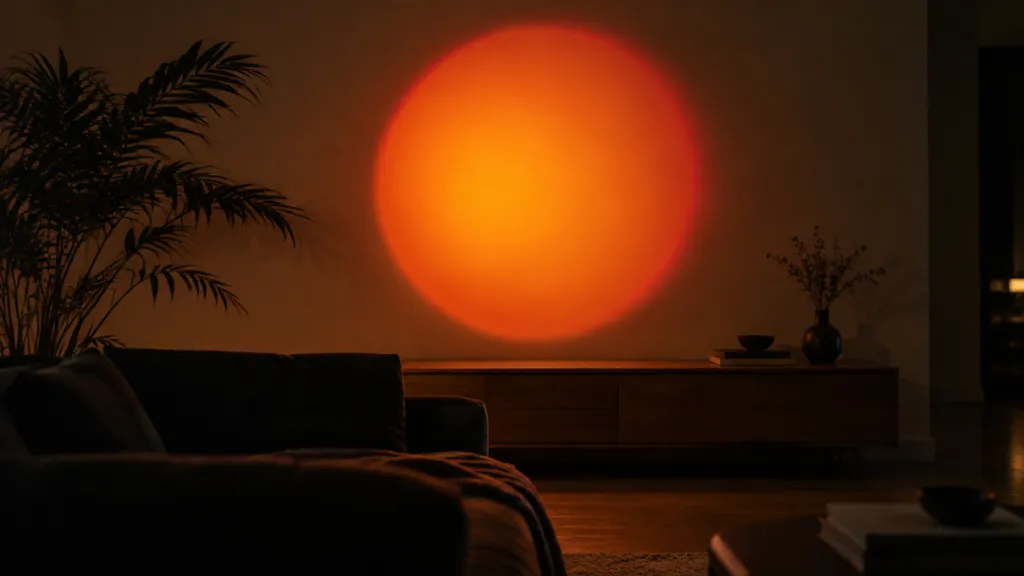
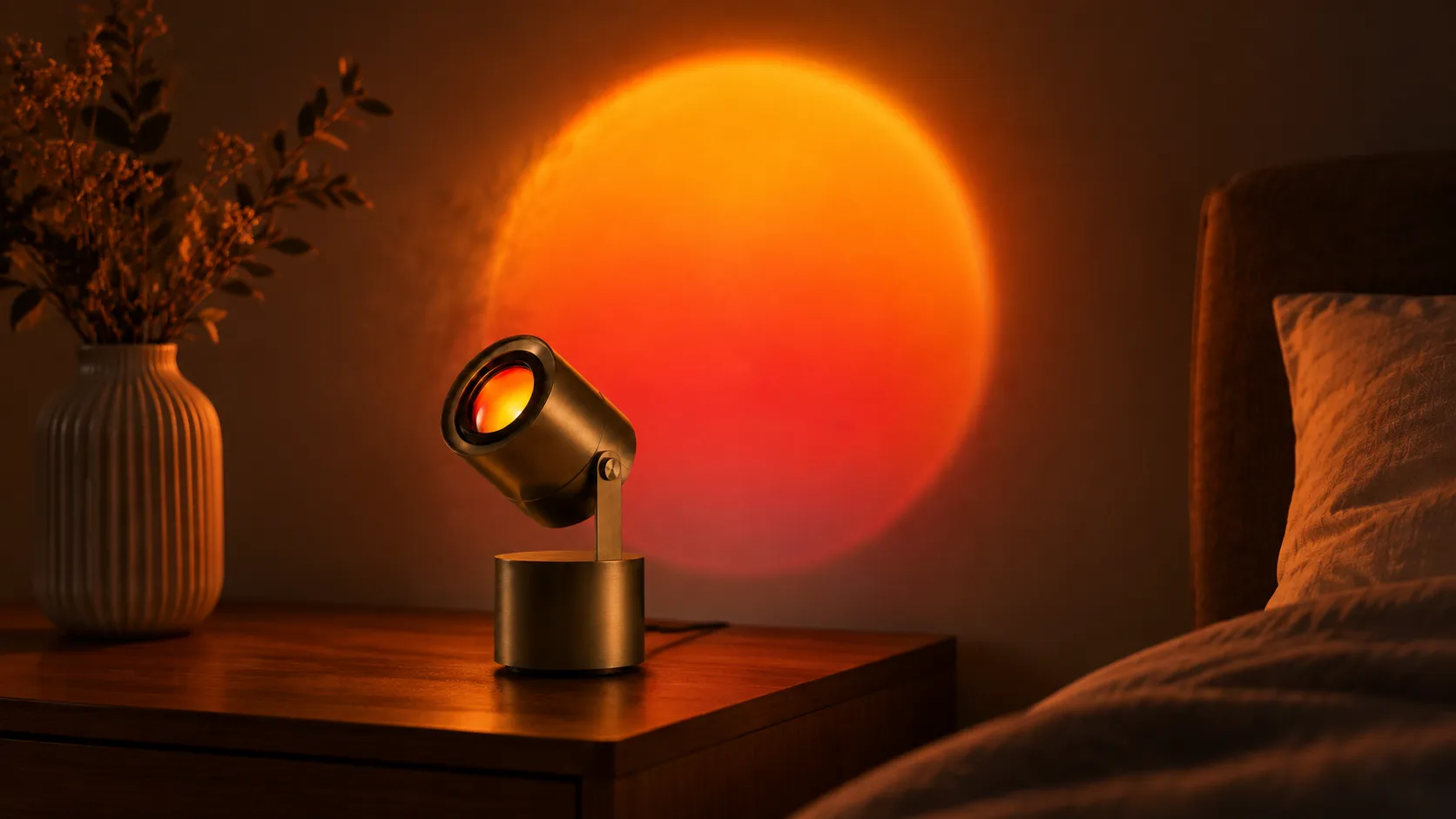
The deliverable is a disc. A narrow-beam emitter fires through a tinted lens, and what the customer actually buys is a graded circle of amber into red on a flat surface, hot in the middle and feathered at the rim. Every line on the spec sheet either serves that disc or is decoration.
The name comes from photography and the window it borrows is genuinely short. Evening civil twilight begins at sunset and ends when the geometric center of the sun is 6 degrees below the horizon (National Weather Service): a handful of minutes of usable color a day, at an hour that moves through the year, in weather that does not cooperate. A lamp that reproduces it on demand has a real job. The trouble starts where the listing implies it reproduces daylight too.
Disc size is trigonometry and nothing else. Diameter is twice the setback multiplied by the tangent of half the beam angle, which for a 45 degree beam works out at 0.83 times the distance to the wall. Put the head 60 cm back and the circle is about 50 cm across; move it to 1.8 m and it approaches 1.5 m. A 30 degree beam gives 0.54 times the setback, a 60 degree beam 1.15 times. None of it appears on the box, which is why the commonest complaint here is that the circle came out smaller than the video.
So the first thing a factory owes a buyer is a number on the card: the setback the photographed disc was taken at. It costs nothing and removes the biggest single reason these units come back. It matters more here than in most lighting because no regulator supplies a comparable figure. The Lighting Facts panel is required on most general service lamps with medium screw bases, and specialty consumer lamps are defined as most lamps with a medium screw, candelabra screw, GU-10 or GU-24 base between 310 and 2,600 lumens or 30 to 199 watts (Federal Trade Commission). A projection head has no screw base at all, so nothing on that list describes it, and brightness, life and light appearance arrive as whatever the supplier chose to print. The label’s own light appearance scale runs from 2,600 K on the left to 6,600 K on the right, and this product lives below the warm end of it. Ask for measured values and keep the measurement conditions beside them.
| Setback from wall | 30° beam | 45° beam | 60° beam | What that suits |
|---|---|---|---|---|
| 0.4 m | 0.21 m | 0.33 m | 0.46 m | Shelf vignette, close product shot |
| 0.6 m | 0.32 m | 0.50 m | 0.69 m | Bedside table against a headboard wall |
| 1.0 m | 0.54 m | 0.83 m | 1.15 m | Desk or console at normal setback |
| 1.5 m | 0.80 m | 1.24 m | 1.73 m | Feature wall behind a sofa |
| 2.0 m | 1.07 m | 1.66 m | 2.31 m | Backdrop wide enough to film against |
| 2.5 m | 1.34 m | 2.07 m | 2.89 m | Event corner or photo booth |
Single Color Sunset Lamp or a Sixteen-Color Head: Where the Split Falls
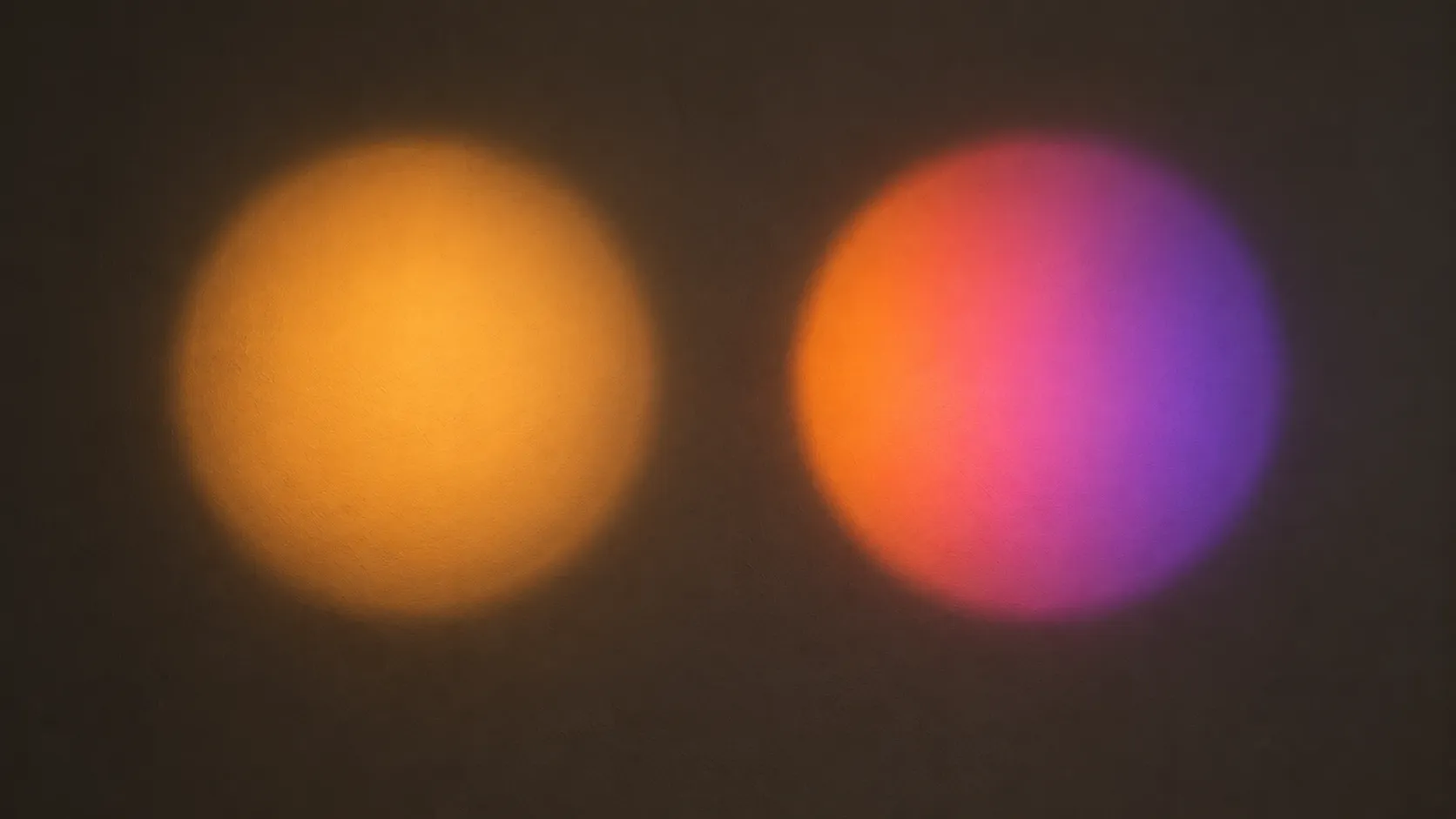
A single color sunset lamp is one fixed amber lens over one emitter, with a switch and nothing else on the board. A sixteen-color head adds an RGB package, a driver able to address it, a receiver for the remote and a mode table in firmware. The lens, the yoke and the base barely change between them.
Almost the entire cost gap sits in those four items and in the extra minutes each unit spends on the test bench, which makes this fork a channel decision rather than a quality one. The fixed build holds an impulse price point, packs small, has fewer things that fail in a customer’s hands and is the sensible body for a multipack or a gift add-on. The color head is what a main shelf facing and a marketplace listing need, because the product beside it will always be claiming sixteen colors and four modes for a couple of dollars more.
We do not hold a fixed-color model today, so treat this as an open tooling conversation rather than a shelf pick: the head, lens and base are parts already running on our lines and the board is the piece that gets simplified. The counterpart that does exist is the color head, and its control and pack options are set out on the 16-color sunset mood projector page rather than repeated here.
One thing gets harder when the color is fixed. A row of twelve units facing out shows any batch drift immediately, and there is no mode button for the customer to correct it with. Most LEDs are binned at 4 to 7 steps, and two parts more than 60 K apart at 3000 K will probably read as different colors (Photometric Testing); amber emitters carry the same problem expressed as dominant wavelength rather than correlated color temperature. One bin per production order, written into the order and not left to the line, is the whole fix.
Multi Color Changing Sunset Lamp: Remote, App and the Cost of Modes
A multi color changing sunset lamp is the category default now, and the default spec inside it is sixteen colors with four modes. The live question is no longer whether to carry the colors but how the customer reaches them, because that choice sets the support load for the next two years.
An infrared remote is cheap, needs line of sight, arrives with a coin cell and gets lost inside six months; the honest version of that spec puts a spare cell in the carton and a button on the body that still cycles the basics without it. An app moves cost from the bill of materials to the inbox: pairing, firmware, a login, one support thread per unusual router. A button-only build is the quiet third option and is right more often than the category admits, because most of these lamps are aimed once and left alone. Where both control paths are wanted on one unit, the configuration is on the sunset and rainbow projection lamp page.
There is one specification nobody here prints and cameras care about far more than eyes do. Color changing and dimming work by modulating the emitters, and LEDs have very little thermal or phosphor persistence, so output follows drive current almost exactly (U.S. Department of Energy). Direct flicker is a low-frequency effect running roughly 3 to 80 Hz and the stroboscopic visibility measure covers about 80 Hz to 1,000 Hz, but where there is relative movement between the eye, the subject and the source, modulation stays visible at 1,000, 2,000 and even 6,000 Hz.
Read that as a buying instruction. A lamp bought as a camera prop has to answer a question no consumer will ever ask: what is the modulation frequency at every dim step, not only at full output. A unit that is clean at full brightness and bands the frame at thirty percent is a defect the buyer finds out about after the first creator posts, by which point the batch has shipped. Ask for the waveform at three brightness levels, or at minimum for a slow pan filmed across the wall at each step.
USB Sunset Lamp: Fix the Power Path Before the Housing
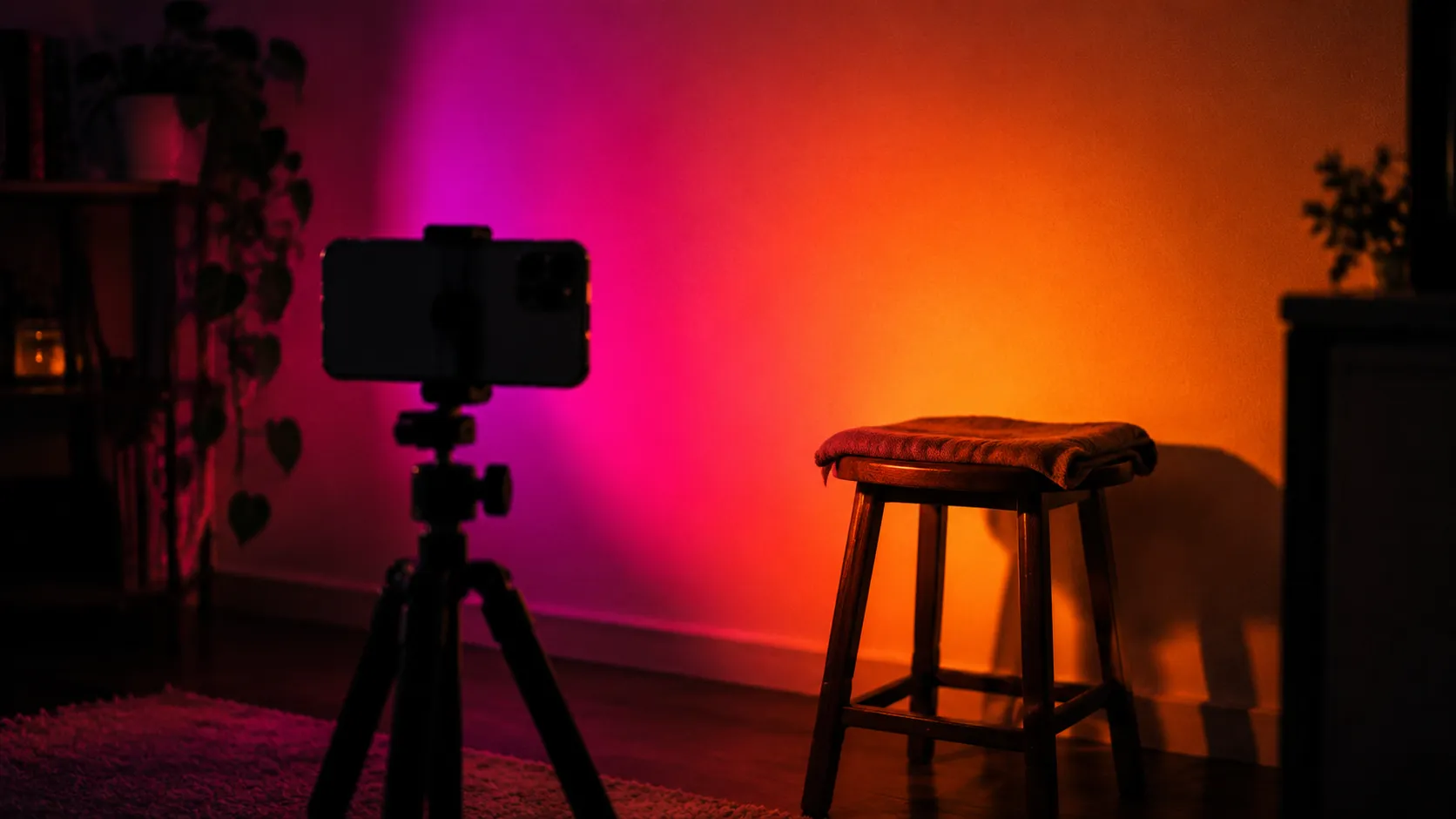
A USB sunset lamp is the mainstream build for a reason that is arithmetic rather than fashion: the entire product fits inside what a computer port can hand out, which takes a plug, a test file and a shipping argument out of the project at once.
Under the USB standards a unit load is 100 mA and a 2.0 host provides up to 2.5 W; at 3.x the unit load rises to 150 mA and the host to 4.5 W. Battery charging mode reaches up to 12 W at 2.4 A, and a USB-C port without Power Delivery can support up to 15 W (Cambrionix). Set against that, LED products put out light up to 90 percent more efficiently than incandescent (ENERGY STAR), so a head bright enough to carry a disc across a dark room sits inside even the smallest of those figures.
Source: Cambrionix, Understanding USB Power Standards, retrieved 2026-09-12.
Two decisions follow, and both belong to the buyer. The first is the connector: a USB-A input on a product landing in 2026 goes to a customer whose chargers all end in C, so either the input moves to C or the carton carries an adapter that costs more than changing the socket would have. The second is what ships in the box. A cable alone keeps the carton light and avoids a plug variant per destination market; an adapter raises the available power and removes a support question, at the cost of weight, paperwork per market and a separate part number. The build we run today is on the USB sunset projection lamp page, including what goes in the retail pack.
The combination to avoid is the one this category keeps producing: a unit sold on brightness, a bare cable in the box, no statement of what it needs. The customer plugs it into a laptop port, gets the 2.5 W version of the product, and writes a review about a dim lamp.
Battery Powered Sunset Lamp: Freedom on the Shelf, Paperwork in the Container
A battery powered sunset lamp is the form buyers ask us about most often and the one we are slowest to push, which is better said before the specification than after the sample.
Runtime is watt-hours divided by watts and nothing about the housing changes that. A head sized to the 2.5 W budget above consumes 2.5 Wh for every hour it runs, so the cell has to carry several times that to survive an evening, and it becomes the largest, heaviest and most expensive single part in a product whose other parts cost very little. We do not have a cell-powered model in the range today either; the form tools easily from parts already running, and the real conversation is what the cell does to the rest of the business.
It does three things. It adds mass to a carton that ships by sea in the thousands. It changes what the shipment is, so packing and documents have to be agreed with your forwarder before the first order rather than argued about at the port. And it gives the product an end of life: the EPA is explicit that lithium-ion batteries and the devices containing them should not go in household garbage or recycling bins, that they belong at separate recycling or household hazardous waste collection points, and that terminals should be taped. For a store that means a returned unit cannot go in the back-of-house bin; for a marketplace seller it means a disposal line a cabled product never needs. The freight and duty side is worth modelling before the sample, and our guide to importing lighting from China sets out how that sum is built.
The case that survives all of it is the one with no socket in reach: event stylists, photo booths, market stalls, pop-up sets. For a bedside table or a desk, where most of this category lives, the cable is the better product and lands cheaper. Spec the cell for the channel that needs it, keep the cabled build as the volume line.
5 Head Sunset Lamp: When One Beam Stops Being the Product
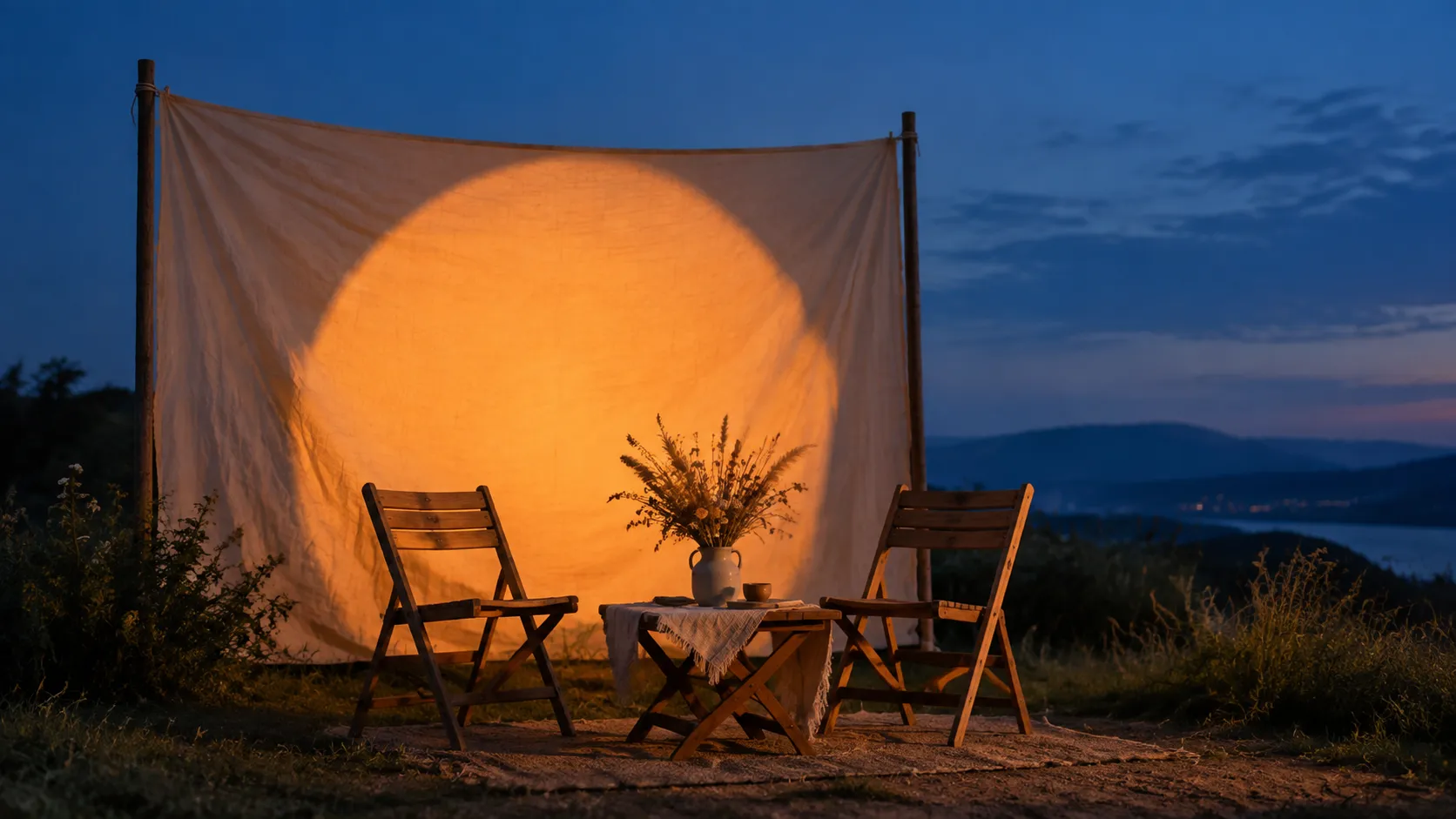
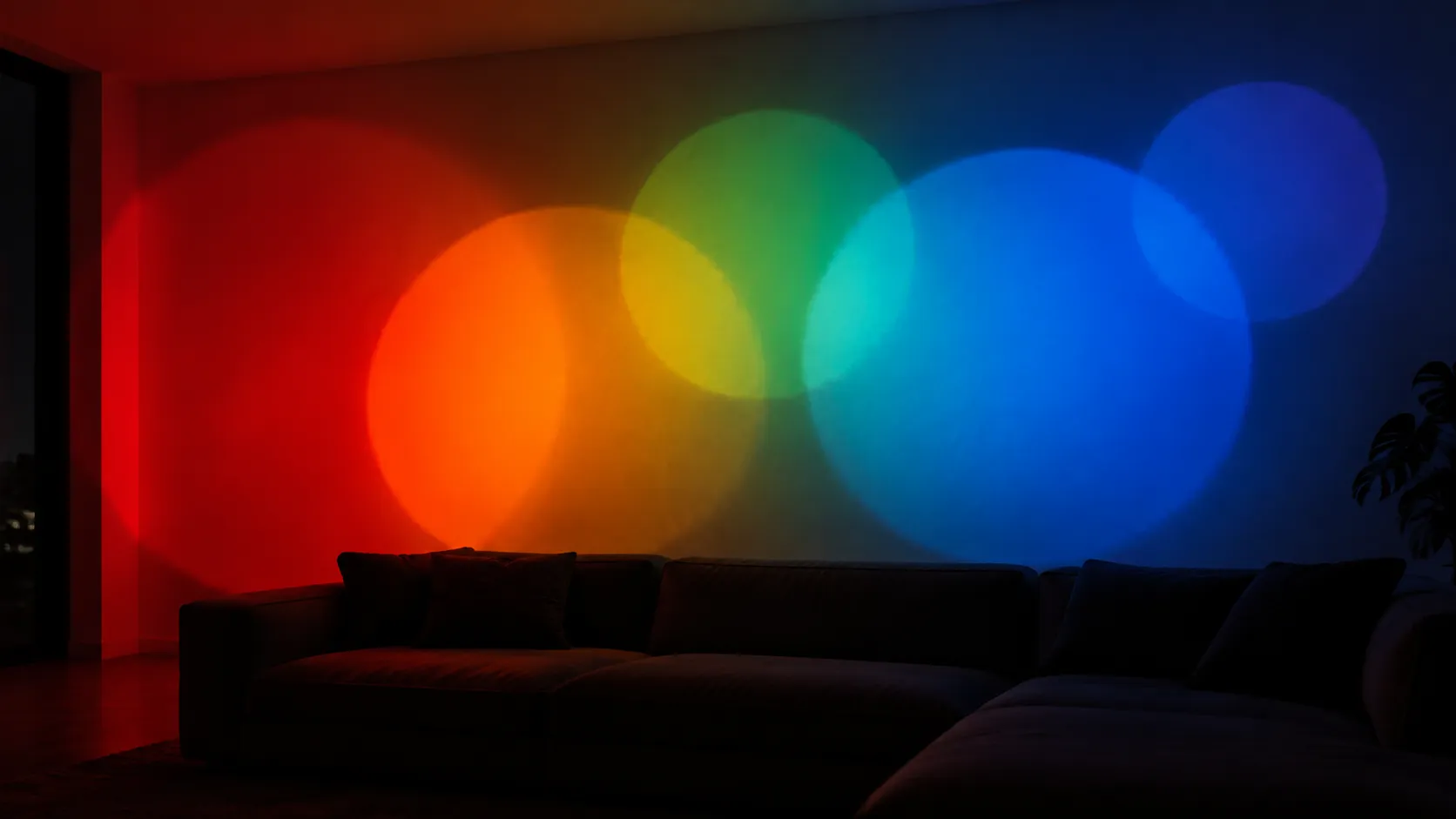
A 5 head sunset lamp is a different product wearing the same name. Instead of one projector on a desk base, several heads sit along a floor stem, usually mixing a sunset lens with a water ripple and an aurora head so the wall carries overlapping color rather than one clean disc.
That format bends the arithmetic in the table above in a useful direction. Each head sits at a different height and therefore a different distance from the wall, so the discs arrive at different diameters and blend into a band instead of stacking. It only works if every head aims independently and then holds its aim. A stem that lets a head creep under its own weight turns a designed gradient into a lopsided smear inside a week, so the hinge rather than the optics is the part to interrogate on the sample.
This is not a form we hold either, and the honest version is that the heads are the easy part while the stem, the base weight and the internal cable routing are the new engineering. What changes commercially is bigger. The carton goes from a mailer to a floor-format box, the price tier steps out of impulse onto a decor shelf, and freight per unit stops being a rounding error. That meets an uncomfortable number: US consumers were expected to return 849.9 billion dollars of merchandise in 2025, 15.8 percent of annual sales, with an estimated 19.3 percent of online sales coming back (National Retail Federation). A floor format sold online carries the higher of those rates on a carton that costs real money to move both ways.
Which is the argument for treating the multi-head build as one hero piece rather than a range. The volume stays with the desk formats, including the dressed version where the projection sits inside a lamp silhouette, on the sunset ambient table lamp page.
Building the Range and Reading the First Sample
Put the four forks together and a range falls out of them without much argument. An entry build for impulse and multipacks, a color head with a remote as the volume line, a dressed table format for the decor shelf, at most one floor piece as the hero. Anything beyond that is finish and packaging rather than a new product.
The hub for all of it is the sunset projection lamps category rather than any single model, because a buyer arriving on a head term is choosing a format, not a part number. If the range is going out under your own name, the mechanics are in our primer on private label for a small business, and the assortment logic for an independent store is in product sourcing for boutiques.
Then there is the sample, which in this category is read carelessly more often than wrongly. People switch it on in a dim room, like it, and approve. The disc is the product, so measure the sample the way the customer will meet it.
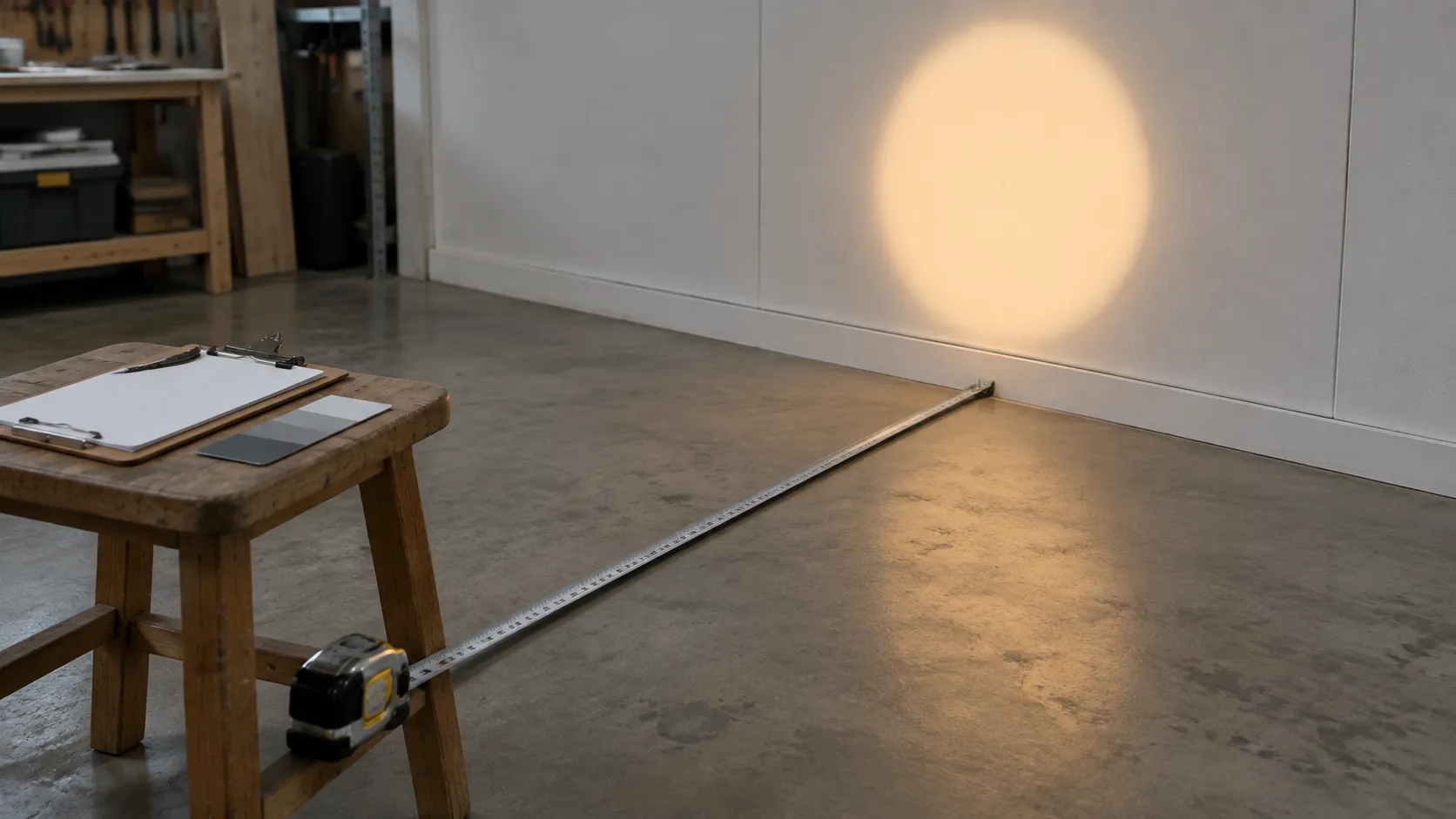
Measure the disc, do not admire it
Tape the head at a stated setback from a plain white wall, kill the room light, photograph the circle and write that setback on the card.
Run every mode cold and warm
Cycle all colors and modes from a cold start, then again after an hour. Note any color that shifts or mode that drops out once the driver is hot.
Film it at each brightness step
Phone on a tripod, slow pan across the wall at full output and every dim level. Banding that appears only at low output is this category’s commonest miss.
Fight the hinge
Aim the head, leave it overnight, check whether it moved. Then re-aim daily for a week and check again. Creep is a design fault, not a tolerance.
Open the carton like a customer
One cut, everything in reach, cable long enough for a socket behind furniture, remote and spare cell where a hand lands.
Line up three from one batch
Ask for three units from one production run, stand them facing out and sight down the row. Drift that survives that test will survive the shelf.
Have the range built to your shelf
We make projection lamps in our own factory in Foshan, 4,000 square metres with 40 people across two production lines, so the lens, the control tier, the connector and the contents of the carton are specification lines rather than a fixed menu. Send the price points you are building to and the channel each is meant for, and we will quote the range.
Watch it work
The setback arithmetic, the port ceiling and the disc that has to land on the wall, in 30 seconds:
FAQ
Are sunset lamps worth it?
As a decorative line, yes, on two conditions. The first is that it is merchandised as an evening and camera item rather than as lighting: a wall wash at this power does not read in daylight, and a customer who bought it to brighten a room sends it back in January. The second is that the unit can be adjusted. The complaint that repeats across consumer reviews is not the light but the absence of control: one brightness, a color set the owner cannot tune, a body thinner than the photograph. A build with real dimming and mass behind it holds its rating.
What kind of wall does a sunset lamp need?
Flat, pale and matte. The disc is a gradient, and a gradient needs a surface that does not compete with it. Heavy texture breaks the circle into shadow, saturated paint eats the color before it reaches the eye, and gloss throws a hot spot back at the camera. Plaster, painted board and pale wallpaper all work. Put that on the retail card, not in a support reply, because a customer who aims the lamp at exposed brick concludes the product is faulty.
Can a golden hour sunset lamp be packed as a two-unit gift set?
It packs well, and the second unit earns its place rather than padding the box: two heads at different setbacks give an overlapping wash that photographs far better than one disc. Check three things before committing artwork. The tray has to hold both heads without the lenses touching, the cable count has to match the head count, and the outer carton has to stay inside the dimensional band your channel charges by.
How long do the LEDs in a sunset lamp last?
Ask for the number and the basis behind it. LED life is stated as a prediction of when output has dropped by 30 percent rather than when the part stops working (ENERGY STAR), so a figure with no test basis under it tells a buyer nothing. In practice the emitter is rarely what ends the product: the switch, the aiming hinge, the cable entry and the remote receiver give out long before the diode does, and those are the parts to put cycle counts against.
Sources
Every external figure above was checked on 2026-09-12: the twilight definition from the National Weather Service, power limits from the USB standards, label coverage from the Federal Trade Commission, color tolerance from photometric testing, flicker from the U.S. Department of Energy, efficiency and rated life from ENERGY STAR, battery disposal from the EPA, and returns from the National Retail Federation.
- NOAA National Weather Service, Definitions of Twilight (evening civil twilight begins at sunset and ends when the geometric center of the sun is 6 degrees below the horizon; terrestrial objects still discernible and artificial lighting often unnecessary), retrieved 2026-09-12.
- Cambrionix, Understanding USB Power Standards (USB 2.0 unit load 100 mA with hosts providing up to 2.5 W; USB 3.x unit load 150 mA with hosts up to 4.5 W; BC 1.2 devices and adapters supporting currents of up to 2.4 A at 5 V for up to 12 W; USB-C unit load 250 mA and support for up to 15 W), retrieved 2026-09-12.
- Federal Trade Commission, The FTC Lighting Facts Label: Questions and Answers for Manufacturers (label required on packaging for most general service lamps with medium screw bases; specialty consumer lamps defined as most lamps with a medium screw, candelabra screw, GU-10 or GU-24 base and a lumen range between 310 and no more than 2,600 lumens, or a rated wattage between 30 and 199; Light Appearance given as correlated color temperature on a scale ranging from 2,600 K on the left to 6,600 K on the right), retrieved 2026-09-12.
- Photometric Testing, LED Colour Difference Metrics: SDCM and MacAdam Ellipses (1-step ellipse indistinguishable to the eye, most LEDs binned at 4 to 7 steps, ANSI C78.377 nominal quadrangle equal to a 7-step ellipse, a difference of more than 60 K visible at 3000 K), retrieved 2026-09-12.
- U.S. Department of Energy, Solid-State Lighting Program, Flicker (little thermal or phosphor persistence in LEDs; direct flicker generally 3 to 80 Hz; stroboscopic visibility measure from about 80 Hz to 1,000 Hz; temporal light modulation visible at 1,000, 2,000 and 6,000 Hz where there is relative movement), retrieved 2026-09-12.
- ENERGY STAR, U.S. Environmental Protection Agency, Learn About LED Lighting (LED products produce light up to 90% more efficiently than incandescent; rated life established on a prediction of when light output decreases by 30 percent), retrieved 2026-09-12.
- U.S. Environmental Protection Agency, Used Lithium-Ion Batteries (batteries and devices containing them should not go in household garbage or recycling bins; take to separate recycling or household hazardous waste collection points; tape terminals and bag separately; cells contain cobalt, graphite and lithium), retrieved 2026-09-12.
- National Retail Federation, Consumers Expected to Return Nearly $850 Billion in Merchandise in 2025 ($849.9 billion total, 15.8% of annual sales, an estimated 19.3% of online sales), retrieved 2026-09-12.
