


Search the phrase best candle warmers and you get a shopping list. Read the same pages as a manufacturer and you get a convergence study. When a dozen unrelated brands, tooled by different suppliers, keep landing on the same head height, shade material and timer stops, those choices are load-bearing. This teardown turns that convergence into a written specification you can hand to a factory.
We build candle warmer lamps in Foshan, so this comes from the supply side. It is not a ranking and recommends no products. It is the decisions that repeat across category leaders, the public evidence behind each, the customs consequences no roundup mentions, and an honest note on what the data does not support.
Key takeaways
- A candle warmer lamp is a controlled heat source, not decor. One retail unit ran a 35W GU10 halogen head to a stated surface temperature of 120 degrees Celsius (CBP ruling N340956, 2024).
- The traits that repeat across leaders are invisible in photography: bulb-to-wax distance, shade and base substrate, timer stops, output control, cord and plug.
- Owner complaints sort into five repeatable families, each mapping to an engineering or packing line you can specify.
- Top-down lamps and bottom-up plates sit in different tariff lines: 6 percent versus 2.7 percent general duty in the two CBP rulings cited here.
- No public dataset shows that warmers reduce house fires. Sell the format on measurable behaviour, not a borrowed fire statistic.
How a factory reads a best candle warmers ranking
A buyer reads a ranking as a shortlist. A manufacturer reads it as a sample population. The winner matters less than the traits surviving across every list, because those already cleared a retail year of returns and reorders at more than one brand. Copying a silhouette reproduces none of that. It copies styling, the part a competitor lifts from the same screenshot.
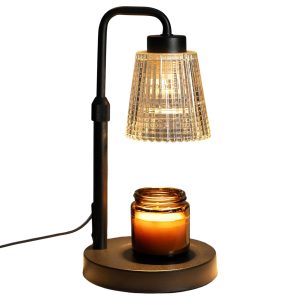
There is also an unusually precise public description of this product. In a 2024 tariff classification ruling, U.S. Customs and Border Protection recorded a retail candle warmer lamp as an iron desk lamp with a disc base roughly 6 inches in diameter, overall dimensions of 12.2 by 7.5 by 6 inches, a 35W GU10 halogen bulb in the head, a dimmer on the cord, and a surface temperature reaching 120 degrees Celsius (CBP, ruling N340956, 2024).
Read as an engineer, that paragraph writes the brief. Everything that matters is thermal: how much wax the head opens, how fast, how evenly, and how long before something is replaced. The wax melts from above, with no wick and no flame. Our candle warmer lamp range is built on that framing, and so is the checklist below.
The five spec lines behind almost every best candle warmer lamps listing
Strip the finishes off a shelf of best candle warmer lamps and five decisions do nearly all the work. None appear in a photograph and most are absent from the listing copy, yet each can be written as a testable line. A supplier who answers all five in writing is quoting a product. One who answers in adjectives is quoting a catalog.
The order matters: the first two decide whether the lamp works, the middle two whether owners keep using it, and the fifth whether it ships at all.
1. Bulb-to-wax distance, the number no listing prints
The melt pool is the disc of liquid wax the head opens across the jar. Too narrow and the candle tunnels, leaving unused wax and a short-changed owner. Too aggressive and the fragrance load flashes off in an afternoon. Pool width is set by beam angle, bulb-to-wax distance and container inner diameter. Since container and jar candles are the most popular format with American consumers, according to the National Candle Association, the jar diameter your customer stocks governs the whole design. Ask for melt behaviour at each pole stop against a named diameter.
2. Shade and base substrate
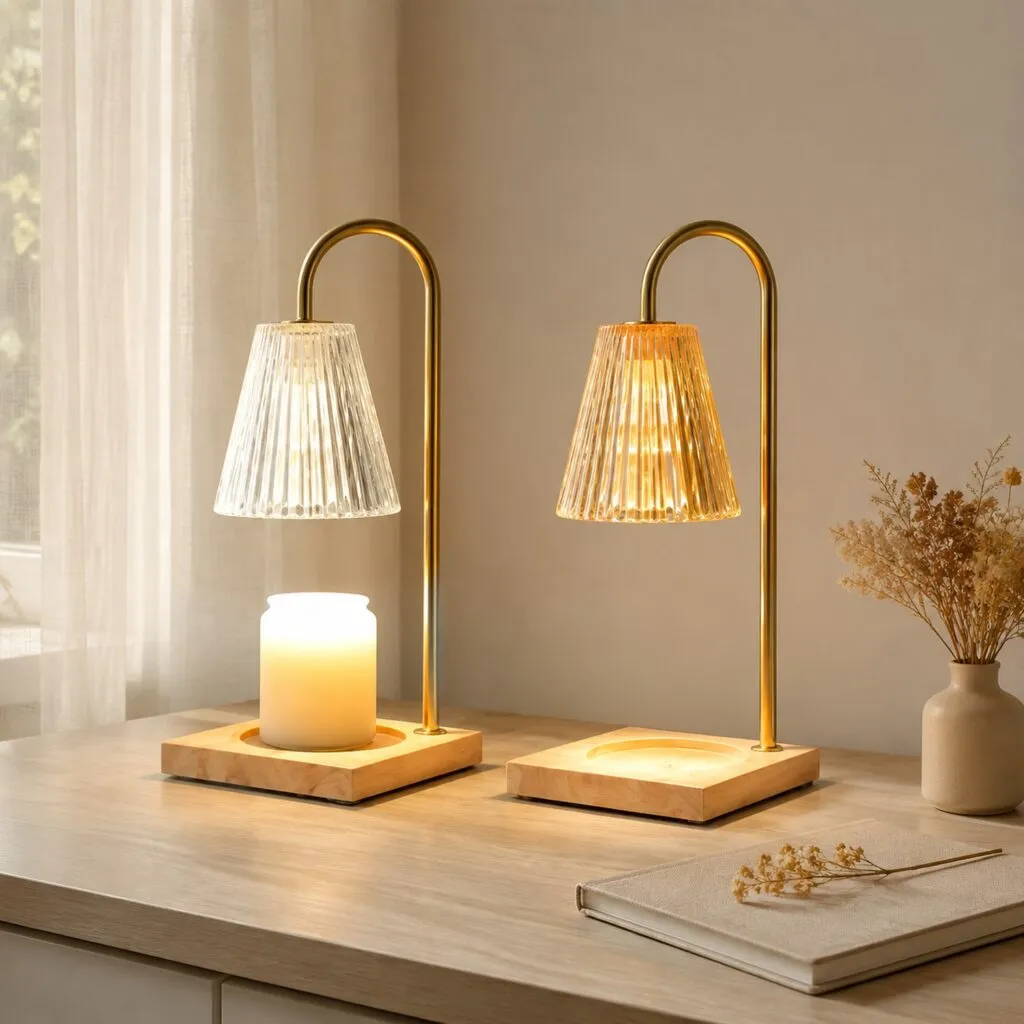
Glass earns its place above a halogen head: it tolerates heat, resists discolouring and photographs well under warm light. Plastic costs less and yellows near a hot bulb. Underneath, the credible substrates are powder-coated steel and solid wood, and the ruling above shows base metal is common enough for customs to treat it as the default. Metal and wood-effect are not answers on a specification. Name substrate, finish process and colour reference, as on the fluted glass cone lamp with a square wood base.
3. Timer stops that match how people actually burn
An auto-off timer answers the most common retail objection to a heated appliance, and it is cheap to specify badly. There is a public anchor: roughly three-quarters of candle users say they typically burn candles for four hours or less per sitting, according to the National Candle Association. A stop list of two, four, eight and ten hours brackets normal use twice over. Confirm behaviour at cut-off, because switching off and dropping to standby are not the same warranty position.
4. Output control, which is really melt-rate control
Dimming here is throttle, not ambience. The CBP ruling records a dimmer on the cord as part of the retail product, which tells you the feature is table stakes rather than a differentiator. A stepped control lets an owner hold a gentle pool overnight or push a strong throw for guests. Specify the stops explicitly, and never claim stepless dimming unless the driver delivers it, because an overstated control comes back as a return.
5. Cord, plug and voltage build
A cord a few inches short turns a countertop product into a shelf product, and the owner writes exactly that in a review. This is where cross-border programmes quietly fail, because cord length, plug standard and voltage build are market-specific and the factory default is whatever the last customer ordered. Confirm all three before sampling, not after the container is booked.
| Spec line | Where leaders converge | What to write into your specification |
|---|---|---|
| Melt pool | Adjustable bulb-to-wax distance | Melt behaviour per pole stop, per named jar diameter |
| Head lamp | GU10 halogen, 35W class | Lamp type, wattage, beam angle, spares included |
| Shade | Heat-tolerant glass | Material, thickness tolerance, finish |
| Base | Powder-coated steel or solid wood | Substrate, finish process, colour reference |
| Timer | Multi-stop auto-off | Stop list in hours, behaviour at cut-off |
| Output control | Stepped dimmer | Stop list as percent of output, no unverified stepless claim |
| Cord and plug | Counter-realistic cord, market plug | Cord length, plug standard, voltage build, per market |
| Packing | Whole-carton export packing | Units per carton, carton dimensions, gross weight |
| Marking | Origin marked on product and pack | Placement and letter size against any domestic address |
What candle warmer reddit threads add that listings never will
Rankings are written before the product has lived with anyone. Forum threads are written afterwards, which is why a candle warmer reddit search repays an hour even though it never produces a supplier shortlist. Posters describe failures in the language of the failure: it only melted the middle, the bulb went and nobody stocks the replacement, my jar will not fit under the shade. Each is a specification line.
The method is mechanical. Collect thirty to fifty posts, ignore every recommendation, tag only complaints, then cluster the tags. Anything appearing in more than a handful of independent threads is a design requirement, not an unlucky unit, because unrelated owners of unrelated brands do not invent the same fault.
Be equally clear about what this evidence cannot do. Forum samples skew toward the annoyed and carry no denominator, and nobody posts about the lamp that simply worked, so those ratios are not the ratios in your returns file. Use threads for hypotheses, then validate frequency against your own data.
Turning candle warmer reviews into failure-mode requirements
Star ratings are close to useless for sourcing. The text underneath is a free failure-mode study, and it is remarkably consistent: read enough candle warmer reviews across enough brands and the criticism collapses into five families that repeat regardless of who built the unit.
That consistency is the point. The failures are structural to the format rather than particular to one supplier, and structural failures can be designed out before tooling. Note that only one of the five below is a manufacturing defect in the normal sense. The rest are specification gaps, which is why they survive supplier changes.
| Complaint pattern | Underlying cause | Where it is fixed |
|---|---|---|
| It only melts the middle | Pool too narrow for that jar diameter | Pole height range and lamp beam angle |
| The bulb died and I cannot find another | Halogen lamps are consumables | Spares in the box plus a documented replacement path |
| It gets very hot | Electro-thermal appliance by design | Timer stops, shade geometry, clear labelling |
| It arrived cracked | Glass shade on a long ocean lane | Inner pack, master carton spec, drop testing |
| I get no scent | Output set low, or wax not matched to the head | Dimmer stops and candle pairing guidance on the pack |
None of these is solved by a better-looking shade. They are solved by writing the third column into a purchase specification before tooling starts.
What the best candle warmers 2025 roundups still leave out
Roundups published for the best candle warmers 2025 cycle did one thing well: they showed which formats survived a full retail year rather than a launch quarter. Glass-shaded arch lamps with a multi-stop timer and a replaceable halogen head dominated them, and still dominate shelves.
What those pages structurally cannot tell a private-label buyer is everything upstream of the shelf. They do not disclose who manufactured the unit, because the reviewer does not know. They carry no carton specification or gross weight, so nothing helps you model freight on a product that is light and bulky. They rarely name lamp type or beam angle, and they never mention the tariff line.
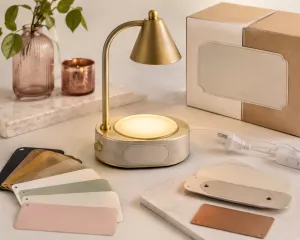
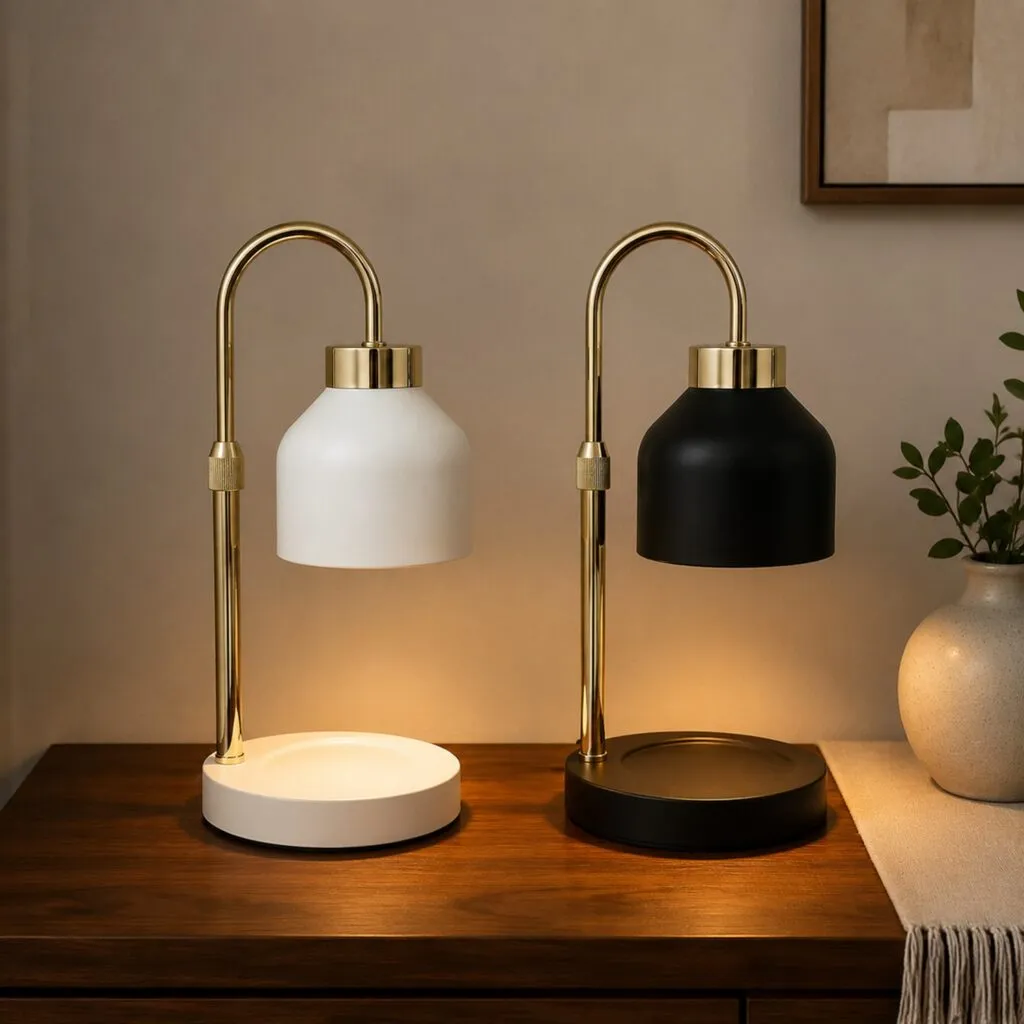
Reviewers also cannot test what decides your reorder rate: consistency between units and between production runs. A journalist tests one sample. You will ship thousands across several runs and a whole finish family. What you need is a platform, one specification carried across every finish, as with our dome shade lamp with a gold collar and metal base.
The safety claim every listing makes, and what the evidence supports
Every listing sells the same benefit: fragrance without an open flame. The underlying fire data is genuine and worth knowing precisely. In 2011 to 2015, U.S. fire departments responded to an average of 8,690 home structure fires started by candles per year, causing an annual average of 82 civilian deaths and 800 civilian injuries, about 24 reported per day (NFPA, United States Home Candle Fires, 2017). Three of every five, 59 percent, started when something combustible sat too close.
The more useful number is where fires start, because it does not match where people say they burn candles. Users report burning most often in the living room, then the kitchen, then the bedroom, yet the bedroom is by a wide margin the leading area of origin, a mismatch documented by the U.S. Fire Administration.
Source: usage shares from the National Candle Association via U.S. Fire Administration, Candle Fires in Residential Structures, 2006; fire origin shares from NFPA, United States Home Candle Fires, 2017 (retrieved 2026-08-24)
Here is the part a supplier should say out loud, because it cuts against our own marketing. None of that evidence measures candle warmers. It measures open-flame candles. No published dataset shows that switching a household from wicks to warmers reduces fires, and it would be dishonest to imply one exists. The mechanism is plausible, the statistic is not transferable, and a retailer who repeats it as a product claim is exposed. The defensible claim is narrow: no flame, no wick, no smoke, and a timer that switches off.
Nor is a warmer a cool appliance. The unit in the CBP ruling reaches 120 degrees Celsius at the surface, hot enough to matter around children and pets. Treat it as a heated countertop appliance in labelling and service scripts. Note the asymmetry in standards too: the candle falls under a consensus fire-safety specification, ASTM F2417, while the lamp melting it is governed as an electrical appliance. The National Candle Association advises keeping burning candles at least 12 inches from anything that can burn, and similar guidance suits a warmer.
Seasonality, packing and the tariff line a teardown never shows
Candle demand is strongly seasonal, and so is the risk attached to it. Roughly 35 percent of candle sales occur during the winter holiday season, according to industry figures cited by the U.S. Fire Administration, and candle fires follow the same curve, peaking in December at 11 percent of the annual total (NFPA, 2017). That curve is a production calendar: gift-boxed inventory must be on the water months before the peak.
Source: National Fire Protection Association, United States Home Candle Fires fact sheet, November 2017 (retrieved 2026-08-24)
The tariff line is the part of a teardown no reviewer sees and every importer pays for. Two public rulings show how much the format decides. A top-down lamp of base metal was classified under 9405.29.6010 as an electric table or desk luminaire at 6 percent ad valorem, plus 25 percent for goods of Chinese origin under 9903.88.03 (CBP, ruling N340956, 2024). A bottom-up scent warmer with a warming plate went under 8516.79.0000 at 2.7 percent (CBP, ruling NY I85511, 2002).
Top-down lamp
- Heats from above, GU10 halogen head
- 9405 luminaire family, ruling N340956
- Duty 6 percent, plus 25 percent Chinese origin
Bottom-up plate
- Heats the container from below
- 8516 electro-thermic family, ruling NY I85511
- Duty 2.7 percent in that ruling
That is an uncomfortable fact for a lamp maker to publish, and it is the honest one. The format we build sits in the more expensive line, and the ruling shows why: CBP noted the lamp produces enough light to read by, even though its primary use is melting the candle. The quality that makes it photograph well on a nightstand helps put it in the luminaire heading. Classification is fact-specific, so confirm the current line for your own build.
Marking is the quiet companion to classification. Where an imported article or its packaging carries a United States address, the country of origin must appear legibly and permanently in close proximity and in comparable letter size, under section 134.46 of the customs regulations. The 2002 ruling flagged exactly that: an importer address at about 4 millimetres against an origin mark half the size. Build it into the pack specification alongside your wholesale candle warmer carton data.
From teardown to a private-label brief
The output of all of the above is one document, not a mood board. A one-page specification does what a screenshot cannot: it makes the first sample either pass or fail, instead of being compared against your memory of a photograph.
Before sending that brief anywhere, prepare four inputs: the jar diameters your brand sells, your destination market with its plug and voltage standard, your target carton cube and units per carton, and the finish family you want on one platform. Those four turn a generic enquiry into a quotable specification.
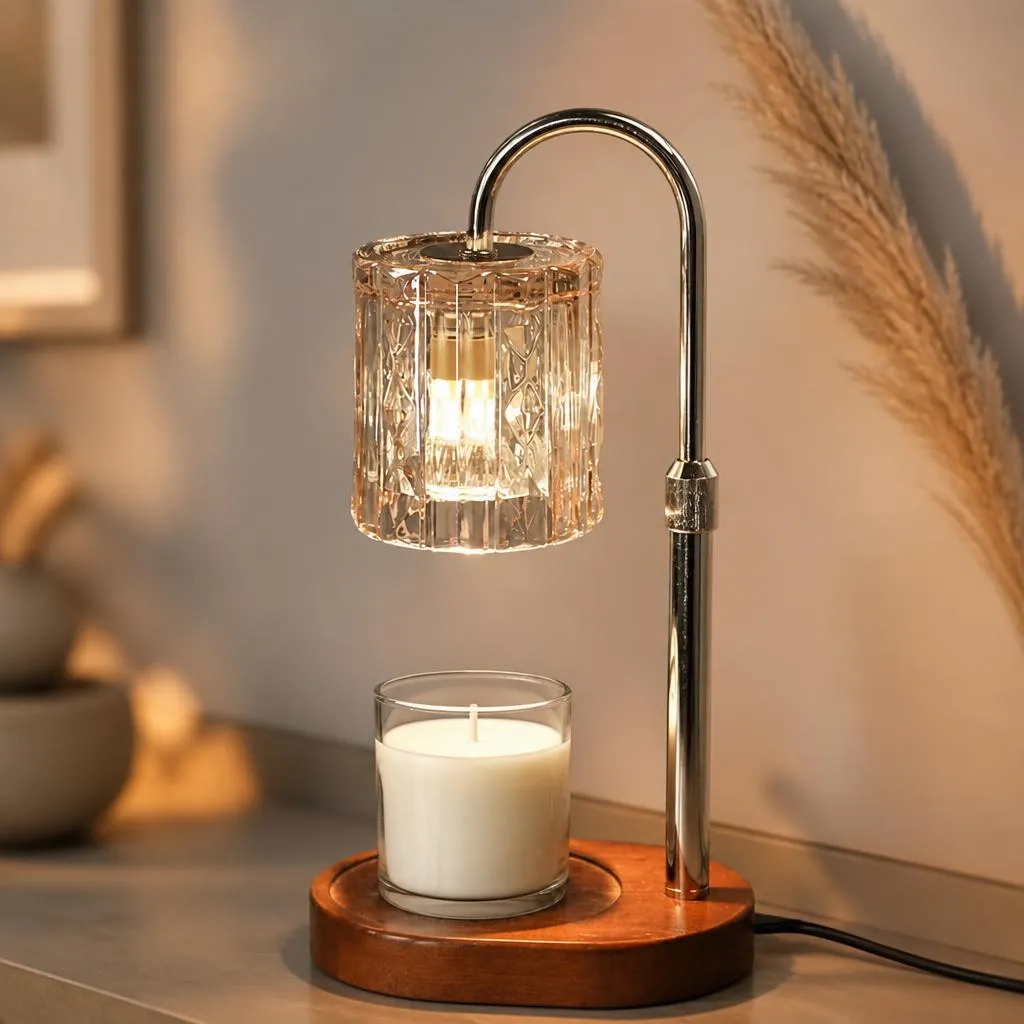
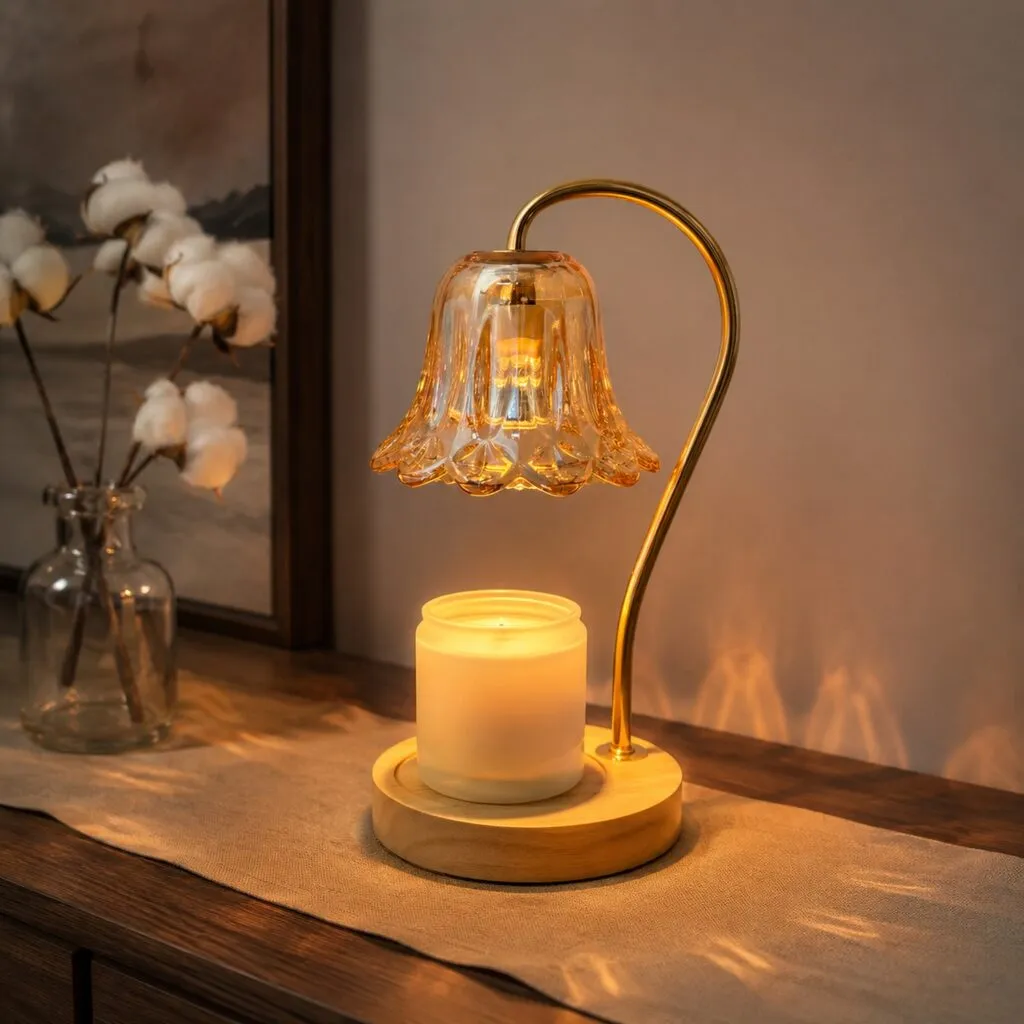
Expect a serious supplier to answer in documents rather than adjectives: a revision-dated carton specification, a lamp and driver specification for the head, a finish list sharing one platform, and photographs of production rather than a showroom. That is the standard we hold ourselves to on formats like the amber bell glass lamp on a round wood base.
Bring the checklist, we will answer it line by line
BeginLighting manufactures candle warmer lamps in Foshan, with glass shades over powder-coated steel or solid wood bases and a replaceable GU10 head. Send the four inputs above and our factory team will answer each line in writing.
Frequently asked questions
How hot does a candle warmer lamp actually get?
Hotter than most buyers assume. In a 2024 ruling, U.S. Customs and Border Protection recorded a retail candle warmer lamp with a 35W GU10 halogen head reaching a surface temperature of 120 degrees Celsius. Label it as a heated countertop appliance, and confirm the figure for your own build.
Are candle warmers safer than burning candles?
The format removes the flame, the wick and the smoke, and a timer removes the unattended-burn scenario. What does not exist is a dataset comparing house fires between warmer and candle households. NFPA and U.S. Fire Administration statistics cover open-flame candles only, so the borrowed statistic is unusable in claims.
Is forum feedback worth reading before a private-label order?
Yes, as a complaint inventory rather than a supplier shortlist. Threads surface the failure modes owners actually hit, from tunnelling wax to bulbs nobody stocks and jars that will not fit under the shade. Convert each recurring complaint into a specification line, but never read the ratios as defect rates.
Why do two similar warmers land in different tariff lines?
Because the heating method changes what the product is for customs purposes. A top-down lamp was classified in the 9405 luminaire family at 6 percent general duty in ruling N340956, while a bottom-up warming plate went into the 8516 family at 2.7 percent in ruling NY I85511.
Which specifications should be locked before the first sample?
Melt behaviour at each pole stop against named jar diameters, lamp type and wattage, shade material, base substrate and finish, the timer and dimmer stop lists, cord length and plug standard, carton dimensions and gross weight, and the origin marking layout.
Sources
Every figure above traces to a document below, each opened and checked on the retrieval date shown. Where a fact sheet has since been superseded, the edition and period are named in the text.
Rulings and regulations came from the issuing agency. Industry figures are attributed to the association that published them.
- U.S. Customs and Border Protection — “N340956: The tariff classification of a candle warmer lamp from China”, 17 July 2024. https://rulings.cbp.gov/ruling/N340956 (retrieved 2026-08-24)
- U.S. Customs and Border Protection — “NY I85511: The tariff classification of an electric scent warmer from China”, 28 August 2002. https://rulings.cbp.gov/ruling/I85511 (retrieved 2026-08-24)
- National Fire Protection Association — “United States Home Candle Fires”, research fact sheet, November 2017. https://www.bellinghamma.org/DocumentCenter/View/1281/RFS-US-Home-Candle-Fires-Final-PDF (retrieved 2026-08-24)
- Marty Ahrens, National Fire Protection Association — “U.S. Home Candle Fires Fact Sheet”, December 2015. https://sfm.illinois.gov/content/dam/soi/en/web/sfm/about/divisions/arson/yfsip/documents/candlefactsheet.pdf (retrieved 2026-08-24)
- U.S. Fire Administration, Topical Fire Research Series — “Candle Fires in Residential Structures”, Volume 6 Issue 1, July 2006. https://apps.usfa.fema.gov/downloads/pdf/statistics/v6i1.pdf (retrieved 2026-08-24)
- National Candle Association — “Facts and Figures”. https://www.candles.org/facts-figures-2/ (retrieved 2026-08-24)
- National Candle Association — “Fire Safety Tips to Follow During Power Outages”. https://www.candles.org/fire-safety/ (retrieved 2026-08-24)
- Electronic Code of Federal Regulations — “19 CFR 134.46: Marking when name of country or locality other than country of origin appears”. https://www.ecfr.gov/current/title-19/chapter-I/part-134/subpart-C/section-134.46 (retrieved 2026-08-24)
- United States International Trade Commission — “Harmonized Tariff Schedule of the United States, subheading 9405.29”. https://hts.usitc.gov/search?query=9405.29 (retrieved 2026-08-24)
- ASTM International — “F2417 Standard Specification for Fire Safety for Candles”. https://www.astm.org/f2417-24.html (retrieved 2026-08-24)
