





Waterproofing LED strip lights is the second-biggest failure mode in this category, and almost none of it is the diode’s fault. A strip that dies four months after install rarely has a dead LED. It has a corroded solder joint, a lifted end cap, or a cable entry that has been wicking water since the day it went up. The IP number on the quotation will not tell you whether that happens: two suppliers can both write IP67 and ship products built two different ways.
Key takeaways
An IP code names a laboratory test, not a build quality. Match the second digit to what actually hits the run, ask which construction earned it, and treat every site-made joint as unrated.
- An IP code names a test, not a construction: IP20 has no water test at all, IP65 passes a jet test, IP67 passes a still-water immersion test.
- Higher is not automatically safer. Under IEC 60529 an immersion rating does not imply jet resistance unless dual coded.
- Outdoors the tape body is rarely what leaks: UV, thermal cycling and the joints do, and site-made joints sit outside the rating entirely.
- The construction behind the code decides heat and repairability: coated, sleeved and filled are three different products under one number.
- Buy the rating for the worst hour the install sees, not the average one; a potted tube in a warm cove costs light for nothing.
What IP20, IP65 and IP67 actually certify
The IP code comes from IEC 60529: first digit solids and dust, second digit water, each water digit mapped to one specific laboratory test run on a new sample. Buyers read the codes as a ladder of goodness. They are closer to a menu of tests.
IP65 is dust-tight, then hosed from every angle with a 6.3 mm nozzle at roughly 12.5 liters a minute from three meters. IP67 is dust-tight, then held under a meter of still water for half an hour. IP20 has met no water at all. Three different physical events, not three grades of one.
| Rating | The test behind it | How it is usually built | Where it belongs | Where it fails |
|---|---|---|---|---|
| IP20 | No water test; solids above 12.5 mm only | Bare flexible circuit, pads and solder joints exposed | Dry coves, cabinets, shelving | Condensation, cleaning spray, steam |
| IP65 | Dust-tight; water jets from a 6.3 mm nozzle at 3 m | Coating over the face, or a slip-on sleeve with glued caps | Kitchens, bathrooms above splash height, covered soffits, garages | Standing water, submersion, a channel that fills with rain |
| IP67 | Dust-tight; 30 minutes under 1 m of still water | Sleeve with the cavity filled, ends and cable entry sealed | Ground level, planters, dock edges, wash-down areas | Permanent submersion (that is IP68); heat, once potted |
Which leads to the trap that costs buyers the most. IEC 60529 treats jets and immersion as separate phenomena: an enclosure coded 7 or 8 on its own is considered unsuitable for water jets unless it is dual coded, as IPX5/IPX7. If the run will be hosed or hit by sprinklers, ask for the jet digit in writing rather than assuming the bigger number swallowed it.
Source: NEMA Enclosures, “IP Ratings Explained: Ingress Protection under IEC 60529” (retrieved 2026-08-25)
The gap between the ratings is a manufacturing gap
Three constructions do nearly all the work, and what separates their prices is labor and material rather than branding.
- Coated. Silicone or polyurethane over the emitter face, back of the tape left open. Thin, cheap, flexible, and where most IP54-to-IP65 claims begin. The edges and the open back are the weakness.
- Sleeved. An extruded tube slid over the finished tape, ends capped and glued. The air gap keeps the strip cooler, but the whole seal is now two caps and a cable exit.
- Filled. The cavity is potted, so there is no air and no path. Best water rejection by a distance, and also a blanket: heat cannot escape, and the run can no longer be cut or repaired.
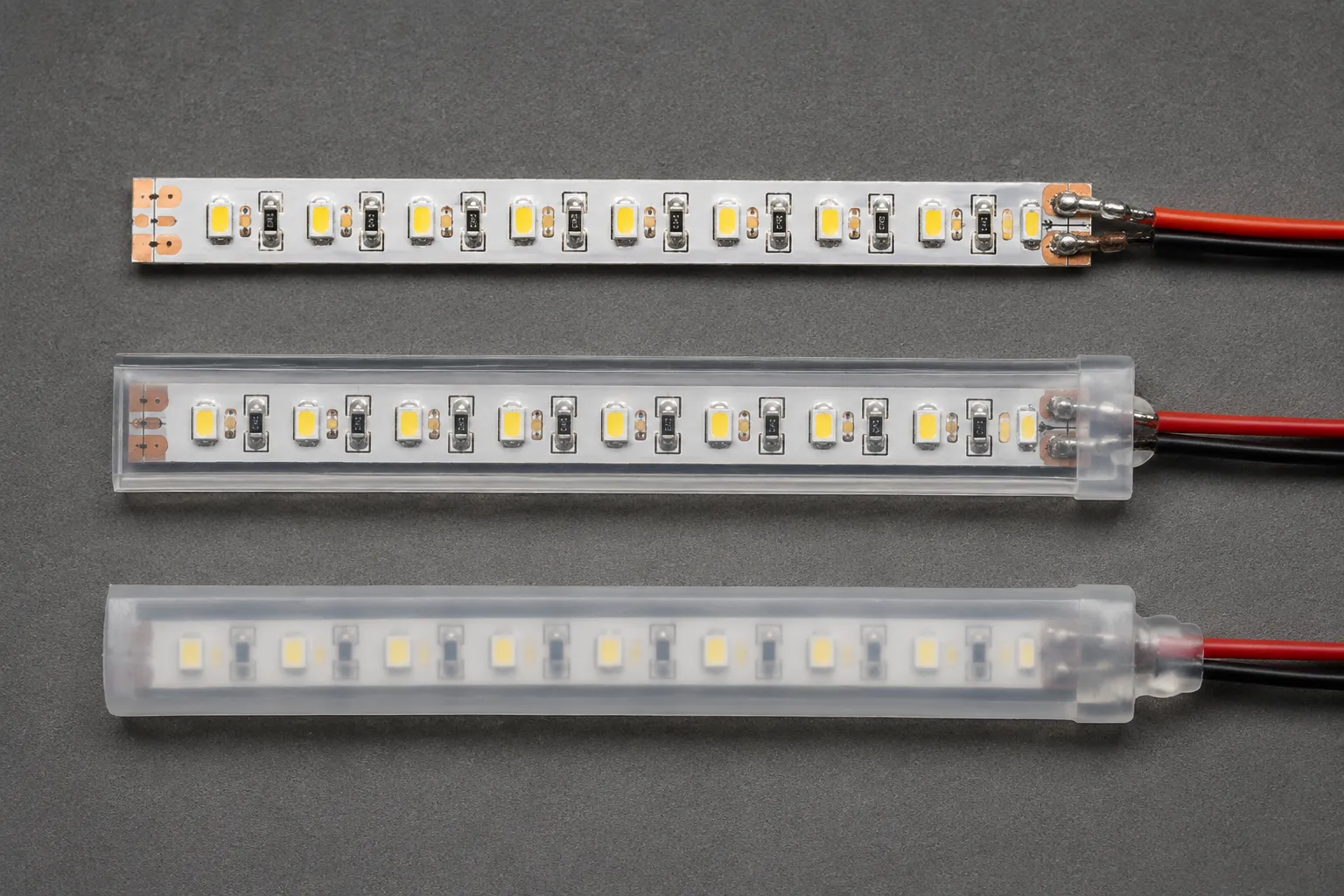
Compound matters as much as method. Epoxy fills are cheap but photo-oxidize: sustained UV yellows them and shifts color, costing output long before it becomes a leak, and leaves the fill brittle enough to crack at the seal it was meant to be. Silicone stays flexible through thermal cycling, which is why it dominates outdoor sleeves. So read IP67 as a category, then ask which construction, which compound, and whether the rating covers the finished assembly or a bare reel. Our LED strip spec decoder covers the rest of the sheet.
Where IP65 LED strip lighting belongs, and where it fails
Spray and splash are its job; standing water is not. That covers most interior and much sheltered exterior work: under-cabinet runs, bathroom coves above splash height, covered porch soffits, garages. Our guide to LED strip lights for kitchens goes further into that install.
It fails in three predictable places: a horizontal open channel is a gutter, so a strip lying in the bottom of one sits in water after every rain; ground-level runs catch sprinkler spray at angles the jet test never simulated; and anything pressure-washed is outside the rating entirely.
Two decisions fix most of that. Mount so water runs off rather than in, with the channel angled or facing down, and never terminate a run at its low point. Then keep the lead and every joint above the wet zone, with a drip loop before any cable entry. The channel pays thermally too: a coated strip pressed to metal runs cooler than the same tape floating in a sleeve.
Indoor wet zones: bathrooms, sinks and the splash line
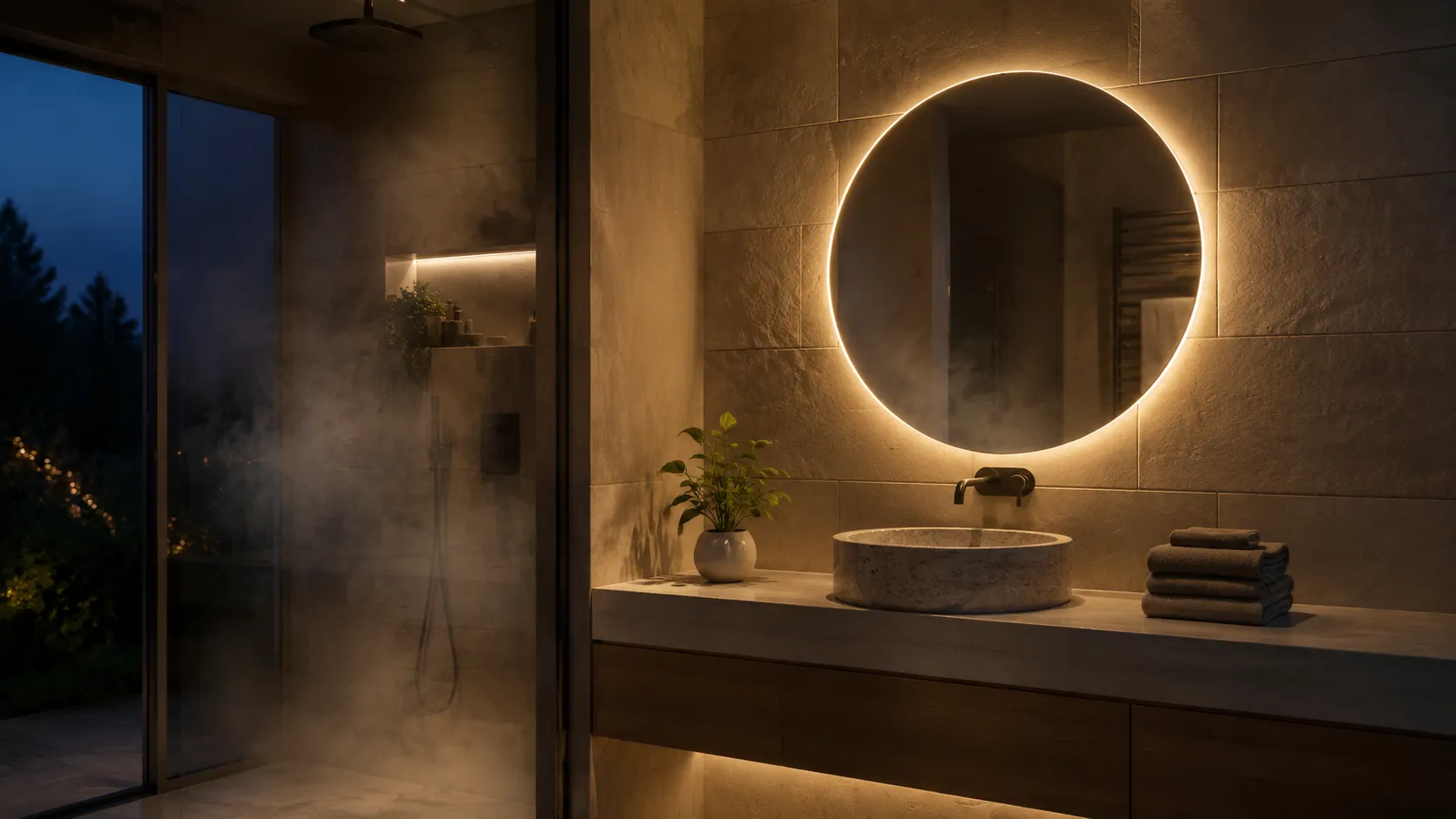
Indoors, the question is rarely rain; it is condensation, cleaning spray and the occasional direct splash, and the bathroom is where the guesswork has already been done for you. Wiring practice divides a bathroom into zones: zone 0, inside the tub or shower, takes only low-voltage fittings rated for immersion (IP67); zone 1, directly above the bath to a height of 2.25 m, and zone 2, the 0.6 m band around it, call for at least IP44, with IP65 the safe answer wherever cleaning jets are likely (Holloways of Ludlow). A strip run outside those zones carries no formal water requirement at all, which is why a mirror backlight two meters from the shower can honestly ship as IP20.
Kitchens have no formal zones, but the same logic transfers. Behind a faucet or inside the sink cabinet counts as splash territory: specify a coated or sleeved strip in the IP54 to IP65 band and keep the cut end and the connector out of the wet path. Above the range, heat and grease age a jacket faster than water does, and a wipeable lens over the channel earns its cost in cleaning alone. Our guide to LED strip lights for kitchens maps those zones room-wide.
The under-sink run is the honest edge case. It sees hose leaks, cleaner overspray and stored chemistry, and it is also where an unsealed joint hides in the dark. Treat it as an exterior job in miniature: factory-terminated ends where possible, the feed entering from above with a drip loop, and the strip mounted on the cabinet wall rather than lying on the floor of the void.
Exterior waterproof LED strip lights: UV, condensation, and the joints
Outdoor runs fail from three directions, and only one of them is rain.
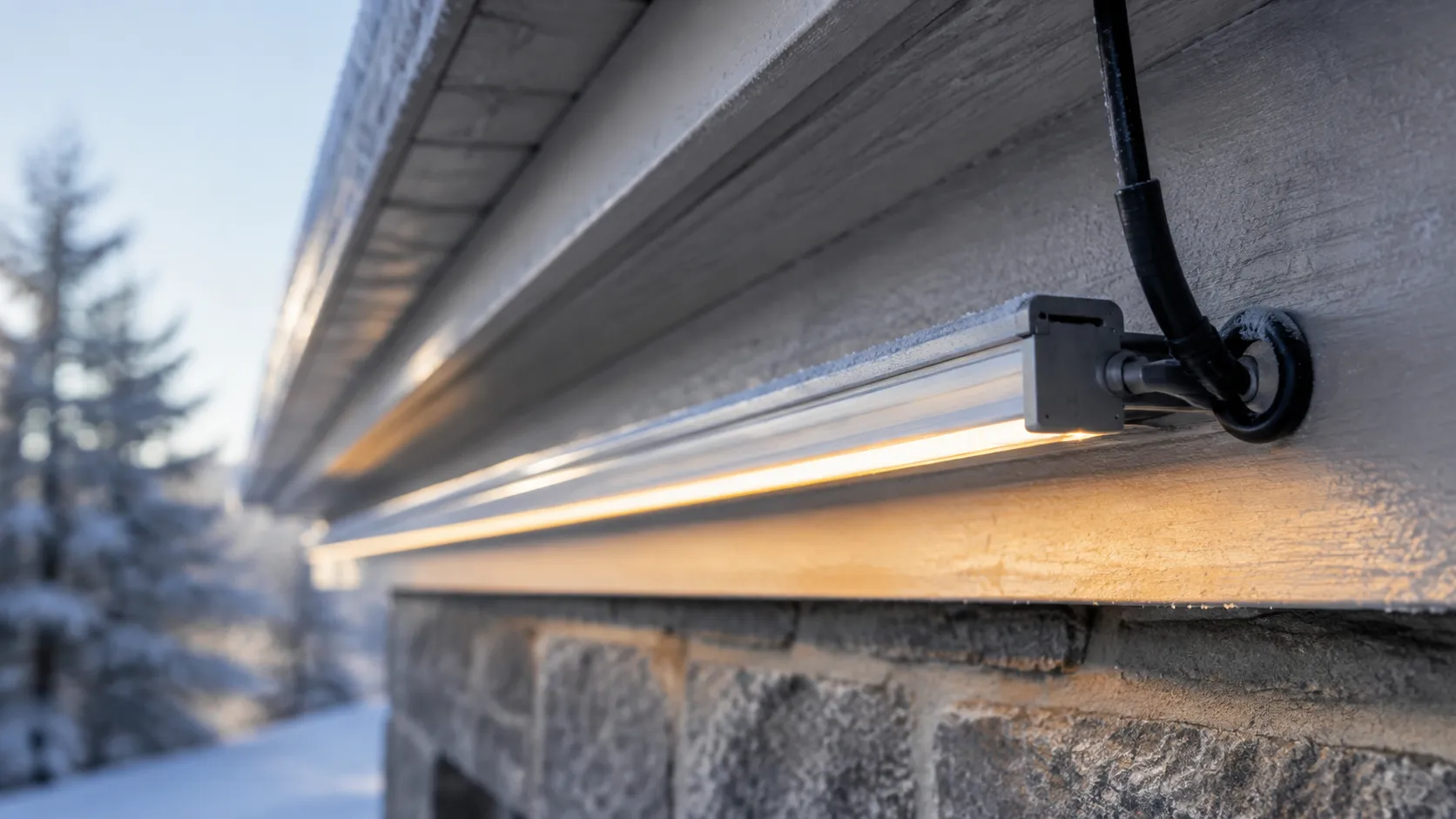
UV attacks the jacket, not the LED. Epoxy-based fills photo-oxidize, shifting color and embrittling at the surface, so the fill that was the seal becomes the crack. A south-facing eave finds this within a summer or two; a shaded north wall may never show it.
Sealed is not the same as dry. A run heats under solar load by day and cools after dark; internal pressure falls, and the assembly pulls damp air in through whichever joint is weakest. That moisture condenses inside a jacket it cannot escape from, which is why strips corrode from within while the outside looks perfect, and why a hose test on a new sample proves little.
The tape body is rarely the leak. End caps, cable entries, solder joints and site-made cuts are. Every connector added in the field sits outside the tested assembly, so its real rating is whatever the installer’s glue achieved that morning. If a run has to be shortened, the seal has to be rebuilt properly, and that sequence is in our guide to cutting LED strip lights.
So for an exterior program: factory-terminated ends, site cuts minimized, and samples judged on a winter of thermal cycling rather than a minute under a tap.
A porch or entry run is the exterior job most often bought for color rather than white, because the color carries the message: purple in October, green in November, blue in April. The month-by-month list buyers plan stock around is in our porch light color guide.
Is the best IP67 LED strip lighting always the right buy?
Not automatically, and there is no ranking table here for a reason: the same reel is correct on a dock edge and wrong in a warm indoor cove. The rating earns its price where flooding is a question of when rather than if — in-ground and step lighting, planter beds, poolside and dock surrounds, wash-down areas.
It costs two things in return. Heat, because a filled tube is insulation and heat drives lumen depreciation, so a potted run driven hard dims sooner than the same tape in open air. And repairability, because it cannot be cut or re-terminated on site, so one dead segment replaces the whole length. Buy the rating for the worst hour the install sees, not the average one.
Reading the datasheet: five lines that decide wet-location fate
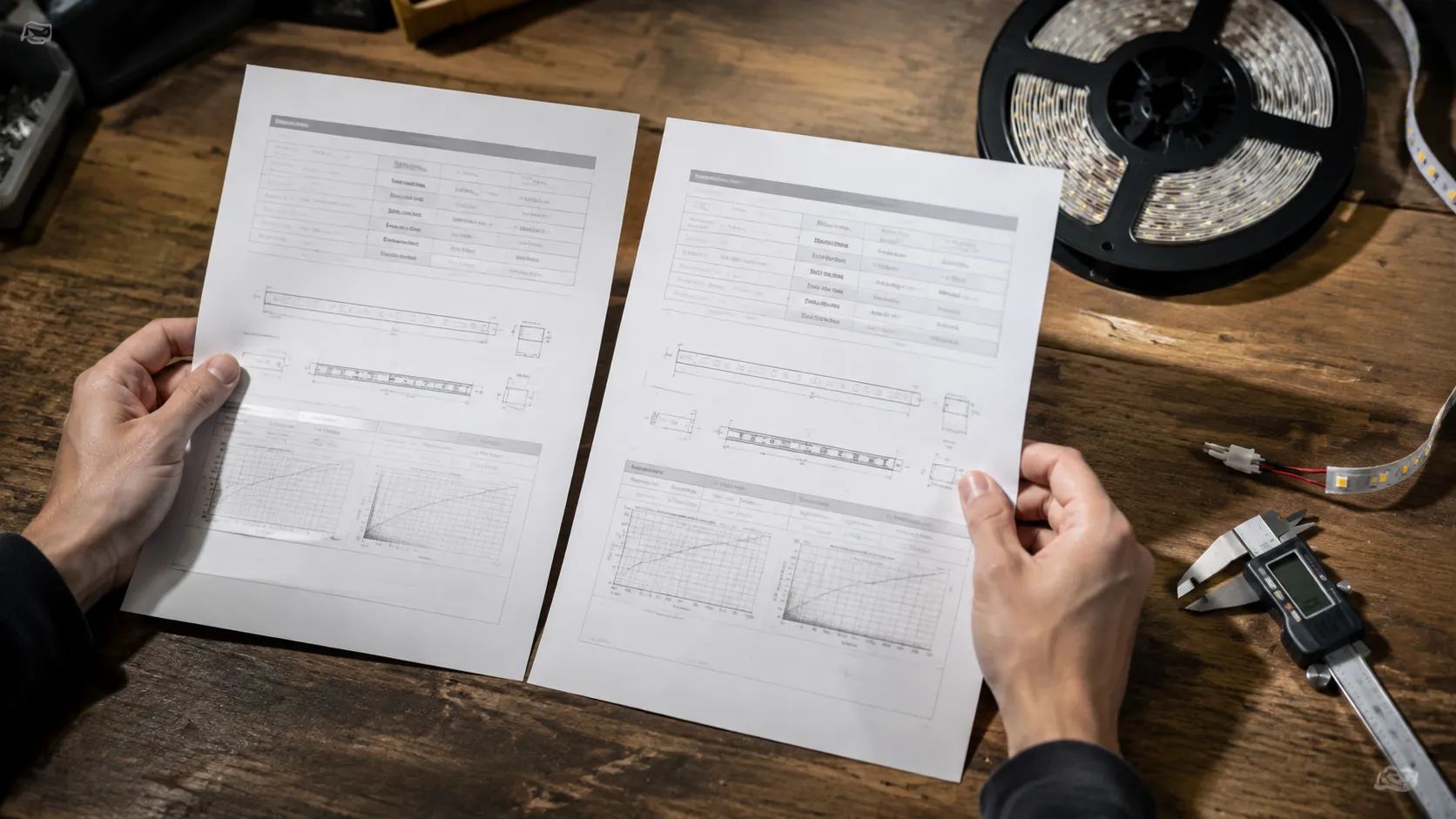
Most failures are visible on the datasheet before a reel ever ships, if five lines get read. First, the exact IP code with the standard behind it: a bare number is marketing, while a code under IEC 60529 is a claim you can hold a vendor to (NEMA Enclosures). Second, whether that code was measured on the finished assembly, with its end caps and cable exit, or on bare tape before termination; water enters at terminations, so a bare-tape figure proves little.
Third, the jacket or fill material by name. Silicone stays flexible through freeze-thaw cycling, while epoxy fills photo-oxidize under UV, yellowing and embrittling at the surface (Polymers, 2023); a sheet that only says waterproof coating has answered neither question. Fourth, the working temperature range, read together with the construction: a filled tube that keeps water out is also insulation, and heat at the LED junction is what drives lumen depreciation, which is why a potted run driven hard dims years before its sealing fails (Access Fixtures).
Fifth, the maximum run length and feed specification at the tape’s real wattage. An over-length run overheats at the feed end and dims at the far end regardless of how good the sealing is, and no water digit fixes an electrical layout. Five lines, five minutes, and most of the vendor conversation below becomes short.
What separates the highest quality LED strip lights
Sealing does, which is the point of everything above: it is the ideal place to cut a corner invisibly, because two reels look identical until the second winter. These are the questions that surface it.
| Ask the supplier | Why it separates suppliers | A weak answer |
|---|---|---|
| Which construction, and which compound? | Coated, sleeved and filled differ in cost, heat and repairability | “It is IP67.” |
| Rating measured on the finished assembly, or bare tape? | A rating covers only what was tested, and water enters at caps and leads | “The tape is rated.” |
| Which water test: jets, immersion, or both? | Separate tests under IEC 60529; only dual coding covers both | “Higher is better.” |
| How are ends and cable entries terminated? | Molded terminations behave differently from hand-applied glue | “We seal them.” |
| What is under the coating: pad size, solder quality, copper weight? | Coating hides poor soldering; thin copper means voltage drop and hot spots | “Standard.” |
| What supply, and what maximum run length? | An over-length run overheats at the feed end regardless | “Any 24 V unit.” |
Then verify instead of trusting. Cycle a sample between a freezer and a warm room a dozen times, power it up, and look for fogging inside the jacket. That is the test that finds a bad end cap, and the one a cut-price supplier does not expect.
Name the worst hour
What hits the run, how often, and for how long: spray, hose, standing water or submersion.
Choose construction and compound
Coated, sleeved or filled; silicone where UV and thermal cycling are real.
Put the digits in writing
Jet, immersion, or dual coded, measured on the finished assembly rather than a bare reel.
Control the terminations
Factory-made ends, site cuts minimized, every field joint resealed properly.
Thermal-cycle the sample
Freezer to warm room a dozen times, then look for fogging inside the jacket.
Specify the environment, not the rating
Sourcing strip for a kitchen program, an exterior run, or both? Send us the install conditions rather than a number: where it mounts, what hits it, and how many hours a day it runs. We quote against those conditions in writing, so construction, terminations and run length are settled before samples ship rather than after the first return.
Watch it work
The three grades and where they fail, in 31 seconds:
Frequently asked questions
Are LED light strips a fire hazard?
The tape itself carries little energy. Strips at 12 V and 24 V are designed to run on a low-voltage limited-energy (Class 2 style) supply, where both the output voltage and the total power the supply can deliver are capped by design. The risk concentrates where mains voltage, resistance and trapped heat are: the power supply and its connections, a run extended past its maximum length so the feed end overheats, hand-made joints, and strip buried under insulation, fabric or a sealed cabinet with no airflow. General practice is a supply carrying a third-party safety listing and sized with headroom rather than run at its ceiling, the manufacturer’s maximum run length respected, an aluminum channel to spread heat, nothing laid over the strip, and installation to local code. No install is risk-free, so treat these as precautions rather than a guarantee.
Do LED light strips get hot?
Yes, warm rather than hot in a healthy install. Part of the input power leaves as heat at the diode junction and more of it in the power supply, and how warm the run gets depends on LED density, drive current and what the tape is mounted to. Anything that traps that heat raises it: a filled waterproof jacket, a closed cove with no airflow, or a strip powered while still coiled on the reel. An aluminum channel pulls heat away. This matters beyond comfort, because heat is the main driver of lumen depreciation, so a strip that runs hot dims earlier than its rated life suggests. If a run is uncomfortable to touch, treat it as a design fault in length, density or mounting rather than as normal behavior.
Can you leave LED strip lights on all the time?
Electrically, yes. LED strips are built for continuous operation and, unlike fluorescent tubes, they are not worn by switching. What continuous operation does is spend the rated life quickly: running around the clock burns 8,760 hours a year, so a lumen-maintenance figure that looks generous on paper arrives sooner than the hour count suggests. Continuous heat compounds it, particularly on a potted outdoor run that cannot shed heat easily, and the power supply usually ages before the tape does. If a run must stay on, specify it for that duty with lower drive current, generous heat sinking and a supply with headroom, and use a timer or motion control wherever the light is not genuinely needed. Follow the manufacturer’s instructions for continuous-duty use.
What IP rating do I need for a bathroom LED strip?
Follow the zone chart rather than a single number. Inside the tub or shower itself (zone 0) only low-voltage fittings rated for immersion, IP67, are acceptable. Directly above the bath to 2.25 m (zone 1) and in the 0.6 m band around it (zone 2), specify at least IP44, and use IP65 wherever cleaning spray is likely (Holloways of Ludlow). Outside those zones a bathroom strip carries no formal water requirement, though condensation argues for at least a coated tape. Wiring in wet zones is regulated work: have a qualified electrician make the connections.
Do waterproof LED strips need a special power supply?
The strip and its driver are rated separately, and the driver is usually the weaker link. Keep the power supply in a dry, ventilated space and only the low-voltage run in the wet zone; where that is impossible, use a driver enclosure rated for the location and treat its cable entries with the same suspicion as the strip’s end caps, since sealed boxes breathe with temperature swings and pull damp air through whichever joint is weakest. Low voltage does not mean water-proof: 12 V and 24 V connections corrode quietly rather than trip anything, so the joint placement matters more than the voltage.
Sources
- Castle Compliance, IEC 60529 Testing (a 7 or 8 code alone is not suitable for water jets unless dual coded), retrieved 2026-08-21.
- InfinitaLab, IPX5 and IPX6 Water Jet Testing Guide (6.3 mm nozzle, 12.5 liters per minute, 3 m), retrieved 2026-08-21.
- Polymers (Basel), 2023, Surface Degradation of DGEBA Epoxy Resins: Effects of UV Radiation (photo-oxidation, yellowing, color change), retrieved 2026-08-21.
- Bud Industries, Selecting an IP67 Enclosure for Outdoor Electronics (solar loading and night cooling draw moist air in, causing internal condensation), retrieved 2026-08-21.
- NEMA Enclosures, IP Ratings Explained: Ingress Protection under IEC 60529 (the second-digit water scale used in the chart above), retrieved 2026-08-25.
- Access Fixtures, LED Lifetime: L70 and Lumen Depreciation (heat at the LED junction drives lumen depreciation, why a potted run driven hard dims sooner), retrieved 2026-08-25.
- Holloways of Ludlow, Bathroom Zones and IP Ratings (zone 0 immersion-rated low voltage; zones 1 and 2 at least IP44, IP65 where jets are likely), retrieved 2026-08-26.
- Waveform Lighting, What is LED strip voltage drop (maximum run lengths and feed planning behind the datasheet’s fifth line), retrieved 2026-08-26.
