

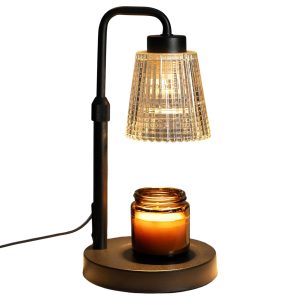
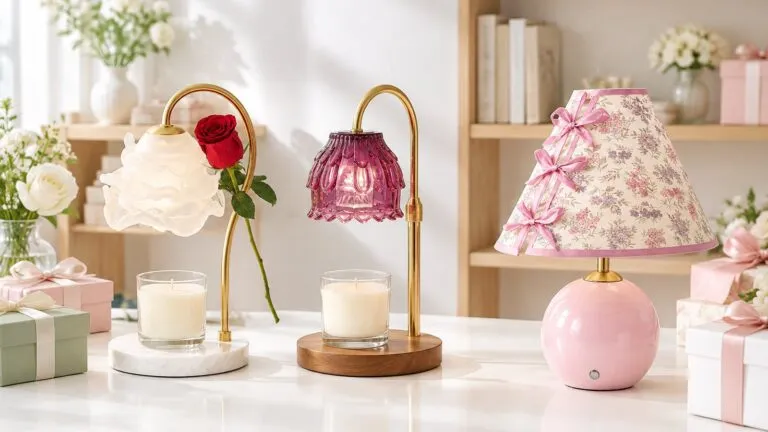
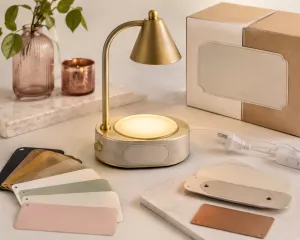

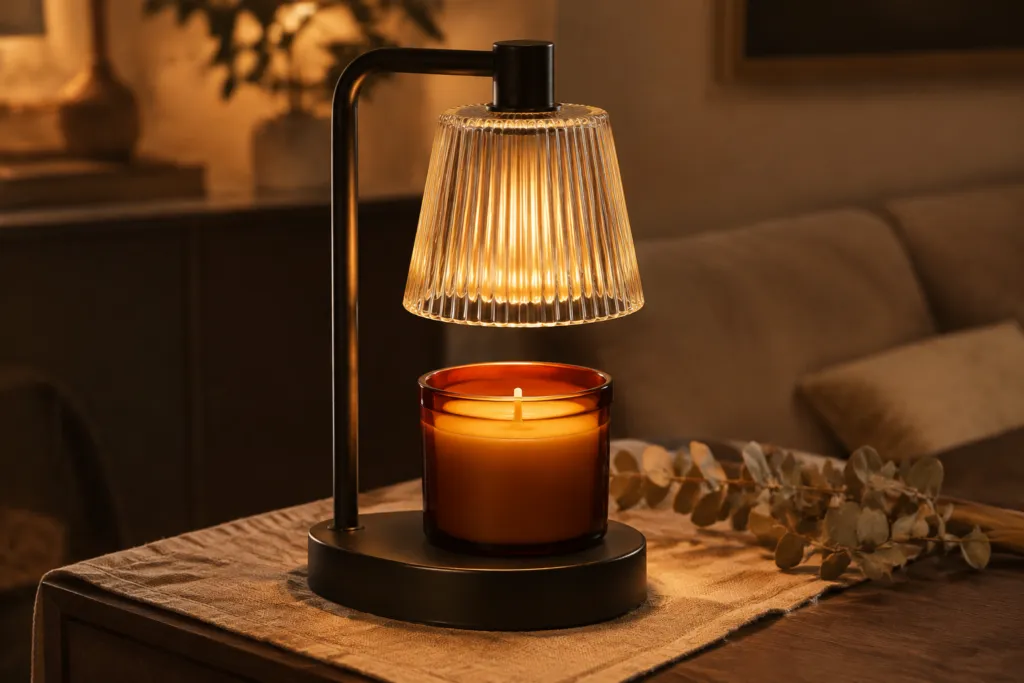
A top down candle warmer is a small lamp that holds a heated shade over a jar candle and melts the wax from above, so the wick is never lit. Scent is released by warmth alone, the wax stays in the jar it was sold in, and nothing burns.
The category background is already covered in our candle warmer lamp category primer. This piece stays on the format: how the geometry works, what the variants add, and what to compare when a sample lands on your desk.
Key takeaways
A top down candle warmer melts a jar candle from above with a heated shade, so scent releases with no flame. Compare formats on head clearance, timer behavior and build, and test everything on the first sample.
- Heat arrives from above: a halogen bulb in the shade forms a shallow melt pool across the whole wax surface, and the jar keeps its label.
- No wick is ever lit, so there is no open flame and no combustion soot; it is still a heated appliance, and placement rules apply.
- A 2-in-1 head that also takes a melt dish serves candle shoppers and melt shoppers with a single SKU.
- An adjustable head is what lets one lamp cover a whole range of jar heights; verify it holds position on the sample.
- The runtime question is answered by the timer and automatic shut-off, confirmed on the spec sheet, not by a rule of thumb.
How the Top-Down Format Works
The heat source sits above the candle rather than underneath it, and that decision drives everything else about the product.
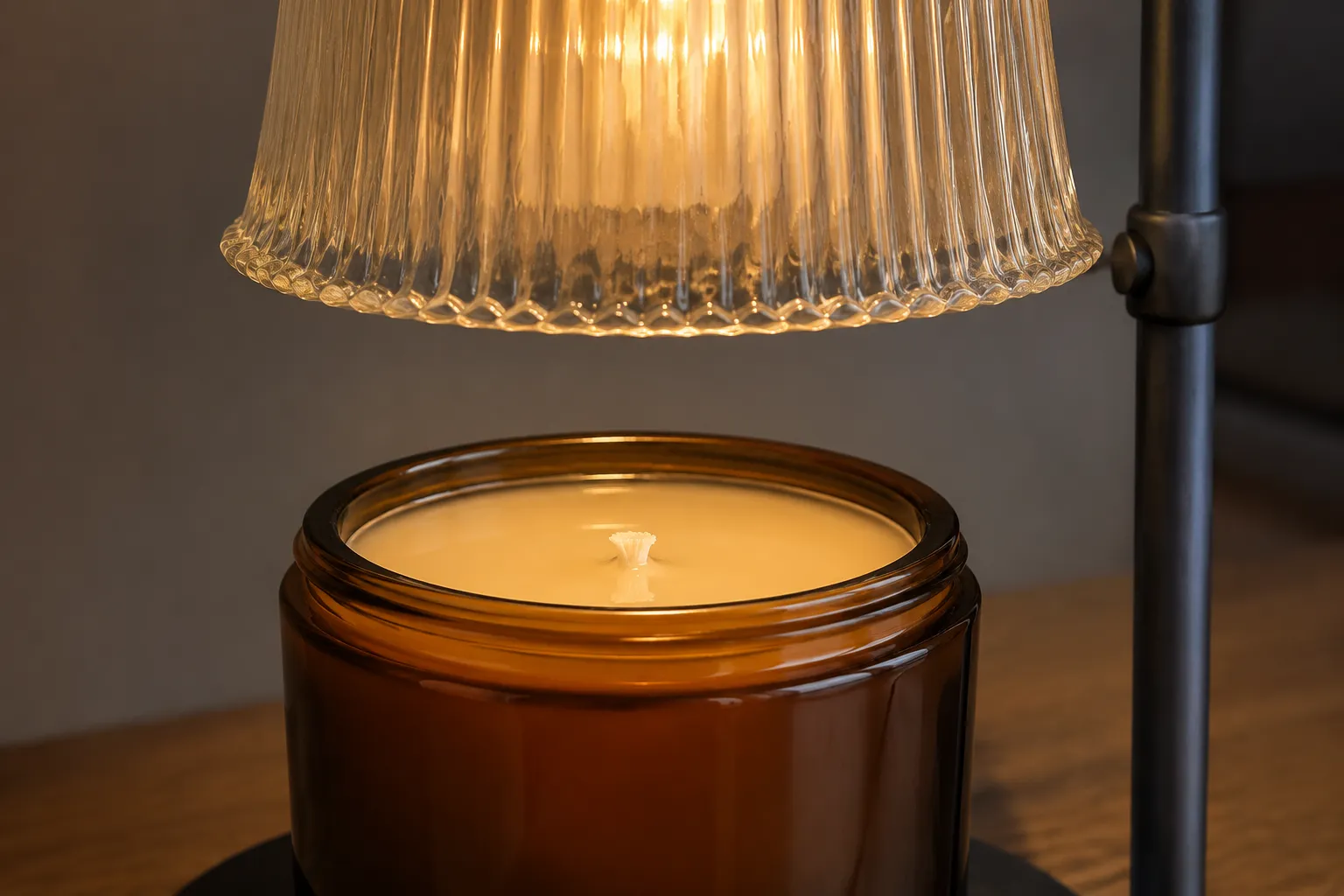
Inside the shade is a small halogen bulb aimed down at the candle. Radiant heat warms the top layer of wax until a shallow pool forms across the surface, and that is where the fragrance is released. The jar is never heated through its base, and the candle keeps its label, so your customer melts the same jar they bought.
Two consequences follow. A shade throws heat across the whole surface, so the pool spreads to the glass wall instead of tunneling down the middle the way an undersized flame does on a wide jar. And the candle becomes reusable: switch the lamp off, the pool sets, and the jar goes back on the shelf looking untouched. Our own candle warmer lamps use this geometry — a glass shade on a steel pole, over a powder-coated steel or solid wood base.
Source: Hywax, “Wax Melting Point: Compare 100-195°F Ranges” (retrieved 2026-08-25)
What a Flameless Candle Warmer Lamp Removes
A flameless candle warmer lamp earns the word literally: no wick is lit, so there is no flame, no combustion soot, and no smoke mark climbing the wall above the shelf.
Take the flame away and three shelf problems go with it: nothing can be knocked over and catch, nothing sooty settles on the paint above a display, and a timer switches the lamp off instead of leaving it burning in an empty room.
That stops short of a blanket safety claim, because this is still a heated appliance with a hot bulb and warm glass. So the buyer’s first question is fair: are candle warmer lamps safe, and what does the answer rest on?
- No open flame and no combustion by-products, because nothing burns.
- The shade and melted wax get hot in use. This is an appliance, not an ornament.
- A timer with automatic shut-off removes the left-it-running risk; confirm every model has one.
- Power draw is low, so it runs for long stretches unnoticed.
- Placement still matters: flat, stable, clear of fabric, out of reach of children and pets.
The full version is in our retailer’s safety explainer. The comparison follows straight on: are candle warmers better than burning candles, or just different? On fire risk and soot the warmer is plainly lower-risk. On scent it is a trade — you give up the flicker, and you get a jar that lasts far longer. Which is why both sell side by side.
The 2 in 1 Candle and Wax Warmer
A 2 in 1 candle and wax warmer is one lamp doing two jobs: it warms a finished jar candle from above, and it takes loose wax melts in a small dish under the same head.
This variant matters for assortment, not engineering. A shopper who owns candles and one who buys melts are two different repeat-purchase habits, and a unit serving both means a single SKU instead of two. The melts are the consumable that brings them back.
What to check is narrow: whether the dish is in the box or sold separately, whether it lifts out for cleaning, and whether the head clears both a tall jar and a shallow dish.
| Format | How heat reaches the wax | What it suits | What to watch |
|---|---|---|---|
| Top-down lamp | Radiant, from a bulb in the shade above the jar | Finished jar candles kept in their own glass | Head height versus your tallest jar |
| Bottom hot-plate warmer | Conducted up through a plate under the jar | Flat-bottomed jars and tins, low profile | Jars that do not sit flat |
| 2-in-1 lamp | Radiant, onto a jar or a melt dish | Retailers stocking both candles and melts | Whether the dish is included and removable |
Why an Adjustable Candle Warmer Lamp Fits More of the Shelf
An adjustable candle warmer lamp lets the head travel up and down the pole, and that one moving part is what makes a single lamp fit a whole fragrance range.
Jar heights are not standardized. A tall apothecary jar, a mid-size two-wick and a squat travel tin each present their wax surface at a different level, and the gap between bulb and surface decides how evenly the pool forms. A fixed head is tuned for one jar height; an adjustable one hands that choice to the customer.
How a shopper actually sets that height on day one — and what goes wrong when they do not — is covered in how to use a candle wax warmer.
Three things are worth testing on the sample. Does the head hold position after twenty moves, or creep down under its own weight? Is the adjustment tool-free? Does the clamp scar the pole finish? And do not trust a travel figure on a listing — stand your own tallest jar under the sample and see whether it clears the shade. That is the only measurement that matters.
What to Compare When the Sample Lands
Everything above collapses into one checklist, worth running properly on the first sample.
The runtime question your customers will ask — how long can you leave candle warmers on — is answered by the timer, not a rule of thumb. Get the durations onto the spec sheet, then verify them on the sample.
Stand your tallest jar under the head
Clearance under the shade is the only measurement that matters; never trust a listing figure.
Run a full melt session
The pool should reach the glass wall instead of tunneling down the middle.
Cycle the timer
Confirm the durations and the automatic shut-off against the spec sheet, on the sample.
Move the head twenty times
Tool-free adjustment that holds position and does not scar the pole finish.
Check the carton
Units per carton and gross weight against your shelf plan and landed cost.
| Check | Why it matters | What to ask for |
|---|---|---|
| Shade and heat source | How evenly the surface melts | Sits square and central over the jar, no rattle |
| Timer and automatic shut-off | Removes the left-it-running risk | Durations on the spec sheet, tested on the sample |
| Head adjustment | Whether one lamp covers your jar range | Tool-free, holds position after repeated use |
| Melt dish, on 2-in-1 models | The consumable that drives repeat purchase | In the box, lifts out, cleans up |
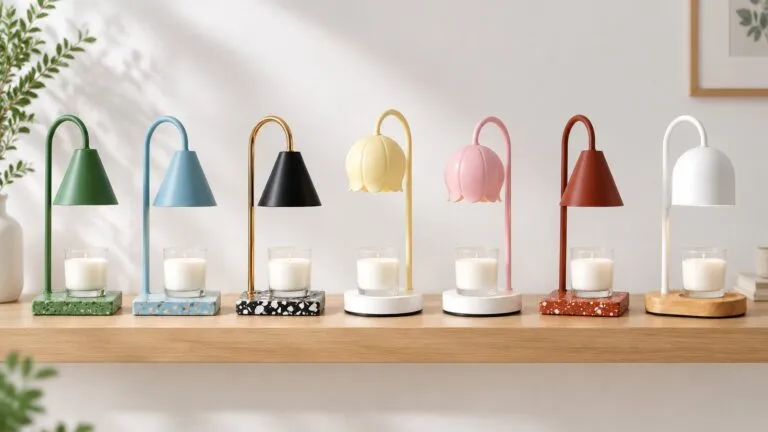
| Base, pole and finish | Countertop stability, and how it photographs | Glass shade, steel pole, powder-coated steel or solid wood base |
| Dimming | Whether it doubles as evening ambient light | Ask whether the head dims, and in how many steps |
| Replacement bulbs | A wear part your customer needs again | How replacements are supplied; a warmer accessory, not a lighting product |
| Carton and packaging | Landed cost and shelf presentation | Units per carton and gross weight; ours ship 12 or 16 by model |
| Electrical paperwork | Market-specific, slow to fix late | Agree in writing what your destination market requires |
Put the format on your own shelf
We build flame-free candle warmer lamps in our own factory in Foshan — 4,000 square meters, 40 people, two production lines. Your order runs on the same line, and through the same checks, as our own retail brand, the one behind our top-selling position in Amazon’s candle-lamp category. Top-down, 2-in-1 and adjustable builds, private label or your own drawings. Samples take about 15 days, and the fee comes back on the order.
Watch it work
The format, in 31 seconds:
FAQ
Are candle warmer lamps safe?
They remove the two hazards shoppers picture first: no wick is lit, so there is no open flame to knock over, and nothing burns, so no combustion soot. That is a real reduction, not zero risk. A warmer is still a heated appliance, and the shade and melted wax get hot while it runs, so it belongs on a flat, stable surface, clear of fabric and out of reach of children and pets. Choose a model with a timer and automatic shut-off.
Are candle warmers better than burning candles?
Better on some things, different on others. On risk the warmer wins clearly: no open flame to be knocked over, no soot marking the wall, and a timer that ends the session instead of leaving something burning in an empty room. On value it also wins, because the wax is melted rather than consumed, so a jar lasts far longer and can be restarted anytime. What you give up is the flicker and the live flame, which is exactly what some customers came for.
How long can you leave candle warmers on?
Follow the timer on the specific model rather than a general rule, and get those durations confirmed on the spec sheet before ordering. A built-in timer with automatic shut-off ends the session for you, so nothing is left running overnight or in an empty room. As a habit worth passing to customers: run it while someone is home and awake, switch it off before bed, and let it cool before moving the jar. A model with no timer is a reason to look at another.
Sources
Every external figure above was checked on 2026-08-25. Wax behavior and flame-risk background come from the candle industry’s own association and fire-safety bodies.
- ENERGY STAR / U.S. Department of Energy, Lighting fact sheet (an incandescent-class bulb releases about 90% of its energy as heat and only 10% as light, the property this format is built around), retrieved 2026-08-25.
- National Fire Protection Association, Candle fire safety (why removing the open flame removes the headline home-fire risk), retrieved 2026-08-25.
- National Candle Association, Candle Safety Tips (placement, drafts and never leaving a burning candle unattended), retrieved 2026-08-25.
- National Candle Association, Elements of a Candle: Wax (how wax carries and releases fragrance when heated), retrieved 2026-08-25.
- National Candle Association, Candle FAQs (a burning candle consumes its wax as fuel; a warmer only melts it), retrieved 2026-08-25.
- Hywax, Wax Melting Point: Compare 100-195°F Ranges (melt ranges by wax type used in the chart above), retrieved 2026-08-25.
