




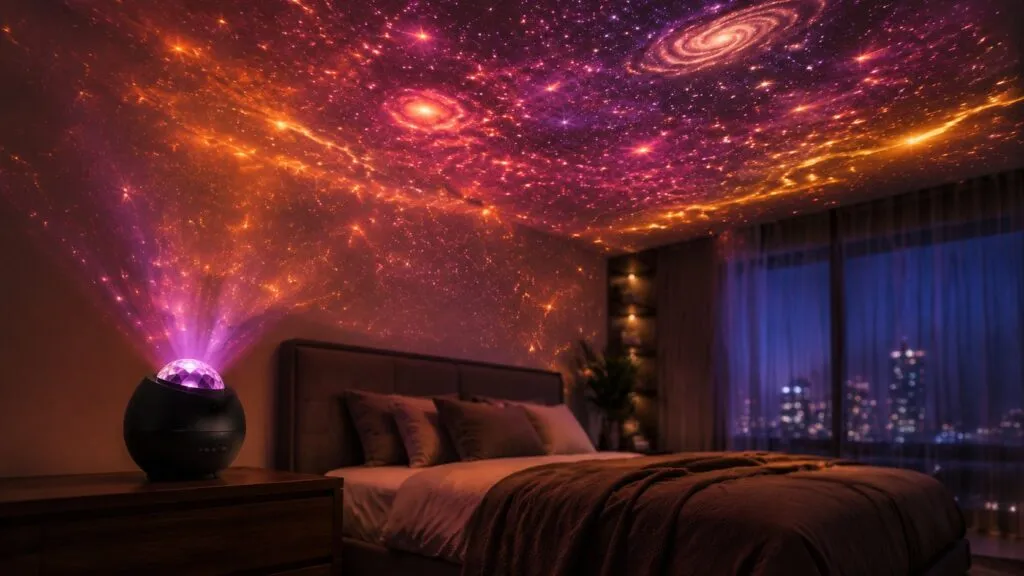
Key takeaways
- Evaluate a projector as a platform you will own for years (optics, motor, controls, roadmap), not as a one-off gadget that photographs well.
- Star projectors cast pinpoint stars (laser); galaxy projectors add a drifting LED nebula. Most sellable units are hybrids that do both.
- Five specs decide returns: coverage area, star and nebula quality, motor noise, controls (remote vs app), and the auto-off timer.
- Match the rated coverage to your buyers’ real rooms. A unit rated for 300 sq ft looks sparse on a 500 sq ft ceiling.
- Read the annual “Nth-Gen / N-in-1” upgrade story skeptically, then source the whole cozy-home basket from one factory-direct partner.
01What makes the best galaxy projector for a private-label line?
The best galaxy projector for a private-label line is judged on very different terms than a consumer favorite. A shopper buys the unit that looks the most magical in a 15-second video. A buyer is choosing a platform to put a brand on, then live with for years, so the winning spec sheet is the one that keeps returns low, reviews high and restocking simple. This guide is a sourcing and spec framework for that decision, not a ranking of consumer picks.
The demand behind the category is real and durable. In 2025, MarketsandMarkets valued the global smart lighting market at about USD 9.86 billion and projected USD 17.38 billion by 2030, a growth rate near 12% per year (MarketsandMarkets, Smart Lighting Market, 2025). Decorative projection is one of the most visible slices of that demand: TODAY reports that sunset and galaxy projection-lamp videos have passed 296 million collective views on TikTok (TODAY, Sunset projection lamps on TikTok, retrieved 2026-07-16). Social pull like that is exactly why the category is worth stocking, and why it sits inside the wider cozy-home basket in our mood lighting for retail guide.
There is a tradeoff worth naming up front. The flashiest unit on a social feed is not always the best one to private-label, because the features that create the “wow” (a phone app, a built-in speaker, dozens of scene modes) are also the parts most likely to draw firmware complaints and warranty returns. A buyer’s shortlist should start from reliability and end at spectacle, not the other way around. The rest of this guide walks the specs in that order, and the assortment context sits in our 2026 home-ambiance trends report.
02Galaxy projector vs star projector: what’s the difference that matters?
The difference is what lands on the ceiling. A star projector casts pinpoint “stars,” usually from a low-power laser diode split by a diffraction grating into thousands of sharp points that hold their edges across the room. A galaxy light projector adds a drifting LED nebula cloud and slow motion on top of those stars. The best star projector for a purist looks like a real night sky; a galaxy unit looks like a dreamy, colored version of one.
The hardware split explains the look. Laser points are coherent light, so they stay crisp with distance, which is why laser engines read as individual stars. LED light is incoherent and spreads softly, which is a weakness for pinpoints but a strength for nebula clouds, giving that fluffy, floating color (BlissLights, What Is a Galaxy Projector, retrieved 2026-07-16). Most sellable units today are hybrids: a laser star field layered under an LED nebula. As documented in 2026, BlissLights’ Sky Lite 2.0 manual specifies a 30-by-30-foot laser star field with a 15-by-15-foot nebula cloud, drawing under 5 watts (BlissLights, Sky Lite 2.0 User Manual, retrieved 2026-07-16), a good illustration of the two engines working at different scales in one box. A simpler example is our star projector night light, which pushes light from an RGB LED through a dome cut with stars and a crescent moon.
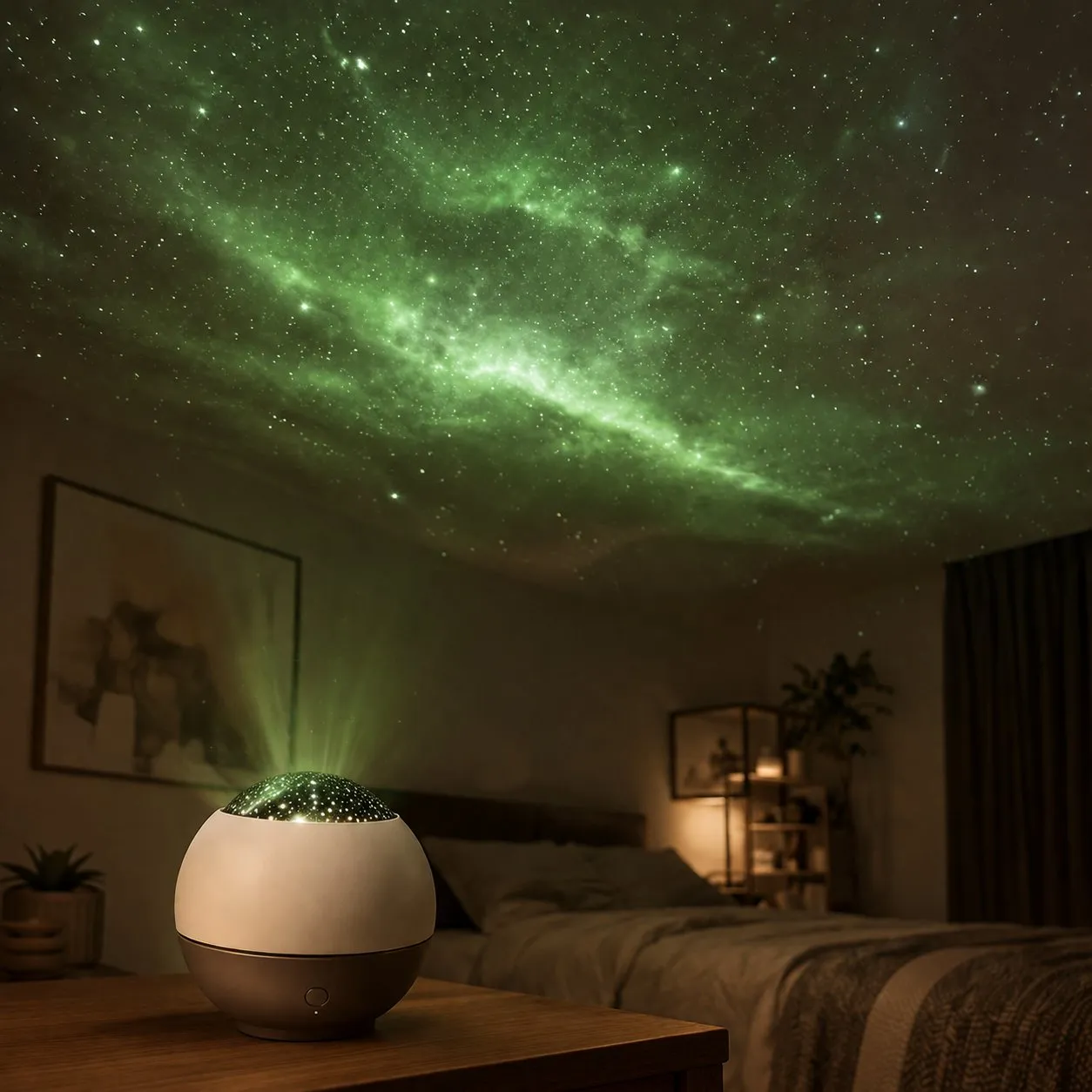
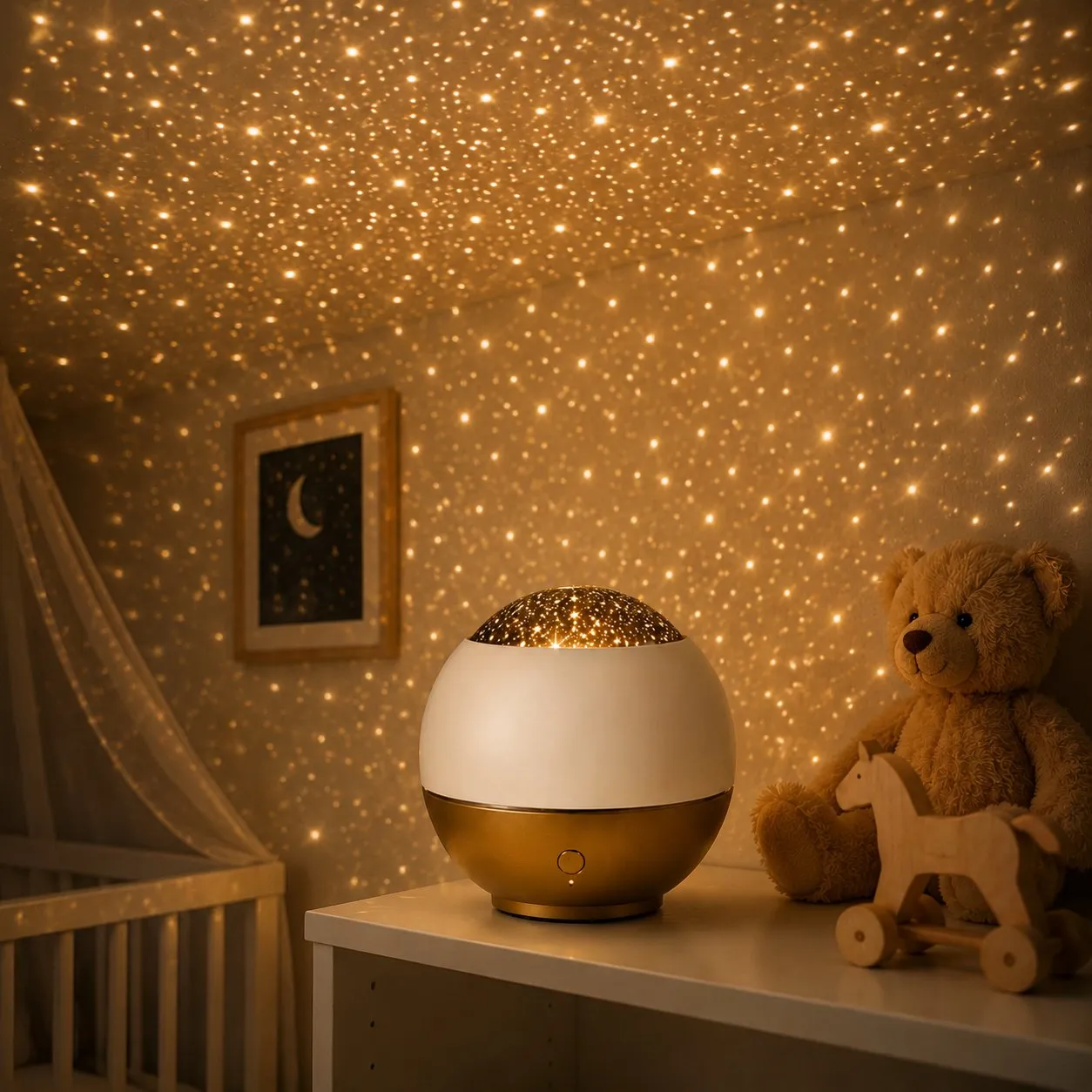
Laser star engine
- Sharp, distinct pinpoints that stay crisp with distance
- Reads as a real “night sky” / planetarium effect
- Low power draw, cool running
- Little to no soft color; less “wow” on camera
LED nebula engine
- Dreamy drifting color clouds, strong on social
- Many colors and scene modes
- Points look fuzzy; no true pinpoint stars
- More LEDs and modes means more to fail
For a buyer, this is a merchandising decision as much as a spec one. A hybrid covers the widest audience, but if you must choose a lead effect, match it to your shopper: a nebula-forward unit for the TikTok-driven bedroom decor buyer, a point-star unit for the customer who wants an accurate ceiling of stars. Our line runs both leads, from an ocean wave projector to a star projector night light, so a store can carry the split under one brand.
03Which projector specs actually matter when you private-label?
Five specs decide whether a projector earns good reviews or fills your returns bin: coverage area, star and nebula quality, motor noise, controls, and the auto-off timer. Everything else is packaging. A buyer who sets a floor on these five before requesting samples will filter out most of the fragile, over-featured units that look great in a listing and disappoint in a real bedroom.
Coverage is the spec buyers most often get wrong, because it is rated for a specific area and thins out as the room grows. Published ratings make the range concrete: the Govee Star Projector 2 Pro is rated near 301 square feet and the larger Govee Star Projector Lights near 540 square feet (gagadget, Best Galaxy Star Projectors, retrieved 2026-07-16), while BlissLights’ Sky Lite 2.0 laser field spans a 30-by-30-foot square, roughly 900 square feet (BlissLights, Sky Lite 2.0 User Manual, retrieved 2026-07-16). Set your coverage floor against the rooms your shopper actually has, then read the rest of the spec sheet.
| Spec | Why it matters to a buyer | What to require |
|---|---|---|
| Coverage area | Decides whether the ceiling looks full or sparse; the top return driver | A rating that matches your shopper’s rooms, stated in sq ft and throw distance |
| Star & nebula quality | Laser points stay crisp; LED nebula sets the mood | Hybrid engine, or a clearly-led effect for the target shopper |
| Motor noise | A buzzing rotation motor kills sleep and nursery use | A quiet motor; test the actual sample in a silent room |
| Controls | Every added control layer adds failure and support tickets | A full-function remote as the baseline; app as a premium tier |
| Auto-off timer | Safety and battery life; shoppers leave these on overnight | A multi-setting timer (the Sky Lite 2.0 auto-off runs at 6 hours) |
The honest limitation here is that more capability is not free. Each mode, sensor and radio you add is one more thing that can fail, one more line in the manual and one more reason a shopper contacts support. A projector with a reliable motor, a clean remote and an accurate timer will out-earn a 20-mode, app-dependent unit that ships with connectivity complaints. Set the spec floor, then add spectacle only where it survives that floor.
04How should a star projector on the ceiling perform in a real room?
It should fill the room it is rated for and stay sharp at ceiling height. Both stars and nebula spread thinner as a room grows, so buyers evaluating a star projector on ceiling performance should check the rated coverage against the real space. Industry buying guides put roughly 200 square feet as a standard-bedroom rating and 500-plus square feet for a living room, and note that image sharpness degrades fast with distance (Space.com, Best star projectors 2026, retrieved 2026-07-16).
Ceiling height matters as much as floor area. A standard 8-foot ceiling works with almost any unit, but a vaulted ceiling over 10 feet loses brightness and detail at the peak, and a projector that looks crisp at 5 feet can turn soft when it has to throw twice that far (Live Science, Best star projectors 2026, retrieved 2026-07-16). This is where the star-versus-galaxy split reappears on the ceiling: what makes the best star projector planetarium models stand out is that their dense laser fields or rotating discs hold recognizable constellations at height, where a loose nebula wash just fades.
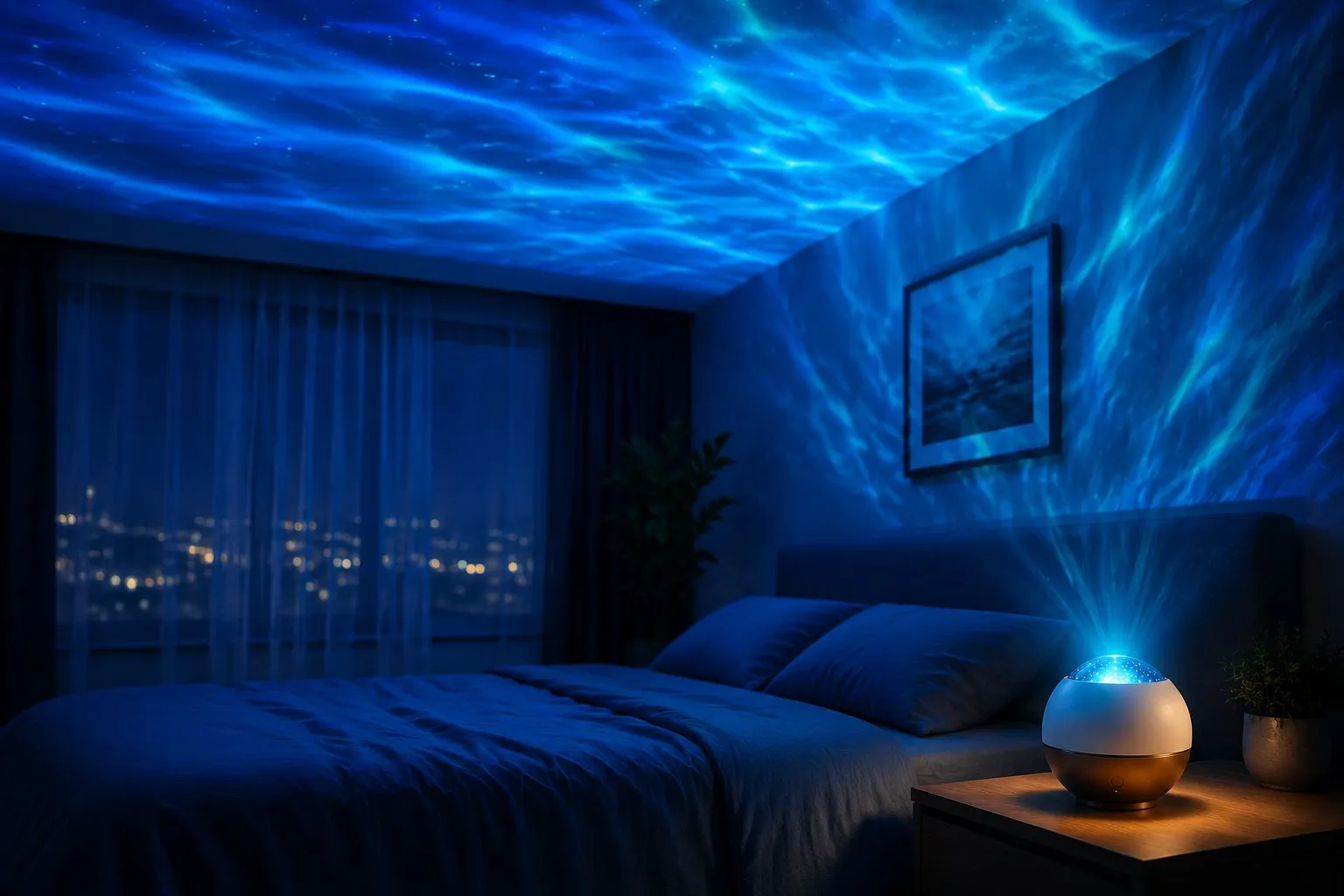
The practical rule for buyers is to under-promise coverage on the listing. It is better to rate a unit for a 200-square-foot bedroom and have it look dense than to claim a 900-square-foot field the shopper mounts in a big living room and finds thin. A large laser field is a genuine strength for showrooms and open-plan spaces, but if your shopper expects a dense, immersive nebula, that same wide throw can read as sparse. Coverage claims are a returns lever, so treat them conservatively.
05The “Nth-Gen / N-in-1” upgrade narrative: reading a real spec change from noise
Every season the category ships a “3rd-Gen” or “12-in-1” projector, and most of that number is marketing until you map it to real hardware. Treat the generation label and the effect count as claims to verify, not features to pay for. What actually changes between versions is usually a shortlist: a better rotation motor, added nebula colors, a new control layer, or a bundled speaker, and only some of those matter to your shopper.
The “N-in-1” framing is really about bundled effects: star field, nebula, aurora, ocean wave and sometimes a flame or party mode in one housing. That bundling is genuinely useful, because it lets one SKU serve several moods, and it is why our line spans an ocean wave projector, a Bluetooth-speaker model and a star projector night light. The catch is that a higher effect count also means more LEDs, more firmware and more to support, so the number alone is not a quality signal. A clean six-effect unit with a reliable motor beats a flaky “16-in-1” every time.
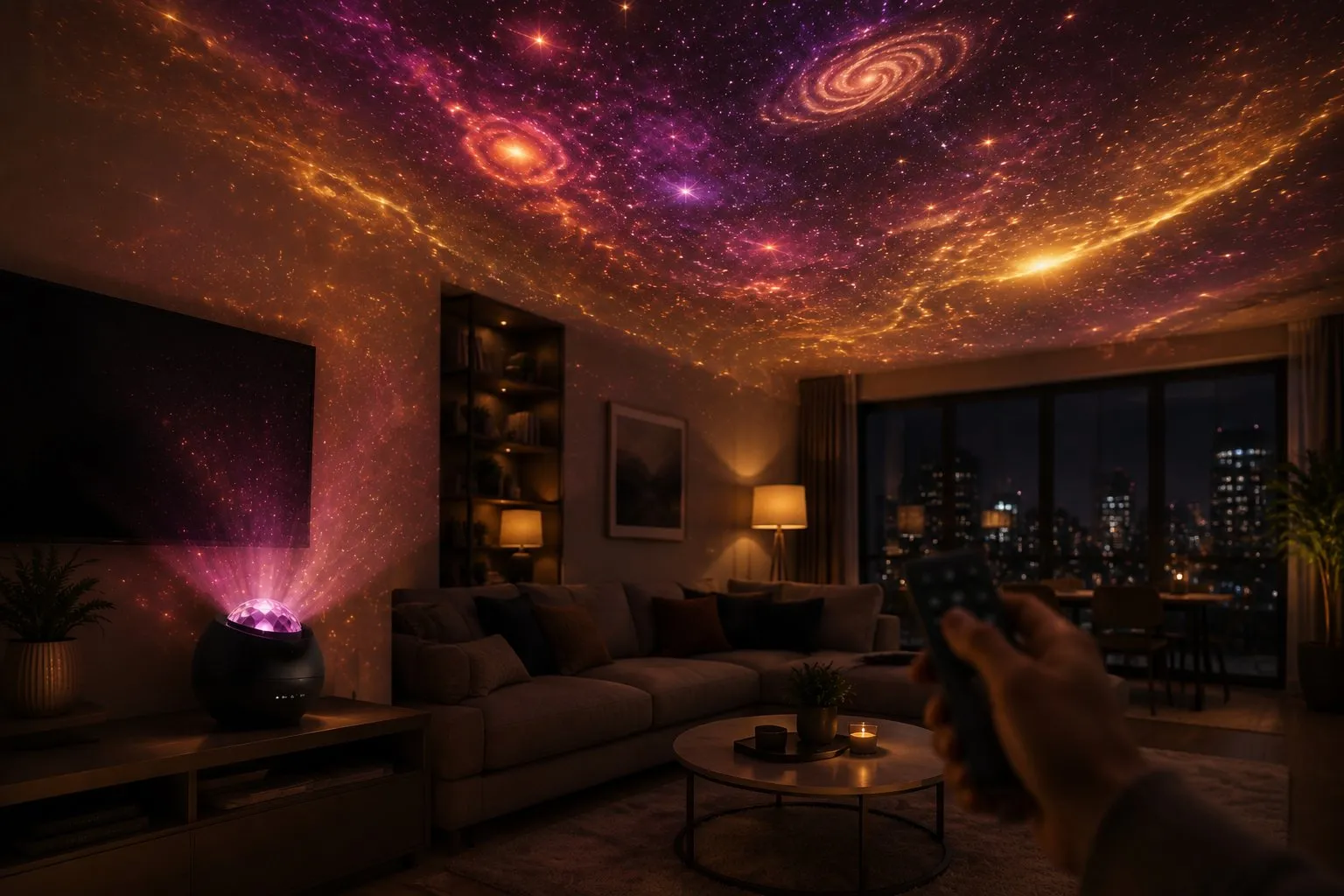
Controls are where this plays out. A wireless remote for color, brightness, motion and the timer is the single most-used convenience, and it rarely breaks. App and Bluetooth control add music sync and custom scenes, but they also add connectivity complaints and warranty exposure, so the smart move is to offer the app version as a premium tier rather than making every unit depend on a phone. Read the upgrade story as a supplier’s roadmap signal, then buy the version whose real changes match your buyers, not the biggest number on the box.
06How to vet a projector supplier and source the line
Vet the platform and the partner together. Beyond the five specs, a buyer should check the safety design (a low-power, cool-running engine and an auto-off timer), the control firmware, the retail packaging, and whether one factory can run the whole cozy-home basket instead of just one hero SKU. The goal is a supplier you can restock and extend, not a single viral unit you cannot get again next season.
A short, disciplined process keeps this objective. Define the room and use case, set a spec floor on the five essentials, sample and test the motor noise and coverage in a real room, then consolidate to one quote. Sourcing projectors, candle warmers, strips and neon from one factory-direct partner collapses five minimums, five freight lines and five quality standards into a single relationship, which is the same logic behind the whole cozy-home basket.
→
→
→
BeginLighting builds its galaxy and star projectors on the same lines and the same checks as its own retail brand, alongside candle warmers, strips and neon, and ships them gift-box-ready so an opening order can cover several formats at once. Prices are quoted per project rather than listed, which is why the next step is a quote rather than a cart. Start narrow, prove the attach rate against your existing shelves, then widen the brand.
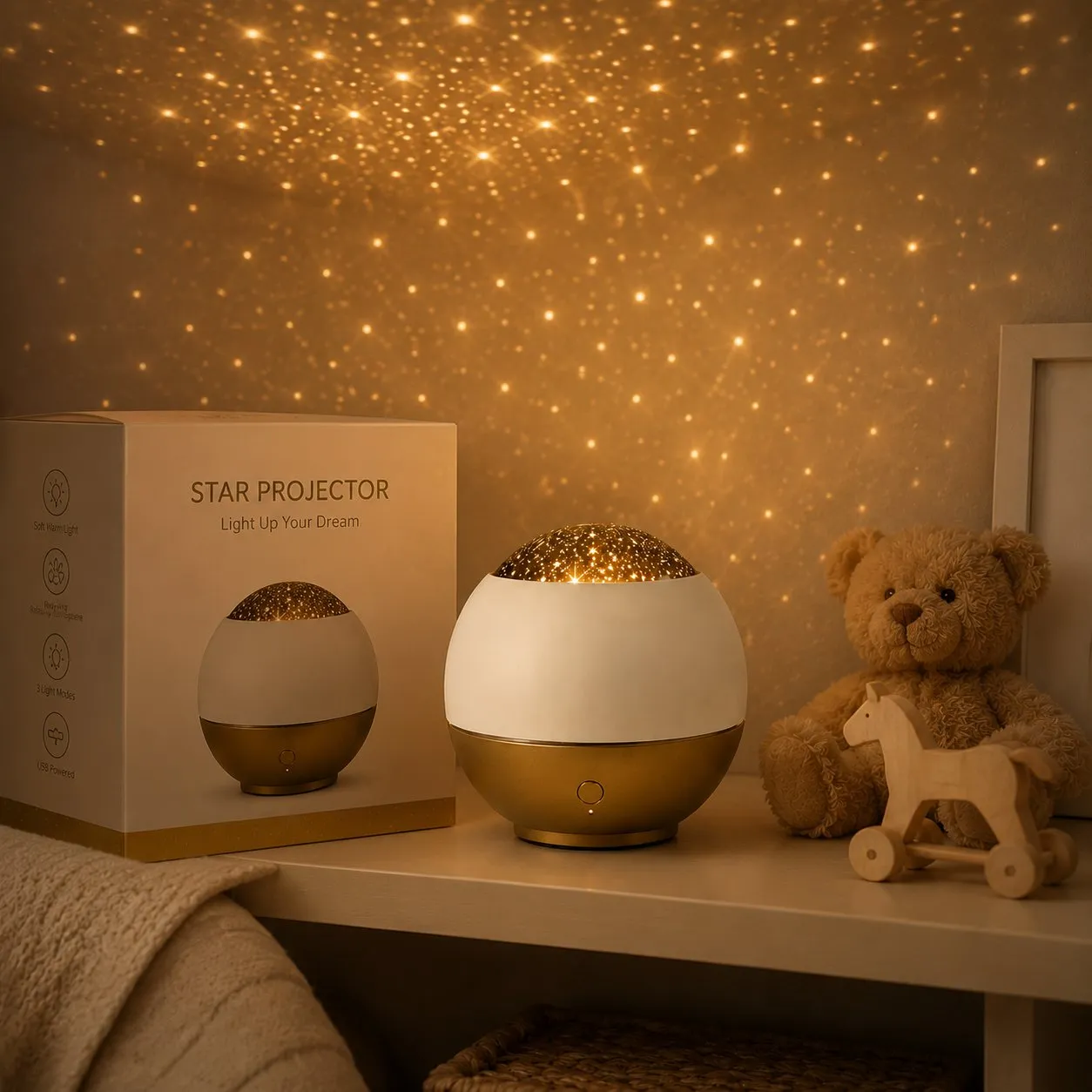
Source galaxy & star projectors, factory-direct
Hybrid star-and-nebula engines, quiet motors, remote and app tiers, gift-box-ready. Built on the same line and checks as our retail brand. Prices are quoted per project.
FAQ
What should I look for in the best galaxy projector to private-label?
Judge it as a platform, not a gadget. The best galaxy projector for a private-label line has a reliable rotation motor, coverage that matches your buyers’ rooms, a laser-or-hybrid star engine that stays crisp with distance, an auto-off timer, and simple controls that generate few support tickets. Wow-factor sells the first unit; low return rates and steady restocking decide whether the SKU is worth owning.
Galaxy projector vs star projector: what is the difference?
A star projector casts pinpoint stars, usually from a laser diode split by a diffraction grating, so the points stay sharp across the ceiling. A galaxy projector adds a drifting LED nebula cloud and motion on top of those stars. Most modern units are hybrids that do both. The spec choice is which effect leads: crisp points for a planetarium feel, or a soft nebula wash for mood.
What makes the best star projector planetarium models different from nebula projectors?
Planetarium models prioritize astronomical accuracy. Many use rotating discs or dense laser fields to place recognizable constellations, so the ceiling reads as a real night sky rather than a decorative color wash. Nebula projectors optimize for atmosphere instead: flowing clouds and shifting color. For buyers, the split is a merchandising decision, because the two formats attract different shoppers and belong in different displays.
Why does a star projector on ceiling look sparse in a large room?
Coverage and throw distance are rated for a specific area, and both stars and nebula spread thinner as the room grows. A unit rated for 300 square feet looks dense on an 8-foot bedroom ceiling but washed out on a 500-square-foot living room. Image sharpness also drops with distance, so a projector that looks crisp at 5 feet can turn soft at a high ceiling. Always match the rated coverage to the real room.
Does the best galaxy projector need an app, or is a remote enough?
For most retail buyers a remote is enough and safer. A wireless remote for color, brightness, motion and the timer covers what shoppers use daily, with almost nothing to break. App and Bluetooth control add music sync and custom scenes but also add firmware, connectivity complaints and warranty exposure. Offer the app tier as a premium SKU rather than making every unit depend on a phone.
Sources
- MarketsandMarkets, Smart Lighting Market Size, Share & Trends, 2025, retrieved 2026-07-16.
- BlissLights, Sky Lite 2.0 Laser Star Projector User Manual (30×30 ft laser / 15×15 ft nebula, under 5 W, 6-hour timer), retrieved 2026-07-16.
- BlissLights, What Is a Galaxy Projector, and Why You Should Get One (laser vs LED nebula mechanism), retrieved 2026-07-16.
- Space.com, Best star projectors 2026 (coverage by room, sharpness vs distance, planetarium models), retrieved 2026-07-16.
- Live Science, Best star projectors 2026: Bring the cosmos indoors, retrieved 2026-07-16.
- gagadget, 6 Best Galaxy Star Projectors in 2026 (Govee 2 Pro 301 sq ft / Govee Star Lights 540 sq ft), retrieved 2026-07-16.
- TODAY, Where to find the sunset projection lamps seen on TikTok (296M views), retrieved 2026-07-16.
- MacRumors, Govee Star Light Projector 2 Pro Review (ocean wave + galaxy, app control), retrieved 2026-07-16.
What the best star projector amazon listings have in common
Most buyers reach this category the same way their shoppers do: a search for the best star projector amazon results, then a scroll down the first page. That page is worth reading as a spec sheet rather than as a ranking, because the units that hold those positions have converged on a short and boring list of features.
Strip the marketing off them and the pattern is narrow. A hybrid engine, laser points under an LED nebula. Coverage published in square feet rather than in adjectives. A full-function remote as the baseline, with an app kept for a premium tier instead of made compulsory. A multi-setting auto-off timer. And a rotation motor quiet enough to run in a bedroom. Published figures give the range: Govee rates units near 301 and 540 square feet, while the BlissLights Sky Lite 2.0 manual specifies a 30 by 30 foot laser field with a 6 hour auto-off.
The other half of the research happens off the marketplace, and it is where the failure modes surface. A buyer who reads through best galaxy projector reddit threads before sampling will see the same three complaints repeat: motor buzz that only shows up in a silent room, an app that stops behaving after a firmware change, and a nebula that looks thin once it is thrown across a large ceiling. None of those appear in a listing bullet, and all three are cheap to test on a sample.
Which is why the spec that decides the review score is optical rather than electronic. A shopper who asks for a realistic star projector means pinpoints that stay sharp at ceiling height, and that is a laser engine job; an LED-only unit is a mood wash and should be listed as one. The range we supply covers both leads, so a private-label program can carry the split under a single brand and let the listing copy tell the truth about each.
Nursery, kids room and gifting: the sub-segment under the volume
A large share of the demand beneath these listings is not decor for an adult, it is a present for a child, and the spec floor moves when it is. A kids projector has to clear a different bar than a bedroom mood unit, and the specs that matter are not the ones on the front of the box.
- A genuine low setting. Brightness floor beats brightness ceiling here. A unit whose dimmest mode still lights the room is a returns generator in a nursery.
- Timer range at the short end. The shortest useful auto-off setting matters more than the longest one, because the unit is meant to end before the night does.
- Motor noise. A hum an adult filters out will wake an infant. Test the sample in a silent room, not on a trade-show floor.
- Materials, base and cord. A stable base, no small detachable parts within a child reach, and a cord long enough to route well away from a crib.
- Compliance, verified not assumed. Products marketed for children can fall under separate rules in the US and the EU. Ask which test reports the supplier actually holds, confirm with your own compliance advisor, and never assume a decor SKU carries children product testing because it was photographed in a nursery.
A close neighbour on the same gift shelf is the children’s story projector, a disc or slide unit that throws illustrated scenes instead of a star field. It shares the housing, motor and timer conversation but is a different optical build, so keep it as its own line on the sheet rather than a mode you expect a galaxy unit to cover. Send us the age bracket and the channel with your request, and the sourcing desk can put the nursery-grade and the decor-grade options side by side in one quote.
Buyers who have to defend that spec on a listing page can lift the detail from what the laser and LED layers each do, written for retail teams rather than engineers.
