




Key takeaways
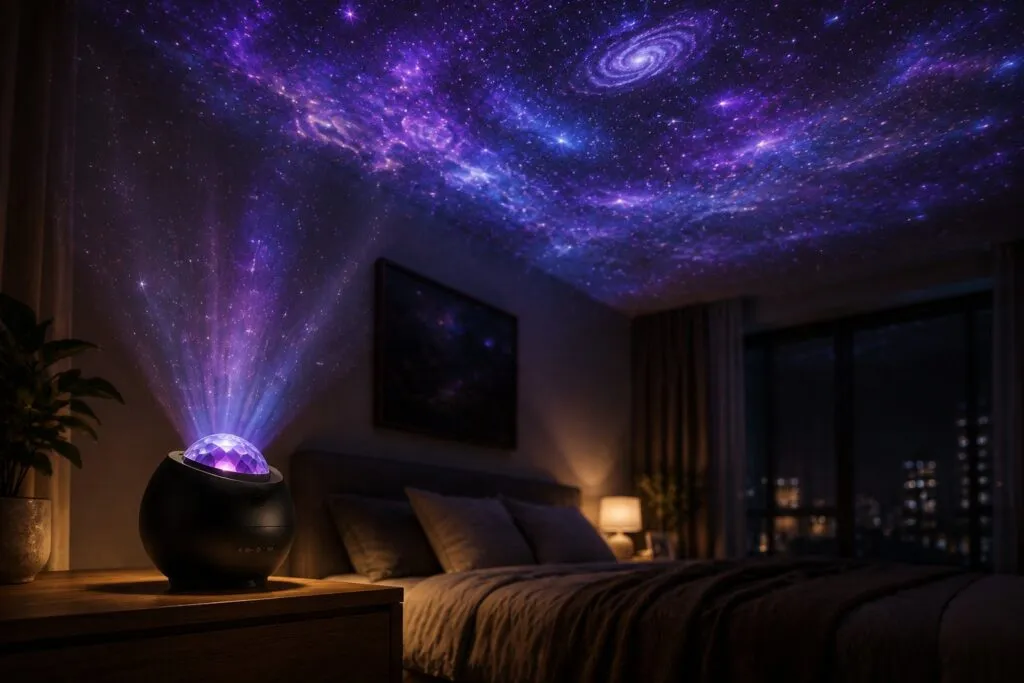
A galaxy projector works by stacking two light layers on your ceiling: a diffracted laser makes thousands of sharp pinpoint stars, while an LED behind a textured lens casts a soft nebula cloud that a small motor slowly rotates.
- The stars come from one low-power laser beam split by a diffraction grating into thousands of beamlets; each beamlet is one star.
- The nebula comes from an RGBW LED shining through a textured or holographic lens; a quiet motor turns the lens so the color drifts.
- Laser light is coherent (stays sharp with distance); LED light is incoherent (spreads soft). That physics is why one layer is crisp and the other is fuzzy.
- US-legal units are registered with the FDA’s CDRH; each Class 3R beamlet is capped at 5 mW, and most home models use even lower Class 1 or Class 2 lasers.
- Coverage is rated for a set area (often around 900 sq ft from 10 ft) and thins out in bigger rooms, so match the rating to the real ceiling.
01What are galaxy projectors, and what’s inside one?
Galaxy projectors are small home lights that throw a moving starfield and a colored nebula onto a ceiling or wall to imitate a night sky. What are galaxy projectors descended from? Planetarium projectors. The first projection planetarium was built by Zeiss in 1923 (B&H eXplora), but instead of a precision glass star plate the size of a beach ball, a modern unit shrinks the idea onto a nightstand using a consumer laser and an LED. Our galaxy star projector for ceilings works on exactly this principle.
The mass-market home version is fairly young. Sega Toys launched the first widely sold home planetarium, the Homestar, in 2006, co-developed with planetarium builder Takayuki Ohira, whose Megastar systems run professional domes (Sega Toys). The category then exploded a second time on social video: TODAY reports that sunset-lamp clips have passed 296 million collective views on TikTok (TODAY, retrieved 2026-07-18). That viral pull is why the category sits inside the wider cozy-home basket we cover in our mood lighting for retail guide.
Inside the housing, almost every unit holds the same short parts list: a laser diode and a diffraction grating for the stars, an RGBW LED and a textured lens for the nebula, a small gear motor to create motion, a control board with a remote or app receiver, and a power input. Understanding those five parts is enough to read any spec sheet in the category, which is the point of this guide.
02How does a galaxy projector work?
How does a galaxy projector work? It works by overlapping two independent light sources on the same surface. A low-power laser diode is passed through a diffraction grating that splits the single beam into thousands of tiny beamlets, each landing as a sharp star. Behind that star field, an RGBW LED shines through a textured or holographic lens to cast a soft, colored nebula cloud, and a quiet motor slowly rotates the lens so the cloud appears to drift. Your eye reads the crisp points and the moving color as one continuous galaxy.
The reason the two-layer trick is so convincing is that each layer is doing the job its light source is physically good at. As BlissLights explains the mechanism, “one laser beam is diffracted into thousands of smaller beams; each of these beams appears as a star, and maintains that appearance no matter how far it’s shining,” while the LED nebula “sends light in multiple directions” to create the soft cloud (BlissLights, What Is a Galaxy Projector, retrieved 2026-07-18). The whole assembly is efficient: a documented reference unit, the BlissLights Sky Lite 2.0, draws under 5 watts to cover a room (BlissLights, Sky Lite 2.0 User Manual, retrieved 2026-07-18).
| Layer | Light source | Optics | What it produces |
|---|---|---|---|
| Star field | Low-power laser diode | Diffraction grating (or pinhole disc) | Thousands of sharp pinpoint stars |
| Nebula cloud | RGBW LED | Textured or holographic lens | Soft, colored, diffuse cloud |
| Motion | Small gear motor | Rotates the nebula lens | Slow drifting effect |
| Control | Remote / app board | Dimming, color, timer | Brightness, color, auto-off |
03The laser star field: one beam, split thousands of ways
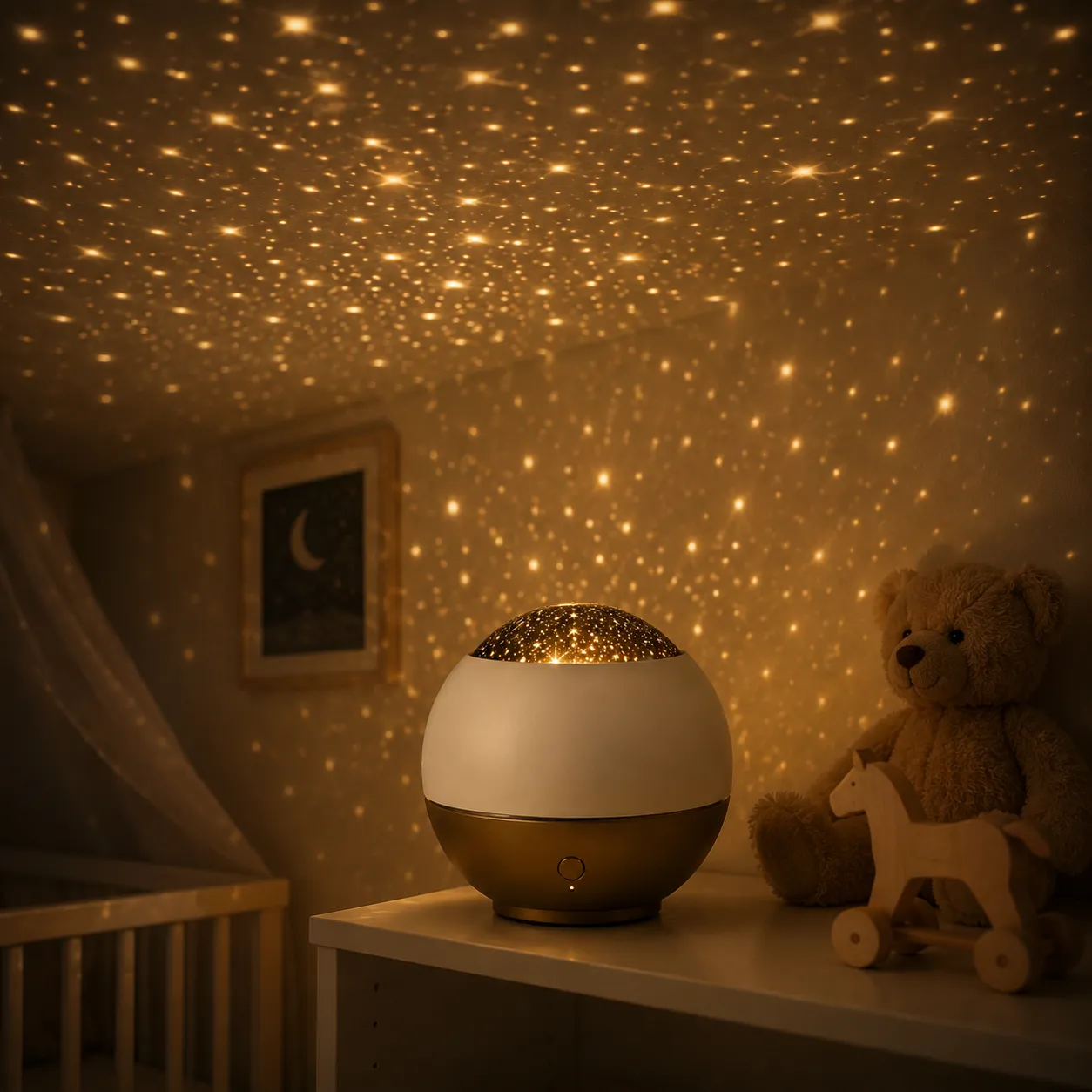
The stars are the part people underestimate. A galaxy projector does not fire thousands of lasers; it fires one and divides it. The laser diode sends a single narrow beam into a diffraction grating, a surface etched with microscopic lines, which bends the light into a fixed pattern of hundreds or thousands of separate beamlets. Because the pattern is etched into the grating, every star lands in the same place each time, which is why a given projector always paints the same constellation-like array rather than a random sky.
This is also the honest limitation of the format. A diffraction-grating star field is fixed: you cannot rearrange it into real constellations, and it will never match the astronomical accuracy of a planetarium disc that mechanically maps actual star positions (Space.com, Best star projectors 2026, retrieved 2026-07-18). Cheaper units use plastic gratings and lenses that smear the points toward the edges of the room, while better ones hold sharpness corner to corner. For a buyer, grating quality is a real differentiator hiding behind identical-looking marketing photos, which is why sampling matters in our private-label sourcing guide.
04How does the LED create the nebula cloud and its drift?
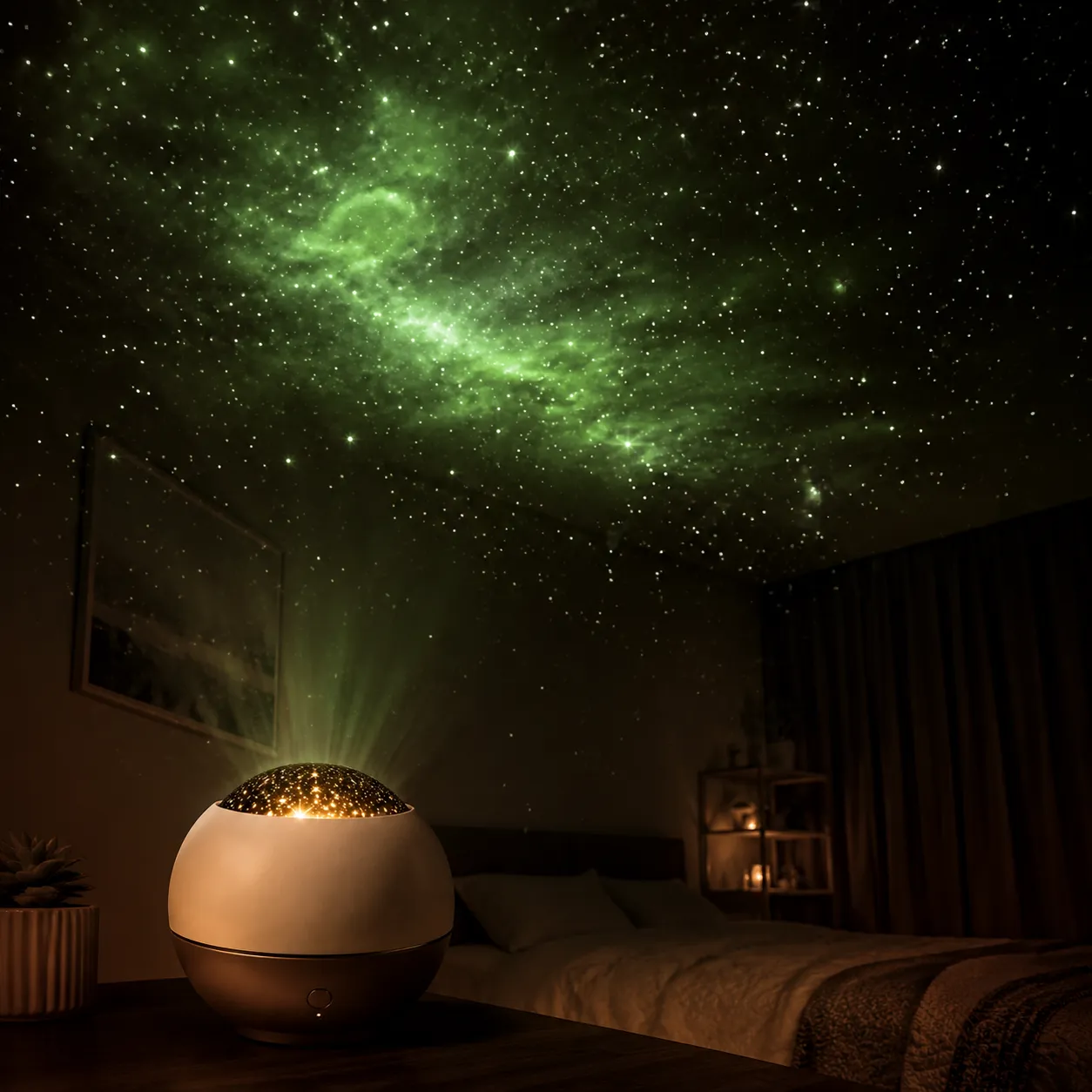
The nebula is an LED story, not a laser one. An RGBW LED, one that can mix red, green, blue and white, sits behind or beside the star field and shines through a textured, translucent lens, sometimes a printed film or a rippled “water-wave” glass. Because LED light is incoherent and spreads in many directions, it does not form points; it pools into the soft, fluffy color that reads as a nebula or an aurora. That same softness that is a weakness for stars is exactly the strength that makes the cloud look dreamy.
The movement is pure mechanics. A small, quiet gear motor slowly rotates the textured lens (or a secondary disc), so the scattered light shifts across the ceiling and the cloud appears to breathe and drift. The motor is the single most-used moving part in the whole device, which is why its noise and lifespan matter more than any effect count: a buzzing motor ruins a bedroom or nursery, and it is the component most likely to fail first. Colors, brightness and the drift speed are then handled by the control board through a remote or phone app.
05Why the stars stay sharp while the nebula stays soft
The difference between the two layers comes down to one word from physics: coherence. Laser light is coherent, meaning its waves travel in step and in the same direction, so a diffracted beamlet stays tight and bright over distance and reads as a hard pinpoint. LED light is incoherent, its waves scattering every which way, so it can only ever produce a soft wash. This is not a quality gap between brands; it is why the same box can give you both a crisp star and a fuzzy cloud at once.
Coherence also explains a complaint buyers hear constantly: the projector that looked dense in the showroom looks sparse at home. Coverage is rated for a specific area, and both layers spread thinner as the room grows. BlissLights rates a laser field at roughly 900 square feet of coverage from ten feet away (BlissLights, retrieved 2026-07-18), while its Sky Lite 2.0 nebula cloud is specified at about 15 by 15 feet, or 225 square feet (BlissLights, Sky Lite 2.0 User Manual, retrieved 2026-07-18). The laser layer throws much farther than the LED layer, which is exactly what coherence predicts.
06Are the lasers in a galaxy projector safe for your eyes?
Consumer galaxy projectors are designed to be eye-safe in normal use, and the design is regulated. Any laser-illuminated projector legally sold in the US must be registered with the FDA’s Center for Devices and Radiological Health, which classifies these products under Laser Notice No. 57 (FDA, Laser Notice No. 57, retrieved 2026-07-18). The safety math is deliberately conservative: in a Class 3R star field, the strongest single beamlet cannot exceed 5 milliwatts, a level considered safe for the brief, accidental exposure you get walking through the light (LaserPointerSafety.com, retrieved 2026-07-18).
That said, “eye-safe in normal use” is not “stare into it freely,” and honest sourcing means saying so. Most home models use even lower Class 1 or Class 2 lasers with added diffusion, but the standing advice is to never look directly into the laser aperture and to place the unit above head height rather than at eye level (LaserPointerSafety.com, retrieved 2026-07-18). For a retailer, that is a packaging and instruction responsibility as much as a hardware one: the safest projectors pair a low laser class with a clear, printed warning and an auto-off timer. The Sky Lite 2.0, for example, shuts off automatically after 6 hours (BlissLights, Sky Lite 2.0 User Manual, retrieved 2026-07-18).
Laser star engine
- Coherent light: sharp pinpoints that hold across the room
- Reads as a real night-sky / planetarium effect
- Low power draw, wide coverage
- Fixed pattern; not astronomically accurate
LED nebula engine
- Incoherent light: dreamy drifting color clouds
- Many colors, aurora and ocean-wave modes
- No true pinpoint stars; softer, smaller reach
- Depends on the motor, the part most likely to fail
Put together, that is the whole machine: a coherent laser for the stars, an incoherent LED for the nebula, a quiet motor for the drift, and a control board and safety class wrapped around them. Once you can name those parts, sourcing the category stops being about the biggest effect count on the box and starts being about grating quality, motor noise, coverage honesty and a clean safety file, the same short list we walk in the private-label sourcing guide.
Sourcing galaxy & star projectors to private-label?
We build hybrid laser-and-LED projectors on our own Foshan lines: quiet motors, remote and app tiers, gift-box-ready packaging, and a documented safety class. Prices are quoted per project, so the next step is a quote, not a cart.
Frequently asked questions
How does a galaxy projector work?
A galaxy projector works by layering two light sources on your ceiling. A low-power laser diode is split by a diffraction grating into thousands of pinpoint beamlets, which read as sharp stars. Behind them, an RGBW LED shines through a textured or holographic lens to cast a soft nebula cloud, and a small motor slowly rotates that lens so the color drifts. The two layers together, laser stars plus LED nebula, are what make the night-sky effect.
What are galaxy projectors?
Galaxy projectors are small home lights that throw a moving starfield and a colored nebula across a ceiling or wall to imitate a night sky. They descend from planetarium projectors but use consumer-grade lasers and LEDs instead of glass star plates. Most sit on a nightstand, run on a household outlet or battery, and are controlled by a remote or phone app for color, brightness, motion and a timer.
What is the difference between the laser and the LED in a galaxy projector?
The laser makes the stars and the LED makes the nebula. Laser light is coherent, so its diffracted beamlets stay tight and crisp no matter how far they travel, giving sharp pinpoint stars. LED light is incoherent and spreads softly, which is poor for points but ideal for a fluffy, drifting nebula cloud. Most sellable units combine both engines in one housing.
Are the lasers in a galaxy projector safe for your eyes?
Consumer galaxy projectors are designed to be eye-safe in normal use. Units legally sold in the US must be registered with the FDA’s CDRH, and each diffracted beamlet in a Class 3R star field cannot exceed 5 milliwatts, a level considered safe for brief, accidental exposure. Most home models use even lower Class 1 or Class 2 lasers with diffusion. The rule that still applies: do not stare directly into the laser aperture, and place the unit above head height.
Why does a galaxy projector look sharp in one room and sparse in another?
Because coverage is rated for a set area and both layers thin out as the room grows. A laser star field rated for roughly 900 square feet from ten feet away looks dense on a small bedroom ceiling but sparse in a large living room, and image sharpness also drops as the throw distance increases. Matching the rated coverage and ceiling height to the real room is the single biggest factor in how full the sky looks.
Sources
- BlissLights, What Is a Galaxy Projector, and Why You Should Get One (laser diffraction, coherent vs incoherent light, ~900 sq ft from 10 ft, 5 mW beamlets, CDRH registration), retrieved 2026-07-18.
- BlissLights, Sky Lite 2.0 Laser Star Projector User Manual (30×30 ft laser / 15×15 ft nebula, under 5 W, 6-hour auto-off timer), retrieved 2026-07-18.
- U.S. FDA, Classification and Requirements for Laser Illuminated Projectors (Laser Notice No. 57), retrieved 2026-07-18.
- LaserPointerSafety.com, Laser safety FAQ (Class 3R 5 mW beamlet cap, Class 1/2 consumer lasers, aim above eye level), retrieved 2026-07-18.
- Space.com, Best star projectors 2026 (planetarium accuracy, coverage by room, sharpness vs distance), retrieved 2026-07-18.
- Sega Toys, Homestar home planetarium (Homestar Original launched 2006, developed with Takayuki Ohira / Megastar), retrieved 2026-07-18.
- B&H eXplora, Planetarium Projection Systems (first Zeiss projection planetarium, 1923), retrieved 2026-07-18.
- TODAY, Where to find the projection lamps seen on TikTok (296M collective views), retrieved 2026-07-18.
- Govee, Galaxy Light Projector 2 Pro product page (rated coverage up to 301 sq ft), retrieved 2026-07-18.
BeginLighting builds galaxy and star projectors on its own Foshan lines; specifications cited above are third-party reference figures, not claims about a specific BeginLighting model.
Galaxy projector film discs, gratings and bulbs: the parts that make the picture
Almost every visible difference between two units comes from a short list of optical parts, and galaxy projector film discs are the one buyers ask about most. The disc is a thin printed or holographic film mounted in front of the LED and turned slowly by a geared motor: the pattern on that film is what you read as the nebula, and the motor speed is what you read as drift. A cheap disc gives flat, obviously repeating clouds with banding at the edge of the throw, while a better one carries finer gradients and layered density, which is why two projectors with near-identical spec sheets can look nothing alike on a ceiling. Some units stack two discs turning at different speeds so the clouds cross each other instead of rotating as one printed sheet, and some replace the film with a water-ripple element for a rippling rather than a drifting effect.
- Diffraction grating. Splits the single laser beam into the star field. Grating quality decides whether stars stay pinpoint or smear into short dashes toward the edges.
- Film disc and motor. Makes the nebula and its movement. Listen to the motor on a bedroom unit, because a whining gear undoes the whole effect.
- Diffuser. Softens the LED so the nebula reads as cloud rather than as a bright blob directly under the lens.
- Focus ring. Lets the user sharpen the star field for their own ceiling height, and its absence is the usual reason stars look soft in reviews.
A star projector light bulb is the stripped-down version of the same idea: the optics are packed into an E26 or E27 lamp body so the whole thing screws into an existing socket or table lamp and draws power from the fixture with no separate adapter. It trades the focus ring, the tilt and often the laser layer for convenience and a much lower shelf price, which makes it a useful opening price point in an assortment rather than a substitute for a full projector.
Coverage and throw distance: matching a ceiling projector to the room
A ceiling projector is rated for a coverage area at a stated distance, and both halves of that rating matter. The same unit that fills a small bedroom ceiling edge to edge looks thin and washed out in an open-plan living room, because the star field spreads across more square footage while each beamlet keeps the same brightness. Distance cuts both ways: too close and the pattern lands as a tight circular patch with a visible hot center, too far and the stars soften while the nebula loses its contrast against whatever ambient light is left in the room.
- Never read coverage without its distance. A coverage figure quoted with no throw distance attached tells you nothing. Ask for both, measured.
- Place it off-center and angled. Aiming across the ceiling from a corner or a nightstand covers more area and hides the circular edge better than sitting the unit in the middle of the room.
- Ceiling color and finish matter. A matte white ceiling holds the pattern, while a dark, glossy or heavily textured one eats it.
- Ambient light beats every spec. Any projector needs a dark room, so a unit that looks weak under showroom lighting may be perfectly good at home.
- Check the tilt range. A fixed-angle body limits where the unit can physically sit, which quietly limits the coverage you can actually achieve.
For a buyer building an assortment, coverage is the spec that drives returns: a projector sold on a coverage claim it only meets at one distance in a fully dark room generates disappointed reviews no matter how good the optics are. We build star and galaxy projectors ourselves and send samples on request, so you can verify coverage, focus and motor noise on your own ceiling before you commit to a range.
