


Key takeaways
Are candle warmers safe? Yes: a candle warmer lamp melts wax with a low-heat bulb from above instead of an open flame, so it removes the ignition source behind roughly 7,610 U.S. home candle fires a year. For a retailer, the safety story is a sellable asset, not just a liability answer.
- No flame, no soot. A warmer has no wick to light, so it cannot ignite nearby fabric or leave combustion soot, the two things that make an open flame risky.
- Low heat, not high. A candle flame runs near 1,000°C; a tested GU10 candle warmer’s warming surface reached about 120°C (U.S. CBP ruling N340956, 2024).
- An auto-off timer covers the human error. Our lamps ship with a real 4-mode timer (2/4/8/10h) plus 4-level dimming, so nothing is left running unattended overnight.
- Be honest about the limit. Flameless removes combustion, but heated scented wax is not zero-emission (Purdue/ACS, 2025), so pair the pitch with a ventilation note.
Are candle warmers safe? A short answer for retail buyers
Yes. A candle warmer lamp is designed to be safer than an open-flame candle because it melts the wax with a low-heat bulb from above and never lights a wick.
For a retail buyer, the phrase “are candle warmers safe” is really two questions wearing one coat. The first is about risk: could this product hurt a customer, start a fire, or come back as a warranty return and a bad review? The second is about merchandising: can I put “safe” on the shelf tag and mean it? This guide answers both, because the honest safety story is one of the strongest reasons a shopper trades up from a jar candle to a lamp, and it is a story your staff can tell at the counter. The category itself is retail-proven: our own candle warmer lamp has held the #1 Best Seller position in Amazon’s Candle Lamps category, and the flameless promise is a large part of why. For the wider category picture, see our candle warmer lamp category primer.
One boundary up front, because it protects you and your customer. The safety features below are design-level and demonstrable: no flame, a low warming temperature, an auto-off timer, glass and steel or solid-wood construction. Formal safety certifications are a separate matter that you should verify with any supplier in writing rather than take on trust. We do not claim marks we cannot show, and neither should the marketing copy on your listing. Sell the design honestly, and keep the certification conversation factual. The auto-off timer on our halogen candle warmer lamp with a timer is one such demonstrable, design-level feature.
Why is a flameless warmer safer than an open flame?
Because it removes the flame, and with it the single ignition source behind the candle-fire statistics.
In its May 2020 Home Candle Fires report, covering 2014 to 2018, the National Fire Protection Association counted an annual average of 7,610 U.S. home structure fires started by candles. Those fires caused 81 civilian deaths, 677 injuries, and $278 million in direct property damage, which works out to about 21 home candle fires every single day. The report also found that three in five (60%) of those fires started when something that could burn, such as bedding, curtains, or decorations, was left too close to the flame, and 16% involved a candle left unattended or abandoned. A warmer changes the arithmetic at the root: there is no flame to catch a curtain and no wick to leave burning. This is the candle warmer vs burning comparison your shoppers are quietly running in their heads.
Source: NFPA, Home Candle Fires (Marty Ahrens), May 2020, 2014–2018 annual averages. Retrieved 2026-07-16.
The second half of the flameless benefit is the air itself. Burning a candle is combustion, and combustion produces soot and fine particulate matter; a 2025 study in Scientific Reports measuring scented-candle use found measurable spikes in indoor PM2.5 and PM10 during burning. A warmer skips that combustion entirely, which is why customers with children, pets, or respiratory sensitivities gravitate to it. None of this makes a warmer a toy: it is still an electrical appliance that belongs on a stable surface, away from water, and clear of the cord. It simply moves the biggest risk, the flame, off the table. For how the heat itself is produced, see our guide to the GU10 heat source.
Open-flame candle
- Live flame near 1,000°C that can ignite nearby fabric
- Soot and fine particulate matter from combustion
- Must be actively watched and extinguished
- Drowned wick often strands the last of the wax
Flameless candle warmer
- No wick lit, so no flame to catch or tip
- No combustion soot; warms rather than burns
- Auto-off timer handles the “did I blow it out?” moment
- Melts the candle evenly, down to the last of the wax
How hot does a candle warmer lamp actually get?
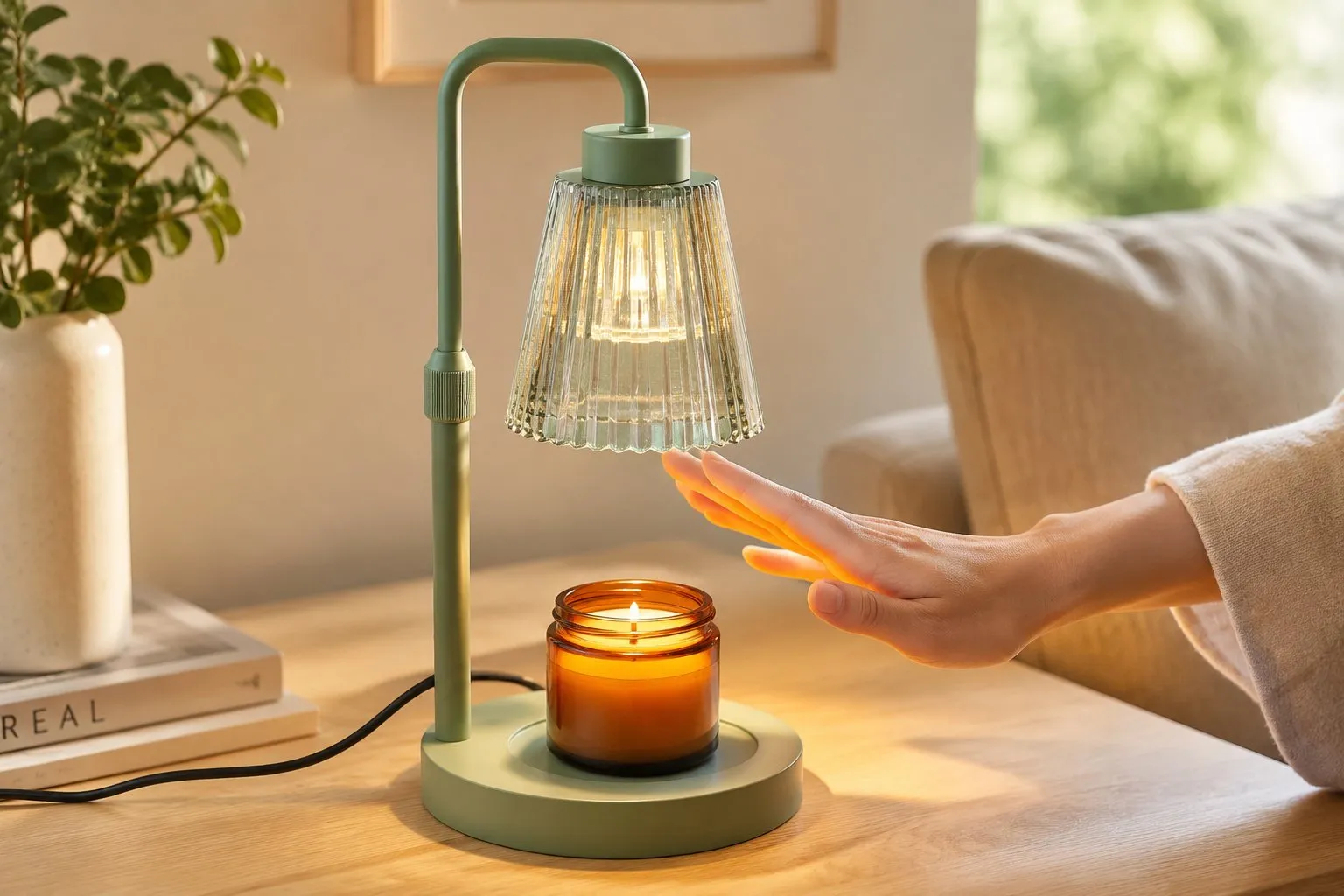
Far cooler than a flame. The warming surface runs warm, not scorching, which is the whole point of the top-down design.
A candle flame is genuinely hot: the National Candle Association puts the orange-brown core near 1,000°C and the blue outer edge as high as about 1,400°C. A candle warmer never approaches that. Instead of a flame, it uses a bulb above the wax to warm the surface gently. In binding ruling N340956, issued July 17, 2024, U.S. Customs examined a candle warmer lamp with a 35W GU10 halogen bulb and recorded a warming surface temperature of about 120°C. That is hot enough to liquefy candle wax, most soy blends melt in the 45–55°C range and paraffin around 50–60°C, but an order of magnitude below a flame.
Source: candle-flame temperatures per National Candle Association, Candle Science; warmer-surface temperature per U.S. CBP Ruling N340956 (35W GU10 lamp), July 2024. Retrieved 2026-07-16.
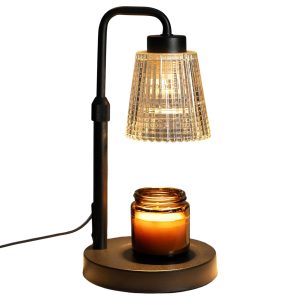
What that lower temperature buys a shopper is real. The wax liquefies and the fragrance lifts, but the glass shade and the base stay at a temperature a hand can be near without the searing risk of a flame. It is still warm, so the sensible guidance you pass to customers is the same as any warm appliance: keep it out of a small child’s reach and off delicate finishes. Our candle warmer lamps use a 50W GU10 halogen bulb, a glass shade, and a powder-coated steel or solid-wood base, a combination chosen so the heat lands on the wax, not on the room. For why the bulb is a GU10 accessory and what U.S. bulb rules mean for it, see our note on GU10 halogen and U.S. bulb rules.
Does an auto-off safety timer reduce the risk?
Yes, materially, because it removes the most common human error behind candle incidents: walking away and leaving it on.
The NFPA data above pins 16% of candle fires on a candle left unattended or abandoned, and consumer-safety guidance has said the same for decades. The U.S. Consumer Product Safety Commission’s long-standing advice is to never leave a burning candle unattended and to keep it in a clear, open area away from anything that can burn. An auto-off timer takes that instruction out of the customer’s memory and builds it into the hardware. Our candle warmer lamps ship with a real 4-mode timer, 2, 4, 8, or 10 hours, alongside 4-level dimming at 10%, 30%, 70%, and 100%. A shopper who sets it and falls asleep is covered: the lamp turns itself off, and nothing is left glowing at 3 a.m.
For a retailer, that timer is doing double duty. It lowers the odds of a fault-or-fright return, and it hands your staff a clean sales line: set-and-forget fragrance that switches itself off. When a nervous first-time buyer asks whether it is safe to leave running, the honest answer is that the timer is designed precisely for that moment. Paired with the dimming, it also lets a customer run the lamp cooler and quieter overnight, which is a comfort feature and a mild energy one at the same time.
Do candle warmers work, and do they make candles last longer?
Yes on both counts, with one honest caveat on the numbers. Do candle warmers work: a top-down warmer melts the wax into a full pool and releases fragrance without a flame, and many users find the scent throw stronger and more even than a lit wick.
The reason a warmer often smells stronger is geometry. A flame only melts a small pool right around the wick, while a top-down lamp warms a wide surface of wax at once, so more fragrance oil is free to evaporate. That same mechanism answers the next question shoppers ask. Do candle warmers make candles last longer? Generally yes, because no wax is consumed by combustion. The fragrance releases more slowly, and the candle is used down to the last of the wax rather than being abandoned around a drowned, tunneled wick. We deliberately do not publish a single “lasts X% longer” figure, because the real gain depends on the wax type, the fragrance load, and how hot the warmer runs. A claim we cannot substantiate is not one we will print on a box.
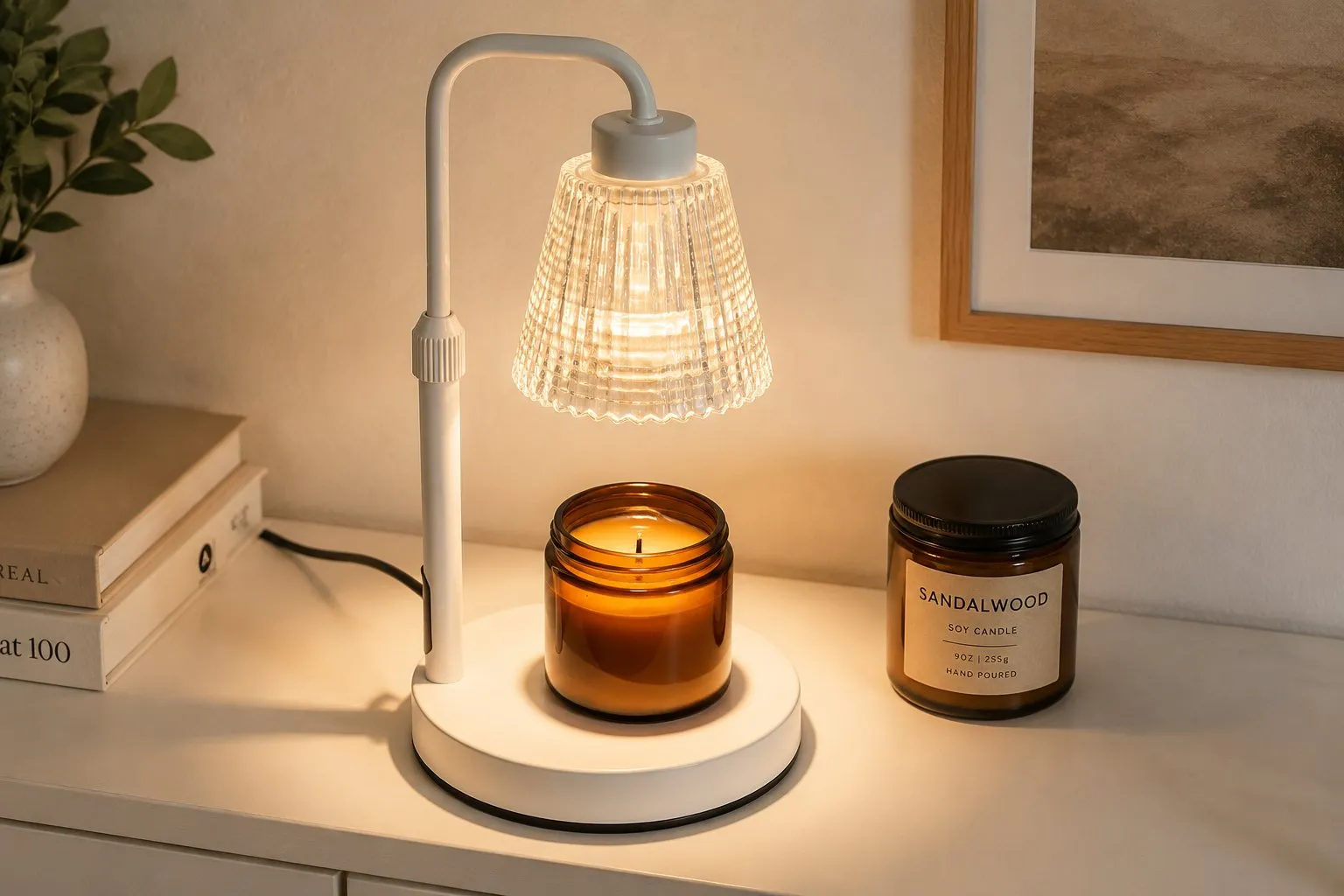
The caveat cuts the other way too, and it is worth telling customers. Because the effect depends on temperature, a warmer that runs too hot can flash off the top notes of a fragrance quickly and leave a candle smelling flat sooner. This is one more argument for a low, dimmable design rather than a single blazing setting. The wax you pair with the lamp matters as well: a clean soy blend behaves differently from cheap paraffin. Our own candle warmer lamp range is built to run cool and even, and we supply soy-wax candles as a matched accessory so a retailer can sell the lamp and the refill scent together.
The honest limit: flameless is not the same as emission-free
Flameless removes soot and combustion, but it does not make heated scented wax inert, and pretending otherwise costs you trust.
Here is the nuance a straight-talking supplier should hand you rather than hide. In a February 2025 study published in the American Chemical Society journal Environmental Science & Technology Letters, Purdue University researchers found that heating scented wax releases fragrance compounds called terpenes, which react with ozone naturally present in indoor air to form new ultrafine nanoparticles, at a median respiratory-tract deposited dose the team measured near 29 billion particles per minute. In other words, the flameless format removes the flame, the soot, and the carbon monoxide from a burning wick, which is a genuine and large benefit, but it is not a claim of “zero emissions.” Heavily fragranced wax warmed in a closed room still puts something into the air.
For a retailer, this is an asset if you are honest with it. The right message to a customer is not “totally emission-free,” it is “no flame, no soot, and used with normal ventilation the way you would with any scented product.” That framing is both defensible and reassuring, and it protects you from the kind of overclaim that fuels a complaint or a return. It also points at the practical advice worth printing on care cards: run the lamp in a ventilated space and choose quality, moderate-fragrance wax. Selling the real benefit, rather than an inflated one, is what makes the safety story durable.
How do you clean a wax warmer safely?
Always cool and unplug first. “How to clean wax warmer” is one of the most common post-purchase searches your customers will run, and the safe answer is four unhurried steps.
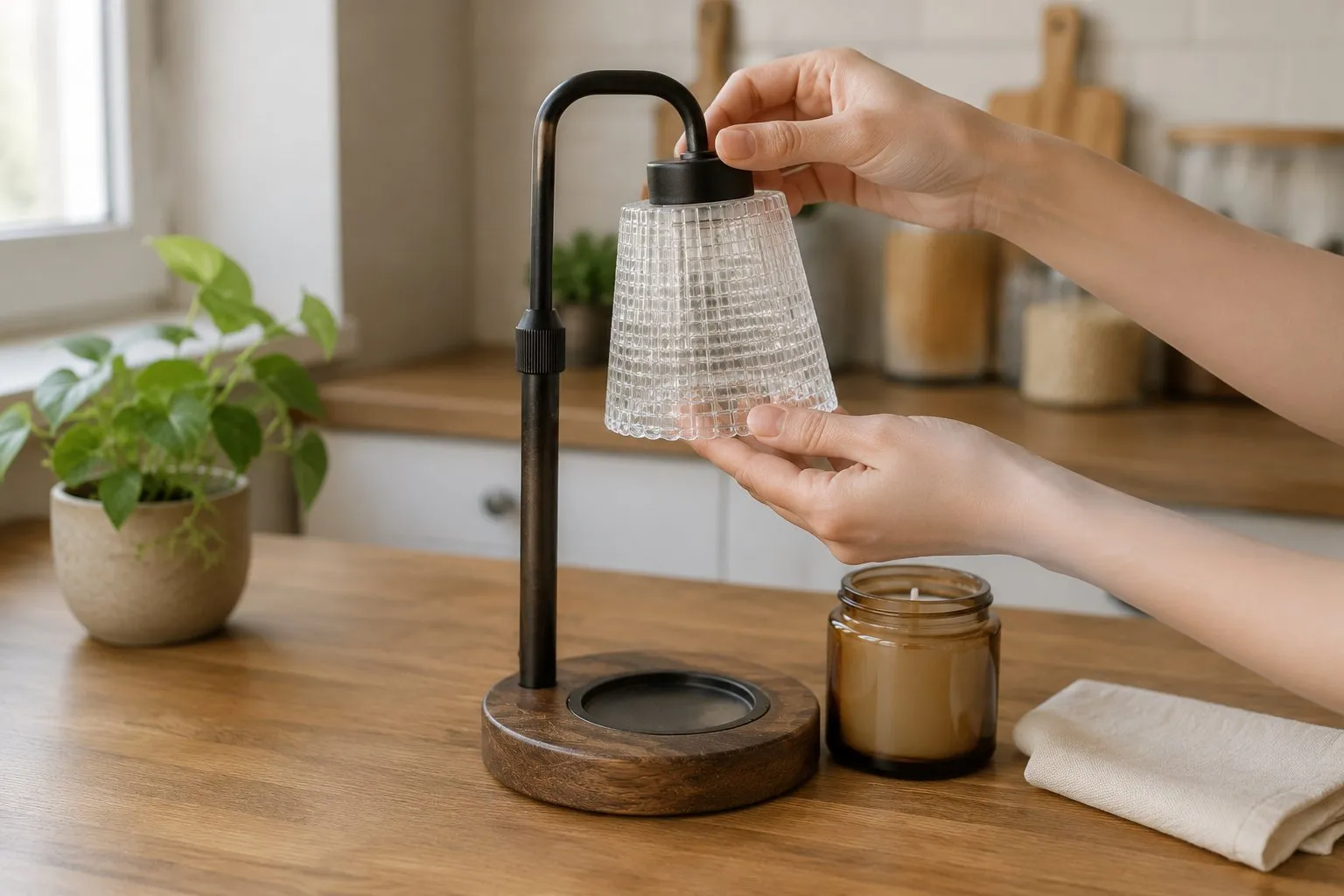
The sequence is simple, and getting it right prevents both burns and electrical damage. Switch the lamp off and unplug it. Let the wax cool and solidify completely, which also makes it far easier to remove. Lift the glass shade or remove the dish, then wipe the cooled wax and the warming area with a soft cloth, dry or slightly warm. If a customer wants to swap scents while the wax is still liquid, the safest move is to pour it into a lined container after unplugging, never while the lamp is powered. The rules that matter most are the two “nevers”: never clean it while it is hot or plugged in, and never submerge the electrical base in water.
What retailers should require of a candle warmer supplier
Ask for design-level safety evidence in writing, not marketing adjectives. Safety is a spec question, and a good supplier will answer it plainly.
The features that make a warmer safe are things you can confirm before you place an order, and they belong in your quote request rather than in a review after the fact. Confirm the auto-off timer and its modes, the low warming behavior, the tip-over stability of the base, the cord and plug rating for your market, and the quality of the glass shade. Ask, too, for any third-party test reports the factory holds, and treat “available on request” as the honest answer it usually is rather than assuming a certification that has not been shown. The table below is the short version of that conversation.
| Safety feature | What to verify | Why it matters to a retailer |
|---|---|---|
| Auto-off timer | Confirmed modes in writing (ours: 2/4/8/10h) | Removes the “left it on” risk; a returns-reducer and a sales line |
| Low warming heat | Top-down bulb design; warm, not scorching, surface | Lower burn risk and a defensible “flameless, low-heat” claim |
| Dimming control | Level count (ours: 10/30/70/100%) | Lets a customer run it cooler; protects fragrance longevity |
| Base stability | Weighted, stable footprint that resists tipping | Fewer knocked-over units, fewer breakages and claims |
| Cord & plug rating | Correct plug and voltage for your destination market | Compliance and a smooth customs and retail entry |
| Materials | Glass shade + powder-coated steel or solid-wood base | Durable, returnable-looking product that survives shelf life |
| Test reports | Ask which reports exist; verify before claiming any mark | Protects you from overclaim liability on the listing |
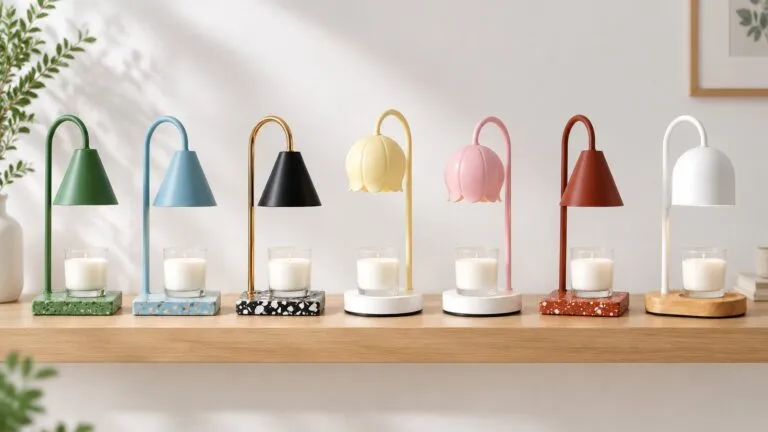
We answer that checklist the same way for every buyer, because it is how a factory-direct relationship should start. Our lamps are built around a real 4-mode timer and 4-level dimming, a glass shade over a powder-coated steel or solid-wood base, and a GU10 halogen accessory bulb. We do not attach certification marks we cannot document, and we would rather tell you which reports are in hand than let a listing imply one that is not. Bring your target market, colors, and packing level, and we will confirm the safety spec in writing before a sample ships.
Stock the flameless format with the safety story built in
Send us your target market and color mix. We confirm the timer modes, dimming, materials, and available test reports in writing, so you can sell “safe” and mean it.
Frequently asked questions
Do candle warmers work as well as a burning candle?
Do candle warmers work? Yes. A top-down candle warmer melts the wax into a full pool and releases fragrance without a flame, and many users report an even, often stronger scent throw than a lit wick because a larger surface of wax is warmed at once rather than a small pool around a flame.
Do candle warmers make candles last longer?
In most cases yes. Because no wax is burned away by a flame, the fragrance evaporates more slowly and the candle is used down to the last of the wax instead of being abandoned around a drowned wick. The exact gain depends on the wax type, fragrance load and warmer temperature, so we do not publish a single fixed percentage.
How to clean wax warmer lamps between candles?
First switch off and unplug the lamp and let the wax cool and harden. Lift the glass shade or remove the dish, then wipe the cooled wax and the warming area with a soft, dry or slightly warm cloth. Never clean the lamp while it is hot or plugged in, and never submerge the electrical base in water.
Candle warmer vs burning: which is safer for a retail customer?
On the candle warmer vs burning question, the warmer is the lower-risk choice for most homes because it has no open flame to ignite nearby fabric and no soot from combustion. A shopper should still treat it as an electrical appliance: place it on a stable surface, keep it away from water and unplug it before cleaning.
Are candle warmers safe to leave on overnight?
Whether candle warmers are safe overnight is best answered by the timer, not the flame. Because there is no wick, a warmer will not start a flame fire, and a model with an auto-off timer switches itself off on a set schedule so nothing is left running unattended. As with any appliance, use the shortest timer setting that suits the room and keep the cord clear.
Safety statements here describe design-level features of the product and general fire-safety guidance from the cited public sources, current as of July 2026. They are not a claim of any specific safety certification; confirm applicable marks and test reports with your supplier before making certification claims on a listing.
Sources
- National Fire Protection Association (Marty Ahrens), “Home Candle Fires,” May 2020 (2014–2018 annual averages: 7,610 fires, 81 deaths, 677 injuries, $278M, 60% too-close, 16% unattended). nfpa.org, retrieved 2026-07-16.
- National Fire Protection Association, “Safety with candles” (behavioral fire-safety guidance). nfpa.org, retrieved 2026-07-16.
- National Candle Association, “Candle Science” (candle-flame temperature ranges). candles.org, retrieved 2026-07-16.
- U.S. Customs and Border Protection, Ruling N340956, “The tariff classification of a candle warmer lamp from China,” July 17, 2024 (35W GU10 lamp, ~120°C warming surface). rulings.cbp.gov/ruling/N340956, retrieved 2026-07-16.
- American Chemical Society, “Scented wax melts may not be as safe for indoor air as initially thought,” February 2025 (Purdue University; ~29 billion particles/min deposited dose). acs.org, retrieved 2026-07-16.
- Environmental Science & Technology Letters (ACS), “Flame-Free Candles Are Not Pollution-Free: Scented Wax Melts as a Significant Source of Atmospheric Nanoparticles,” 2025, DOI 10.1021/acs.estlett.4c00986. pubs.acs.org, retrieved 2026-07-16.
- Scientific Reports (Nature), “Impact of scented candle use on indoor air quality and airborne microbiome,” 2025 (combustion PM2.5/PM10). nature.com, retrieved 2026-07-16.
- U.S. Consumer Product Safety Commission, candle safety guidance (never leave a burning candle unattended; keep in a clear, open area). cpsc.gov, retrieved 2026-07-16.
- BeginLighting factory product specification sheet, revision 2026-06-12 (4-mode timer 2/4/8/10h, 4-level dimming 10/30/70/100%, 50W GU10 halogen, glass shade with powder-coated steel or solid-wood base). Primary source, on file with the BeginLighting sourcing desk.
Can a candle warmer catch on fire?
Asked directly, can a candle warmer catch on fire? Not the way a candle can. There is no wick to light and no flame to reach a curtain, which removes the ignition source behind the more than half (56 percent) of home candle fires the NFPA attributes to something flammable left too close to a flame. That is the honest headline, and it is a large benefit.
What replaces it is an ordinary mains appliance risk, and a buyer should be able to name it rather than wave it away. The realistic failure modes are electrical and thermal, not combustive:
- Cord and plug. A plug or cord that is not rated and certified for the destination market is the single most common compliance failure in small lighting imports.
- Tipping. An arch lamp is top-heavy by design, so the weighted, stable base is a safety feature, not a styling one.
- Bulb rating. A holder fitted with a bulb above the rated wattage runs hotter than the housing was designed for. Spare-bulb packs exist so the customer replaces like with like.
- Blocked or covered heat. Anything draped over the shade traps warmth that the design assumes will disperse.
- Water and cleaning. Cleaning a live or warm lamp, or letting water reach the electrical base, is where most incident reports in this category actually start.
Retail buyers ask the same question about the flat format: are wax warmers a fire hazard? The reasoning is identical. A plate has no flame either, so its risk profile is also electrical and thermal, with the added variable that a plate is often used with loose wax or an open dish that can be overfilled. In both formats the mitigations are the same short list: a stable base, a bulb or element used at its rated wattage, a correct plug for the market, clearance around the unit, and an auto-off timer that ends the session whether or not anyone remembers to.
Candle warmer electricity usage: what the bulb actually draws
Safety and running cost land on the same page for a reason: both are questions about how much heat the unit makes and for how long. Since energy labeling arrived on more retail shelves, candle warmer electricity usage is a question accounts now put in writing, and it has a simple answer because the heat source is a single bulb.
Our lamps use a 50W GU10 halogen bulb, so the arithmetic is straightforward. A 50W bulb running for four hours draws about 0.2 kWh. A shopper using it that way every evening for a month is near 6 kWh, and multiplying that by your own market rate per kWh gives a figure you can quote without borrowing anyone else numbers. There is no standby heating element and no motor, so the bulb is effectively the whole load.
The important control here is the timer rather than the dimmer. A 4 mode timer at 2, 4, 8 or 10 hours puts a hard ceiling on how long the bulb can draw at all, which is the same mechanism that bounds the safety exposure. That is a useful line for staff: the feature that stops it running all night is also the feature that stops it costing anything overnight. Quote the wattage and the timer modes, let the customer apply their own tariff, and avoid publishing a cost-per-hour figure that changes with every energy market.
Candle warmer safety: the card to hand your staff
The supplier checklist above is a buying document. Your floor team needs a shorter one, because the whole candle warmer safety story fits on a single shelf card and answers most of what a shopper asks at the counter.
The companion card for everyday use — setting the arm height, choosing a dimmer step and a timer window, swapping the bulb — is written up in how to use a candle wax warmer.
- No flame, so no flame risk. There is no wick lit and no soot, which is the reason the format exists.
- It is still an appliance. Stable surface, cord clear of walkways, away from water, and out of a small child reach.
- Set the timer. The shortest mode that suits the room. Nothing is meant to run indefinitely.
- Off, unplugged, cooled, then wiped. Never clean it hot or live, and never put the electrical base in water.
- Container candles only. Jars and tins. A pillar or a taper has no vessel to hold the melt pool.
- Replace like with like. A spare GU10 at the rated wattage, fitted only once the lamp is cool and unplugged.
- Ventilate normally. Flameless removes the flame and the soot; warmed scented wax is still a scented product in a room.
The one comparison staff will be asked to make is the one shoppers have already half made in their heads: are candle warmers safer than burning candles? The defensible answer is that the warmer removes the open flame, which is the largest single cause of candle fires, and that it is still an electrical appliance to be treated as one. Say both halves. A claim that survives a follow-up question is worth more on a shelf card than one that does not, and design-level features are what we describe here rather than any certification mark we have not shown you.
