




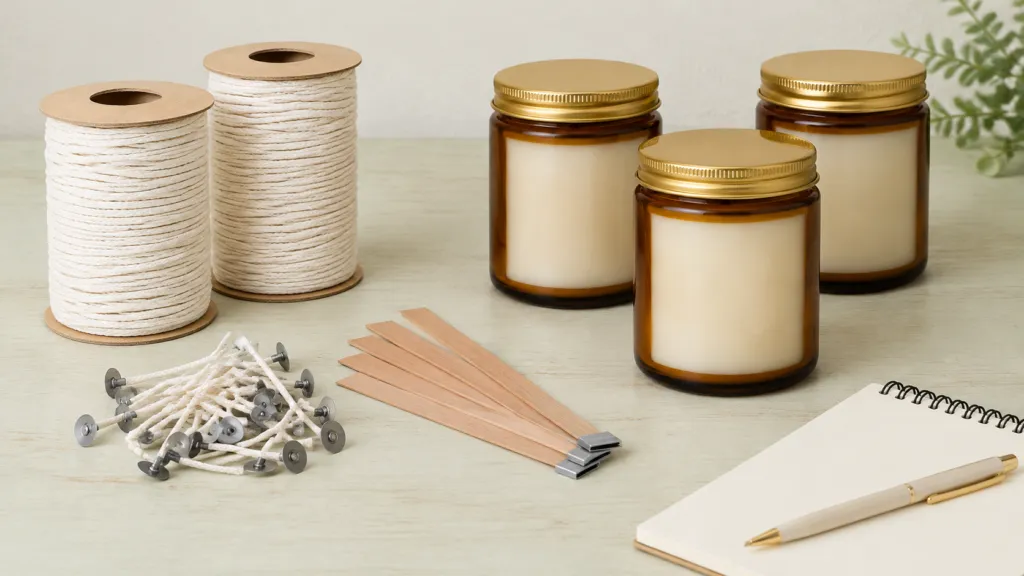
This candle wick guide is written for the buyer holding a quotation rather than the maker holding a pouring pot. On most spec sheets the wick is one word, cotton, sitting a few rows under a jar diameter, and that pairing decides whether the candle you approved is the candle that lands in your warehouse.
Three neighbouring questions are answered elsewhere on this site and stay there. How wick size turns into the hours printed on a box belongs to how long a candle burns. The trimming method, tool in hand, lives on the candle care and wick trimmer kit page.
Whether a wick is documented as free of a metal core is a paperwork question, covered in verifying non toxic candles. What follows is the part a purchase order can control: the series, the size, the tab, the three signals that a wick is wrong, and which of the candle accessories belongs beside which candle on the shelf.
Key takeaways
The wick is the fuel pump, not a piece of string. Vessel diameter picks a size, the wax moves it again, and the only proof anyone can offer is a burned sample.
- Published sizing ladders are rated for a base paraffin. Soy and single-pour waxes generally need a larger wick, sometimes one to three sizes up (Lone Star Candle Supply).
- Acceptance rests on the melt pool: it should reach the container wall within two to four hours of the first burn (Lone Star Candle Supply). A ring of unmelted wax means undersized, a deep flickering pool means oversized.
- Mushrooming is carbon from incomplete combustion, and on a heavily scented candle it cannot usually be avoided altogether (Candle Shack). Write the acceptance around pool behaviour, not around a promise of a clean tip.
- A wooden wick loses reach in soy. The medium size covers containers up to 3.0 in in paraffin but only up to 2.25 in in soy (Lone Star Candle Supply), so the same jar needs a bigger wick or it tunnels.
- Three tools, three jobs: a trimmer for the braid, a dipper for a wide pool, a snuffer for a taper. Attach the wrong one and you have funded a return.
What a supplier means when the spec sheet says cotton wick
A candle is a small engine and the wick is its fuel line. Heat from the flame melts the wax closest to the wick, and that liquid wax is then drawn up the wick by capillary action before it vaporises and burns (National Candle Association). Everything a customer later judges the candle on, how wide the pool runs, how far the fragrance throws, how much soot lands on the glass, follows from how much fuel the braid carries per hour. Two jars with the same wax, the same fill and different wicks are two different products.
Wick stock is sold in families, and the family is chosen before the size. One supplier’s public catalogue lists six: zinc-core, CD, ECO, HTP, LX and wooden (Lone Star Candle Supply). A cored wick carries a wire centre that holds it upright while the candle sets and burns, which suits votives, pillars and gel. A flat braid has no rigid core and is woven to curl at the tip, so it trims itself as it burns and puts down less carbon.
Priming matters to anyone writing label copy. That same catalogue primes zinc-core wicks at 180°F wax, CD, HTP and LX at a 212°F high-melt wax, and ECO at a vegetable wax of 161°F (Lone Star Candle Supply). Our reading: if the artwork says plant based, the wick coating is part of that claim, so ask what the braid was primed in before the copy goes to print.
| Family | How it is built | Where it is specified | Ask the supplier for |
|---|---|---|---|
| Zinc-core | Cotton around a zinc wire centre, primed at 180°F | Votives, pillars, small containers, gel | Confirmation the core is zinc, and the tab neck height |
| CD | Flat-braided cotton with paper filament, primed at 212°F | Harder and more viscous paraffin and vegetable waxes | The size against your measured inside diameter |
| ECO | Coreless cotton braided with thin paper threads, primed in vegetable wax at 161°F | Soy and other natural waxes | The priming wax, if the label makes a natural claim |
| HTP | Coreless cotton with paper filament that bends the tip into the hottest part of the flame | Votives, pillars, containers, gel | Soot behaviour on the burn sheet, not just a size |
| LX | Flat-braided treated cotton, primed at 212°F | Paraffin and moderate fragrance loads | A different family if your load is heavy |
| Wooden | Two thin wood pieces pressed together for a wide flame and a crackle | Containers only, easiest in paraffin blends | Wood origin, and the size rated for your wax |
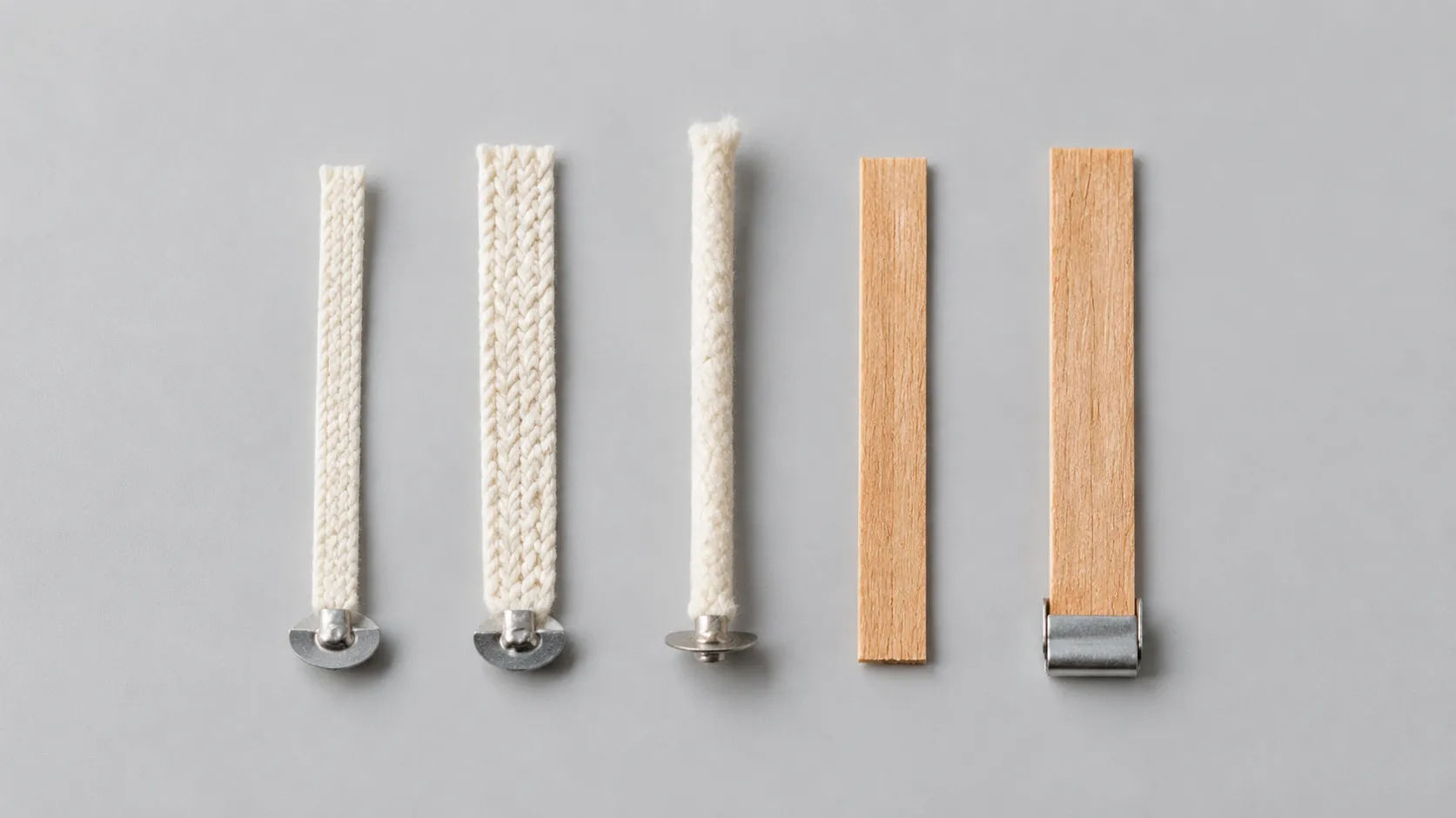
One line most buyers never ask about is the tab. That metal disc at the base is not only a mount: a taller neck leaves a thin layer of wax unburned when the wick runs out, so the flame dies before it heats the bottom of the glass, and one supplier’s catalogue makes a 10mm neck tab its standard for that reason (Lone Star Candle Supply). It backs up the instruction nobody reads, which is to stop burning when half an inch of wax remains (National Candle Association). Put the tab on the sheet next to the wick size and the end of the candle’s life is specified too.
Jar diameter picks the wick size, and the wax moves it again
Sizing starts with a measurement, not a catalogue. Measure the inside diameter of the container, then read across the ladder for the family you are using. In one published set of ranges, CD-6 is rated for 2.0 to 2.25 in, CD-8 for 2.5 to 3.0 in, and CD-12 for 3.25 to 3.5 in (Lone Star Candle Supply). Those ranges are built around a base paraffin. The ECO ladder is the exception, rated for soy from the start, which is why it reads differently: ECO-4 covers 2.0 to 2.5 in and ECO-8 covers 2.75 to 3.0 in.
Source: Lone Star Candle Supply, Candle Wick Sizing Guide (ECO Series Sizing, rated for soy), retrieved 2026-09-20
The adjustment that catches buyers out is the wax. Single-pour paraffin and vegetable waxes generally need a larger wick, sometimes one to three sizes up, because soy holds heat and holds fragrance, and a braid that gave a full pool in paraffin leaves a ring in soy. So when a supplier quotes a CD size for a soy candle, the useful follow-up is which wax that size was read against. A paraffin number applied to a soy pour is the commonest way a jar arrives with a ring welded to the glass and nobody at fault on paper.
None of it is settled by a chart. The catalogue that publishes the ranges says so itself: the sizes are recommendations, not guarantees, and the only way to confirm a wick is to burn a finished candle and watch the melt pool. One number is worth holding a supplier to: the pool should reach the container wall within two to four hours of the first burn. That is the most useful acceptance criterion in this candle wick guide: observable, cheap, and runnable on a sample before a container is booked.

Three failure signals, and which one is the wick’s fault
Complaints arrive as stories, not diagnoses: the candle is faulty, the wax will not melt, the jar went black. Underneath there are three signals worth sorting by, and two point straight back at the wick line on your specification.
The first is a ring. Unmelted wax clinging to the glass after a long first burn means the flame is not heating the surface edge to edge, which is the classic undersized wick, and left alone it becomes a tunnel. The tunnel and the counter repair belong to our piece on how long a candle burns, which carries the memory-burn rule and the rescue sequence. For sourcing purposes the ring is enough: it is the signature of a wick chosen off the wrong ladder.
Signal two is the opposite, and easier to miss: customers rarely complain about a lively flame. A pool that goes deep fast, a flame that dances and smokes, glass that gets too hot to hold: that is an oversized wick burning through fuel the candle was not designed to spend. It shortens the hours you printed and it puts thermal stress into a container chosen for looks.
Signal three is the black bulb on the tip. Clubbing, or mushrooming in extreme cases, is caused by incomplete combustion of the wax and fragrance oil, which happens when more fuel reaches the wick than the available oxygen can burn, and the surplus deposits as carbon (Candle Shack). Pronounced mushrooming usually means the candle is overwicked, and the first correction is to go down a size.
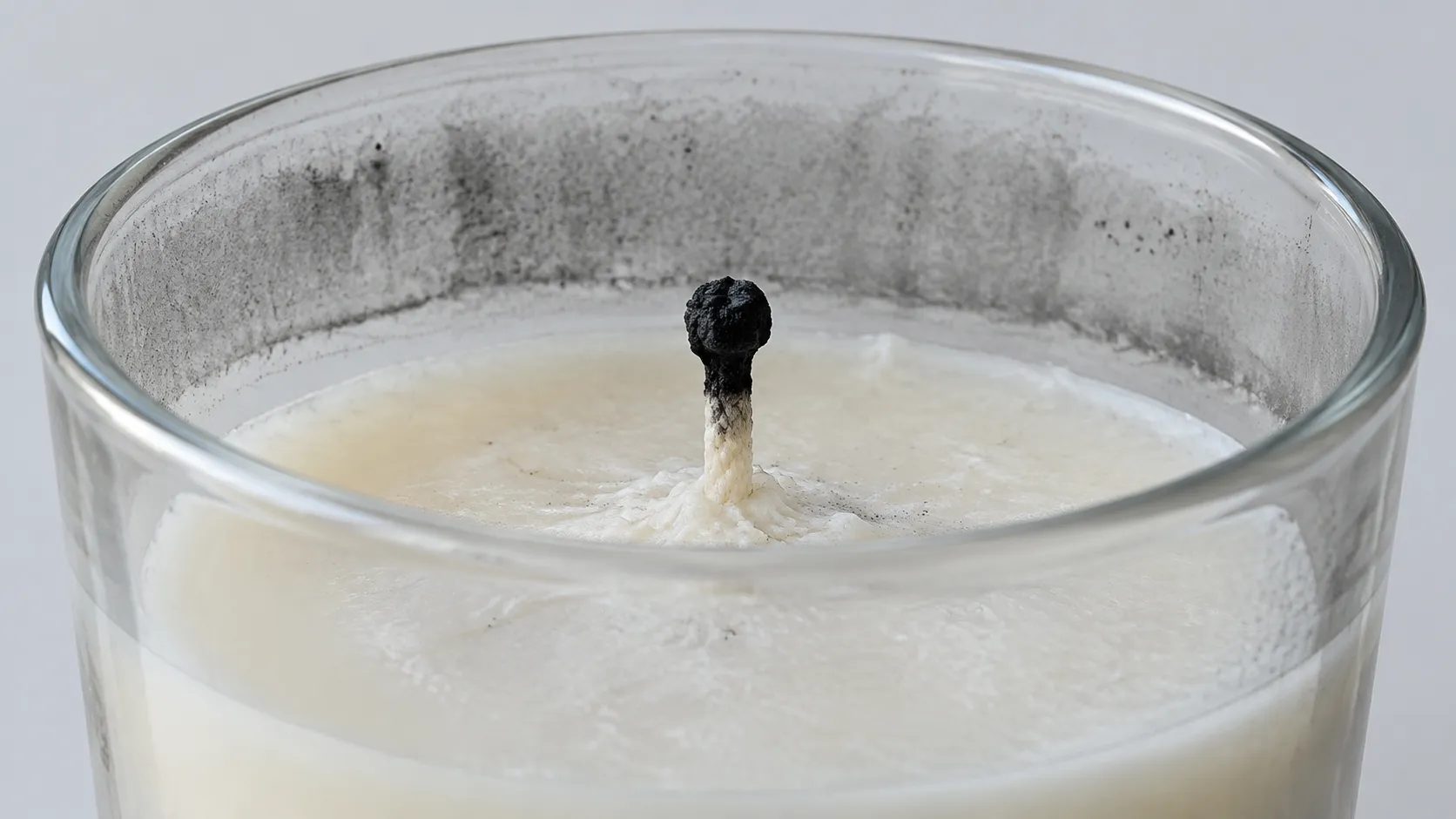
Here is the part that does not suit a tidy purchase specification. Minor clubbing is very common and not normally a cause for concern, and on highly scented candles it cannot usually be avoided at all (Candle Shack). Down-wicking to chase a clean tip shrinks the melt pool, so you trade one complaint for another, and sometimes the answer is a different family rather than a different size, since LX wicks suit paraffin at moderate scent loads while V wicks are built for heavy fragrance loads (Candle Shack). Writing zero mushrooming into an agreement on a heavily fragranced line sets up a dispute you will lose. Specify the pool instead, add a limit on soot visible on the glass after a full burn cycle, and let the tip be what the chemistry makes it.
How to trim wood wick candles, and where cotton is different
A wooden wick is not a braid at all. It is two thin wood pieces pressed together, sold for containers only, and it burns with a wide flat flame and the crackle that sells the format (Lone Star Candle Supply). Because there is no braid to curl, it does not self-trim. It chars, and the char sits there as a dark crust across the whole width of the wick.
That changes the maintenance instruction your shelf card has to carry. Guidance from one wooden wick brand is to trim between burns and to remove the burnt bits of wood that collect on the surface of the candle (Makesy). Debris is the half of the job that gets left off cards, and the source of the complaint staff hear as black flakes floating in my candle. Across a display the question changes shape: how to trim wooden wicks on every open tester, without a member of staff working through them each morning, is a card and a tool problem rather than a technique problem.
Cotton behaves differently enough that a single card will not cover both. Flat braids in the CD, ECO, HTP and LX families are engineered to curl at the tip and trim themselves as they burn, so the cadence is not the same. Customers ask how to trim wick length on a cotton candle far more often than they ask about wood, and the method with the tool in hand sits on our wick trimmer kit page, while the reason a fixed length is really a burn-rate setting is worked through in how long a candle burns.
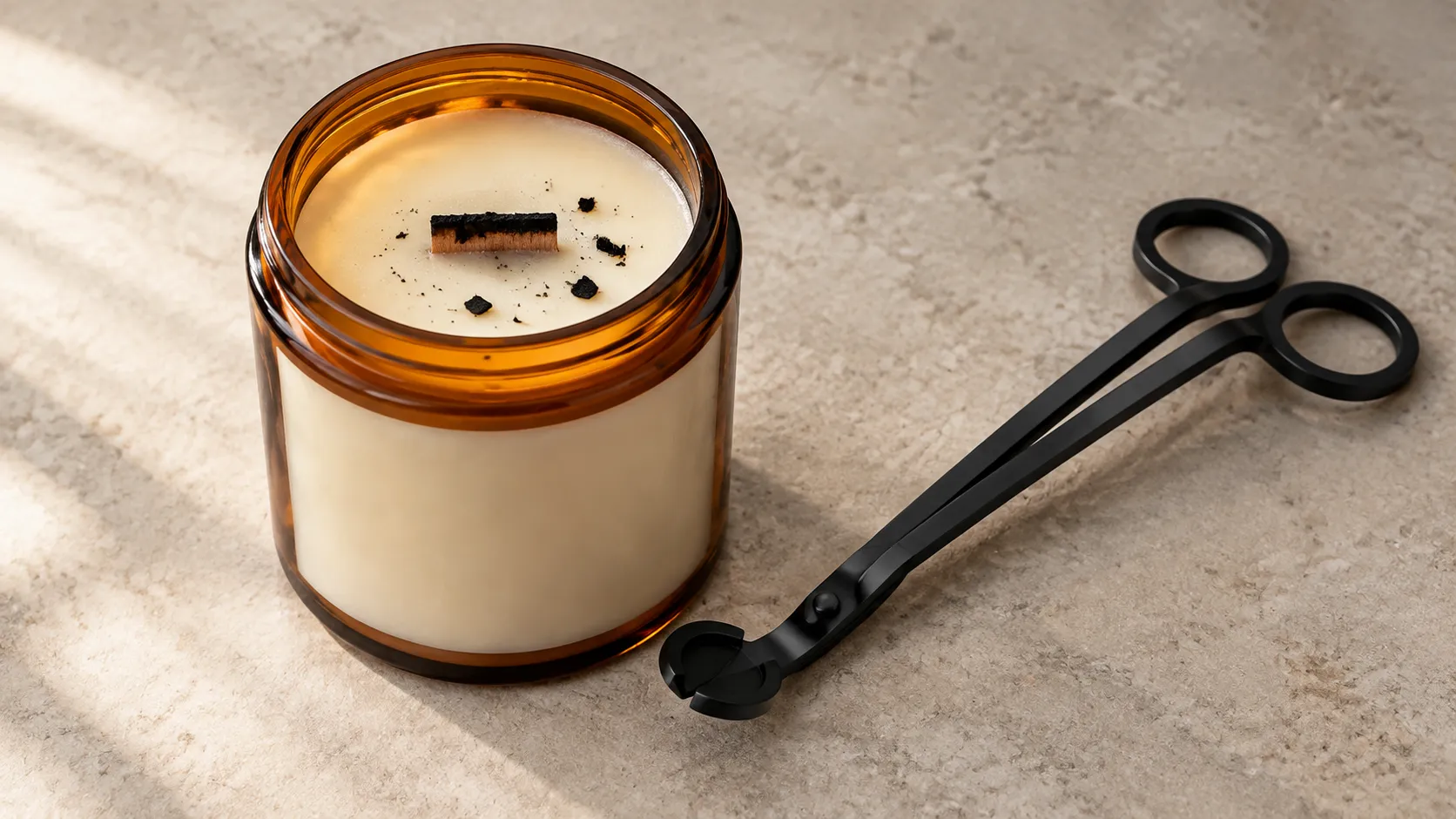
The sourcing consequence of a wooden wick is reach. Rated against paraffin, the small size covers containers up to 2.25 in while the medium reaches 3.0 in; rated against soy, the small size is not recommended at all, the medium stops at 2.25 in, and the extra-large reaches 3.5 in against 3.75 in in paraffin (Lone Star Candle Supply). A soy wooden-wick jar therefore starts further up the ladder than the same jar in paraffin, and the fragrance load has to be held back or the crackle dampens. Two questions belong in the same email: which size was tested in the exact wax you are buying, and where the wood came from. A responsible-forestry claim on the artwork travels with a certified supply chain and its documents, not with a sentence (Forest Stewardship Council).
What is a wick dipper, and what does a wick dipper do
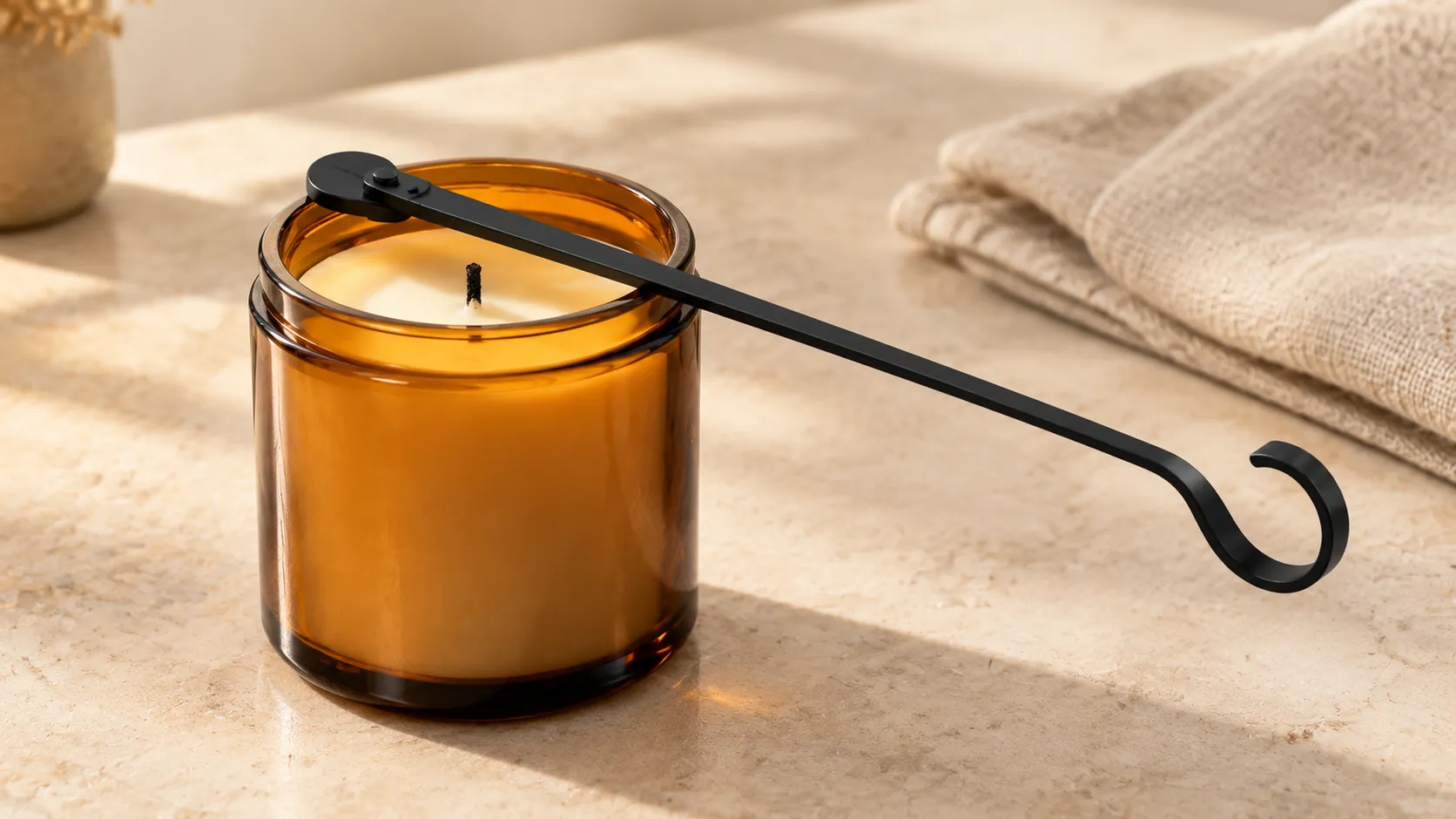
A wick dipper is a slender metal tool, roughly 8 inches long, with a bend at one end (Honey Candles). Its job is to submerge the lit wick into the molten wax, which snuffs the flame without producing smoke or soot (Kalamazoo Candle Company). On a wide jar you push the wick into the pool with the curved end, then straighten it back up ready for the next light.
The second effect is the one that sells the tool to a retailer. Bending the wick into the pool also coats it in wax, priming it for the next burn, so the candle lights cleanly instead of smouldering. Set that against the alternative your customer currently uses. Blowing the flame out sprays wax fine enough to damage a tablecloth or furniture, which is why the guidance is to put a hand behind the flame before you do it (Honey Candles); the dipper skips the smoke and soot the alternative produces (Kalamazoo Candle Company). A candle is rarely returned for wax on the tablecloth. The customer still remembers.
One limit is our reading of the construction rather than a claim from the tool makers: a dipper is a cotton-wick instrument. It needs a braid flexible enough to bend into the pool and lift back out, and a pool wide enough to bend it into, which is why the tool is recommended for larger diameter candles. Two pressed pieces of wood do neither. If your wooden-wick line is the one you are building the gift set around, the dipper in that set is decoration.
Which of the three tools belongs beside which candle
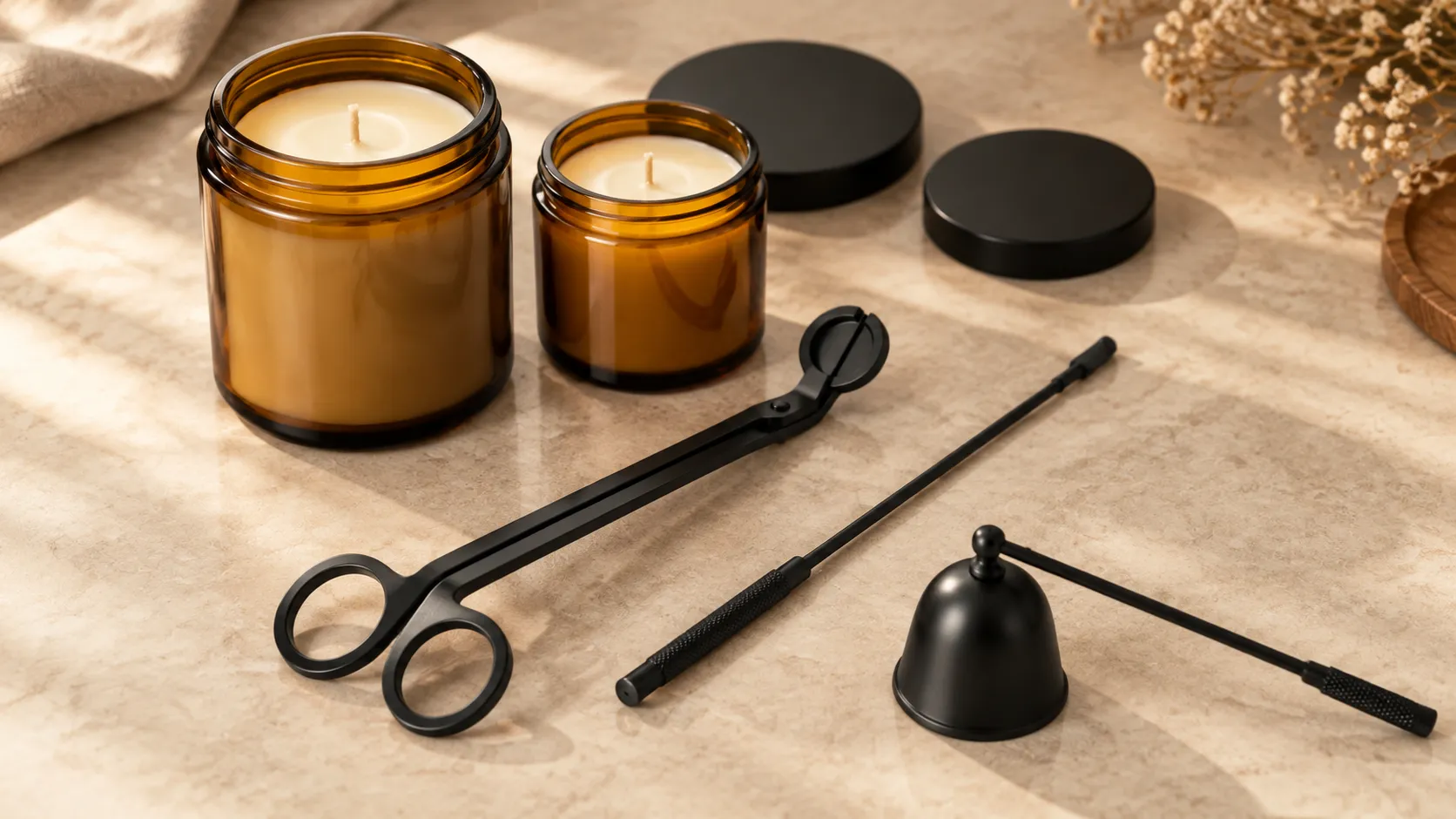
Sorted by job rather than by gift-set convention, the three tools barely overlap, and the buying question is not what each one does but which candle it follows onto the shelf. A trimmer manages the braid and the carbon. Dippers extinguish and re-prime, and they want a pool to work in. Snuffers starve the flame of air, in two shapes that behave differently: a bell can produce excess smoke, which is both smelly and a nuisance when relighting, while a pinch style works like miniature tongs and suits candlesticks (Honey Candles). Trade association guidance stops at using a snuffer or blowing the flame out gently, and warns against water because hot wax can splatter (National Candle Association).
That maps onto an assortment cleanly. A wide single-wick soy jar earns a dipper. A candlestick or taper programme earns a pinch snuffer. A wooden-wick line earns a trimmer and a card, and nothing else. Mixed assortments are where our three-piece candle care and wick trimmer kit does its work, because a buyer who cannot predict which format the gift recipient owns is better served by all three, and it attaches to the soy candle line at the till rather than competing with it.
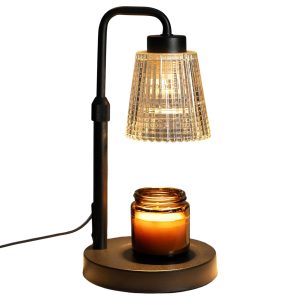
One attach quietly generates returns, and it is worth a planogram check. A wickless jar made for a warmer lamp has no wick, so a trimmer, a dipper and a snuffer are all inert next to it; the correct attach there is a spare bulb and a second jar, which is the logic behind the usage card in how to use a candle wax warmer. Tool sets sell to flame customers. Appliance customers buy consumables.
How to qualify a wick before you sign the first order
The expensive failure is not a bad first sample, which gets rejected. It is a wick that changes quietly between production runs, because the supplier’s wick stock ran out or a cost exercise found a cheaper braid. Nothing on the carton changes. Pool behaviour does, and the complaints arrive four months later attached to your label rather than theirs.
The defence is dull and it works: make the wick a controlled line on the specification instead of a word in an email, and make one observable test the acceptance gate.
Write the family and size per SKU
Not cotton wick. ECO-8, or CD-10, or wooden medium, against the measured inside diameter of that exact vessel, with the tab neck height beside it.
Ask which wax the size was read against
Published ladders are rated for a base paraffin apart from ECO. If the pour is soy, ask whether the size was already moved up, and by how many steps.
Request the burn sheet behind the sample
How many cycles were run, how long each session lasted, what the pool measured at the end. A supplier who tests keeps this. One who does not will send a photograph.
Burn your own sample and time the pool
Watch for the pool reaching the glass inside the agreed window, then read the tip and the glass for carbon. Two people, one bench, one afternoon.
Lock it with a change-notice clause
Any change of wick family, size or tab requires a new sample and a fresh burn before shipment. This is the clause that catches the silent substitution.
Two adjacent checks ride along with the same email. Metal-cored wicks are a documents question rather than an open one in the US market, and what to ask for is set out in our supplier spec check for non toxic candles. If the programme is a private-label candle meant to sit under a warmer as well as take a flame, the wick decision interacts with the wax and the vessel, which is the subject of our candle and warmer pairing guide.
Two emails and one burn test are the whole qualification, repeatable by whoever holds the category next year, and they turn the vaguest line on a candle specification into something you can accept or reject on evidence. Tools that follow the candle onto the shelf sit in the wider candle accessories and consumables range, chosen by what the customer actually owns.
Spec the candle and the wick in one email
Our candles and candle care tools are poured and assembled on our own lines in Foshan, in a 4,000 m² factory running two production lines with 40 people, so the wick family, the tab and the tool that ships beside the jar are answered by one team instead of three.
Send the vessel diameter and the wax you want, and we will come back with a wick specification and a sample you can burn.
Watch it work
How the wick is sized, what the melt pool proves and which tool does which job, in 30 seconds:
FAQ
Wick dipper vs candle snuffer?
Buy on format, not on preference. If the customer burns wide jars, the dipper earns its keep, because a jar is the only format that reliably gives it a pool to work in. If they burn tapers, candlesticks or pillars, the snuffer is the only one of the two that works at all. Where a retailer can stock just one line, the snuffer travels further, because it asks nothing of the candle, while a dipper is dead weight beside anything narrow.
How wide can a jar be before it needs more than one wick?
Published single-wick ladders run out at roughly 4.75 to 5.0 in of container diameter (Lone Star Candle Supply), which is the practical ceiling for one flame in a standard family. Past that, ask the supplier for a multi-wick layout together with the spacing they tested, and treat it as a new qualification rather than a bigger version of the old one: two flames interact, and the pool behaviour is not the single-wick result doubled.
Can you reject a candle delivery for a wick problem?
Some of it is inspectable at goods-in, and that part belongs in the agreement: the wick upright and centred, the tab seated flat, no loose debris in the vessel, and the family and size matching the specification. The behavioural half needs a burn from the delivered lot. Agree in advance which lot sample gets burned and who watches it, or you will be arguing about photographs.
Can one wick size cover a family of jars?
Only where the vessels fall inside the same published range. ECO-4 is rated for 2.0 to 2.5 in, so two jars that both measure inside that band are genuinely one part number (Lone Star Candle Supply). Three jar sizes quoted with one wick is not rationalisation: it is a ring in the widest jar and a hot pool in the smallest.
Sources
Every external figure above was checked on 2026-09-20:
- Lone Star Candle Supply, Candle Wick Sizing Guide (the six wick families and their priming temperatures, the CD and ECO diameter ladders, the one to three sizes up rule for soy, the two to four hour melt pool test, wooden wick sizing in soy against paraffin, the 10mm tab neck, the largest single-wick sizes LX-30 and HTP-1212 topping out at 5.0 in), retrieved 2026-09-20.
- Candle Shack, Troubleshooting Mushrooming (clubbing as incomplete combustion, fuel against oxygen, the down-wicking trade-off, wick family choice by scent load), retrieved 2026-09-20.
- National Candle Association, Candle Science: How Candles Burn (liquid wax drawn up the wick by capillary action), retrieved 2026-09-20.
- National Candle Association, Candle Safety Tips (stop burning when half an inch of wax remains; use a snuffer or blow the flame out gently, never water), retrieved 2026-09-20.
- Makesy, How To Trim A Wooden Wick (trim between burns and remove the burnt bits of wood that collect on the surface of the candle), retrieved 2026-09-20.
- Kalamazoo Candle Company, What Does A Candle Wick Dipper Do? (submerging the lit wick to extinguish it without smoke or soot, and re-coating the wick for the next burn), retrieved 2026-09-20.
- Honey Candles, Candle Wick Dipper vs Snuffer and Types of Snuffers (dipper dimensions and use on larger diameter candles, bell against pinch snuffers, the wax spray when a candle is blown out and the hand-shield instruction), retrieved 2026-09-20.
- Forest Stewardship Council, Chain of Custody Certification (the label on a finished product signals that the materials met the chain of custody requirements at every step in the supply chain, and that the production, purchase and sales records are kept), retrieved 2026-09-20.
